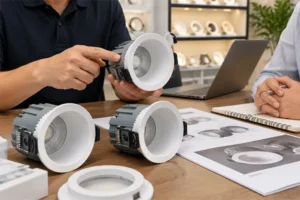

Supplier reliability is often the hidden issue behind a low LED downlight quotation. A lower unit price can look attractive during sourcing, yet unclear specifications, inconsistent production, delayed delivery, or slow problem resolution can create much larger costs later. I believe buyers should compare the supplier’s ability to execute, not only the number on the quotation.
Supplier reliability matters more than low LED downlight prices because the real purchase cost includes specification accuracy, sample-to-production consistency, delivery execution, communication speed, and after-sales resolution1. A low price can be a valid commercial advantage, but buyers should verify what quality controls, documentation, capacity planning, and issue-handling processes support that price before making a sourcing decision.
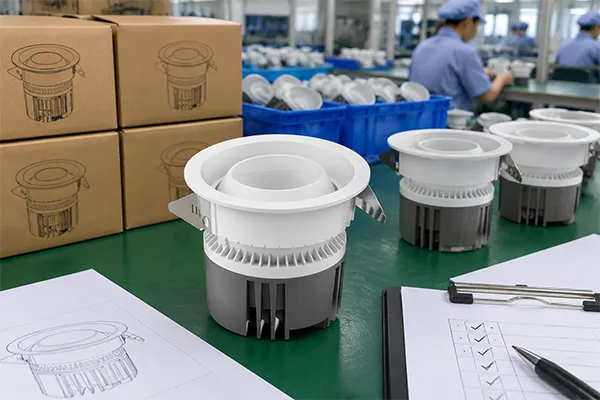
In our conversations with overseas buyers, I often see that the first comparison starts with wattage, appearance, and unit price. Those details matter. However, the more important procurement question is whether the supplier can keep every agreed detail aligned from quotation through shipment and beyond.
How Does Supplier Reliability Protect LED Downlight Procurement?
Supplier reliability becomes important when a product moves beyond a quotation or one approved sample. Buyers may face pressure from project schedules, customer commitments, and inventory plans. I have seen that a supplier’s execution process often determines whether an LED downlight order remains predictable or becomes a source of follow-up work.
Supplier reliability protects LED downlight procurement by helping buyers confirm specifications before production, maintain approved requirements during mass manufacturing, communicate delivery expectations clearly, and trace issues when they occur. It does not mean that problems never happen. It means the supplier has a practical process for preventing, identifying, and resolving them.
A sample is a checkpoint, not a full production guarantee
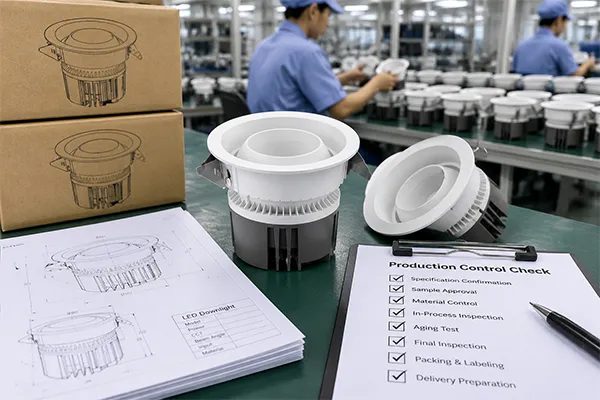
I often remind buyers that a passed sample proves that one unit met the expected requirement at one moment2. It does not automatically demonstrate that thousands of units will match the same color temperature, wattage, beam angle, finish, driver configuration, and packaging standard.
This distinction matters most for customized LED downlights. A buyer may approve a 3000K, 12W, 60-degree downlight with a white trim and a specific carton marking. If the purchase order, approved sample record, and production instructions do not state those points clearly, the factory team may interpret requirements differently at later stages.
From the supplier side, I consider reliable execution to include documented handoffs such as:
- A clear quotation with the agreed product configuration
- Product drawings, photographs, or sample references where needed
- Confirmation of critical parameters before mass production
- Internal production instructions linked to the approved version
- Defined packaging, labeling, and shipping-mark requirements
- A process for recording inspection findings and buyer feedback
What buyers should verify before placing an order
I recommend that buyers evaluate the supplier’s control process, not simply ask whether the factory has “good quality.” That phrase is too broad to guide a purchasing decision.
| Procurement point | What I recommend buyers ask | Why it matters |
|---|---|---|
| Product specification | “Can you confirm wattage, CCT, CRI, beam angle, cutout, driver input, and finish in writing?” | It reduces interpretation gaps.3 |
| Approved sample | “How will this sample be referenced during production?” | It connects sample approval to bulk production. |
| Bill of materials | “Which components are fixed, and which substitutions require approval?” | It helps buyers understand change-control expectations. |
| Packaging | “Can you provide carton dimensions, labeling details, and packing quantity?” | It supports logistics and retail planning. |
| Inspection | “What checks are performed before shipment?” | It reveals whether quality control is defined or vague. |
At Upward Lighting, I can verify that our own team discusses product parameters and customization requirements before production, and that we perform a 100% aging test lasting 4 to 8 hours4 before shipment. Buyers should still evaluate whether that process fits their own application, quality plan, and market requirements. A buyer may also need third-party inspection, additional testing, or application-specific professional review.
What Costs Can Low LED Downlight Prices Hide?
Low LED downlight prices can be useful, especially for competitive distribution channels and price-sensitive projects. However, I have learned through repeated quotation discussions that the quoted unit price is only one part of the commercial picture. A small difference in price can become less meaningful if it creates avoidable coordination, replacement, or schedule costs.
Low LED downlight prices may hide costs when the quotation excludes key specifications, uses unclear assumptions, provides limited communication support, or lacks a clear plan for delivery and issue resolution. Buyers should compare the total procurement risk, not assume that the lowest price represents the lowest overall cost.
Price comparisons must compare like for like
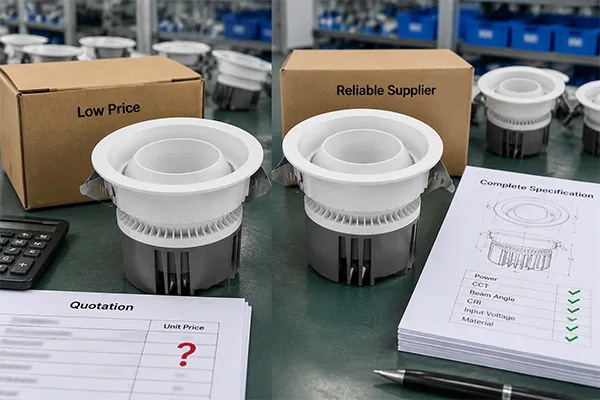
I have received inquiries where several suppliers quoted the same-looking recessed downlight at very different prices. In many cases, the buyer needed more information before the quotes could be compared fairly. The products may have differed in driver type, LED source, housing thickness, heat management design, CRI, dimming compatibility, warranty terms, packaging, or testing scope.5
A low quotation is not automatically suspicious. A supplier may have a more efficient supply chain, lower overhead, a standardized model, or stronger purchasing leverage. At the same time, buyers should ask what is included and what is not included.
I suggest using a comparison sheet that goes beyond the headline unit price:
| Cost or risk area | Questions for the supplier | Potential procurement impact |
|---|---|---|
| Specification completeness | Are all electrical, optical, and mechanical requirements listed? | Avoids receiving a technically different product. |
| Quotation validity | Is the price tied to a quantity, material assumption, or currency condition? | Helps prevent later commercial surprises. |
| Tooling or customization | Are mold, printing, color, or packaging costs included? | Prevents incomplete budget planning. |
| Lead time | Does the stated lead time begin after deposit, artwork approval, or sample confirmation? | Supports realistic project scheduling. |
| Replacements | How are confirmed quality claims reviewed and handled? | Clarifies post-shipment responsibilities. |
| Communication | Who owns technical and order follow-up? | Reduces delays during decision points. |
Delays create operational pressure
For contractors and project managers, a delayed downlight shipment can affect installation sequencing6. For importers and distributors, it can affect stock availability, customer confidence, and freight planning. I do not use generic industry cost figures here because each buyer’s commercial exposure is different and should be calculated internally.
Still, the pattern is clear from supplier-side coordination: unclear decisions at the beginning can create repeated questions later. A buyer may need to reconfirm cutout size, color temperature, driver option, carton artwork, labels, or shipment instructions after production has already been planned.
I view supplier reliability as a form of risk control. It helps keep commercial, technical, and delivery decisions visible before they become urgent.
The better question is not “Who has the cheapest LED downlight?” The better question is “Which offer gives us the clearest, most verifiable route from specification to delivery?”
How Can Buyers Verify Supplier Reliability Before Ordering?
Buyers do not need to rely only on sales promises when assessing supplier reliability. I believe reliability leaves observable signals in a supplier’s quotation process, technical replies, sample handling, production communication, and response to difficult questions. These signals are more useful than broad claims about quality or service.
Buyers can verify supplier reliability by reviewing how the supplier confirms requirements, documents approved samples, explains production controls, communicates realistic lead times, provides certification documents, and handles potential nonconformities. Strong answers should be specific, consistent, and open to verification.
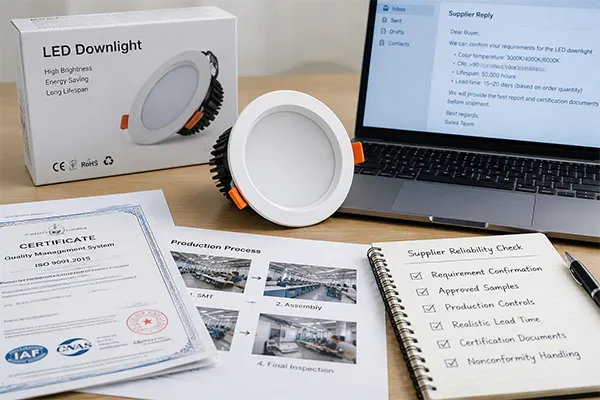
Start with the quotation response
A reliable supplier does not need to provide every answer instantly. However, I expect a capable supplier to identify missing information rather than make assumptions. For example, if a buyer asks for “a 20W downlight,” the supplier should clarify the cutout, diameter, CCT, beam angle, dimming need, voltage, CRI, trim color, and target market before presenting the final offer.
When I speak with buyers, the most productive discussions happen when both sides turn general requests into a controlled specification. This process may take a little more time at the beginning, but it can reduce uncertainty before mass production.
Use a practical supplier evaluation checklist
I recommend that purchasing teams ask suppliers for evidence that matches their order risk. A small trial order may require a lighter review than a large project order, but every order benefits from a basic verification process.
-
Request a detailed product specification.
Buyers should confirm dimensions, cutout size, power, CCT, CRI, beam angle, input voltage, IP rating where relevant, finish, and driver details. -
Ask how sample approval is controlled.
Buyers should ask whether the supplier uses a sample code, signed confirmation, photographs, drawings, or retained reference samples. -
Confirm the production timeline.
Buyers should ask what event starts the lead time. This could be deposit receipt, artwork confirmation, sample approval, or final purchase-order confirmation. -
Review quality-control steps.
Buyers should ask what checks take place during assembly, aging, final inspection, and packing. The supplier should explain the scope without making unsupported claims. -
Request applicable certification documents.
Buyers should verify CE, RoHS, or other required documents for the intended market, product model, and current revision.7 A certificate alone does not replace the buyer’s compliance review.8 -
Ask about complaint handling.
Buyers should understand how the supplier requests evidence, traces the batch, assesses root causes, and agrees on corrective action for confirmed issues.
Look for consistency across departments
One practical sign of supplier reliability is whether the sales, engineering, production, and logistics information aligns. I have seen procurement discussions become difficult when a sales promise does not match a production reality. Buyers can test alignment by asking the same key question in different formats.
For example:
- “Is this downlight available in 4000K?”
- “Will 4000K be the same configuration as the approved sample?”
- “Can the packing label show 4000K and the buyer’s model number?”
- “Does selecting 4000K change the lead time?”
The answers should remain consistent. If details change, the supplier should explain why and update documents accordingly.
Why Does Supplier Reliability Matter During Delivery and After-Sales Support?
Supplier reliability does not end when products leave the factory. Delivery coordination, document accuracy, packaging execution, and issue response all affect whether the buyer can receive, inspect, distribute, or install LED downlights with confidence. I consider these post-order stages essential parts of the original purchasing decision.
Supplier reliability during delivery and after-sales support means the supplier communicates shipment status clearly, prepares agreed documentation and packing correctly, supports traceability, and responds to verified issues with a structured process. Buyers should assess these capabilities before placing repeat or project-critical orders.
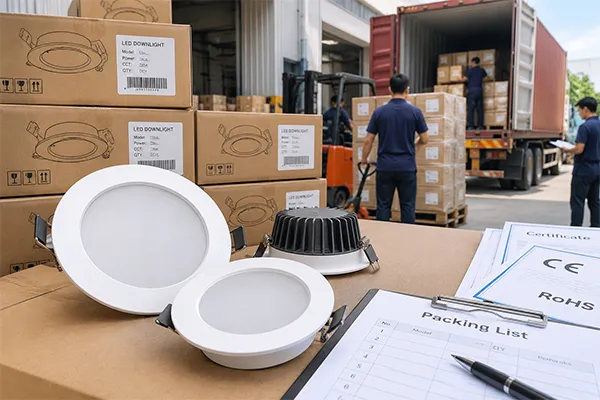
Delivery commitments should be realistic, not simply fast
Many buyers ask for the fastest possible lead time. I understand this need, especially when a project deadline or inventory shortage is involved. However, I believe the most useful commitment is a realistic one that states assumptions clearly.
A delivery estimate should account for factors such as:
- Final specification confirmation
- Material availability
- Customized components or surface finishes
- Production scheduling
- Aging and final inspection time
- Packaging artwork approval
- Export documentation and freight booking
At Upward Lighting, we aim to provide quick quotation responses and clear order coordination. Yet buyers should always ask us, or any supplier, which assumptions support the promised delivery date. That question is more valuable than receiving an optimistic date without context.
Traceability helps both sides solve problems9
When an issue occurs, an emotional or vague discussion rarely produces a fast answer. I have found that documented information helps both buyer and supplier investigate efficiently.
Buyers can prepare the following when reporting a concern:
- Purchase order number and product model
- Batch, carton, or label information
- Quantity affected
- Photos and videos showing the condition
- Installation environment and wiring details where relevant
- Test observations or inspection records
- Date of receipt and date of issue discovery
This does not place all responsibility on the buyer. Instead, it gives the supplier a starting point for traceability. A reliable supplier should review the information, identify what can be verified, and communicate the next steps. Depending on the case, the supplier may need to inspect retained records, production information, packaging data, or returned samples.
Reliability supports long-term sourcing decisions
For repeat buyers, supplier reliability can simplify future procurement10. Once a supplier has demonstrated that it can hold specifications, communicate clearly, and deliver predictable documentation, the buyer may spend less time re-explaining standard requirements. That does not mean buyers should stop checking quality. It means the relationship can operate with better controls and fewer avoidable assumptions.
I encourage buyers to treat a first order as a structured evaluation. They can assess not only the product itself, but also:
- Was the quotation complete?
- Were changes documented?
- Did the sample match production?
- Was delivery communication accurate?
- Were cartons and labels correct?
- Did the supplier respond clearly after receipt?
These questions create a more balanced basis for repeat orders than price alone.
Frequently Asked Questions
Is the lowest LED downlight price always a bad sign?
No. A low LED downlight price may reflect efficient sourcing, standard product design, production scale, or a supplier’s commercial strategy. I recommend that buyers verify specifications, materials, quality controls, lead-time assumptions, and after-sales procedures before treating a lower quote as a true saving.
What is the best way to assess supplier reliability?
I suggest buyers assess supplier reliability through observable actions: detailed quotations, written specification confirmation, sample-control procedures, realistic delivery communication, documented inspection steps11, and structured complaint handling. Buyers should compare these signals across suppliers rather than relying only on general promises or marketing claims.
Does an approved LED downlight sample guarantee mass production quality?
No. An approved sample confirms one unit under specific conditions.12 Buyers should ask how the supplier links that approved sample to production instructions, component control, in-process checks, aging tests, final inspection, and packing requirements. This helps reduce sample-to-production variation.
Should buyers verify CE and RoHS documents for LED downlights?
Yes. Buyers should request and verify applicable CE, RoHS, and other required compliance documents for the exact product model and destination market. I recommend that buyers confirm document validity, scope, product matching, and local regulatory requirements with qualified compliance professionals when necessary.
What should a buyer ask before confirming an LED downlight order?
Buyers should confirm the complete product specification, approved sample reference, quantity, packaging, labeling, pricing terms, payment terms, lead-time starting point, inspection expectations, shipping arrangement, and complaint process. I find that written confirmation of these points prevents many avoidable misunderstandings later.
Conclusion
Supplier reliability is not simply friendly communication or a higher quoted price. I see it as the verifiable ability to keep LED downlight specifications, approved samples, mass production, delivery commitments, and issue resolution aligned. Low LED downlight prices can be valuable, but buyers should evaluate the controls behind the offer before deciding. If you are sourcing customizable LED downlights, track lights, or office linear lights, I invite you to send us your specifications for a clear quotation and practical procurement discussion.
"process group definitions – procurement", https://ofm.wa.gov/wp-content/uploads/sites/default/files/public/onewa/OneWa_Benchmark_Process_Def_PR_NASACT.pdf. Procurement and supplier-selection research commonly treats purchase price as one component of total acquisition cost, alongside quality, delivery performance, service, and transaction-related costs. Evidence role: general_support; source type: research. Supports: Supplier evaluation and total-cost approaches commonly consider quality, delivery, service, and lifecycle or transaction costs in addition to purchase price.. Scope note: The relative importance and monetary value of these factors depend on the buyer's product, contract, and operating context. ↩
"What kinds of Lot Acceptance Sampling Plans (LASPs) are ...", https://www.itl.nist.gov/div898/handbook/pmc/section2/pmc22.htm. Acceptance-sampling guidance explains that inspection of a sample provides evidence for a lot-acceptance decision under specified sampling risks, rather than a guarantee that every item in the production lot conforms. Evidence role: mechanism; source type: government. Supports: Sampling inspection uses observations from a sample to make a decision about a lot under defined plans and risks; it does not establish that every unit is conforming.. Scope note: The source addresses statistical inspection generally and does not evaluate any particular LED downlight production process. ↩
"Formal Representation of Product Design Specifications for ...", https://tsapps.nist.gov/publication/get_pdf.cfm?pub_id=902722. Quality-management standards require suppliers to determine and review customer requirements and retain relevant documented information, providing a basis for reducing ambiguity in product specifications. Evidence role: mechanism; source type: institution. Supports: Quality-management systems require organizations to determine, communicate, and review product and service requirements before committing to supply.. Scope note: Documented requirements can reduce ambiguity but cannot by themselves prevent all interpretation errors or manufacturing defects. ↩
"Improved indoor lighting improved healthy aging at home - PMC", https://pmc.ncbi.nlm.nih.gov/articles/PMC6526775/. A supplier quality-control record or independent audit should verify whether each shipped unit undergoes an aging test and whether the documented duration is four to eight hours. Evidence role: case_reference; source type: other. Supports: A dated supplier quality-control procedure, production record, or independent audit should document the stated test coverage and duration.. Scope note: General LED reliability literature cannot substantiate this company-specific testing practice; direct operational records are required. ↩
"Lighting Specification Guidance for Schools", https://www.energy.gov/sites/default/files/2024-12/lighting-spec-guidance-school_nov24.pdf. Technical guidance on LED luminaires identifies driver characteristics, thermal management, color rendering, and control compatibility as product attributes that can affect performance and reliability. Evidence role: general_support; source type: government. Supports: LED luminaire performance and reliability are influenced by component selection, driver characteristics, thermal management, color quality, and control compatibility.. Scope note: The guidance supports the relevance of these attributes generally; it does not establish differences among any specific suppliers' quotations. ↩
"Design~Sequencing", https://dot.ca.gov/-/media/dot-media/programs/legislative-affairs/documents/design-sequencing-report-a11y.pdf. Construction-management research reports that material-delivery delays can disrupt planned work sequences and contribute to project schedule impacts. Evidence role: mechanism; source type: research. Supports: Construction supply-chain and schedule research documents that late material deliveries can disrupt planned work sequencing and contribute to schedule delays.. Scope note: The extent of disruption depends on project scheduling, inventory buffers, substitutability, and the criticality of the delayed material. ↩
"Preparing technical documentation - Your Europe", https://europa.eu/youreurope/business/product-rules-compliance/general-product-compliance/preparing-technical-documentation/index_en.htm. European Commission guidance states that CE marking and applicable EU product rules require conformity assessment and supporting documentation for products placed on the EU market, including obligations under restrictions on hazardous substances where applicable. Evidence role: definition; source type: government. Supports: EU CE-marking and RoHS obligations require applicable conformity assessment and technical or declaration documentation for products placed on the relevant market.. Scope note: The applicable directives, standards, and documentation requirements vary by product, intended use, and destination market. ↩
"CE marking - Internal Market, Industry, Entrepreneurship and ...", https://single-market-economy.ec.europa.eu/single-market/goods/ce-marking_en. Official CE-marking guidance explains that compliance depends on the applicable legal requirements, conformity assessment, technical documentation, and declaration of conformity for the product concerned, not solely on possession of a certificate. Evidence role: general_support; source type: government. Supports: Conformity assessment requires applicable documentation, product-specific assessment, and responsible-party obligations; third-party certificates are not universally required or universally sufficient.. Scope note: The precise role of a certificate varies by EU legislation, product category, and conformity-assessment route. ↩
"Metrological Traceability: Frequently Asked Questions and ...", https://www.nist.gov/metrology/metrological-traceability. Quality-management guidance treats identification and traceability as controls that help organizations determine product status and investigate nonconforming outputs through associated production and inspection records. Evidence role: mechanism; source type: institution. Supports: Traceability systems link products or batches to relevant production, inspection, and distribution information, aiding investigation of nonconformities.. Scope note: Traceability improves the ability to investigate an issue but does not determine fault or guarantee a particular remedy. ↩
"Transaction Cost Economics: An Assessment of Empirical ...", https://scholarship.law.duke.edu/cgi/viewcontent.cgi?referer=&httpsredir=1&article=2287&context=faculty_scholarship. Buyer-supplier relationship research indicates that established performance history and shared routines may reduce coordination, monitoring, and information-processing costs in repeat transactions. Evidence role: general_support; source type: paper. Supports: Research on buyer-supplier relationships and transaction costs examines how established, reliable relationships can reduce coordination and monitoring burdens.. Scope note: Such efficiencies depend on continued performance and appropriate controls; prior reliability does not eliminate the need for ongoing verification. ↩
"Metrological Traceability: Frequently Asked Questions and ...", https://www.nist.gov/metrology/metrological-traceability. Quality-management standards describe planned inspection and retained documented information as mechanisms for demonstrating conformity and controlling operational processes. Evidence role: general_support; source type: institution. Supports: Quality-management systems use planned monitoring, measurement, inspection, and retained documented information to demonstrate conformity and support control of processes.. Scope note: The existence of records is not, by itself, proof that inspections were effective or that supplied products will be defect-free. ↩
"Draft, Handbook 133, Checking the Net Contents of ...", https://www.nist.gov/document/07-lr-appb-hb133-10-pub15-finalpdf. Statistical quality-control guidance distinguishes the measured conformity of an inspected sample from conclusions about a wider production lot, which require defined sampling and process-control methods. Evidence role: expert_consensus; source type: government. Supports: Statistical quality-control guidance distinguishes evidence obtained from a sample from evidence about an entire lot or production process.. Scope note: The statement does not imply that sample approval lacks value; it addresses the limits of what a single sample can demonstrate. ↩