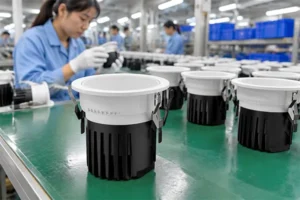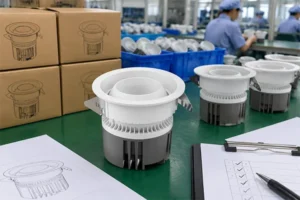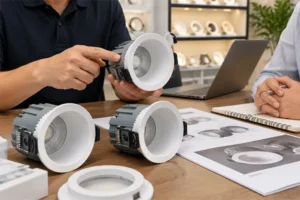

An LED downlight manufacturer can look suitable on paper yet still create problems after the first order if specifications, communication, and delivery expectations are unclear. A low unit price may feel attractive, but inconsistent products, slow responses, or undocumented changes can increase procurement risk. We believe a structured working process creates a more dependable long-term relationship.
An effective long-term partnership with an LED downlight manufacturer is built through verified product specifications, transparent quotation discussions, realistic delivery planning, documented compliance requirements, and a clear process for managing changes. Buyers should evaluate total procurement risk1—not only price—and share market, application, and forecast information early so the manufacturer can turn requirements into a workable production and supply plan.

In our pre-sales communication with overseas buyers, we often see that the strongest supplier relationships begin before a purchase order is issued. The sample stage, quotation revisions, technical questions, and forecast discussions show whether both sides can solve practical problems together. That is where a repeat-order program becomes more than a one-time transaction.
Why Should You Evaluate an LED Downlight Manufacturer Beyond Unit Price?
Price pressure is real for importers, distributors, contractors, and local lighting brands. However, a low initial quotation can become costly when product specifications drift, documents are incomplete, or a supplier cannot respond when a project requirement changes. Buyers need a wider view of supplier capability.
You should evaluate an LED downlight manufacturer based on total procurement risk, including product consistency, specification control, response speed, delivery planning, documentation, and issue handling. Unit price remains important, but it should be compared alongside the operational cost of delays, rework, replacement, and unclear communication.

Look at the full cost of procurement
A quotation usually shows visible costs: product price, packaging, tooling, shipping terms, and perhaps sample charges. Yet many procurement costs appear later. A buyer may spend extra time clarifying a beam angle, correcting a label, chasing a certification document, or explaining why a revised housing color does not match the approved sample.
From our manufacturing perspective, these issues rarely come from one factor alone. They often result from an incomplete handover between commercial discussion, technical confirmation, purchasing, production, and final inspection.
When we assess whether a requirement is workable, we need to understand what the buyer is actually trying to achieve. For example, a request for a lower-priced recessed downlight may be feasible, but the buyer should also define which features are essential:
- Required wattage range and light output expectation
- Color temperature and color consistency requirements
- Beam angle for the intended ceiling height and application
- CRI requirement for retail, residential, office, hospitality, or other spaces2
- Dimming or driver compatibility needs
- Trim color, housing finish, and branding needs
- Target market compliance and documentation requirements
- Packaging, barcode, instruction, and labeling requirements
A supplier that asks these questions is not necessarily making the process difficult. In many cases, the questions help prevent a mismatch between the quoted item and the product that a buyer expects to sell or install.
Compare suppliers with a practical scorecard
We recommend that buyers use the same comparison criteria across each candidate supplier. This creates a more balanced decision than comparing price alone.
| Evaluation area | What buyers can verify | Why it matters for repeat purchasing |
|---|---|---|
| Product specification control | Datasheets, approved drawings, sample confirmation records | Reduces variation between sample and repeat orders |
| Quotation clarity | Itemized quotation, Incoterms3, MOQ, lead time, exclusions | Prevents commercial misunderstandings |
| Quality process | Aging-test process, inspection steps, traceability approach | Supports consistency, though buyers should define their own acceptance criteria |
| Documentation | Available CE, RoHS, test reports, labels, manuals | Helps buyers verify market-entry and customer requirements |
| Responsiveness | Quality of answers, speed of revisions, question follow-up | Indicates how issues may be handled after ordering |
| Customization capability | Limits, MOQ implications, sample timing, approval process | Helps private-label and project buyers plan realistically |
| Delivery planning | Material lead times, production schedule, shipping coordination | Supports inventory and project planning |
| Problem resolution | Escalation contacts, corrective-action communication, agreed process | Reduces disruption when an issue occurs |
At Upward Lighting, we have learned that buyers who use a structured supplier review often make faster repeat-order decisions later. Their teams already know who confirms specifications, who approves artwork, what documents are required, and how changes should be communicated.
A long-term supplier relationship does not remove risk. It makes risk more visible, easier to assign, and more manageable before it affects a shipment or project.
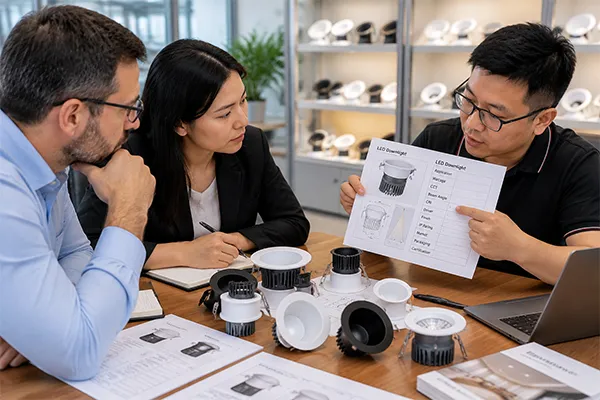
Many buyers send an inquiry with only a photo, wattage, and quantity. That can be enough for an initial reference quotation, but it is usually not enough to support a stable product program. Without application and market context, the manufacturer may quote an option that looks comparable but does not fit the final use.
Buyers should give an LED downlight manufacturer early information about the target market, application, core specifications, compliance needs, packaging expectations, and expected purchase rhythm. This information allows the manufacturer to assess feasibility, identify open questions, prepare a more relevant quotation, and plan suitable samples or production options.
Turn a broad inquiry into an executable brief
We do not expect every buyer to have a complete technical file at the first contact. Many importers are still comparing product families. Contractors may be waiting for a project drawing. A local lighting brand may be testing a new market category.
Still, the more relevant information a buyer shares, the more useful our quotation and recommendation can be. In our pre-sales communication, we find that the following details make a major difference.
1. Define the target application
A downlight for a residential living room may have different priorities from one used in a hotel corridor, retail store, office renovation, or commercial project. The application affects questions about light distribution, glare control, trim style, driver selection, color rendering, operating environment, and installation conditions.
Buyers should explain:
- Where the product will be installed
- Whether the installation is residential, commercial, hospitality, retail, or project-based
- Ceiling cutout and available ceiling depth
- Whether dimming is required
- Whether the end customer has a stated specification or approved brand list
- Whether the product is for stock sales, tender submission, or a named project
This context does not mean that a manufacturer should make final application decisions on the buyer’s behalf. Application-specific lighting and electrical decisions should be reviewed by qualified professionals.4 However, the context helps us identify where a proposed product may need further checking.
2. Separate “must-have” requirements from preferences
Some requirements are fixed. Others are negotiable. Buyers can make quotation discussions more efficient by separating them.
| Requirement type | Example | Procurement effect |
|---|---|---|
| Non-negotiable | Target market document requirement | May determine available product options and lead time |
| Non-negotiable | Required cutout size for an existing ceiling | Limits physical product selection |
| Preferred | Matte black or white trim finish | May affect MOQ or surface-treatment timing |
| Preferred | Higher CRI option | May affect cost and component availability |
| Commercial target | Target price range | Helps identify feasible configurations |
| Forecast information | Expected quarterly volume | Helps assess material planning and customization support |
This distinction is useful when a buyer wants OEM or ODM support. For example, customized surface colors, packaging, labels, wattage, color temperature, beam angle, and CRI can be discussed, but every customization has practical limits. A manufacturer should clarify MOQ, sample needs, material availability, tooling requirements, and possible lead-time effects before making commitments.
Share compliance requirements early, then verify documents
Certification conversations require precision. Buyers should identify the destination market and the document type requested by their customer, local authority, retailer, or project consultant. A generic request for “all certificates” can lead to confusion because requirements vary by market and product configuration.5
At Upward Lighting, our products may be supplied with documents such as CE and RoHS documentation6 for applicable products and markets. However, buyers should always verify that the document scope, product model, revision, test standard, issuing organization, and destination-market requirement match their intended sale or installation. Certification documents should be treated as records to check, not as assumptions.
An early compliance checklist can include:
- Target country or region
- Product model and electrical configuration
- Required declarations, reports, labels, or instructions
- Customer-specific or project-specific documentation
- Any language, packaging, or marking requirements
- Required document-review timing before order release
That process protects both the buyer and the LED downlight manufacturer from discovering a document mismatch after production is already scheduled.
How Do Quotation Revisions and Samples Test an LED Downlight Manufacturer?
Repeated quotation revisions can feel inefficient, especially when a project deadline is close. Yet revisions often reveal the exact details that determine whether a product can be supplied consistently. A supplier that only says “yes” quickly may not have identified important production, material, or documentation questions.
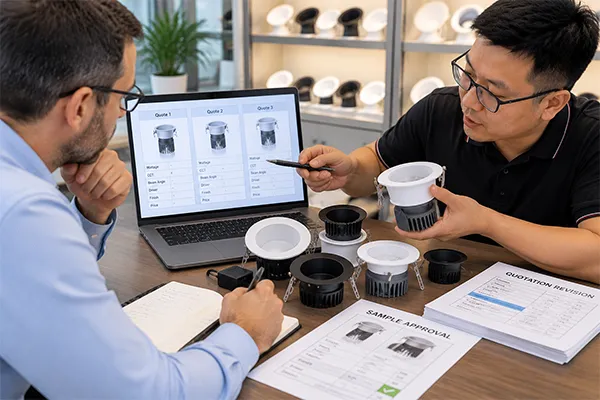
Quotation revisions and sample-stage questions are useful tests of an LED downlight manufacturer because they show how the supplier handles incomplete information, technical changes, cost trade-offs, and approval records. A productive process turns each revision into a clearer specification rather than leaving critical details in chat messages or verbal assumptions.
Treat revisions as specification control, not friction
In our experience, buyers often revise an inquiry for reasonable commercial reasons. A customer may ask for a different color temperature after reviewing a local competitor’s range. A contractor may receive a new ceiling plan. A brand may decide that private-label packaging is necessary. An importer may need to adjust the price target after calculating freight and duty.
These are normal business changes. The key issue is how both sides record and assess them.
Each meaningful revision should be reflected in a controlled document7, such as an updated quotation, product specification sheet, sample confirmation form, packaging artwork approval, or purchase order revision. A clear revision trail helps answer basic but essential questions:
- Which wattage and color temperature did both sides approve?
- Does the final price include a specific driver or dimming option?
- Which trim finish was approved?
- Is the product intended for a fixed cutout size?
- Does the carton artwork match the latest private-label design?
- Which samples represent the approved production configuration?
- Did the requested change affect MOQ, lead time, or documentation?
Build a sample approval process that reflects production reality
A sample should be useful, but it should not be treated as a universal guarantee. A hand-prepared sample may be made before full material allocation, final packaging approval, or complete production scheduling.8 Therefore, buyers should ask what the sample represents and what remains subject to confirmation.
A practical sample review can include the following stages:
- Confirm the sample purpose. Is it for appearance review, fit testing, light-output comparison, customer presentation, or full technical validation?
- Record the sample configuration. Note model code, wattage, CCT, beam angle, CRI, driver, trim color, cutout, and packaging status.
- Review the intended use. Confirm whether the installation environment or control system requires additional evaluation.
- Document feedback. Use written comments, marked photos, and clear acceptance points.
- Issue a revised commercial document. Update pricing, MOQ, lead time, and any customization implications.
- Approve the production reference. Make sure the purchase order matches the confirmed specification.
At Upward Lighting, we sometimes see a gap between a buyer’s sample feedback and the final purchase order. A buyer may approve a warm-white sample but issue an order without a clear CCT line. Or a buyer may approve a black trim but use an older quotation that lists white. These gaps are preventable when both teams pause to compare the order against the final approved configuration.
Ask how the supplier responds to uncertainty
The quality of a manufacturer’s questions often matters as much as the speed of its first answer. Buyers can observe whether the supplier explains trade-offs, identifies missing details, and distinguishes between confirmed capability and items that require checking.
Useful questions include:
- What assumptions are included in this quotation?
- Which specifications could change the price or lead time?
- Can this customization be supported for the expected order volume?
- What must be confirmed before mass production?
- How will the supplier identify the approved version during production?
- Who will respond if a sample finding requires a commercial or technical revision?
These questions help buyers assess whether the LED downlight manufacturer has a process that can support repeat orders, rather than only a process for winning the first inquiry.
How Can You Turn a First Order into a Long-Term LED Downlight Partnership?
The first production order is a critical transition point. The buyer moves from evaluation to commercial exposure, while the manufacturer moves from quotation to material purchasing, production scheduling, quality control, and shipment coordination. If expectations remain informal, small misunderstandings can become larger problems.
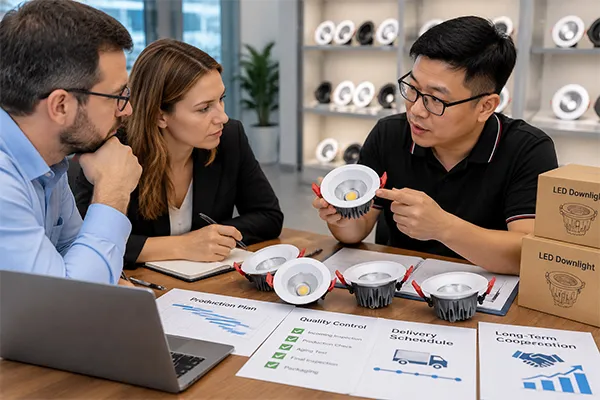
A long-term LED downlight partnership develops when buyers and manufacturers agree on repeatable processes for order confirmation, production planning, quality expectations, delivery communication, documentation, and issue escalation. Shared forecasts or product plans can also help the manufacturer assess materials and capacity more realistically9, although forecasts should not be treated as guaranteed orders.
Establish a working rhythm after the first order
A dependable relationship needs more than a positive first shipment. It needs a regular communication rhythm that matches the buyer’s business model.
For a distributor, this may include stock planning, popular SKUs, packaging updates, and reorder thresholds. For a contractor, it may include project delivery windows, approved sample records, and site-specific changes. For a lighting brand, it may include product-roadmap planning, private-label artwork control, and market feedback.
Based on the issues customers commonly raise, a useful working rhythm includes:
| Process area | Buyer responsibility | Manufacturer responsibility |
|---|---|---|
| Forecast sharing | Share expected demand range and planned launches where possible | Review feasibility and flag material or capacity considerations |
| Purchase order release | Provide complete product, packaging, and shipping instructions | Confirm order details and identify open points |
| Production updates | Communicate project changes promptly | Share realistic milestones and change impacts |
| Quality review | Define inspection priorities and acceptance expectations | Explain available quality-control steps and provide agreed records |
| Documentation | Confirm destination-market and customer requirements | Provide applicable available documents for buyer verification |
| Escalation | Identify decision-makers and response urgency | Assign relevant commercial or production contacts |
At Upward Lighting, we conduct a 100% aging test for 4 to 8 hours before shipment10 as part of our stated process for applicable products. Buyers should still discuss what records, inspections, or acceptance criteria they require for their own market and product program. A factory process does not replace a buyer’s responsibility to define commercial requirements or arrange qualified inspection where needed.
Use forecasts to improve planning, not to create false certainty
A forecast is valuable even when it is not exact. It helps a manufacturer understand whether the buyer is planning a one-time project order, a seasonal stock program, a new private-label launch, or recurring container-level purchasing.
When customers share a broad product plan, we can better discuss matters such as:
- Whether certain finishes or packaging materials need longer planning
- Whether a requested SKU range is likely to need phased sampling
- Whether small-batch orders are practical for a particular customized configuration
- When a repeat order should be discussed before stock becomes urgent
- Which product changes could affect component or material planning
However, forecasts should be described honestly. A manufacturer should not reserve unlimited capacity based on an informal estimate, and a buyer should not assume that an old forecast locks in price or lead time. The best approach is to agree on what the forecast means, how often it will be updated, and when it becomes a confirmed purchase order.
Agree on a change and escalation process
Every long-term program eventually changes. A product may need a new label, a revised CCT range, a different package, an updated price target, or a substitute component evaluation. What matters is whether both sides know how the change will be reviewed.
A clear change-management process should state:
- Who can request a change on each side.
- How the request is documented, such as email, revision form, or updated purchase order.
- What the manufacturer will assess, including cost, MOQ, sample need, document implications, and lead-time impact.
- Who approves the final revision before it enters production.
- How urgent issues are escalated, including primary and backup contacts.
- How the final decision is recorded for future repeat orders.
I have found that straightforward escalation channels reduce stress for both teams. The goal is not to pretend that problems will never happen. The goal is to make sure a problem reaches the people who can clarify it and decide the next action.
Frequently Asked Questions
What makes a good LED downlight manufacturer for repeat orders?
A good LED downlight manufacturer can provide clear specifications, responsive communication, realistic commercial commitments, and a documented process for samples, revisions, production, and delivery. Buyers should also verify product documentation, quality-control practices, customization limits, and the supplier’s ability to support their expected purchasing pattern.
Should I choose the lowest-priced LED downlight supplier?
Not necessarily. A low price may be suitable if the product specification, documentation, delivery conditions, and communication process fit your needs. Buyers should compare the full procurement risk, including consistency, response time, packaging, compliance records, and the possible cost of specification errors or delivery disruption.
What information should I include in an LED downlight inquiry?
You should include the target market, application, product photo or reference, wattage, CCT, CRI, beam angle, cutout size, trim color, dimming needs, expected quantity, packaging needs, and required documents. You should also identify which requirements are fixed and which are open for discussion.
How should I verify CE or RoHS documents for LED downlights?
You should check that the document applies to the exact product model, electrical configuration, and destination-market requirement.11 You should review the document date, issuing organization, referenced standards, and product description. When requirements are project-specific, you should seek qualified compliance or regulatory guidance as needed.
Can an LED downlight manufacturer support small-batch OEM orders?
Some manufacturers can support small-batch orders, but feasibility depends on the product configuration, custom finish, private-label packaging, components, and required documentation. Buyers should ask about MOQ, sample charges, tooling, material lead times, and whether the customized version can be repeated consistently in future orders.
Conclusion
A reliable relationship with an LED downlight manufacturer starts with more than an attractive quotation or an approved first sample. Buyers should evaluate total procurement risk, provide clear application and market information, verify documentation, record specification revisions, and establish realistic processes for forecasts, changes, and escalations. At Upward Lighting, we work with buyers to turn these details into practical quotations, samples, production planning, and ongoing communication. If you are evaluating a repeat-order, private-label, or project supply program, contact our team to discuss your LED downlight requirements and available OEM/ODM options.
"Assessing the Best Supplier Selection Criteria in Supply ...", https://pmc.ncbi.nlm.nih.gov/articles/PMC9102987/. Supplier-selection research commonly evaluates price alongside quality, delivery, service, and risk-related criteria rather than treating unit price as the sole decision variable. Evidence role: general_support; source type: paper. Supports: Research and procurement guidance describing supplier-selection criteria that extend beyond purchase price, including quality, delivery performance, and risk.. Scope note: The relative weight assigned to each criterion depends on the buyer, product category, contract, and market. ↩
"LED Basics", https://www.energy.gov/cmei/ssl/led-basics. Color-rendering metrics describe how a light source affects the appearance of object colors, a consideration that can be important in applications involving visual evaluation, merchandise, interiors, or occupant preference. Evidence role: definition; source type: government. Supports: Authoritative information defining color rendering and explaining its relevance where accurate color appearance is important.. Scope note: CRI alone does not fully characterize color quality, and no single CRI value is universally appropriate for all applications. ↩
"Know Your Incoterms", https://www.trade.gov/know-your-incoterms. Incoterms rules define specified buyer and seller responsibilities for delivery, transport-related costs, export or import formalities, and risk transfer under the selected trade term. Evidence role: definition; source type: institution. Supports: The function of Incoterms rules in defining delivery obligations, allocation of costs, and transfer of risk in sales contracts.. Scope note: Incoterms rules do not by themselves settle all contractual matters, including product conformity, payment terms, or transfer of title. ↩
"Qualified employee requirements for the servicing and ...", http://www.osha.gov/laws-regs/standardinterpretations/1993-09-09-3. Electrical-safety guidance commonly distinguishes qualified or competent persons for work and determinations involving electrical hazards and installation safety. Evidence role: expert_consensus; source type: government. Supports: Electrical-safety guidance recognizing that certain electrical work and safety determinations require qualified or competent persons.. Scope note: The legal definition of a qualified or competent person, and the work requiring one, varies by jurisdiction and installation context. ↩
"CE marking – obtaining the certificate, EU requirements ...", https://europa.eu/youreurope/business/product-rules-compliance/general-product-compliance/ce-marking/index_en.htm. Official product-compliance guidance indicates that applicable conformity obligations, declarations, and technical documentation depend on the product, the legislation that applies, and the market in which the product is placed. Evidence role: general_support; source type: government. Supports: Official conformity-assessment guidance showing that applicable product requirements and technical documentation depend on the relevant legal framework and product placed on a market.. Scope note: This support does not determine the requirements for a specific downlight model or destination; applicable rules must be assessed for the particular product and market. ↩
"CE marking – obtaining the certificate, EU requirements", https://europa.eu/youreurope/business/product-rules-compliance/general-product-compliance/ce-marking/index_en.htm. In the European Union, CE marking may be required under applicable harmonisation legislation, while the RoHS Directive restricts specified hazardous substances in electrical and electronic equipment within its scope. Evidence role: definition; source type: government. Supports: The distinct regulatory roles of CE marking and the EU RoHS restrictions for electrical and electronic equipment within their applicable scope.. Scope note: CE marking and RoHS applicability depend on the product and legislation concerned, and the terms do not establish compliance in markets outside the relevant legal regime. ↩
"managing the configuration of information systems with a", https://tsapps.nist.gov/publication/get_pdf.cfm?pub_id=909644. Quality-management systems commonly require organizations to control documented information and to review and manage changes that can affect product conformity or process performance. Evidence role: general_support; source type: institution. Supports: Quality-management principles requiring controlled documented information and planned control of changes affecting products or processes.. Scope note: A general quality-management standard does not prescribe the exact forms, approvals, or revision workflow suitable for every buyer–supplier relationship. ↩
"Prototype vs Pre-Production Sample: Complete Guide", https://www.criterionprecision.com/feeds/blog/prototype-vs-pre-production-sample. Manufacturing quality assurance distinguishes prototype or approval samples from serial production, because final production conditions may involve separately controlled materials, processes, packaging, and inspection arrangements. Evidence role: general_support; source type: research. Supports: Quality-assurance concepts distinguishing development or approval samples from controlled serial-production output.. Scope note: Whether a particular sample is representative can only be determined from its documented configuration and the controls applied to subsequent production. ↩
"Using Machine Learning Approaches to Improve Long- ...", https://dspace.mit.edu/handle/1721.1/126503. Operations-management research treats demand forecasts as important inputs to aggregate planning, capacity decisions, inventory planning, and material procurement. Evidence role: mechanism; source type: paper. Supports: Operations-management evidence that demand forecasts are inputs to material, inventory, workforce, and capacity planning.. Scope note: Forecasts are uncertain and improve planning rather than creating a contractual production commitment or guaranteeing material availability. ↩
"Stress Testing of Organic Light-Emitting Diode Panels and ...", https://www.energy.gov/sites/prod/files/2018/05/f51/ssl_oled-stresstest_2018.pdf. Reliability literature describes burn-in and screening as methods that may be used to identify certain early-life failures in electronic products before use. Evidence role: mechanism; source type: research. Supports: Research on burn-in or screening as a method used to expose some early-life electronic failures before deployment.. Scope note: General evidence on burn-in does not verify this manufacturer's stated 100% coverage, 4-to-8-hour duration, applicable models, test conditions, or shipment records. ↩
"Signing an EU declaration of conformity - Your Europe", https://europa.eu/youreurope/business/product-rules-compliance/general-product-compliance/signing-declaration-conformity/index_en.htm. Conformity-assessment guidance requires relevant declarations and technical documentation to identify the product and address the legislation or requirements applicable to it. Evidence role: general_support; source type: government. Supports: Official conformity-assessment guidance requiring declarations and technical documentation to identify the product and the applicable legal requirements.. Scope note: Document review alone may not establish actual product conformity; additional testing, traceability review, or specialist regulatory assessment can be necessary. ↩