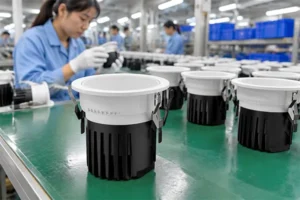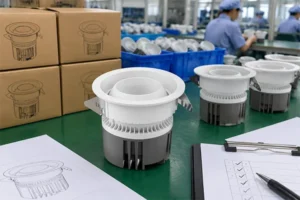

LED downlight manufacturers can be easy to find online, but difficult to assess for long-term wholesale distribution. A low quotation, polished factory photos, or a fast reply may look promising at first. However, inconsistent specifications, unclear compliance documents, and weak replenishment support can quickly turn an attractive product into a margin-draining channel problem.
To find LED downlight manufacturers for wholesale distribution, buyers should define their target market and product requirements first, then verify model-specific quality controls, compliance documents, customization capability, communication standards, and repeat-order delivery performance. The best supplier is not simply the lowest-priced option; it is the manufacturer that can support profitable, compliant, and repeatable resale.
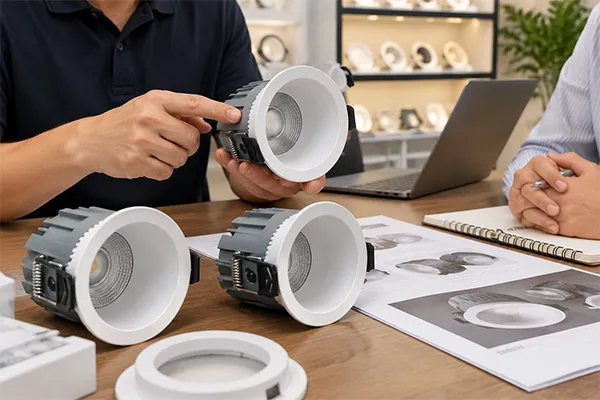
I have seen that the supplier search becomes much clearer when buyers stop asking only, “Are they a real factory?” and start asking, “Can this supplier reliably support my channel?” The detailed checks below can help wholesalers, importers, distributors, and local lighting brands reduce avoidable sourcing risk.
What Should You Define Before Contacting LED Downlight Manufacturers?
Many buyers begin by sending a broad request for a catalog and price list. That approach often creates confusion because suppliers quote different product levels, drivers, materials, and specifications. Without a clear brief, a buyer may compare prices that do not represent equivalent LED downlights.
A practical sourcing brief helps you compare LED downlight manufacturers on the same basis. I recommend defining the target market, installation type, lighting specifications, desired price position, packaging needs, and expected order volume before requesting quotations. This makes supplier responses more relevant and exposes whether a manufacturer understands your application.
Start With the Resale Market, Not the Catalog
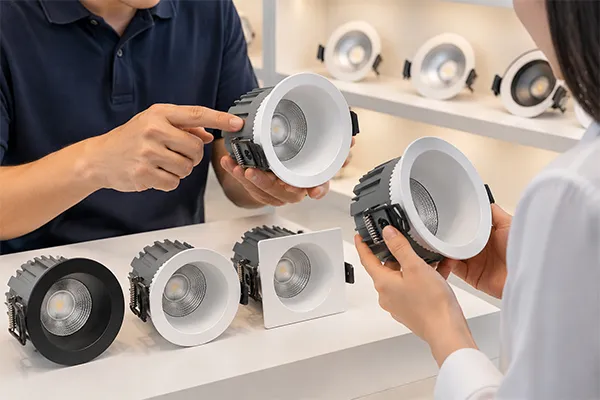
A wholesale LED downlight is not just a product with a wattage and a price. It is a product that must work for a specific buyer group, installation environment, and local market expectation.
For example, an electrical wholesaler selling to small contractors may need fast-moving recessed downlights with standard cutout sizes, easy installation, neutral packaging, and stable stock availability. A local lighting brand may need a more differentiated range with custom finishes, higher CRI options, branded packaging, and consistent color temperature across repeat orders.
In conversations with overseas channel buyers, I often see a common issue: the first inquiry asks for “cheap LED downlights,” but the real requirement only becomes clear after discussing the customer base. A low-cost residential downlight may not fit a hotel renovation project. A narrow-beam accent light may not suit general office circulation areas. The sourcing brief must reflect the actual selling environment.
Build a Product Requirement Sheet
I suggest preparing a short requirement sheet before contacting manufacturers. It does not need to be overly technical, but it should be specific enough to support meaningful quotations.
| Requirement Area | Questions to Define | Why It Matters for Distribution |
|---|---|---|
| Target market | Which country or region will receive the goods? | Compliance, voltage, plug, labeling, and buyer expectations may differ.1 |
| Application | Residential, retail, hospitality, office, corridor, or commercial? | The application affects output, beam angle, glare control, and product design.2 |
| Installation | Recessed, surface-mounted, trimless, or adjustable? | Installation compatibility affects contractor acceptance and returns. |
| Wattage and lumen range | What product tiers will you sell? | A clear range supports catalog planning and price positioning. |
| Color temperature | 2700K, 3000K, 4000K, 5000K, or tunable options? | Color temperature consistency affects repeat sales and project satisfaction.3 |
| CRI | Is standard CRI acceptable, or does the market require higher color rendering? | Higher CRI can support premium retail, hospitality, and showroom applications.4 |
| Beam angle | Flood, medium, narrow, or adjustable beam? | Beam distribution determines whether the product fits its intended space. |
| Finish | White, black, silver, gold, or custom colors? | Finish consistency matters for retail display and branded collections. |
| Packaging | Neutral box, private label, barcode, manual, or carton markings? | Packaging affects shelf readiness, customs handling, and brand control. |
| Order plan | Trial order, small batch, container order, or rolling replenishment? | Manufacturers need this information to assess MOQ and lead-time options. |
Separate “Must-Have” From “Nice-to-Have”
I recommend dividing requirements into three levels:
-
Non-negotiable requirements
These include the destination market, electrical input, core safety expectations, installation dimensions, and mandatory documentation. -
Commercially important requirements
These can include target pricing, packaging, MOQ, lead time, payment terms, and spare-part or after-sales expectations. -
Differentiation requirements
These can include custom colors, branded packaging, special beam angles, higher CRI, dimming functions, or exclusive product combinations.
This process protects buyers from a common procurement mistake: selecting a product based on an attractive feature that does not improve resale performance. A downlight with many options may look impressive, but a distributor may achieve better turnover with a smaller, stable range that contractors can reorder easily.
How Can You Verify LED Downlight Manufacturers Beyond Factory Claims?
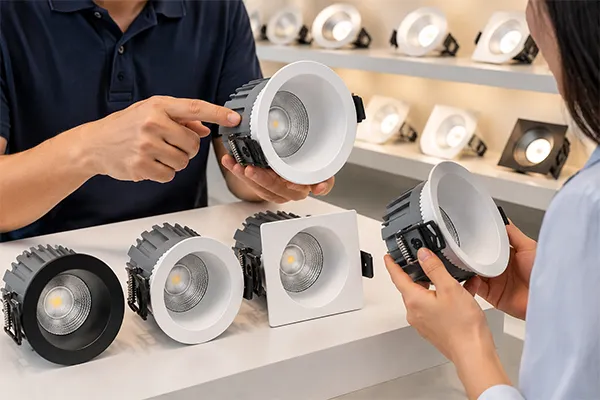
Factory photos, exhibition images, and “manufacturer” labels can help buyers begin a search, but they do not prove that a supplier can maintain quality, communication, or delivery across repeat orders.5 A supplier should be evaluated through evidence that connects directly to your selling and replenishment risks.
To verify LED downlight manufacturers, buyers should review product information, ask model-specific technical questions, assess response quality, request relevant documentation, inspect samples, and clarify how repeat orders are controlled. I view verification as a process, not a single pass-or-fail check.
Look for Repeatable Capability, Not Just a Good Presentation
A manufacturer may have a professional website and a broad product catalog. Those assets can be useful, but they should only be starting points. The key question is whether the supplier can repeatedly deliver the same agreed product specification.
When I speak with importers, a common question is, “How can I tell whether this is a real manufacturer?” I think a more useful question is, “Can this supplier prove reliable control over the product I plan to sell?”
Buyers can ask practical questions such as:
- What is the exact model number for the quoted downlight?
- What are the cutout size, outer diameter, height, and installation requirements?
- Which LED source, driver configuration, housing material, and diffuser are included?
- Is the quoted price based on a specific color temperature, CRI, beam angle, and finish?
- What changes if the buyer requests dimming, a higher CRI, or a black surface finish?
- How does the supplier identify and control product revisions?
- What aging or functional tests are performed before shipment?
- How are nonconforming products handled before packing?
At Upward Lighting, we state that products undergo a 100% aging test lasting between 4 and 8 hours before shipment. Buyers should still ask how any supplier applies its stated process to the exact model, driver, and configuration they intend to order. A quality-control statement is more useful when it is linked to a specific purchase requirement.
Evaluate Communication as a Supply-Chain Signal
A fast reply alone does not guarantee reliable service. However, the quality of a supplier’s reply often indicates how carefully they manage product information.
I suggest reviewing whether the supplier:
- Answers the actual questions instead of sending only a generic catalog.
- Identifies unclear requirements before confirming a quotation.
- States assumptions behind the quoted price.
- Explains differences between models instead of treating all downlights as interchangeable.
- Provides a clear quotation with model numbers, specifications, quantity basis, trade terms, and lead-time assumptions.
- Communicates limitations honestly when a requested feature is not available.
A vague quotation can create trouble later. For example, a quote for “12W downlight, 3000K” may omit essential details such as cutout size, housing depth, driver type, CRI, beam angle, trim color, dimming function, packaging, or input voltage. Those omissions can lead to product mismatch, customer complaints, or delays while the buyer seeks clarification.
Verify Business Information With Multiple Sources
I recommend using more than one verification method. No single document or online signal is conclusive.
| Verification Method | What It Can Show | What It Cannot Prove Alone |
|---|---|---|
| Company website | Product focus, market positioning, contact details | Current production control or repeat-order consistency |
| Video call | Communication quality, facility visibility, team interaction | Full quality-system effectiveness |
| Factory photos or videos | Basic production environment and product range | Whether your exact model will be controlled correctly |
| Product datasheets | Claimed specifications and available options | Actual performance of every production batch |
| Samples | Fit, finish, light output, installation experience | Long-term consistency in future orders |
| Compliance documents | Claimed support for a model or market requirement | Automatic compliance for all configurations and destinations |
| Third-party inspection | Condition of a defined shipment or production stage | Future performance without ongoing controls |
The goal is not to assume that every supplier has a problem. The goal is to make the purchasing decision based on relevant evidence rather than presentation alone.
How Should You Compare LED Downlight Manufacturers Beyond Unit Price?
A low unit price can improve a quotation, but it does not always improve wholesale profit.6 If a downlight creates installation complaints, inconsistent appearance, delayed replenishment, or difficult claims handling, the distributor may lose more than the initial savings.7
Buyers should compare LED downlight manufacturers based on total channel risk and expected resale performance. I recommend calculating the likely commercial impact of quality consistency, documentation, communication, order flexibility, packaging, lead time, and after-sales handling alongside the unit price.
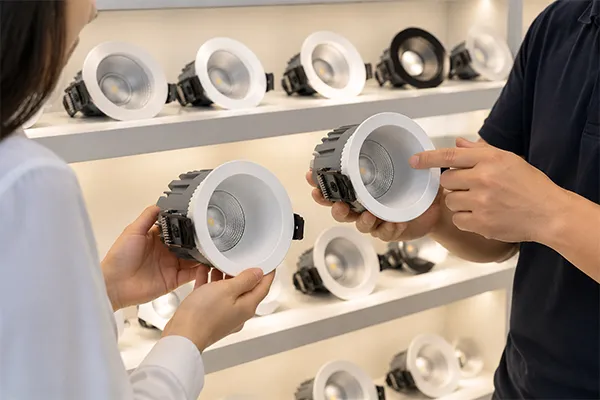
Understand the True Cost of a “Cheaper” Downlight
A product that costs less at the factory can still cost more after it enters your sales channel. Wholesale distribution involves several costs that may not appear in the initial quotation.
These costs can include:
- Customer returns and replacement shipments
- Contractor labor disputes caused by installation issues
- Time spent answering technical complaints
- Discounts offered to retain dissatisfied customers
- Inventory that cannot be sold because specifications changed
- Delayed sales caused by missing documentation
- Emergency air freight when replenishment arrives late
- Loss of trust in your own local brand or distribution business
For this reason, I encourage buyers to compare suppliers with a total-cost view.
A distributor does not earn margin only when the product leaves the warehouse. The distributor protects margin when the product can be sold, installed, reordered, and supported with minimal friction.
Use a Weighted Supplier Comparison Scorecard
A scorecard can prevent procurement teams from overreacting to one very low quotation. The weights should match your market and business model, but the following example offers a useful starting point.
| Evaluation Category | Example Weight | Questions to Ask |
|---|---|---|
| Product specification fit | 20% | Does the model match the required wattage, CCT, CRI, beam angle, dimensions, and installation method? |
| Quality-control evidence | 15% | What checks are performed, and can the supplier explain them for the quoted model? |
| Documentation and compliance support | 15% | Are relevant documents available, current, and clearly linked to the model? |
| Price and payment terms | 15% | Is the price competitive for the agreed specification and order quantity? |
| Communication and quotation clarity | 10% | Does the supplier answer accurately and identify assumptions? |
| Lead time and replenishment planning | 10% | Can the supplier give realistic timelines for trial and repeat orders? |
| OEM/ODM flexibility | 5% | Can the supplier support packaging, color, CCT, wattage, or branding needs? |
| MOQ and trial-order support | 5% | Can the buyer test the market without excessive inventory exposure? |
| After-sales process | 5% | Is there a documented approach to claims, replacements, and technical questions? |
A buyer can score each supplier from 1 to 5 in every category. The final number does not replace professional judgment, but it makes the trade-offs visible.
Compare Like With Like
The most important rule is simple: never compare prices unless the underlying configuration is equivalent.
For example, two 12W LED downlights may differ in:8
- Aluminum housing design and thermal management
- LED source and color consistency
- Driver quality and dimming compatibility
- CRI level
- Beam angle
- IP rating
- Cutout size
- Trim finish
- Packaging protection
- Aging-test procedures
- Warranty terms and claims process
A buyer should ask each supplier to quote against the same written specification. If suppliers recommend alternatives, those alternatives should be listed separately rather than blended into one comparison.
This approach also protects the supplier relationship. When expectations are documented clearly, the buyer and manufacturer have fewer reasons to argue later about what was included in the original price.
How Can Samples and Compliance Documents Reduce Wholesale Risk?
Samples and documents are essential sourcing tools, but they have limits. A good sample shows how a specific product performs at one point in time.9 A compliance document may support a model’s market entry requirements. Neither should be treated as complete proof that every future shipment will be identical or automatically suitable for every destination.
Buyers should use samples and compliance documents to verify defined requirements, then connect those checks to repeat-order controls. I recommend confirming that the sample, quotation, purchase order, packaging, and supporting documents all refer to the same model and agreed configuration.
Test Samples as a Distributor Would
A sample should not only be turned on for a few minutes. It should be evaluated in a way that reflects your customer’s real buying and installation experience.
For a wholesale evaluation, I suggest checking:
-
Physical dimensions
Measure the cutout requirement, outer diameter, height, and trim dimensions. Confirm that these match the drawings and your intended ceiling systems. -
Installation experience
Review spring clips, driver placement, cable length, connector design, and access requirements. A difficult installation can create contractor resistance even when the light output is acceptable. -
Appearance and finish
Inspect the trim, paint or powder-coating quality, lens or diffuser condition, visible gaps, and consistency between multiple samples. -
Light characteristics
Compare color temperature, beam distribution, glare perception, and color rendering in an appropriate environment. A product may look different on a bench than it does in a retail shelf, corridor, office, or hospitality space. -
Functional compatibility
If dimming is required, evaluate the sample with the intended dimming system. If emergency, sensor, smart-control, or special driver functions are required, verify those functions under realistic conditions. -
Packaging readiness
Review carton strength, internal protection, labels, barcodes, manuals, and required market markings. Packaging is part of the resale product, not an afterthought.
Treat Certifications as Documents to Verify
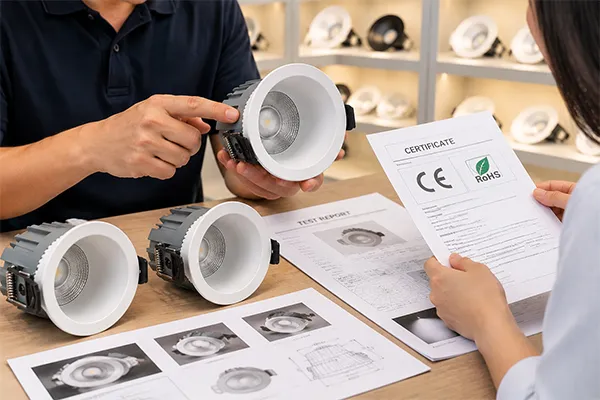
Buyers frequently ask for CE and RoHS documentation when sourcing from China.10 These documents can be important, but responsible procurement requires more than receiving a PDF file.
I recommend verifying:
- The legal entity named on the document
- The product model or model series covered
- The report date and document validity where applicable
- The standards or directives referenced
- Whether the quoted configuration matches the documented model
- Whether the destination market has additional requirements
- Whether labeling, technical files, declarations, or local importer obligations apply
At Upward Lighting, our products hold certifications such as CE and RoHS. However, I always encourage buyers to review whether the provided documents apply to the specific LED downlight model, destination market, and configuration they plan to import. A buyer may also need qualified regulatory or testing guidance for application-specific decisions.11
Lock the Approved Sample Into the Purchase Process
A sample becomes more valuable when it is used as a reference for future production. Buyers can reduce ambiguity by documenting the approved configuration in the purchase order.
The purchase order should clearly state:
- Model number and product photos where useful
- Wattage and voltage
- Color temperature and allowed tolerance expectations
- CRI requirement
- Beam angle
- Housing and trim finish
- Cutout size and key dimensions
- Driver and dimming requirements
- Packaging details
- Labels and carton markings
- Required documents
- Inspection requirements
- Agreed lead time and shipment terms
For larger or higher-risk orders, buyers may consider a qualified third-party inspection before shipment.12 The inspection scope should be agreed in advance and should focus on the requirements that matter to your channel.
Which Supply Terms Matter Most When Choosing LED Downlight Manufacturers?
A product can pass a sample review and still create difficulties if the commercial process is unclear. Wholesale distribution depends on predictable ordering, accurate documentation, workable MOQs, stable communication, and an agreed approach to product changes or claims.
The best LED downlight manufacturers for distribution are usually those that can explain their commercial boundaries clearly. I recommend treating quotation speed, small-batch support, OEM/ODM options, lead times, and after-sales terms as supply-performance factors that must be confirmed before placing a larger order.
Ask About the Repeat Order, Not Only the First Order
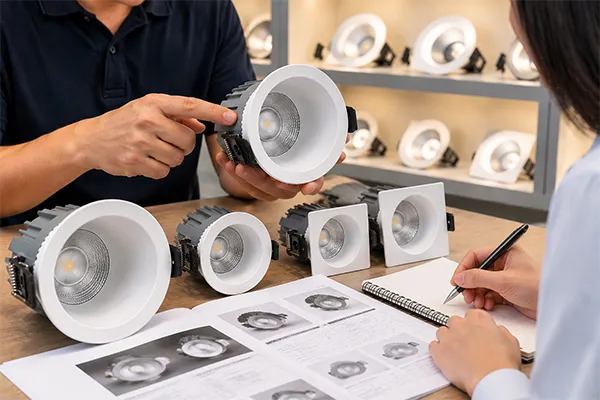
The first order is often a test. The repeat order is where a distributor learns whether the manufacturer can support a real channel partnership.
I suggest asking these questions early:
- What is the MOQ for standard models and customized models?
- Does the MOQ change for custom CCT, CRI, finish, packaging, or branding?
- What is the estimated lead time for samples, trial orders, and repeat orders?
- How will the supplier notify the buyer about component or design changes?
- Can the supplier maintain the same product specification for future orders?
- What happens if a component becomes unavailable?
- Can the supplier support mixed models in one order?
- What export packaging and shipping documents can be provided?
- What is the process for handling verified quality claims?
- Who will respond to technical questions after delivery?
A supplier that answers these questions directly may be more useful than one that simply promises “no problem.” In distribution, clear limits are often safer than broad promises.
Assess OEM and ODM Capability Carefully
OEM and ODM services can help wholesalers and local brands build a more distinctive product range. However, customization should be evaluated according to its commercial value.
At Upward Lighting, we can customize color temperature, wattage, beam angle, CRI, and surface finish colors. We also support OEM/ODM requirements and small-batch orders. For buyers, the important next step is to determine whether each customization supports a real sales opportunity.
For example:
- A black finish may strengthen a premium retail or hospitality range.
- A specific 3000K or 4000K option may align with local project preferences.
- A high-CRI version may fit showrooms, residential upgrades, or selected commercial applications.
- Private-label packaging may improve local brand recognition.
- A custom wattage may help a buyer create a clearer product ladder.
However, every customization can affect MOQ, cost, lead time, inventory planning, and reorder complexity. I recommend starting with the customization that most directly supports your market positioning rather than changing every possible feature at once.
Create a Supplier-Onboarding Plan
A disciplined onboarding process can reduce surprises. I use the following phased approach when discussing long-term wholesale cooperation:
| Stage | Buyer Action | Main Purpose |
|---|---|---|
| 1. Requirements | Issue a clear specification and market brief | Ensure meaningful quotations |
| 2. Supplier screening | Compare communication, documents, product fit, and commercial terms | Shortlist suitable suppliers |
| 3. Sample review | Test physical, functional, visual, and packaging requirements | Verify product suitability |
| 4. Trial order | Place a controlled first order | Assess actual execution |
| 5. Shipment review | Check documents, packaging, inspection results, and delivery coordination | Confirm supply performance |
| 6. Market feedback | Gather installer and customer feedback | Identify improvements before scaling |
| 7. Repeat-order agreement | Lock core specifications and replenishment process | Support stable resale |
This method gives both parties a chance to build confidence based on evidence. It also helps the buyer avoid making a large inventory commitment before the supplier relationship has been tested.
Frequently Asked Questions
How do I find reliable LED downlight manufacturers in China?
I recommend starting with suppliers that match your target market and product category, then verifying their quoted model, communication quality, samples, documents, quality-control process, MOQ, and repeat-order terms. Do not rely only on factory photos, marketplace badges, or a low initial quotation.
What should wholesalers ask LED downlight manufacturers before ordering?
Wholesalers should ask about model specifications, cutout size, wattage, lumen output, CCT, CRI, beam angle, driver type, dimming compatibility, packaging, MOQ, lead time, quality checks, compliance documents, and after-sales procedures. Each answer should relate to the exact model being quoted.
Are CE and RoHS documents enough to import LED downlights?
CE and RoHS documents may be relevant, but they are not automatically sufficient for every product configuration or destination market. Buyers should verify that documents apply to the specific model and should confirm local regulatory, labeling, importer, and testing obligations with qualified professionals where necessary.
Why is the lowest LED downlight price not always the best choice?
The lowest price may exclude important product features, quality controls, packaging protection, documentation, or service support. A cheaper product can reduce wholesale margin if it causes returns, installation complaints, delays, customer discounts, or difficult replenishment.
Can I order customized LED downlights in small quantities?
Some manufacturers support small-batch orders and selected OEM/ODM customization, but feasibility depends on the requested changes. Custom color temperature, wattage, CRI, finish, packaging, or branding can affect MOQ, cost, production time, and future reorder planning.
Conclusion
Finding LED downlight manufacturers for wholesale distribution requires more than collecting catalogs and comparing unit prices. I recommend beginning with your market requirements, verifying supplier capability through model-specific evidence, testing samples carefully, reviewing relevant documents, and evaluating repeat-order performance. The right manufacturing partner should support stable specifications, practical communication, appropriate customization, and channel-safe supply terms. If you are building or expanding an LED downlight range, contact Upward Lighting to discuss your target specifications, OEM/ODM needs, and wholesale sourcing requirements.
"Mains electricity by country", https://en.wikipedia.org/wiki/Mains_electricity_by_country. European Commission guidance explains that electrical equipment placed on the EU market must meet applicable conformity and information requirements; electrical supply and plug conventions also vary internationally, so destination-market requirements must be checked. Evidence role: general_support; source type: government. Supports: That electrical-product conformity, labeling, and market-access requirements are jurisdiction-specific, with national differences in supply voltage and plug systems.. Scope note: The source establishes the general principle and does not determine requirements for every individual importing country or downlight configuration. ↩
"2024 Lighting Design Guidelines", https://www.codot.gov/safety/traffic-safety/assets/documents/cdot-lighting-design-guideline.pdf. International lighting guidance identifies illuminance, luminous-intensity distribution, glare limitation, and luminaire selection as interrelated factors in designing lighting for particular interior applications. Evidence role: general_support; source type: institution. Supports: That lighting applications require consideration of illuminance, beam distribution, glare limitation, and luminaire characteristics.. Scope note: This supports the design principle generally; it does not prescribe a single downlight specification for every application. ↩
"Solid-state lighting metrology", https://www.nist.gov/programs-projects/solid-state-lighting-metrology. U.S. Department of Energy LED guidance describes color consistency as a significant product-quality consideration because perceptible differences in chromaticity or correlated color temperature can be noticeable among luminaires in an installation. Evidence role: mechanism; source type: government. Supports: That visible color variation among LED products can occur and that color consistency is a relevant quality attribute in lighting installations.. Scope note: The source supports the relevance of color consistency, not a direct causal estimate of repeat sales or customer satisfaction. ↩
"Background and Guidance for Using the ANSI/IES TM-30 ...", https://www.energy.gov/sites/default/files/2022-04/ssl-royer-leukos-tm-30-tutorial-2022.pdf. CIE technical material explains that colour-rendering metrics characterize the fidelity of object colours under a light source, making colour quality relevant in settings where merchandise, materials, or interiors are visually assessed. Evidence role: mechanism; source type: institution. Supports: That color-rendering measures describe how a light source affects the appearance of colored objects and are relevant where visual appraisal is important.. Scope note: This does not establish that a higher CRI alone makes a product premium or guarantees better commercial performance in every retail or hospitality setting. ↩
"NIST releases the finalized C-SCRM Due Diligence ...", https://www.nist.gov/news-events/news/2026/07/nist-releases-finalized-c-scrm-due-diligence-assessment-quick-start-guide. ISO quality-management guidance treats supplier evaluation, selection, monitoring, and re-evaluation as evidence-based processes, indicating that initial representations alone do not demonstrate continuing supply performance. Evidence role: expert_consensus; source type: institution. Supports: That supplier evaluation should use criteria and ongoing performance monitoring rather than relying only on supplier assertions or initial qualification evidence.. Scope note: The framework is general to supplier management and does not specifically test LED-downlight factories. ↩
"Life-cycle costing as a tool in mainstreaming green public ...", https://www.oecd.org/en/publications/life-cycle-costing-in-public-procurement-in-hungary_8d90f627-en/full-report/component-5.html. OECD procurement guidance describes total cost of ownership and life-cycle costing as approaches that consider relevant costs beyond initial acquisition price when evaluating value. Evidence role: general_support; source type: institution. Supports: That procurement decisions may account for costs beyond the initial purchase price, including operating, maintenance, risk, and end-of-life costs.. Scope note: The framework does not quantify the total cost of a particular downlight or distributor channel. ↩
"Cost Containment Review Will Save Money, Provide ...", https://www.nist.gov/blogs/manufacturing-innovation-blog/cost-containment-review-will-save-money-provide-supply-chain. Quality-management literature on the cost of poor quality identifies failure-related costs such as returns, warranty work, complaint handling, rework, and lost customer goodwill, which can exceed apparent savings from lower-cost inputs. Evidence role: mechanism; source type: research. Supports: That defects, rework, warranty claims, returns, and service failures create costs beyond the original purchase price.. Scope note: The relative size of these costs depends on the distributor, product, contract terms, and actual failure rate. ↩
"ENERGY STAR Lamps V2.1 Final Specification", https://www.energystar.gov/sites/default/files/ENERGY%20STAR%20Lamps%20V2.1%20Final%20Specification.pdf. U.S. energy-efficiency specifications evaluate LED lighting with multiple performance criteria—including light output, efficacy, color quality, and electrical characteristics—showing that identical nominal wattage does not establish equivalent luminaire performance. Evidence role: definition; source type: government. Supports: That LED-luminaire evaluation requires multiple attributes, such as light output, efficacy, color characteristics, electrical performance, and physical or environmental ratings, rather than wattage alone.. Scope note: Such specifications do not assess every listed commercial attribute, such as packaging quality or claims handling. ↩
"6.2.1. What is Acceptance Sampling?", https://www.itl.nist.gov/div898/handbook/pmc/section2/pmc21.htm. Acceptance-sampling standards describe sampling as a statistical method for making decisions about a defined lot, rather than as proof that every unit in subsequent production will conform to an approved sample. Evidence role: mechanism; source type: institution. Supports: That sampling inspection draws inferences about a lot under defined procedures but does not constitute inspection or proof of every future production unit.. Scope note: The source addresses statistical inspection generally and does not measure the future consistency of a specific manufacturer. ↩
"RoHS", https://en.wikipedia.org/wiki/RoHS. European Commission and EUR-Lex materials explain that CE marking is required where applicable EU harmonisation legislation covers a product, while Directive 2011/65/EU (RoHS) restricts specified hazardous substances in electrical and electronic equipment. Evidence role: historical_context; source type: government. Supports: That CE marking may apply to products covered by relevant EU harmonisation legislation and that the RoHS Directive restricts specified hazardous substances in electrical and electronic equipment.. Scope note: Applicability depends on the product, its configuration, and the market in which it is placed; a document alone does not establish compliance. ↩
"A guide to EU standards and conformity assessment", https://www.govinfo.gov/content/pkg/GOVPUB-C13-07a06d81c863b5241d6249891a51fb90/pdf/GOVPUB-C13-07a06d81c863b5241d6249891a51fb90.pdf. International conformity-assessment guidance explains that demonstrating product conformity involves applying the relevant requirements and evidence procedures, which may include competent testing, certification, or technical assessment depending on the applicable scheme. Evidence role: expert_consensus; source type: institution. Supports: That conformity assessment requires identification of applicable requirements, technical documentation, and—in some cases—testing or assessment by qualified bodies.. Scope note: The necessary route varies by jurisdiction, product category, and applicable legislation. ↩
"Pre-shipment inspection", https://en.wikipedia.org/wiki/Pre-shipment_inspection. Inspection practice based on recognized sampling procedures can provide evidence that a defined shipment was checked against agreed criteria before release, helping buyers identify nonconformities at that stage. Evidence role: general_support; source type: institution. Supports: That independent inspection can assess a specified lot against defined acceptance criteria before shipment.. Scope note: A pre-shipment inspection is limited to its stated scope, sampling plan, and inspection time and cannot guarantee future product reliability or every unit’s conformity. ↩