
A China LED downlight factory can look competitive on a quotation sheet, yet buyers often discover the real difference only after samples, production changes, shipment schedules, or repeat orders are involved. A low initial price may create expensive problems when specifications are unclear or delivery slips. In my experience, predictable execution is the better measure of competitiveness.
A competitive China LED downlight factory combines suitable pricing with disciplined requirement confirmation, repeatable quality controls, relevant documentation, responsive communication, and realistic delivery coordination. Buyers should evaluate total procurement risk—not just unit cost—by checking whether the supplier can carry approved specifications consistently from quotation and sample stages through mass production, shipment, and future reorders.
When I speak with importers, contractors, and lighting brands, I hear a similar concern: they do not simply need a downlight supplier. They need a partner that reduces the risk of receiving products that are unsuitable, inconsistent, delayed, or difficult to reorder. The sections below explain what buyers should examine before selecting a factory.
How Should Buyers Evaluate a China LED Downlight Factory Beyond Unit Price?
Many buyers begin with a familiar problem: several suppliers quote similar LED downlight models, but the prices vary widely. The lowest quote may seem like an easy choice. However, unclear product scope, unstable component sourcing, or missed delivery dates can quickly turn an apparent saving into a costly procurement issue.
A China LED downlight factory should be evaluated through total procurement value rather than the lowest ex-works price1. Buyers should compare product consistency, confirmed specifications, documentation accuracy, sample-to-production alignment, packaging, delivery reliability, communication quality, and the supplier’s ability to support repeat orders under similar agreed conditions.
The difference between price and procurement cost
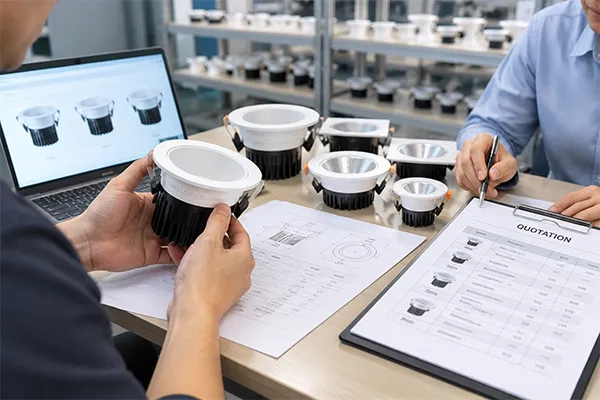
I have seen quotation comparisons where two products appeared identical because both were described as “LED downlight, 12W, 4000K.”2 In practice, that description leaves many important details unresolved. It may not state the cutout size, driver configuration, color tolerance expectation, housing finish, beam angle, input voltage, packaging requirements, or the basis for certification documentation.
A lower unit price can be valid if the product scope is genuinely the same. However, buyers should not assume equivalence based on wattage and diameter alone.
I recommend evaluating quotations through a wider cost lens:
- Product suitability: Does the model match the intended installation, ceiling cutout, voltage, lighting layout, and visual requirements?
- Specification clarity: Are wattage, CCT, CRI3, beam angle, trim color, driver type, and dimensions listed clearly?
- Sample consistency: Can the approved sample be used as a practical reference for mass production?
- Quality-control process: Does the factory explain its inspection steps before shipment?
- Delivery risk: Are lead times based on real material availability and production capacity?
- Reorder continuity: Can the supplier maintain the agreed version when the buyer places a follow-up order?
- After-sales exposure: If there is a problem, does the supplier provide traceable information and a workable response process?
In my own quotation work, I find that a clear specification sheet often prevents more problems than a small reduction in the unit price.
A practical quotation comparison table
| Evaluation area | Questions buyers should ask | Why it matters |
|---|---|---|
| Product configuration | What LED source, driver type, wattage, CCT, CRI, and beam angle are quoted? | A model name alone rarely defines a complete product. |
| Physical dimensions | What are the outer diameter, height, and cutout dimensions? | Installation compatibility can affect project acceptance.4 |
| Finish and appearance | Is the trim white, black, silver, or another agreed finish? | Visual inconsistency can create site-level complaints. |
| Packaging | How many pieces per carton? Is custom labeling required? | Packaging affects handling, branding, and import operations. |
| Lead time | Is the delivery date based on current material availability? | A fast promise is not useful if it cannot be met. |
| Documentation | What product documents and certification records are available for review? | Buyers need to assess suitability for their target market. |
A competitive supplier does not need to claim that it is the cheapest supplier in every case. Instead, it should help the buyer understand exactly what is included, what needs confirmation, and where project-specific verification is still necessary.
Why Does OEM and ODM Execution Define a Competitive China LED Downlight Factory?
Customization is attractive because lighting buyers often need a product that fits their brand, local market, or project specifications. Yet customization can become a problem when requirements are discussed loosely and interpreted differently by sales staff, purchasing teams, and production personnel. The risk increases when a buyer assumes a factory will “understand” without written confirmation.
A competitive China LED downlight factory treats OEM and ODM work as a controlled execution process. The factory should confirm specifications in writing, align samples with production requirements, identify changes before manufacturing begins, and coordinate materials and production around the approved configuration rather than relying on informal verbal descriptions.
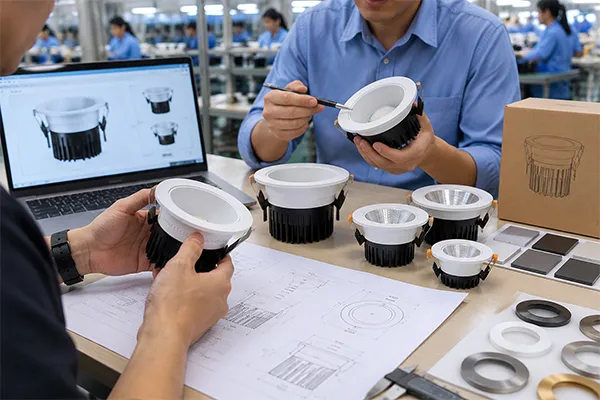
Customization means more than adding a logo
In the LED downlight business, buyers may request different color temperatures, wattages, beam angles, CRI levels, surface finishes, labels, packaging, or product markings. Some requirements are straightforward. Others affect material selection, component availability, production timing, or inspection criteria.
At Upward Lighting, we regularly discuss options such as:
- Color temperature: for example, warm white, neutral white, or cool white configurations5
- Wattage: based on product positioning and application needs
- Beam angle: depending on whether buyers need wider ambient illumination or more focused light distribution
- CRI: based on the buyer’s requested product specification
- Surface finish: such as white, black, or other requested trim colors
- Branding and packaging: including labels, cartons, manuals, and product identification
However, I do not consider a factory “strong in OEM” simply because it says yes to these requests. The more meaningful question is whether the factory can document them accurately and repeat them consistently.
What buyers should confirm before production
A good requirement-confirmation process should create a shared reference point. In my experience, this is especially important for small-batch orders and new customer projects, where there may be less historical ordering data.
Before mass production, buyers should ask for confirmation of:
-
Product model and appearance
Confirm the housing style, trim shape, finish color, dimensions, and ceiling cutout requirement. -
Electrical and optical specifications
Confirm the requested wattage, CCT, CRI, beam angle, input requirements, and any project-specific parameters. -
Sample status
Clarify whether the sample is approved, what changes were made after sampling, and which version will be produced. -
Packaging and markings
Confirm inner boxes, master cartons, labels, barcode needs, logo placement, and shipping marks. -
Documentation needs
Agree on the documents the buyer expects to review, such as specification sheets, packing lists, and applicable certification records. -
Change-control process
Establish how the factory will notify the buyer if a material, component, or production detail needs adjustment.
Sample-to-production consistency is the real test
I have learned that a sample is useful only when both sides define what it represents. A buyer may approve a sample for appearance but still need written confirmation of the final production specifications. A supplier may have a standard configuration in mind while the buyer expects a modified version.
For this reason, buyers should avoid relying on photos alone. They should connect the approved sample, quotation, purchase order, and final specification sheet. This does not eliminate all risk, but it makes misunderstandings easier to identify before goods are assembled and packed.
How Do Quality Controls Affect China LED Downlight Factory Selection?
Buyers often worry about defects because lighting products can create expensive downstream issues. A failed inspection, a customer complaint, or an installation mismatch can affect a distributor’s reputation and a contractor’s project schedule. At the same time, buyers should be careful about broad claims that any single quality-control step guarantees lifetime performance.
A reliable China LED downlight factory should explain its quality-control procedures clearly and present them as part of a broader manufacturing process. For example, a 100% aging test is a useful control step before shipment6, but buyers should still validate samples, specifications, documentation, and product suitability for their own application.
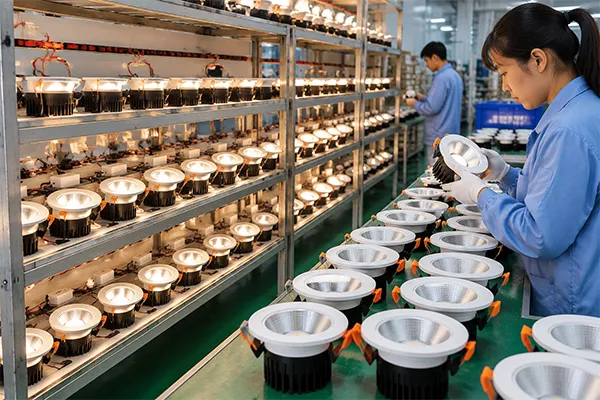
What a 100% aging test can—and cannot—show
At Upward Lighting, every product undergoes a 100% aging test lasting between four and eight hours before shipment. In our process, this step helps us identify certain visible operating issues before products are packed and dispatched. It is a concrete part of our shipment-preparation routine.
However, I believe buyers deserve a balanced explanation. An aging test should not be described as conclusive proof of zero defects, universal reliability, or lifetime performance under every installation condition. Product outcomes can also depend on installation methods, electrical environments, ventilation, application conditions, transport handling7, and whether the selected product is suitable for the intended project.
Buyers should view aging tests as one layer of quality assurance—not as the entire quality system.
Quality questions worth asking suppliers
A serious supplier should be able to discuss its process in specific operational terms. Buyers can ask questions such as:
- When does the factory inspect incoming materials?
- What checks occur during assembly?
- Does every finished unit receive an aging test?
- How long is the aging period for the quoted product?
- What does the factory do when a product does not pass a pre-shipment check?
- Are product labels, carton marks, and quantities checked before shipment?
- Can the factory provide photos or records from production and packing when agreed?
- How does the factory link the final production batch to the buyer’s confirmed requirements?
Quality control should match the buyer’s risk level
Different buyers have different exposure. A trader purchasing a standard stock item may prioritize straightforward inspection and quick replenishment. A lighting brand may need more detailed control over appearance, brand labels, packaging, and reorder consistency. A contractor may focus heavily on installation dimensions, delivery timing, and the match between approved sample and site requirement.
| Buyer type | Common quality concern | Useful supplier evidence |
|---|---|---|
| Importer | Repeatability across containers | Approved sample reference, specifications, production photos |
| Lighting brand | Product identity and presentation | Branding confirmation, packaging layout, finish sample |
| Contractor | Installation fit and delivery schedule | Dimensions, cutout details, sample approval, lead-time plan |
| Distributor | Low complaint risk and reorder continuity | Stable model documentation, inspection process, responsive support |
| Wholesaler | Price-to-quality balance | Clear configuration comparison and packaging details |
In my view, qualified buyer-side evaluation remains essential. Buyers should inspect samples, verify critical specifications, and use third-party inspection or professional technical review when the project, regulation, or application requires it.
Are Certifications Enough When Choosing a China LED Downlight Factory?
Certification logos can create confidence, but they can also create confusion when buyers assume they apply automatically to every product, destination, or installation. A document may support market-entry assessment, yet the buyer still needs to confirm that the specific product configuration, documentation, and local project requirements match.
A China LED downlight factory becomes more credible when it provides relevant certification information for buyer review and avoids overstating what documents prove. CE and RoHS documentation can support applicable market-entry and environmental requirements8, but buyers should verify product scope, document validity, target-market expectations, and project-specific compliance needs independently.
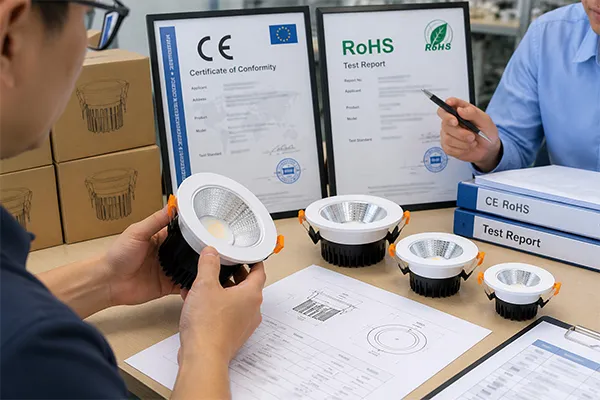
Certification documents require product-level checks
At Upward Lighting, our products hold certifications such as CE and RoHS. These documents are important to many customers because they are often part of the evaluation process for major global markets. Still, I always encourage buyers to check the documents carefully rather than relying only on a logo printed on a catalog or product image.
A buyer should verify:
- Whether the document identifies the relevant product or product family
- Whether the quoted model and configuration fall within the document scope
- Whether the document is current and issued by an appropriate organization
- Whether the buyer’s destination market has additional requirements
- Whether the project specification calls for particular test reports or declarations
- Whether labels, manuals, markings, and electrical details match the supplied product
CE and RoHS are not universal project approval9
CE and RoHS should not be presented as automatic approval for every country, building project, electrical system, or application. Requirements can vary by destination, channel, customer, installation type, and project tender.
For example, a local contractor may need to satisfy a building consultant’s specified documentation process. A distributor may need country-specific labeling. A brand owner may require document review before private-label production starts. These are commercial and compliance-management questions that should be addressed before shipment, not after goods arrive.
I recommend that buyers involve qualified compliance, technical, or legal professionals when product use, local regulations, or tender requirements create uncertainty.
Documentation discipline supports long-term supplier relationships
Documentation is not only a compliance issue. It also supports reorder accuracy. If a buyer can trace the agreed model, version, packaging, and relevant documents, both parties can reduce confusion when the next purchase order arrives months later.
A competitive factory should make documentation part of its commercial discipline. It should not hide behind vague statements such as “standard quality” or “same as sample.” Clear documents create a stronger foundation for repeat business.
Can Fast Quotations and Flexible Orders Improve Procurement Results?
Slow replies can cause buyers to miss opportunities, especially when a contractor needs pricing for a tender or a distributor needs to replenish stock. However, speed alone is not enough. A fast quote that omits important assumptions can create more work later, while an unrealistic delivery promise can damage project planning.
A competitive China LED downlight factory combines quick communication with accurate requirement review, practical small-batch support, supply-chain coordination, and realistic delivery commitments. The goal is not merely to send the first quote quickly; it is to help buyers move from inquiry to confirmed order with fewer avoidable gaps.

Fast response should improve decision quality
At Upward Lighting, we place value on rapid customer responses and quick quotation turnaround. Our customers often need answers on model availability, pricing, customization options, packaging, and lead-time expectations. We also support small-batch orders where the product configuration and supply situation allow.
Still, I believe fast communication works best when it follows a structured process:
- Receive the inquiry and identify missing details.
- Confirm the desired product configuration.
- Check material availability and production implications.
- Prepare a quotation with clear commercial assumptions.
- Confirm samples, artwork, and specifications before production.
- Coordinate production, aging tests, packing, and shipment preparation.
This process may appear simple, but each step reduces a specific procurement risk.
Delivery reliability depends on coordination
Delivery performance depends on more than factory floor capacity.10 It can involve components, driver availability, custom finishes, packaging materials, production scheduling, inspections, shipping bookings, and export documentation. A supplier that promises a very short lead time without checking these factors may create a later delay.
Buyers should ask suppliers to distinguish between:
- Standard product lead times
- Customized product lead times
- Sample lead times
- Lead times during peak production periods
- Time required for packaging artwork or custom labels
- Estimated shipping and export-document preparation timelines
In my experience, transparent lead-time communication is more useful than aggressive promises. Buyers can plan inventory and projects more effectively when a supplier explains the conditions behind the schedule.
Frequently Asked Questions
What should I ask a China LED downlight factory before placing an order?
I recommend asking for a detailed specification sheet, product dimensions, cutout size, wattage, CCT, CRI, beam angle, packaging details, sample process, lead time, available documentation, and quality-control steps. You should also confirm how the factory handles changes between sample approval and mass production.
Does the lowest LED downlight price offer the best value?
Not necessarily. The lowest price may reflect a different configuration, less detailed packaging, limited documentation, or assumptions that are not visible in the initial quote. Buyers should compare total procurement risk, including quality consistency, delivery reliability, reorder support, and potential after-sales exposure.
Are CE and RoHS documents enough for every lighting project?
No. CE and RoHS documentation may support market-entry and environmental assessments, but buyers should verify that documents match the quoted product and target market. Local regulations, project specifications, labeling rules, and installation requirements may require additional review by qualified professionals.
What does a 100% aging test mean for LED downlights?
A 100% aging test means every unit is operated for a defined period before shipment11 as part of the factory’s quality-control process. It can help identify certain issues before packing. However, it does not guarantee zero defects or prove performance in every installation environment.
Can a factory support small-batch OEM LED downlight orders?
Some factories can support small-batch orders, but buyers should confirm minimum order quantities, customization limits, material availability, packaging needs, and lead times. Small orders may have different pricing or production conditions than standard-volume orders12, especially when custom components or branding are involved.
Conclusion
A competitive China LED downlight factory is not defined by low pricing, a fast reply, a large facility, or a certificate logo alone. In my experience, real competitiveness comes from disciplined execution: clear requirement confirmation, sample-to-production consistency, meaningful quality-control steps, accurate documentation, realistic delivery coordination, and dependable reorder support. If you are sourcing LED downlights for distribution, projects, or private-label sales, contact Upward Lighting to discuss your specifications, OEM/ODM needs, small-batch requirements, and documentation expectations.
"Total cost of ownership factors in procurement and ...", https://ui.adsabs.harvard.edu/abs/2024E3SWC.48401022P/abstract. Supplier-selection research describes total-cost approaches as evaluating purchasing decisions beyond initial price, including costs and risks associated with quality, delivery, and subsequent operations. Evidence role: general_support; source type: research. Supports: Total-cost or total-cost-of-ownership approaches assess acquisition price alongside quality, delivery, lifecycle, and other downstream costs in supplier decisions.. Scope note: The framework supports the procurement principle generally; it does not establish the relative importance of each factor for a particular LED downlight order. ↩
"Lighting Specification Guidance for Schools", https://www.energy.gov/sites/default/files/2024-12/lighting-spec-guidance-school_nov24.pdf. Lighting guidance identifies LED luminaires through multiple photometric, electrical, colour, and physical characteristics; wattage and correlated colour temperature alone do not describe complete product performance or fit. Evidence role: definition; source type: government. Supports: Technical evaluation of LED luminaires uses multiple characteristics, such as light output, efficacy, colour properties, distribution, electrical requirements, and physical form.. Scope note: The exact set of required fields depends on the application, jurisdiction, and purchaser's specification. ↩
"Purchasing Energy-Efficient Light Bulbs", https://www.energy.gov/cmei/femp/purchasing-energy-efficient-light-bulbs. Technical lighting guidance defines the colour rendering index (CRI) as a measure of how faithfully a light source renders test colours compared with a reference source of similar colour temperature. Evidence role: definition; source type: government. Supports: CRI is a standardized metric used to describe aspects of how a light source renders object colours relative to a reference illuminant.. Scope note: CRI has recognized limitations and does not by itself characterize every aspect of colour preference or colour quality. ↩
"November 20, 2008", https://www4.wou.edu/php/get_blob_orpu.php?vfileid=5242. Luminaire installation guidance requires conformance with specified mounting dimensions and installation instructions, so incompatible cutout or fixture dimensions can prevent correct installation. Evidence role: general_support; source type: institution. Supports: Recessed luminaires must be selected and installed according to their specified mounting opening, dimensions, clearances, and installation instructions.. Scope note: Project acceptance may additionally depend on design approval, electrical rules, and contractual requirements. ↩
"Understanding LED Color-Tunable Products", https://www.energy.gov/cmei/ssl/understanding-led-color-tunable-products. Lighting guidance explains that correlated colour temperature characterizes the apparent warmth or coolness of white light: lower colour temperatures appear warmer, while higher colour temperatures appear cooler. Evidence role: definition; source type: government. Supports: White-light appearance is commonly described by correlated colour temperature, with lower values perceived as warmer and higher values as cooler.. Scope note: Terms such as “neutral white” do not have a single universal numerical boundary across all markets or product catalogues. ↩
"Reliability technology for cardiac pacemakers III", http://nvlpubs.nist.gov/nistpubs/Legacy/SP/nbsspecialpublication400-50.pdf. Reliability literature describes burn-in as a screening procedure that can expose certain early-life failures under defined operating conditions before release or shipment. Evidence role: mechanism; source type: paper. Supports: Burn-in or aging operation can be used to screen for some early-life or immediately observable failures before products are released.. Scope note: Burn-in results do not demonstrate zero defects, lifetime reliability, or performance under every field installation condition. ↩
"LED Luminaire Reliability: Impact of Color Shift", https://www.energy.gov/sites/prod/files/2017/04/f34/lsrc_colorshift_apr2017.pdf. LED reliability research identifies thermal conditions, electrical stress, and environmental exposure as factors that can influence degradation and failure mechanisms in LED lighting systems. Evidence role: mechanism; source type: research. Supports: Temperature, electrical stress, environmental exposure, and installation-related thermal conditions influence LED and driver degradation or failure risk.. Scope note: The effect and magnitude of each factor vary by luminaire design, driver, operating profile, and installation environment. ↩
"RoHS Directive - Environment - European Commission", https://environment.ec.europa.eu/topics/waste-and-recycling/rohs-directive_en. European Commission guidance states that CE marking applies only to products covered by relevant EU harmonisation legislation, and the RoHS framework restricts specified hazardous substances in covered electrical and electronic equipment. Evidence role: historical_context; source type: government. Supports: CE marking is used for products covered by applicable EU harmonisation legislation, while RoHS restricts specified hazardous substances in covered electrical and electronic equipment.. Scope note: These frameworks do not by themselves confirm that a particular product configuration, documentation set, or installation satisfies all applicable national and project requirements. ↩
"CE marking – obtaining the certificate, EU requirements", https://europa.eu/youreurope/business/product-rules-compliance/general-product-compliance/ce-marking/index_en.htm. Official EU guidance explains that CE marking is a conformity indication for products within the scope of applicable EU legislation, rather than a universal quality mark or approval for all markets and uses. Evidence role: definition; source type: government. Supports: CE marking is not a general quality certificate or universal authorization, and its applicability depends on the relevant EU legislation and product scope.. Scope note: Additional obligations may arise under national law, sector-specific rules, contractual specifications, or installation standards. ↩
"What is Supply Chain Management? Components and ...", https://www.scu.edu/business/blog/business-concepts/what-is-supply-chain-management/. Supply-chain research characterizes delivery performance as the result of coordinated sourcing, production planning, inventory, logistics, and information flows, not factory capacity alone. Evidence role: mechanism; source type: research. Supports: Delivery reliability depends on coordination across sourcing, production planning, inventory, transport, and information processes rather than production capacity alone.. Scope note: The relative influence of these factors differs by product design, order size, supplier network, and transport route. ↩
"Burn-In - Integration and Test > Thermal Testing - S3VI - NASA", https://s3vi.ndc.nasa.gov/ssri-kb/topics/47/. Quality and reliability references define burn-in testing as operating units for a specified period under stated conditions to screen for certain early failures. Evidence role: definition; source type: institution. Supports: Burn-in or aging testing consists of operating products under specified conditions for a defined interval as a reliability-screening practice.. Scope note: Whether a test is truly “100%” is a factory-specific procedural fact that must be verified through that factory's records and process controls. ↩
"Economies of Size in Auto Body Manufacture", https://www.journals.uchicago.edu/doi/pdfplus/10.1086/466766. Economic and operations teaching materials explain that fixed setup and production costs are spread across more units at higher volumes, which can make small batches subject to different unit-cost conditions. Evidence role: mechanism; source type: education. Supports: Fixed setup, tooling, purchasing, and administrative costs can be spread over more units at larger production volumes, affecting unit economics and production conditions.. Scope note: Actual pricing also depends on materials, customization, capacity utilization, supplier strategy, and negotiated commercial terms. ↩