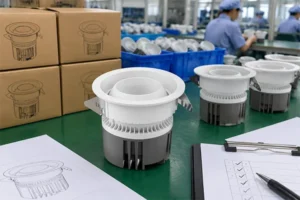

LED downlight factory audits matter because an approved sample can look excellent while later production batches vary in output, components, finish, or assembly control. For international buyers, that gap can lead to project delays, returns, and difficult supplier discussions. We see audits as a practical way to examine whether a supplier can repeat agreed specifications at scale.
A LED downlight factory audit helps international buyers verify whether a supplier’s real production controls, records, and shipment processes can consistently support approved product specifications.1 It should examine traceability across incoming materials, assembly, aging tests, inspection, and packing—not simply factory size, equipment appearance, or certificates. An audit does not guarantee quality, but it can reveal risks before purchasing volume increases.2

When we host overseas buyers at our Zhongshan lighting facility, we find that the most useful conversations rarely focus on showroom displays. Buyers usually gain more value when they follow one product configuration through the actual workflow: from specification confirmation to aging, inspection, packing, and shipment release.
Do LED Downlight Factory Audits Show Whether Quality Controls Are Real?
A supplier may present modern machines, clean work areas, and polished samples, yet buyers can still face inconsistent production later. That risk becomes serious when a project depends on uniform color temperature, reliable drivers, consistent beam angles, and on-time delivery. We recommend looking beyond appearances.
LED downlight factory audits can indicate whether quality controls are operating in daily production when buyers review how workers follow instructions, how inspections are recorded, and how nonconforming products are handled. Useful evidence connects the approved specification to production steps, aging-test records, quality checks, and shipment release documents.

A Factory Tour Is Not the Same as Process Verification
We understand why buyers notice factory scale first. A large workshop, automated equipment, and a well-organized showroom can signal investment. However, none of those points alone proves that a supplier produces stable LED downlights across every order batch.
During an audit, we suggest that buyers ask process-based questions rather than relying only on visual impressions:
- What production document tells workers which wattage, CCT, CRI, and beam angle to build?
- How does the team identify the correct driver, LED module, reflector, housing, and finish?
- Where are inspection requirements displayed or recorded?
- What happens when an item fails a functional or visual inspection?
- Can the supplier show records from a recent completed batch?
- How does the shipment team confirm that the packed product matches the purchase order?
These questions matter because each production stage can introduce a different risk. A wrong LED module can create color inconsistency.3 A substituted driver can affect electrical performance.4 An incorrect reflector can change the beam angle.5 A packing error can result in the right product being produced but the wrong configuration being shipped.
At Upward Lighting, we prepare production and quality documentation around the customer’s approved configuration. We also conduct a 100% aging test for 4 to 8 hours before shipment, depending on the product and order requirements.6 Buyers should still independently verify how any supplier defines, performs, and records its aging process.
| What buyers observe | What it may indicate | Buyer risk if not verified |
|---|---|---|
| Clean production line | Basic workplace organization | It does not confirm configuration control |
| New assembly equipment | Potential production capacity | It does not confirm inspection discipline |
| Approved sample room | Product development capability | It does not prove mass-production consistency |
| Inspection station | A stated QC process | It does not prove records are complete or used |
| Batch documents | Traceable process control | Documents should match actual products and dates |
A useful audit does not need to become an overly complex exercise. We believe it should simply help buyers answer a commercial question: Can this supplier repeatedly make and ship the product we approved?
How Do LED Downlight Factory Audits Verify Batch Traceability?
When a shipment has a problem, buyers need more than a general quality promise. They need to know which batch was affected, what configuration was produced, which components were used, and whether the issue may affect other cartons. Without traceability, root-cause discussions can become slow and uncertain.7
LED downlight factory audits should examine whether a supplier can link a finished product or shipment batch to its approved specifications, key materials, aging-test information, inspection records, and packing details. This traceability helps buyers investigate batch inconsistency and determine whether corrective action is specific, documented, and practical.

Traceability Connects Production Evidence
In our experience, traceability is one of the clearest signs that a manufacturing process is structured for repeatability. It does not mean that a supplier will never experience a defect. Instead, it means the supplier may be better positioned to identify what happened and contain the affected scope when an issue appears.
For LED downlights, buyers can ask to see how the following information is connected:
-
Order specification
This should identify the model, wattage, input requirements, CCT, CRI, beam angle, finish color, trim style, and other agreed details. -
Material or component identification
This may include the LED source, driver, housing, diffuser, reflector, cable, and packing materials. The depth of component traceability varies by product and supplier, so buyers should clarify what records are available. -
Production batch or date information
A batch code, work order, or production date can help connect physical goods to internal records. -
Aging-test record
Buyers should ask where aging occurs, how products are identified during the process, how failures are handled, and whether records can be related to a production batch. -
Quality-inspection record
This may include appearance, assembly, function, labeling, dimensions, or packing checks based on the agreed inspection criteria. -
Shipment release and carton markings
Buyers should verify whether carton labels, packing lists, and shipment records make it possible to identify the shipped configuration.
We recommend that buyers select one recent order or one current production batch and follow its paperwork through the production floor. This approach often provides more meaningful insight than reviewing generic quality manuals alone.
For example, if a buyer orders a 12W recessed LED downlight in 4000K, CRI 90, with a white trim and a 60-degree beam angle, the audit should help confirm that this precise combination is controlled. A record that only says “LED downlight” may not be enough for a customized product order.
Traceability also supports delivery-stage checks. A shipment can fail commercially even when the lamps themselves function correctly.8 Mixed CCT cartons, incorrect labels, missing installation accessories, or wrong finish colors can disrupt a contractor’s work schedule. Therefore, buyers should ask how the final packing team verifies order-specific requirements before containers or pallets are released.
Can LED Downlight Factory Audits Protect OEM and ODM Specifications?
OEM and ODM projects create more opportunities for product differentiation, but they also create more points where specifications can drift. A custom wattage, beam angle, surface finish, or branded package must move accurately from the quotation stage into purchasing, production, inspection, and shipment.
LED downlight factory audits can help buyers assess whether an OEM or ODM supplier has a controlled method for confirming custom requirements and communicating them to production. Buyers should verify how changes are approved, how revised specifications are identified, and how the supplier prevents outdated instructions from reaching the factory floor.

Customization Requires Change Control9
We regularly discuss customized requirements with lighting brands, importers, distributors, contractors, and project buyers. A buyer may request a specific CCT for a hospitality project, higher CRI for a retail application, a narrow beam for accent lighting, or a unique trim color for a local brand line.
Each request sounds straightforward on its own. However, a product becomes more complex when several variables change together.
A useful audit conversation can cover how the supplier manages:
| Custom requirement | Production-control question | Risk if control is weak |
|---|---|---|
| Wattage | How is the correct driver and LED configuration assigned? | Output or electrical mismatch |
| CCT | How are LED bins or specified light colors identified? | Visible color variation between units |
| CRI | How is the approved LED specification confirmed? | Product may not match the stated performance target |
| Beam angle | How is the correct reflector or lens selected? | Lighting distribution may differ from project design |
| Surface finish | How is finish color approved and checked? | Inconsistent appearance across installations |
| Private label packaging | How are artwork revisions and carton labels controlled? | Brand, labeling, or shipment errors |
At Upward Lighting, we support OEM/ODM customization for parameters including color temperature, wattage, beam angle, CRI, and surface finish. We believe buyers should document every approved configuration clearly before volume production begins. We also recommend that buyers confirm whether the supplier uses a revision number, signed approval record, sample reference, or other method to distinguish the final version from earlier discussions.
One of the most practical questions is: “If we change one specification after sample approval, how will you prevent the original version from being produced?”
The answer should include more than a verbal assurance. Buyers should look for a documented update path. For example, a revised specification should reach the quotation record, order confirmation, bill of materials where applicable, production instructions, inspection criteria, and packaging information.
We also suggest that buyers define what constitutes an acceptable variation before placing a project order. This can include finish appearance, carton markings, color-temperature tolerance, accessories, or branding placement. Application-specific requirements may require qualified technical evaluation, testing, or third-party inspection beyond a supplier audit.
What Should Buyers Check Before Approving a LED Downlight Shipment?
An audit can show how a factory operates, but buyers still need order-level verification before goods leave the supplier. This is especially important for first orders, new product configurations, large projects, and products entering markets with specific regulatory requirements.
LED downlight factory audits should be combined with product review, certification-document verification, pre-shipment inspection, and market-specific compliance checks.10 Before shipment approval, buyers should confirm that the finished batch matches the approved sample, purchase order, labels, packing requirements, and applicable documents for the intended market.

Audits Are One Layer of Supplier Evaluation
We never present a factory audit as a complete substitute for product testing or compliance review. An audit is valuable because it examines the system behind production. However, it does not independently establish that every individual lamp will perform perfectly in every installation or that every product configuration meets every market requirement.
For a balanced supplier-evaluation process, we recommend combining several checks:
- Sample evaluation: Confirm performance, appearance, installation method, dimensions, driver compatibility, and project suitability.
- Specification approval: Ensure that the purchase order and approved sample describe the same configuration.
- Factory audit: Review how the supplier manages production, traceability, aging, inspection, and shipment control.
- Certification review: Request relevant certificates and reports, then verify document validity, product coverage, issuing body, expiry dates where applicable, and market applicability.
- Pre-shipment inspection: Check the completed order against agreed quality levels, packing details, markings, quantities, and key product requirements.
- Market-specific review: Consult qualified professionals where local electrical, safety, energy-efficiency, installation, or labeling rules apply.
Our products hold CE and RoHS documentation for relevant product and market requirements. However, buyers should independently verify that the documents are valid and applicable to the exact product configuration and destination market. A certificate associated with one model, component set, or region should not automatically be treated as proof for every customized version.
Shipment Checks Should Relate to Buyer Risk
A buyer should tailor pre-shipment checks to the consequences of an error. A distributor launching a private-label product may focus heavily on packaging artwork, barcode accuracy, and finish consistency. A contractor may prioritize cutout dimensions, driver compatibility, delivery quantity, and installation accessories. A lighting brand may need close attention to CCT consistency, CRI documentation, photometric expectations, and long-term configuration stability.
Before shipment, we recommend confirming:
- The model number and product configuration
- The quantity and carton count
- The wattage, CCT, CRI, beam angle, and finish
- The product and carton labels
- The accessories and installation instructions
- The aging-test and inspection status
- The packing method and shipment marks
- The required documents for the destination market
In our own workflow, we conduct a 100% aging test before shipment and support inspection discussions based on the buyer’s requirements. Still, each buyer should decide what level of independent inspection is appropriate for the order value, application, and business risk.
Frequently Asked Questions
What is the main purpose of a LED downlight factory audit?
The main purpose of a LED downlight factory audit is to evaluate whether a supplier can consistently convert approved specifications into stable mass production. We recommend reviewing traceability, process controls, aging tests, inspection records, customization management, and shipment checks rather than focusing only on facility size.
Should buyers audit a supplier before placing a first LED downlight order?
We recommend an audit before a first substantial order, especially when the product is customized, intended for a project, or planned for private-label distribution. Smaller trial orders may still benefit from remote document review, sample testing, and pre-shipment inspection when an on-site audit is not practical.
Do CE and RoHS documents replace a factory audit?
No. CE and RoHS documents, where applicable, address different questions from a factory audit.11 Buyers should verify the validity and relevance of certification documents for the exact product and market. An audit examines production controls, while compliance documentation should be reviewed separately.
What records should buyers ask to see during LED downlight factory audits?
Buyers should ask to see order specifications, production instructions, batch identifiers, aging-test records, inspection records, nonconformance handling procedures, packing information, and shipment-release checks. We recommend following one actual batch through these records rather than reviewing only blank templates or general policy documents.
Can a factory audit guarantee that every LED downlight will be defect-free?
No factory audit can guarantee defect-free production or universal compliance.12 It can help buyers identify whether a supplier has visible, documented controls for reducing and managing risks. We recommend combining audits with approved samples, product testing, document verification, and appropriate pre-shipment inspection.
Conclusion
LED downlight factory audits matter because international buyers need evidence that a supplier can deliver more than an attractive sample or convincing quotation. We recommend focusing on traceability, specification control, aging-test practices, inspection records, and shipment-stage verification. A well-run audit should support better purchasing decisions, but it should work alongside sample evaluation, certification-document review, pre-shipment inspection, and application-specific professional advice. If you are sourcing customized LED downlights from China, we welcome the opportunity to discuss your specifications, audit requirements, and OEM/ODM project needs.
"Metrological Traceability: Frequently Asked Questions and ...", https://www.nist.gov/metrology/metrological-traceability. ISO auditing and quality-management guidance describes audits as systematic evaluations of documented processes and objective evidence used to assess whether operational controls are implemented and can support consistent conformity to specified requirements. Evidence role: general_support; source type: institution. Supports: Guidance on management-system auditing and quality management supports evaluating documented processes, operational controls, and objective evidence when assessing conformity and consistency.. Scope note: Such guidance supports the audit approach generally; it does not prove that any particular LED-downlight supplier will consistently meet specifications. ↩
"Yellow Book: Government Auditing Standards", https://www.gao.gov/yellowbook. Management-system audit guidance treats an audit as an evidence-based assessment that can identify nonconformities and risks, rather than as a guarantee of future product quality or universal compliance. Evidence role: expert_consensus; source type: institution. Supports: Audit standards characterize audits as evidence-based assessments and distinguish audit findings from guarantees of future performance or conformity.. Scope note: The principle applies broadly and does not quantify how effectively a particular audit predicts later defects. ↩
"Going beyond the 20th century color space to evaluate ...", https://pubmed.ncbi.nlm.nih.gov/38017966/. U.S. Department of Energy lighting guidance explains that variations in LED chromaticity and bin selection can produce perceptible color differences among nominally similar LED products. Evidence role: mechanism; source type: government. Supports: Technical lighting guidance explains that LED chromaticity variation and binning influence perceived color consistency among luminaires.. Scope note: The guidance establishes the mechanism; whether a wrong module causes a visible difference depends on the module specifications and the magnitude of the chromaticity change. ↩
"LED Basics", https://www.energy.gov/cmei/ssl/led-basics. Lighting technology guidance describes an LED driver as the component that converts and regulates electrical power for LEDs, so driver characteristics can affect a luminaire’s operating current, output, and electrical behavior. Evidence role: mechanism; source type: government. Supports: Authoritative lighting resources describe LED drivers as power-conversion and current-regulation components whose electrical characteristics affect LED-system operation.. Scope note: The specific effect of a substituted driver depends on compatibility with the LED load, dimming arrangement, and luminaire design. ↩
"Reflective Optics Design for an LED High Beam Headlamp of Motorbikes", https://pmc.ncbi.nlm.nih.gov/articles/PMC4414011/. Research on LED luminaire optics reports that reflector design shapes the angular light-intensity distribution and can therefore alter the resulting beam angle. Evidence role: mechanism; source type: paper. Supports: Optical-design research shows that reflector geometry and surface properties influence the angular distribution of light from LED luminaires.. Scope note: Actual beam-angle change depends on the reflector, LED source, lensing, and the complete optical assembly. ↩
"The Importance of Aging Testing for LED Lighting Fixtures", https://www.grinsafe.com/news/ensuring-quality-and-reliability-the-importance-of-aging-testing-for-led-lighting-fixtures/. Batch-level aging-test logs, work instructions, and traceable production records can document whether all units in a specified order underwent the stated four-to-eight-hour test before shipment. Evidence role: case_reference; source type: research. Supports: A primary factory record should substantiate the stated aging-test coverage, duration, product scope, and disposition of failures for the relevant shipment batch.. Scope note: General research on LED burn-in may explain screening practices but cannot independently verify this manufacturer-specific testing claim. ↩
"FSMA Final Rule on Requirements for Additional ...", https://www.fda.gov/food/food-safety-modernization-act-fsma/fsma-final-rule-requirements-additional-traceability-records-certain-foods. Manufacturing traceability guidance explains that records linking materials, production events, and finished products help organizations identify affected lots and investigate the source of quality problems. Evidence role: general_support; source type: government. Supports: Manufacturing traceability guidance supports linking products and materials to production records so affected scope can be identified during investigations and corrective action.. Scope note: Traceability improves the available evidence but does not by itself establish the root cause of a defect. ↩
"Packaging and Labeling Requirements FAQs", https://www.nist.gov/pml/owm/faqs/packaging-and-labeling-requirements-faqs. Quality-management guidance treats product identification, packaging, preservation, and delivery information as controlled requirements, meaning an otherwise functional product may still be nonconforming when the delivered configuration or accompanying materials are wrong. Evidence role: general_support; source type: institution. Supports: Quality-management requirements recognize identification, preservation, packaging, and delivery information as elements of conformity to customer requirements.. Scope note: Commercial consequences such as project delays vary by contract, market, and the nature of the shipment error. ↩
"configuration management - Glossary | CSRC", https://csrc.nist.gov/glossary/term/configuration_management. Quality-management and configuration-control guidance calls for planned, documented changes and control of current versus obsolete production information so that approved requirements are communicated consistently. Evidence role: expert_consensus; source type: institution. Supports: Quality and configuration-management guidance supports controlling changes and ensuring current approved information is available where production work is performed.. Scope note: These principles support the need for change control but do not prescribe one universal workflow for every OEM or ODM project. ↩
"Third-Party Programs to Assess Regulatory Compliance", https://www.acus.gov/sites/default/files/documents/Third-Party-Programs-Report_Final.pdf. European product-conformity guidance distinguishes production controls from product-specific conformity assessment, technical documentation, and applicable legal requirements, supporting the use of multiple forms of verification. Evidence role: general_support; source type: government. Supports: Conformity-assessment guidance distinguishes quality-system controls from product-specific technical documentation, testing, and regulatory obligations.. Scope note: The exact checks required depend on the product, destination market, and applicable legislation or contract terms. ↩
"CE marking", https://en.wikipedia.org/wiki/CE_marking. European Commission guidance states that CE marking is linked to demonstrating conformity with applicable EU requirements, while RoHS restricts specified hazardous substances in electrical and electronic equipment; these regulatory questions differ from an audit of manufacturing-process controls. Evidence role: definition; source type: government. Supports: Official EU guidance defines CE marking and RoHS-related conformity obligations as product and regulatory compliance matters, distinct from a supplier’s internal process audit.. Scope note: Whether CE marking or RoHS applies, and what documentation is sufficient, depends on the exact product, its intended use, and the market in which it is placed. ↩
"Sampling Methodologies | Comptroller's Handbook", https://www.occ.gov/publications-and-resources/publications/comptrollers-handbook/files/sampling-methodologies/pub-ch-sampling-methodologies.pdf. Audit guidance characterizes audits as limited examinations based on available evidence and sampling, so their findings cannot guarantee defect-free output or universal regulatory conformity across all products and circumstances. Evidence role: expert_consensus; source type: institution. Supports: Audit methodology recognizes that audits are time-bounded, evidence-based examinations and cannot provide absolute assurance regarding every product unit or every legal requirement.. Scope note: The degree of assurance depends on audit scope, sampling, auditor competence, product testing, and the regulatory review performed. ↩