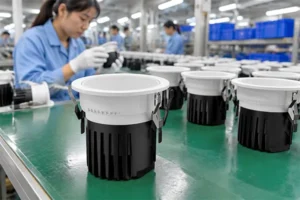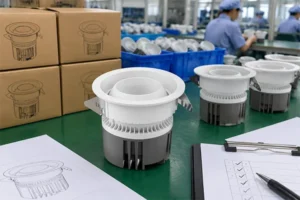

Chinese LED downlight manufacturers often face a cheap means risky reputation, which can make importers hesitant to compare suppliers seriously. That hesitation can also cause buyers to miss capable production partners with strong supply coordination. We believe the better solution is to evaluate total procurement value, not only the quoted unit price.
Importers often prefer Chinese LED downlight manufacturers because well-organized suppliers can combine competitive component sourcing, flexible production, OEM/ODM support, and export experience. However, we recommend that buyers verify batch quality controls, specification consistency, delivery planning, and certification relevance before placing a mass order. The lowest quote alone does not define the lowest procurement cost.1
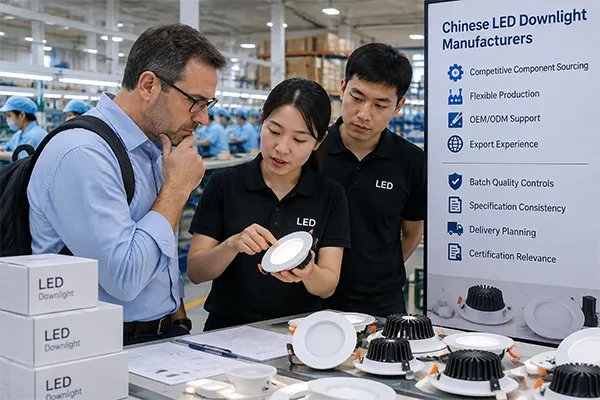
At Upward Lighting, our team handles inquiries, quotations, specification discussions, production coordination, quality checks, and delivery for international buyers. We have seen that the strongest sourcing decisions come from buyers who ask structured questions early, test supplier processes, and compare risks alongside prices.
Why Do Importers Choose Chinese LED Downlight Manufacturers?
Importers need margin, reliable replenishment, and products that fit their channel requirements. A low purchase price can look attractive, but delayed shipments, inconsistent specifications, or extensive rework can quickly reduce that advantage. We encourage buyers to assess the whole supply process before choosing a Chinese supplier.
Importers choose Chinese LED downlight manufacturers when a supplier can offer competitive total procurement costs, responsive communication, practical customization, and dependable production coordination. Supply-chain concentration can help suppliers source components and adjust production efficiently, but buyers should confirm these capabilities with documentation, samples, inspections, and clear order specifications.
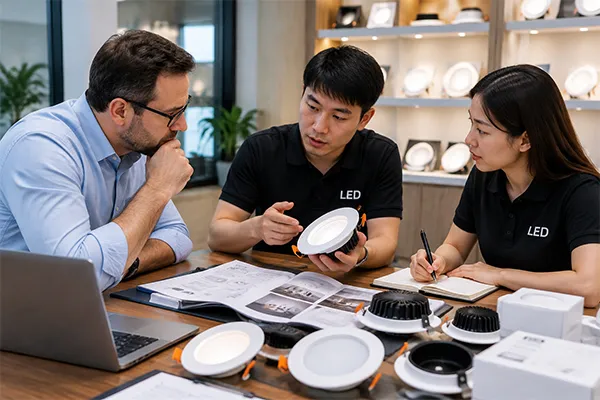
Total Cost Matters More Than Unit Price
When we receive a new inquiry, buyers often begin with a target price. That is understandable. Yet we find that the unit price is only one part of the commercial calculation.
A more useful measure is total procurement cost. This includes the visible costs of buying and shipping products, as well as the operational costs created when a supplier cannot maintain agreed quality or delivery requirements.
| Cost Factor | What Buyers Should Review | Potential Commercial Impact |
|---|---|---|
| Unit price | Price by wattage, finish, driver option, and packaging | Affects immediate gross margin |
| Sample and approval time | Speed and accuracy of technical confirmation | Affects launch schedules |
| Production consistency | Whether mass goods match the approved sample | Affects returns and rework |
| Inspection effort | Need for third-party checks or additional internal review | Affects administrative cost |
| Lead-time reliability | Production planning and delivery communication | Affects stock availability |
| Replenishment capability | Ability to repeat approved configurations | Affects long-term channel continuity |
| Non-conformance handling | Process for documenting and resolving issues | Affects risk exposure |
In our day-to-day quotation work, we see that importers value fast clarification almost as much as a competitive offer. A buyer may need confirmation about a 3000K or 4000K color temperature, a black or white surface finish, a particular cutout size, or a higher CRI requirement. If a supplier cannot confirm those details clearly, the buyer may lose time before an order even begins.
We recommend that buyers compare quotations line by line. A lower quote is less meaningful if the driver specification, housing material, CRI, packaging, warranty terms, or test requirements are unclear.
Why Supply-Chain Coordination Can Help
China’s lighting manufacturing regions can provide access to component suppliers, assembly operations, packaging providers, and export services within connected industrial networks.2 This does not make every factory equally capable. However, it can give a well-managed manufacturer practical advantages when coordinating an order.
For example, a supplier may need to align:
- LED light source selection
- Driver availability and electrical requirements
- Aluminum housing or heat-sink production
- Diffuser, reflector, and trim options
- Powder-coating or surface-finish requirements
- Packaging artwork and carton dimensions
- Aging-test schedules and final inspection
- Export documentation and shipping arrangements
At Upward Lighting, we are based in Zhongshan, where our team works with this type of supply environment every day. We have found that coordination matters most when buyers adjust a requirement after the first quotation. A buyer may change from a standard beam angle to a narrower option, request branded packaging, or need a small initial batch for market testing.
We do not suggest that buyers assume flexibility without evidence. Instead, we recommend that they ask how the supplier manages component sourcing, production scheduling, and change control. Clear answers can reveal more than a broad statement such as “fast delivery” or “full customization available.”
How Should Buyers Verify Chinese LED Downlight Manufacturers?
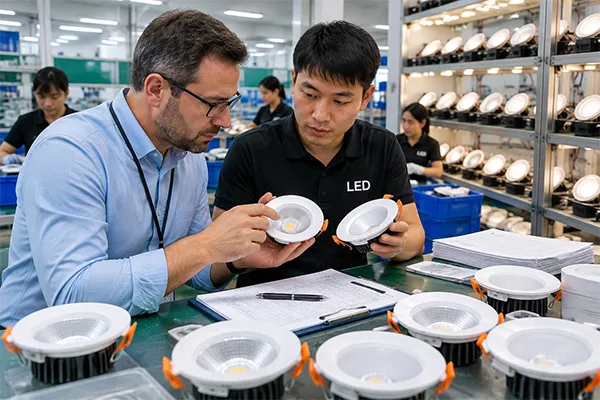
A sample can look excellent and still fail to represent normal production control.3 Importers can face costly problems when the approved sample, production specification, and delivered batch are not tightly connected. We advise buyers to examine how Chinese LED downlight manufacturers control repeatability before they commit to volume purchasing.
Buyers should verify Chinese LED downlight manufacturers by reviewing product specifications, sample approval records, aging-test procedures, incoming-material controls, in-process inspections, final checks, and corrective-action processes. A supplier should be able to explain how it locks the agreed configuration before mass production and how it handles deviations.
A Sample Is an Entry Point, Not Batch Proof
We understand why samples are important. A buyer needs to inspect appearance, installation details, brightness, beam distribution, dimming behavior where relevant, packaging, and perceived build quality. However, a sample is usually one unit or a limited group of units. It does not automatically demonstrate batch consistency.
We recommend that buyers treat the sample as the first step in a broader qualification process.
A practical sample review can include:
- Visual construction: Check trim finish, lens or diffuser condition, housing quality, labels, and packaging.
- Technical alignment: Confirm wattage, voltage range, color temperature, CRI, beam angle, cutout size, and dimensions.
- Functional review: Check start-up, flicker concerns where applicable, dimming compatibility if specified, and thermal behavior under suitable conditions.
- Documentation match: Ensure the sample label, datasheet, quotation, and test documents describe the same configuration.
- Approval record: Create a written reference that identifies the approved model and agreed options.
Ask About the Production Control Path
In our own process, we perform a 100% aging test before shipment, generally lasting between four and eight hours. We use this procedure as one quality-control step intended to identify certain early functional issues before dispatch. We do not present an aging test alone as a guarantee of lifetime performance, because product performance depends on design, components, operating conditions, installation, and application environment.
Buyers should ask any potential supplier to describe its actual controls. Useful questions include:
- What checks occur when LED chips, drivers, housings, and accessories arrive?
- How does the factory identify different color temperatures or wattage versions?
- How does the factory prevent mixing of 3000K, 4000K, and 6500K units?
- Does the factory conduct aging tests? If yes, for how long and under what conditions?
- What final inspection items are recorded before packing?
- Can the supplier provide photos, inspection records, or batch references where appropriate?
- What happens if an inspection finds a non-conforming item?
- Who approves production changes after the sample stage?
Lock Specifications Before Production
A specification sheet protects both the buyer and the supplier.4 We recommend that buyers avoid approving an order through informal descriptions alone, especially when multiple variants are involved.
| Specification Item | Example of What to Lock |
|---|---|
| Product model | Recessed LED downlight model number |
| Electrical data | Wattage, input voltage, driver type |
| Light quality | CCT, CRI, lumen target, beam angle |
| Mechanical details | Cutout, outer diameter, height, trim style |
| Finish | White, black, silver, or custom finish |
| Brand presentation | Label artwork, logo, packaging design |
| Compliance documents | Exact report or declaration linked to the model |
| Quality requirements | Aging test, AQL inspection, buyer inspection method |
| Order terms | Quantity, production schedule, shipping mark |
We once received a request from a buyer who wanted “warm white, high CRI, black downlights.” That description was useful for an early conversation, but it was not enough for mass production. Our team needed to confirm the exact color temperature, target CRI, wattage, driver option, beam angle, packaging, and labeling. These details are where procurement risk is either controlled or created.
What OEM and ODM Options Can Importers Realistically Request?
Importers often need a product that fits a local brand, project specification, or established distribution range. Generic promises about customization can create unrealistic expectations, especially when the buyer expects multiple changes without considering quantity, tooling, component availability, or production time. We recommend defining the commercial boundaries of customization early.
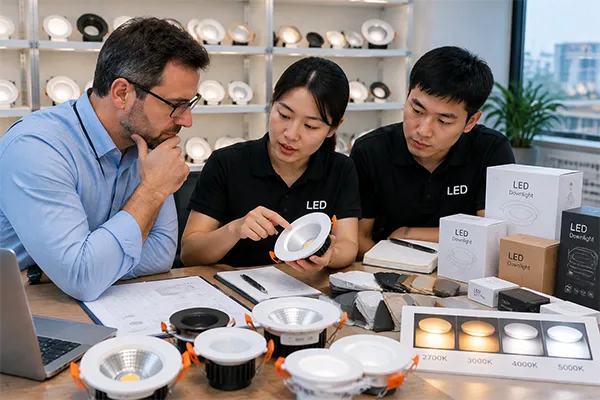
Chinese LED downlight manufacturers may support OEM or ODM requests such as color temperature, wattage, beam angle, CRI, finish colors, packaging, and labeling. However, buyers should confirm the requested configuration, minimum order quantity, tooling needs, sample process, cost impact, and production timeline together because each change can affect feasibility.5
OEM Customization Is Not One Single Service
In lighting procurement, “customization” can mean very different things. A buyer may only need a logo label and branded carton. Another buyer may require a different color temperature, driver, bezel color, reflector, or product structure.
We encourage buyers to separate configuration changes from design-development changes.
| Customization Type | Typical Example | Buyer Consideration |
|---|---|---|
| Branding | Logo label, manual, color box | Artwork approval and packaging MOQ |
| Lighting configuration | 3000K, 4000K, 5000K; CRI 80 or CRI 90 | Component selection and performance confirmation |
| Optical configuration | Different beam angle or reflector | Light distribution and sample validation |
| Electrical configuration | Wattage or driver option | Thermal design and market requirements |
| Cosmetic configuration | White, black, gold, or custom finish | Surface-treatment consistency |
| Structural development | New housing, trim, or installation system | Tooling, engineering review, and larger commitment |
At Upward Lighting, we offer OEM/ODM services for requirements such as color temperature, wattage, beam angle, CRI, and surface finish. However, we discuss each request with the buyer rather than assuming that every option is available for every model and order quantity.
Confirm the Trade-Offs Before Promising a Customer
Custom options can affect more than price. They can affect sourcing, production planning, inspection methods, inventory risk, and future replenishment. A unique driver or uncommon finish may help a local brand stand out, but it may also require a higher MOQ or more planning.
We suggest that buyers use a simple decision framework:
- Is the change essential to market positioning or project compliance?
- Can the supplier provide a sample that represents the intended configuration?
- Does the order quantity support special components, packaging, or tooling?
- Can the exact configuration be replenished later?
- Will the customized model require additional compliance review in the destination market?
- Can the buyer accept the added time needed for confirmation and production planning?
For small-batch orders, buyers may benefit from selecting an existing product platform with controlled changes rather than immediately requesting a new structural design.6 This approach can reduce complexity while still allowing meaningful brand differentiation through finish, color temperature, packaging, or labeling.
We also recommend that buyers ask whether custom components will be reserved, substituted, or re-approved in future orders. Replenishment is often more important than the first order. A product range only creates long-term value when the supplier can support repeat purchasing with stable specifications.
How Should Importers Check Certifications and Market Requirements?
Certification logos can create confidence, but documents can be misunderstood or applied too broadly. Importers may assume that a CE or RoHS document covers every version of a product, every driver, every electrical configuration, and every destination market.7 We advise buyers to treat compliance review as a verification task, not a marketing shortcut.
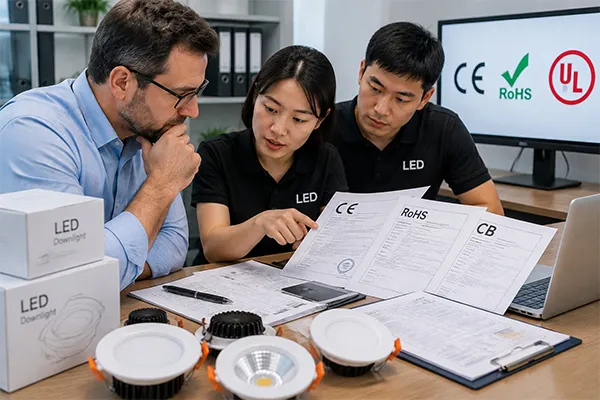
Importers should check whether certification documents apply to the exact LED downlight model and configuration they plan to purchase. Buyers should verify report numbers, product descriptions, rated electrical parameters, issuing bodies, and destination-market requirements. We recommend qualified compliance or legal guidance for market-specific decisions.
Documents Must Match the Ordered Product
At Upward Lighting, our products hold certifications such as CE and RoHS. We provide relevant documentation for applicable products and markets as part of the buyer’s evaluation process. Still, we encourage buyers to review those documents carefully rather than treating any certificate or declaration as an automatic approval for all market conditions.
A document review should compare the following details:
- Product model number
- Rated voltage and frequency
- Wattage range
- Driver configuration
- Product description and photos
- Applicable standards or directives
- Document date and validity considerations
- Name of the issuing organization
- Manufacturer or applicant information
- Any limitations shown in the report
Ask the Right Compliance Questions
Different markets, applications, and sales channels can have different requirements. A downlight for a commercial project may require a different evaluation path from a product sold through a retail channel. Electrical requirements, labeling rules, energy-performance rules, importer responsibilities, and installation expectations can vary.8
We recommend that importers ask:
- Does this document clearly identify the exact product configuration?
- Does the report include the driver that will be supplied in the order?
- Are the rated voltage, wattage, and model references aligned with the purchase order?
- Does the destination market require additional documents, markings, testing, registration, or local representation?
- Who will be responsible for importer obligations in the target market?
- Has a qualified local compliance professional reviewed the intended sales route?
We do not act as a legal authority or independent testing laboratory. We recommend that buyers obtain qualified professional advice for application-specific and market-specific compliance decisions.
Build Compliance Review Into Supplier Selection
Compliance should not be left until the shipment is ready. If a buyer waits until final inspection to discover a document mismatch, the commercial damage can be substantial.9 The buyer may face relabeling, retesting, delayed delivery, or an inability to sell the goods through the intended channel.
We suggest including document verification in the supplier qualification stage. Buyers can request copies early, compare them with technical specifications, and identify questions before production begins. This approach gives both parties time to clarify the requirement and avoid preventable changes later.
Frequently Asked Questions
Are Chinese LED downlight manufacturers always the lowest-cost option?
No. Chinese LED downlight manufacturers may offer competitive pricing because of supply-chain access and production scale10, but buyers should calculate total procurement cost. We recommend comparing specifications, inspection needs, freight, delivery reliability, rework risk, and replenishment capability rather than choosing solely by unit price.
How can we evaluate LED downlight quality before placing a large order?
We recommend reviewing a sample, confirming the written specification, asking about aging tests and final inspection, and considering third-party inspection for larger orders11. Buyers should also confirm how the supplier identifies different configurations and prevents product mixing during production and packing.
Can we order customized LED downlights in small quantities?
Some suppliers can support small-batch customization, especially for packaging, labels, standard color temperatures, finishes, or existing product platforms. We recommend confirming MOQ, component availability, sample cost, tooling requirements, and repeat-order conditions before promoting a customized model to customers.
Do CE and RoHS documents guarantee that LED downlights can be sold in every market?
No. CE and RoHS documents do not automatically confirm compliance for every product variation or destination market.12 Buyers should verify that documents match the ordered configuration and consult qualified local compliance professionals regarding applicable laws, labeling, testing, and importer responsibilities.
What should we include in an LED downlight purchase specification?
We recommend including model number, wattage, voltage, color temperature, CRI, beam angle, dimensions, cutout size, finish, driver details, packaging, labels, compliance documents, inspection requirements, quantity, and shipment terms. A complete specification reduces ambiguity before mass production.
Conclusion
Importers prefer Chinese LED downlight manufacturers when they find suppliers that offer more than an attractive quotation. We believe the best supplier relationship combines competitive total cost, responsive specification support, repeatable quality controls, realistic OEM/ODM options, and transparent documentation. Buyers should verify every critical point, from batch-aging procedures and configuration control to certification relevance and replenishment planning. If you are sourcing LED downlights for distribution, branding, or project supply, our Upward Lighting team can help you review product options, clarify specifications, and prepare a practical quotation.
"Analyzing Costs Using Total Cost of Ownership", https://psep.smeal.psu.edu/short-courses/supply-chain-accelerator/advanced-procurement-analyzing-costs-using-total-cost-of-ownership. Total-cost-of-ownership guidance explains that supplier evaluation may include costs beyond the purchase price, including operation, maintenance, quality, logistics, and end-of-life costs. Evidence role: general_support; source type: government. Supports: Total-cost or life-cycle-cost approaches assess purchasing decisions beyond initial price by including operational and risk-related costs.. Scope note: Such frameworks are general procurement guidance and do not quantify the cost difference for any particular LED downlight order. ↩
"Lighting", https://en.wikipedia.org/wiki/Lighting. Industrial-cluster research describes how geographic concentration of related producers, component suppliers, and service providers can facilitate coordination within manufacturing supply chains. Evidence role: general_support; source type: research. Supports: Research or institutional reporting should document the concentration of lighting-related manufacturers and supporting firms in Chinese industrial clusters, including the Zhongshan/Guzhen area where applicable.. Scope note: Evidence of cluster concentration does not establish that every manufacturer in the region has the same capabilities or service quality. ↩
"Manufacturing Supply Agreement", https://www.sec.gov/Archives/edgar/data/317093/000119312506252522/dex1037.htm. Quality-control guidance distinguishes approval of an initial sample from ongoing process control, because conformity of a sample does not by itself demonstrate consistency across later production lots. Evidence role: general_support; source type: institution. Supports: Quality-management and inspection guidance should explain that product sampling provides limited evidence and that controlled production processes and inspection plans are needed to manage batch conformity.. Scope note: The principle supports the need for broader controls but does not prove that a particular supplier's production batch will differ from its sample. ↩
"Purchase Order Guidelines", https://www.paloverde.edu/business/purchasing/vendor/purchase-order.html. Quality-management standards require organizations to determine, review, and communicate product requirements, providing a basis for controlling conformity between ordered and delivered products. Evidence role: mechanism; source type: institution. Supports: Quality-management guidance should support documenting customer and product requirements before production to ensure that requirements are understood and controlled.. Scope note: A written specification reduces ambiguity but cannot alone prevent manufacturing defects, unauthorized changes, or contractual disputes. ↩
"Engineering change management in individual and mass ...", https://www.sciencedirect.com/science/article/abs/pii/S073658450400081X. Research on engineering change management finds that product changes can affect dependent components, manufacturing processes, tooling, validation activities, cost, and delivery schedules. Evidence role: mechanism; source type: paper. Supports: Engineering-change research should show that design or configuration changes can propagate through materials, tooling, process planning, quality validation, cost, and lead time.. Scope note: The magnitude of these effects depends on the design change, existing production platform, supplier capacity, and order volume. ↩
"Low-Volume Manufacturing: Processes, Costs, and Scaling ...", https://www.fictiv.com/articles/low-volume-manufacturing. Product-platform research indicates that reuse of common architectures and components can reduce development and manufacturing effort while enabling selected product variants. Evidence role: general_support; source type: paper. Supports: Product-platform and modular-design research should support the use of common platforms to reduce development and manufacturing costs while allowing limited variation.. Scope note: Platform reuse may not satisfy project-specific performance, safety, installation, or regulatory requirements that require a new design. ↩
"A guide to EU standards and conformity assessment", https://www.govinfo.gov/content/pkg/GOVPUB-C13-07a06d81c863b5241d6249891a51fb90/pdf/GOVPUB-C13-07a06d81c863b5241d6249891a51fb90.pdf. European Commission guidance states that CE marking is applied by the manufacturer for products meeting applicable EU requirements and must be supported by the appropriate conformity-assessment and technical documentation. Evidence role: definition; source type: government. Supports: European Commission guidance should explain that CE marking and related technical documentation concern compliance with applicable EU rules for the specific product placed on the EU market, and that economic operators have defined responsibilities.. Scope note: The applicable legal route depends on the product, its intended use, relevant EU legislation, and the market in which it is placed. ↩
"General Use Products: Certification and Testing", https://www.cpsc.gov/Business--Manufacturing/Testing-Certification/General-Use-Products-Certification-and-Testing. International policy resources on lighting regulation document that jurisdictions use differing combinations of energy-performance requirements, labeling schemes, safety rules, and market-surveillance obligations. Evidence role: general_support; source type: institution. Supports: International or governmental sources should document that lighting-product rules differ across jurisdictions and can address energy performance, labeling, safety, and economic-operator duties.. Scope note: A general comparison of regulatory systems does not identify the complete legal requirements for a specific product or destination country. ↩
"Recalls, Corrections and Removals (Devices)", https://www.fda.gov/medical-devices/postmarket-requirements-devices/recalls-corrections-and-removals-devices. Market-surveillance rules provide for corrective measures when products fail to meet applicable requirements, including bringing products into conformity, restricting availability, withdrawing products, or recalling them where necessary. Evidence role: general_support; source type: government. Supports: Market-surveillance guidance should show that inadequate conformity documentation or non-compliance can require corrective action, withdrawal, recall, or restrictions on market placement.. Scope note: These regulatory consequences establish potential risk, but the actual commercial loss from a document mismatch varies by product, jurisdiction, timing, and remedy. ↩
"Economies of scale", https://en.wikipedia.org/wiki/Economies_of_scale. Economies of scale describe the reduction in average unit cost that can occur when increased output spreads fixed costs and improves production efficiency. Evidence role: mechanism; source type: encyclopedia. Supports: A neutral economics source should explain that economies of scale can lower average unit costs as fixed costs are spread across greater output, while supply networks may reduce transaction and sourcing costs.. Scope note: Economies of scale are a general economic mechanism and do not demonstrate that a particular Chinese manufacturer offers the lowest price or best total value. ↩
"Quality Assurance Program Guide", https://www.energy.gov/documents/quality-assurance-program-guide. Acceptance-sampling standards provide methods for inspecting production lots against defined quality criteria and making accept-or-reject decisions based on sampled units. Evidence role: general_support; source type: institution. Supports: Inspection standards and trade-quality guidance should describe independent or acceptance sampling inspections as tools for assessing whether a production lot meets defined criteria before shipment.. Scope note: Sampling inspection estimates lot conformity rather than proving that every unit in a shipment is defect-free. ↩
"CE marking", https://en.wikipedia.org/wiki/CE_marking. Under EU guidance, CE marking indicates conformity with applicable EU harmonisation legislation for the relevant product, while RoHS obligations apply within the directive's defined scope and conformity-assessment framework. Evidence role: definition; source type: government. Supports: Official EU sources should establish that CE marking relates to applicable EU harmonisation legislation and that RoHS compliance is assessed within the scope of the directive and its supporting documentation.. Scope note: This does not determine whether a particular downlight configuration complies; that assessment requires review of the exact product, documentation, and applicable rules. ↩