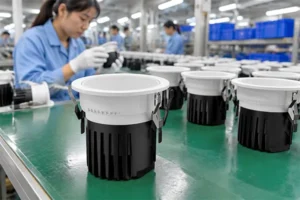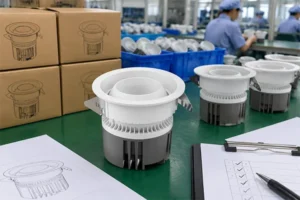

Choosing an LED downlight supplier can look simple when every quote includes attractive prices, product photos, and a sample that appears acceptable. However, the real risk often appears after the purchase order is placed. Batch inconsistency, specification drift, and slow quality follow-up can create expensive project acceptance problems.1 Factory experience matters because it can reduce these risks when buyers verify the processes behind the quotation.
Factory experience matters when choosing an LED downlight supplier because it can indicate whether the supplier has repeatable systems for specification control, component coordination, production, testing, inspection, and issue handling.2 A factory claim alone is not enough. Buyers should verify how the supplier turns an approved sample into a consistent bulk order, communicates changes, and manages quality exceptions before shipment.

In my work with LED downlight production and OEM/ODM coordination, I have seen that the gap between a good sample and a stable order is often created by small details. Those details include material substitutions, driver matching, labeling, beam-angle confirmation, and inspection records. Buyers who examine the manufacturing process can make a more informed supplier decision.
Does an LED Downlight Supplier Need a Factory to Be Reliable?
A buyer may worry that a supplier without a visible factory cannot control product quality, while a supplier with a factory may seem automatically safer. That assumption can lead to poor supplier selection. A factory building does not guarantee disciplined production, but process transparency can help buyers understand who is responsible when something goes wrong.3
An LED downlight supplier does not need to own every production process to create value, but buyers should understand the supplier’s role, factory access, quality authority, and accountability. A capable supplier should be able to explain who controls specifications, approves materials, performs inspections, manages production exceptions, and supports the buyer after delivery.

Factory Presence Is Different From Manufacturing Control
A business license, catalog, showroom, product video, or polished sample can provide useful initial information. However, none of these items proves that a supplier can reproduce the same performance across a bulk order.4
I encourage buyers to separate two questions:
- Does this company have access to production capacity?
- Can this company demonstrate control over repeatable manufacturing results?
The first question concerns physical capability. The second question concerns systems, records, decision-making, and responsibility.
For example, a supplier may show a clean assembly line and still lack a clear process for handling a driver substitution. Another supplier may work through a partner factory but maintain strong specification documents, incoming material checks, production follow-up, and final inspection standards. Neither business model should be judged only by its label. Buyers should focus on transparency and process access.
What Buyers Should Verify Before Placing a Bulk Order
A reliable LED downlight supplier should be prepared to discuss practical evidence, not only broad claims. I recommend asking for appropriate documentation and explanations during supplier qualification.
| Verification Area | Buyer Question | Procurement Risk Reduced |
|---|---|---|
| Production responsibility | Who manages assembly, testing, and final inspection? | Unclear accountability |
| Product specifications | How are approved specifications transferred into production? | Specification drift |
| Component sourcing | How are LED chips, drivers, housings, and optics controlled? | Material inconsistency |
| Quality records | What inspection records are retained for the order? | Limited traceability |
| Issue escalation | Who investigates bulk-order quality complaints? | Delayed resolution |
| Change control | How are component or process changes communicated? | Unapproved substitutions |
I have participated in customer factory audits where the most useful questions were not about the size of the facility. Buyers wanted to understand the route from approved specification to finished carton. That is usually where the important procurement evidence appears.
A factory should not simply say that it has quality control. It should be able to explain what it checks, when it checks it, who records it, and what happens when a result does not meet the agreed requirement.
How Does Factory Experience Improve LED Downlight Batch Consistency?
A single approved sample may perform well, but a project order may include hundreds or thousands of units. Buyers then need confidence that the same appearance, electrical configuration, beam distribution, and packaging requirements can be repeated. Without process discipline, small differences can become visible only after installation.
Factory experience can improve LED downlight batch consistency when the supplier uses controlled specification handover, component coordination, production checks, aging, and final inspection.5 Buyers should ask how these steps connect, because no single test or sample approval can prove that every unit will be identical or suitable for every application.

What Happens Between Sample Approval and Shipment?
From a buyer’s perspective, the finished product may look straightforward. From a manufacturing perspective, several decisions occur between sample approval and shipment. Each decision can affect consistency.
In our own production workflow, the process typically includes the following stages:
-
Specification confirmation
We confirm the model, wattage, input requirements, color temperature, beam angle, CRI, trim color, packaging, labels, and order quantity. Requirements vary by product and target market. -
Material and component coordination
We coordinate LED light sources, drivers, heat sinks, reflectors, diffusers, springs, wires, cartons, and labels. A buyer should ask how the supplier confirms that the correct components are assigned to the order. -
Production scheduling
We arrange production according to material readiness, line capacity, required delivery timing, and inspection planning. Buyers should understand that schedule control is linked to supply-chain coordination, not only assembly speed. -
Assembly and in-process checks
Operators assemble the product, while inspection staff may check key characteristics based on the product and order requirements. These checks can include appearance, wiring, dimensions, labeling, and basic function. -
Aging and final inspection
At Upward Lighting, products undergo a 100% aging test before shipment, generally lasting between four and eight hours. This is one useful quality-control step. It does not prove zero defects, universal compliance, or performance in every installed environment. Buyers should still ask what other inspections are applied and how exceptions are handled. -
Packing and pre-shipment review
The supplier verifies carton markings, quantity, accessory inclusion, and visible product condition before shipment.
Why Small Variations Become Big Project Problems
A procurement team may regard a minor difference as unimportant during quotation. In an installed lighting project, that same difference can create a visible or operational issue.
Common examples include:
- A requested 3000K color temperature that is not consistently defined across production batches.6
- A different beam angle that changes wall-wash effects or task-lighting coverage.7
- A lower-than-expected CRI that affects retail, hospitality, or display environments.8
- A finish variation between white, black, gold, or custom painted trims.
- A driver configuration that does not match the dimming method or input requirement.
- Packaging labels that do not match site receiving, retail, or local channel requirements.
I have learned that many quality concerns begin as communication gaps. A buyer might say “warm white downlight,” while the supplier needs a confirmed CCT, tolerance expectation, beam requirement, driver type, trim finish, and application context. The more clearly the order requirements are documented, the easier it becomes to detect inconsistencies before the goods leave the factory.
What Questions Should You Ask an LED Downlight Supplier Before Ordering?
Procurement teams often begin with price, specifications, certificates, and sample availability. Those are reasonable starting points, but they do not fully reveal whether a supplier can manage a bulk order. Buyers need questions that expose the supplier’s planning discipline and response process before committing to production.
Before selecting an LED downlight supplier, buyers should ask about application requirements, target market, order volume, acceptance criteria, component control, aging procedures, inspections, change management, and quality-issue follow-up. Clear answers can reveal whether the supplier understands the practical difference between selling a sample and managing a repeatable order.
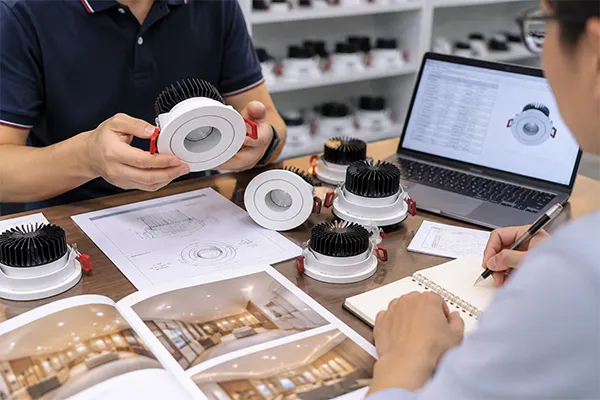
Start With Application and Acceptance Requirements
A capable supplier should ask more than, “What wattage do you need?” Wattage and price are important, but they are incomplete inputs for supplier selection.
I usually find that the following buyer information helps establish a more workable project discussion:
- Application: residential, office, retail, hotel, corridor, showroom, or other environment
- Target market: destination country or region and relevant market-entry needs
- Installation details: ceiling cutout, recess depth, insulation conditions, mounting arrangement
- Visual expectations: CCT, beam angle, CRI, glare preference, trim style, and finish
- Electrical needs: input voltage, dimming type, driver preference, wiring requirements
- Order requirements: quantity, packaging, logo, private label, barcode, and delivery date
- Acceptance criteria: sample reference, inspection standard, permitted variations, and documentation needs
These questions do not make a supplier difficult. They show that the supplier is trying to reduce ambiguity before production begins.
Ask for Process-Specific Answers
Generic claims such as “high quality,” “strict QC,” or “professional factory” provide limited purchasing value unless the supplier can explain what those terms mean in practice.
Here are questions that can help a buyer evaluate manufacturing experience:
| Question | What a Useful Answer May Include |
|---|---|
| How do you confirm OEM/ODM specifications? | Drawings, approved samples, specification sheets, order confirmation, label artwork approval |
| How do you control components for my order? | Material list, supplier coordination, incoming checks, approved alternatives process |
| What aging test do you perform? | Duration, product status during aging, records, and handling of failures |
| How do you inspect finished products? | Appearance, basic function, packaging, labeling, and order-specific checks |
| How do you handle nonconforming products? | Isolation, rework review, recordkeeping, root-cause investigation where appropriate |
| What happens if a component changes? | Buyer notification, sample reconfirmation when needed, documented change control |
| Can you support a factory audit? | Production access, relevant records, inspection process explanation, audit coordination |
A buyer should also verify certificates and compliance documents independently for the intended product and target market. CE and RoHS documentation, for example, can be relevant for market-entry requirements9, but certificates should not replace application-specific technical review or supplier process evaluation.
Why Are Price, Certificates, and Samples Not Enough to Select an LED Downlight Supplier?
The lowest quotation can be tempting, especially when several products appear visually similar.10 A certificate file can create confidence, and a passing sample can help a project move forward. Still, these signals do not always explain how the supplier will perform during full-scale production or after a quality concern is reported.
Price, certificates, and samples are useful supplier-selection inputs, but they are incomplete when choosing an LED downlight supplier. Buyers should compare how suppliers control bulk consistency, document specifications, manage changes, support inspections, and respond to quality exceptions. The best commercial decision considers total purchasing risk, not only the visible unit price.
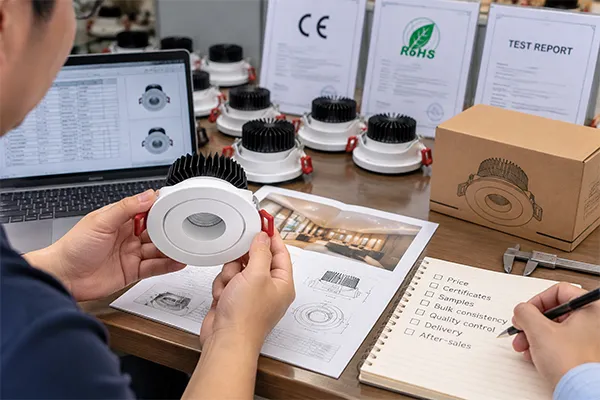
The Hidden Cost of a Low Unit Price
A low unit price may reduce the purchase order total, but it can create other costs if the supplier does not control the order properly. These costs may appear after delivery, when replacement work and project delays become much more expensive.
Potential hidden costs include:
- Re-inspection time at a warehouse or job site
- Installation delays caused by missing or incorrect accessories
- Rework costs for incorrect labels, packaging, or trim colors
- Replacement freight for products that do not match the approved requirement
- Contractor labor costs for removing and reinstalling fixtures11
- Customer dissatisfaction when the installed appearance is inconsistent
- Internal time spent chasing answers from multiple parties
I have seen buyers compare two quotations that differ by only a small amount per unit. The better decision was not always the lowest quote. The buyer needed to know which supplier could answer detailed questions, confirm specifications quickly, and provide a clear path for issue investigation.
Use a Weighted Supplier Evaluation Matrix
A structured scoring system can help purchasing teams avoid overemphasizing price. The exact weighting should depend on the project, product complexity, and risk level.
| Evaluation Criterion | Example Weight | What Buyers Should Review |
|---|---|---|
| Product and specification fit | 25% | Cutout, wattage, CCT, beam angle, CRI, driver, finish |
| Manufacturing process transparency | 20% | Production flow, inspections, records, audit access |
| Quality-control approach | 15% | Aging, final inspection, exception handling, traceability |
| Commercial terms and pricing | 15% | Quote clarity, payment terms, MOQ, sample costs |
| Supply-chain and schedule coordination | 10% | Material planning, production timeline, communication |
| OEM/ODM capability | 10% | Custom colors, labels, packaging, parameters, small batches |
| Documentation support | 5% | Certificates, test records, product documents, packing details |
This type of matrix does not eliminate procurement risk. However, it forces the team to compare suppliers on the factors that affect total project outcomes.
Evaluate Accountability, Not Just Capability
A supplier may have the technical capability to make a downlight, but buyers should also assess accountability. When an issue occurs, the important question is not simply, “Can you make this product?” It is also, “Can you investigate what happened and coordinate a response?”
A capable factory should be able to explain:
- How it identifies the production batch involved.
- How it compares the reported issue with approved specifications.
- How it checks relevant production and inspection records.
- How it communicates findings and corrective actions.
- When it recommends additional testing or qualified professional review.
For application-specific decisions, buyers should involve qualified lighting, electrical, or project professionals. A supplier’s explanation can support procurement, but it should not replace engineering evaluation for installation conditions, controls compatibility, safety requirements, or local regulations.
Frequently Asked Questions
How can I verify an LED downlight supplier’s factory experience?
Buyers can request a factory visit, virtual audit, production walkthrough, and explanations of specification control, testing, inspection, and issue handling. Buyers should also ask for order-related records where appropriate. The goal is not simply to confirm a factory address, but to understand the supplier’s repeatable manufacturing process.
Is a 100% aging test enough to prove LED downlight quality?
No. A 100% aging test can help identify certain early functional issues before shipment, but it is only one quality-control measure.12 Buyers should also review component control, in-process checks, final inspection, packaging verification, and how the supplier manages nonconforming products or customer complaints.
What OEM/ODM details should I confirm for LED downlights?
Buyers should confirm color temperature, wattage, beam angle, CRI, driver type, dimming requirement, trim finish, cutout size, labels, packaging, and branding. A written specification sheet and approved sample can reduce misunderstandings. Buyers should also ask how changes will be documented before production begins.
Should I choose a factory instead of a trading company for LED downlights?
Not necessarily. Both factories and trading companies can provide value. The buyer should focus on transparency, product knowledge, access to production information, quality responsibility, and communication efficiency. A supplier’s business model matters less than its ability to provide clear accountability for the order.
How should I compare LED downlight supplier quotations?
Buyers should compare more than unit price. Review specification completeness, component assumptions, sample alignment, MOQ, packaging, lead-time assumptions, inspection process, documentation, customization support, and issue-resolution procedures. A lower quote may not offer the same controls or services as a more complete proposal.
Conclusion
Factory experience matters because choosing an LED downlight supplier is ultimately a decision about consistency, transparency, and accountability. A good sample, low price, or certificate file can support the evaluation, but none should stand alone. Buyers should verify how specifications move into production, how components and changes are controlled, what testing and inspections occur, and how exceptions are handled. If you are sourcing LED downlights with OEM/ODM requirements, I encourage you to share your application, market, acceptance criteria, and quantity so we can help you build a clearer supplier evaluation process.
"systems engineering producibility modeling & simulation ...", https://www.nist.gov/document/sanderspdf. Quality-management guidance recognizes that nonconforming products and ineffective corrective action can generate rework, delay, and additional quality costs across production and delivery processes. Evidence role: general_support; source type: institution. Supports: Quality-management literature should support that nonconforming outputs and delayed corrective action can lead to rework, delays, and additional costs.. Scope note: This support addresses general manufacturing quality risk rather than the cost of a particular LED-downlight project. ↩
"SURFACE ROUGHNESS REPEATABILITY ANALYSIS ...", https://www.nist.gov/publications/surface-roughness-repeatability-analysis-multi-build-overhang-parts-powder-bed-fusion. ISO 9001 quality-management principles emphasize controlled and documented processes, control of externally provided inputs, monitoring of outputs, and action on nonconformities as elements of consistent product realization. Evidence role: expert_consensus; source type: institution. Supports: ISO 9001 principles should support the importance of controlled processes, documented information, supplier control, inspection, and treatment of nonconforming outputs.. Scope note: The standard describes management-system requirements and principles; certification or factory tenure alone does not prove a supplier will meet a particular order's requirements. ↩
"Supply Chain Risk Management Practices for Federal ...", https://nvlpubs.nist.gov/nistpubs/SpecialPublications/NIST.SP.800-161.pdf. Supplier-assurance practice evaluates documented processes, assigned responsibilities, and objective audit evidence; the existence of production premises alone is not evidence that those controls operate effectively. Evidence role: general_support; source type: government. Supports: Supplier-assurance guidance should support evaluation of documented controls, responsibilities, and audit evidence rather than reliance on premises or declarations alone.. Scope note: Audit guidance provides a general evaluation principle and does not determine the performance of any individual supplier. ↩
"6.2.2. What kinds of Lot Acceptance Sampling Plans (LASPs ...", https://www.itl.nist.gov/div898/handbook/pmc/section2/pmc22.htm. Statistical quality-control principles distinguish evidence from an individual sample from evidence about an entire production lot: sample results can inform acceptance decisions but do not demonstrate that every unit has identical performance. Evidence role: mechanism; source type: research. Supports: Sampling and inspection references should support that observations of a sample provide information about a lot but do not establish conformance of every unit without suitable process and acceptance controls.. Scope note: The inference depends on the sampling plan, process stability, and defined acceptance criteria. ↩
"Quality and Consistency of Machined Components and ...", https://www.nist.gov/system/files/documents/oles/2-Donmez-Alkan-Manufacturing-2012-07-10-MSSFFA.pdf. Quality-management frameworks treat control of production inputs, in-process monitoring, verification, and release inspection as complementary controls for maintaining conformity of repeated production outputs. Evidence role: mechanism; source type: institution. Supports: Quality-management sources should support that controlled production inputs, in-process monitoring, verification, and release controls are used to maintain conformity of production outputs.. Scope note: These controls reduce risk rather than guaranteeing identical optical, electrical, or cosmetic characteristics in every unit. ↩
"LED Color Characteristics", https://www.energy.gov/sites/prod/files/2016/08/f33/led-color-characteristics-factsheet.pdf. LED color consistency is assessed using chromaticity tolerances around a nominal correlated color temperature; therefore, products labeled 3000 K may still differ visibly when their allowed chromaticity ranges differ. Evidence role: definition; source type: government. Supports: Lighting references should support that correlated color temperature is a nominal chromaticity designation and that color consistency depends on specified chromaticity tolerances or binning.. Scope note: Perceived difference depends on the specified tolerance, viewing conditions, adaptation, and the products being compared. ↩
"Lighting Specification Guidance for Schools", https://www.energy.gov/sites/default/files/2024-12/lighting-spec-guidance-school_nov24.pdf. A luminaire's beam distribution governs how its luminous intensity is spread across surfaces and work planes, so changes in beam angle can alter coverage, uniformity, and wall-wash appearance. Evidence role: mechanism; source type: education. Supports: Lighting-design materials should support that a luminaire's beam distribution determines the spatial distribution of luminous intensity and illuminance on surfaces and work planes.. Scope note: The resulting effect also depends on mounting height, spacing, aiming, room geometry, and surface reflectance. ↩
"Background and Guidance for Using the ANSI/IES TM-30 ...", https://www.energy.gov/sites/default/files/2022-04/ssl-royer-leukos-tm-30-tutorial-2022.pdf. Color rendering metrics, including the general color rendering index (CRI), characterize how faithfully a light source renders object colors relative to a reference illuminant; this property is relevant where color appearance is important. Evidence role: definition; source type: government. Supports: Authoritative lighting sources should support that CRI is a color-rendering metric describing how a light source renders object colors relative to a reference illuminant.. Scope note: CRI is not a complete predictor of color preference or visual quality, and application-specific assessment may require additional metrics and design review. ↩
"CE marking – obtaining the certificate, EU requirements", https://europa.eu/youreurope/business/product-rules-compliance/general-product-compliance/ce-marking/index_en.htm. For electrical and electronic equipment within their scopes, applicable EU CE-marking legislation requires conformity assessment and a declaration of conformity, while the RoHS framework restricts specified hazardous substances and entails supporting technical documentation obligations. Evidence role: historical_context; source type: government. Supports: European Commission guidance should support that applicable CE-marking legislation may require conformity assessment and documentation, while RoHS restricts specified hazardous substances in relevant electrical and electronic equipment.. Scope note: Applicability depends on the product, its intended market, the relevant EU legislation, and the role of the economic operator. ↩
"Cost And Price Analysis In Procurement", https://training.jacksonms.gov/Resources/PktAvU/2OK043/cost__and_price_analysis_in-procurement.pdf. Public-procurement guidance commonly distinguishes lowest initial price from best value, allowing evaluation of quality, lifecycle cost, delivery, and other relevant non-price criteria where these are specified in advance. Evidence role: expert_consensus; source type: institution. Supports: Procurement guidance should support use of total cost, quality, lifecycle considerations, and non-price criteria when evaluating suppliers where appropriate.. Scope note: The appropriate criteria and weighting depend on the procurement rules, product risk, and buyer's stated requirements. ↩
"Effect of construction defects on construction and demolition ...", https://pmc.ncbi.nlm.nih.gov/articles/PMC11844343/. Construction-management research identifies defects and rework as sources of additional labor, schedule disruption, and direct cost, including work required to correct or replace installed items. Evidence role: general_support; source type: paper. Supports: Construction-management research should support that defects and rework create additional labor, schedule, and direct-cost burdens.. Scope note: The magnitude of removal and reinstallation cost varies with access, installation method, contract terms, and the nature of the defect. ↩
"A Methodology for Testing", https://nvlpubs.nist.gov/nistpubs/Legacy/IR/nbsir76-1157.pdf. Burn-in and aging procedures are used as reliability screens for certain early-life failures; however, passing such a screen does not by itself establish long-term reliability, compliance, or suitability under every service condition. Evidence role: mechanism; source type: research. Supports: Reliability references should support that burn-in or aging can screen some early-life failures but does not demonstrate all performance, safety, durability, or field-use conditions.. Scope note: Screening effectiveness depends on the stress conditions, duration, failure mechanisms, and test coverage used. ↩