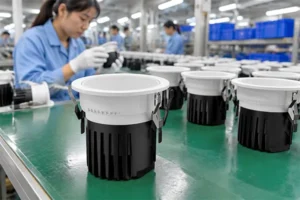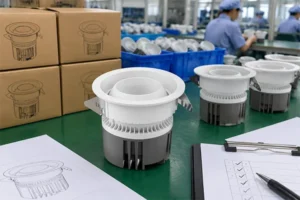

Choosing a China LED downlight manufacturer can feel risky when product photos and headline specifications look similar across many suppliers. A low quotation may hide application mismatches, compliance gaps, or inconsistent delivery.1 We believe the solution is to evaluate each supplier against your actual market, product, quality, and supply requirements.
A China LED downlight manufacturer can be a strong sourcing partner when it demonstrates reliable quality control, application knowledge, responsive communication, customization capability, and verifiable compliance documentation. Buyers should not select a supplier based only on country of origin or unit price. Instead, they should compare total procurement risk, including product fit, batch consistency, delivery planning, and long-term support.

At Upward Lighting, we have handled inquiries from importers, contractors, distributors, and local lighting brands in many markets. We often see buyers begin with price comparisons, then discover that installation conditions, beam angles, dimming requirements, cutout sizes, or certification needs need closer attention. That is where a more structured supplier evaluation becomes valuable.
Can a China LED Downlight Manufacturer Reduce Sourcing Costs Beyond Unit Price?
Many buyers focus first on the lowest factory quotation. That approach can create pressure when products arrive with unsuitable specifications, unclear documentation, or inconsistent appearance between batches. We encourage buyers to look beyond the unit price and assess the full commercial cost of sourcing LED downlights.
A China LED downlight manufacturer may help reduce total sourcing cost through supply-chain access, flexible product configuration, and efficient quotation processes.2 However, the real value depends on whether the supplier can consistently deliver the correct specification, stable quality, suitable packaging, and reliable documentation for the buyer’s intended market.

Unit Price Is Only One Part of Procurement Cost
A low unit price does not automatically mean a low procurement cost. We have seen inquiries where two downlights appeared similar on paper because both used the same wattage and color temperature. Once we discussed the application, important differences became clear.
For example, a recessed LED downlight quotation should be reviewed alongside details such as:
- Housing material and thermal design
- LED chip and driver configuration
- Actual cutout size and ceiling compatibility
- Beam angle and glare-control requirements
- Color temperature tolerance
- Color Rendering Index (CRI)
- Dimming compatibility
- Ingress Protection (IP) requirements
- Surface finish and visual consistency
- Packaging suitable for transport and resale
- Required technical files and compliance documents
A lower-cost product can become expensive if a buyer must manage returns, replace inventory, rework installations, or explain performance differences to downstream customers.3 For project buyers, one incorrect cutout size or driver compatibility issue may also interrupt installation schedules.
| Cost Area | What Buyers Should Check | Potential Risk if Ignored |
|---|---|---|
| Product specification | Wattage, lumens, beam angle, cutout, driver | Product may not fit the intended application |
| Batch consistency | CCT, finish, output, labels, packaging | Mixed appearance or product complaints |
| Compliance | Applicable test reports and declarations | Delays in market entry or project approval |
| Logistics | Carton size, protection, labeling, delivery plan | Freight damage or receiving problems |
| After-sales process | Response method, spare parts, issue documentation | Slower resolution of quality concerns |
We recommend that buyers compare quotations using the same specification sheet. This helps avoid a common procurement mistake: comparing prices for products that are not genuinely equivalent.
At Upward Lighting, we aim to clarify requirements before confirming a quotation. We can customize color temperature, wattage, beam angle, CRI, and surface finish colors for appropriate projects and order models. Still, we recommend that buyers verify feasibility before committing because each customization request may affect technical design, materials, testing, documentation, and production planning.
What Should Buyers Verify Before Choosing a China LED Downlight Manufacturer?
A supplier website can show attractive products, broad export claims, and many specification options. Yet buyers still need to verify whether the supplier understands the intended lighting application. We believe that identical-looking LED downlights can differ significantly in materials, thermal management, optics, drivers, and quality-control practices.4
Before selecting a China LED downlight manufacturer, buyers should verify the installation environment, product parameters, materials, quality-control process, communication accuracy, and available technical documents. A capable supplier should be able to explain how its proposed downlight matches the buyer’s application rather than simply confirm every requested feature.
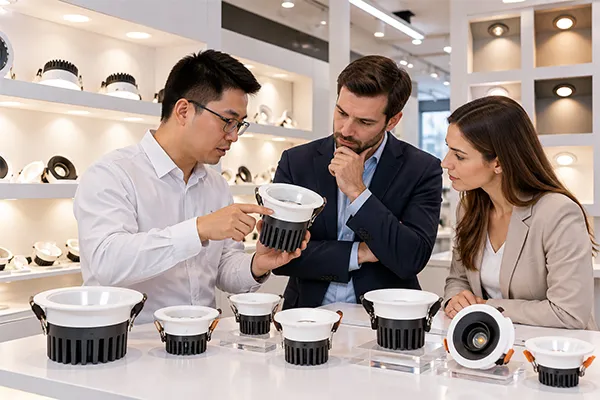
Start With the Application, Not the Catalog Image
We regularly receive inquiries that ask for “a 12W LED downlight” or “a COB downlight” without enough detail about the intended use. Those terms are useful starting points, but they are not complete purchasing specifications.
A downlight for a residential retail channel may require a different balance of price, finish, packaging, and light quality than a downlight for a hotel, office, supermarket, or commercial renovation project. The ceiling depth, opening size, voltage, dimming system, and visual expectations can all affect product selection.5
Buyers should prepare a practical requirement checklist:
- Application type: Residential, retail, office, hospitality, corridor, showroom, or other commercial space.
- Installation details: Recessed, surface-mounted, trimless, fixed, adjustable, or gimbal design.
- Ceiling constraints: Cutout diameter, ceiling thickness, available depth, insulation conditions, and access for maintenance.
- Lighting targets: Wattage, lumen output, beam angle, CCT, CRI, UGR expectations, and required dimming method.
- Electrical requirements: Input voltage, driver location, local plug or connector needs, and emergency-lighting integration where relevant.
- Commercial needs: Target quantity, branding, packaging, labeling, spare-parts approach, and order frequency.
- Market requirements: Applicable compliance documents, language requirements, and channel-specific approval processes.
Ask About Quality Control in Specific Terms
Broad statements about quality are not enough. We advise buyers to ask how a supplier controls the parameters that matter for their own sales channel or project.
At Upward Lighting, every product undergoes a 100% aging test lasting between 4 and 8 hours before shipment as part of our operating process. We use this practice to support checks for product operation before packing and shipment. This is our own approach, not evidence that every China LED downlight manufacturer follows the same procedure or that any product is suitable for every application.
Buyers should ask suppliers questions such as:
- Is each finished product powered on before shipment?
- How are color temperature and appearance consistency managed?
- What checks are completed for driver operation and wiring?
- How are incoming materials inspected?
- How are product labels, cartons, and accessory quantities checked?
- How does the supplier record and respond to quality claims?
- Can the supplier provide samples for evaluation before a larger order?
We have found that the clarity of a supplier’s answers is often as useful as the answer itself. A reliable manufacturer should explain limitations clearly. If a requested configuration is not appropriate for a stated application, the supplier should identify the concern rather than agree without technical review.
How Does a China LED Downlight Manufacturer Support OEM and ODM Requirements?
Many importers and lighting brands need more than a standard catalog model. They may need a particular color temperature, wattage range, beam angle, branded packaging, finish color, or product combination for a local market. The challenge is finding a supplier that can distinguish between practical customization and requests that require further engineering review.
A China LED downlight manufacturer can support OEM and ODM programs when it has suitable component resources, clear specification control, and disciplined communication. Buyers should confirm which elements can be customized, what documents must be updated, and whether samples accurately represent the final production configuration.
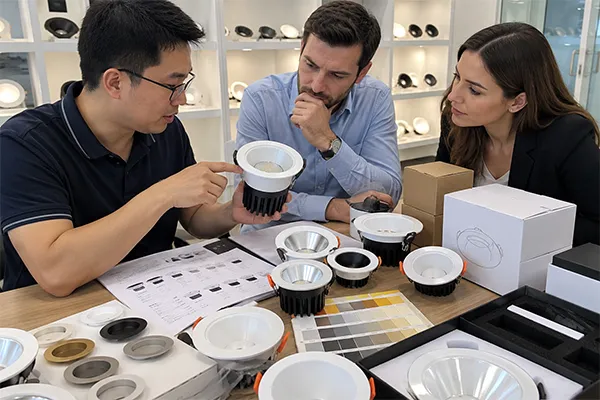
Customization Must Be Controlled, Not Assumed
We support OEM and ODM discussions for LED downlights, track lights, and office linear lighting. In our experience, the best customization projects begin with a controlled specification rather than a long list of changing requests.
Common downlight customization options can include:
| Customization Area | Examples | Buyer Consideration |
|---|---|---|
| Light output | Wattage, lumen package, efficiency target | Confirm application needs and thermal implications |
| Light quality | 2700K, 3000K, 4000K, 6500K, CRI options | Review sample consistency and market preference |
| Optical performance | Narrow, medium, wide beam angles | Test against mounting height and visual task |
| Product appearance | White, black, silver, custom surface finish | Confirm finish reference and batch expectations |
| Branding | Logo, label, retail box, master carton | Check artwork approval and local labeling rules |
| Product configuration | Driver type, cable length, connectors | Verify compatibility with local installations |
A request that looks simple may affect more than one component. For instance, changing a wattage can affect driver selection, heat management, lumen output, labels, packaging information, and possibly technical documentation. Changing from a non-dimmable driver to a dimmable version can require separate compatibility checks with the intended control system.6
Samples Are a Decision Tool, Not a Formality
We recommend that buyers use samples to evaluate both product suitability and supplier communication. A sample should reflect the configuration under consideration as closely as possible. If a final order will include a specific CCT, finish, driver, branding requirement, or beam angle, buyers should document those details during the sampling stage.
When we review samples internally or with customers, we encourage attention to:
- Physical dimensions and cutout fit
- Trim appearance and surface finish
- Light distribution on the intended surface
- Color appearance beside existing fixtures
- Driver behavior and dimming performance, where applicable
- Installation convenience
- Product labeling and packaging condition
- Documentation accuracy
We believe that a sample approval process should create a reference point for later production, not simply confirm that one individual unit can turn on.
This is especially important for local lighting brands and distributors that plan repeat orders. A manufacturer should be able to retain the approved specification and use it as a basis for future purchasing discussions. Buyers should still reconfirm order details for each production run, particularly when materials, regulations, packaging, or product standards may have changed.
Can a China LED Downlight Manufacturer Meet Compliance and Delivery Expectations?
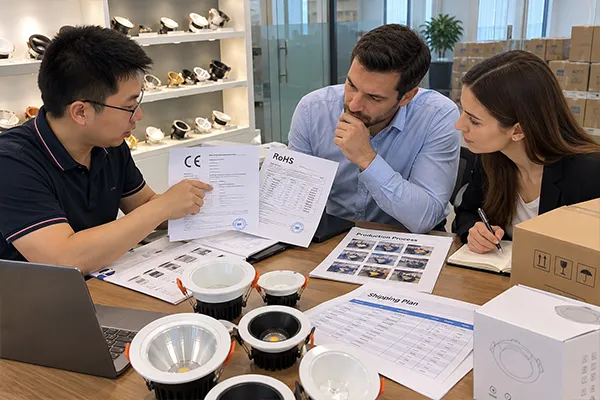
Market access requirements and delivery planning are frequent concerns for importers, contractors, and product managers. Buyers may need CE, RoHS, or other documents, but paperwork alone does not remove the need for market-specific verification. At the same time, a promised shipment date has little value if the specification has not been fully confirmed.
A China LED downlight manufacturer should provide relevant product documentation, explain its production and inspection approach, and communicate delivery planning clearly. Buyers must verify whether documents meet the requirements of their country, customer channel, project consultant, or local authority before placing an order.
Verify Documents for the Intended Market
Upward Lighting’s products hold certifications such as CE and RoHS. These documents can support market-entry discussions in relevant situations, but buyers should not treat any certificate or report as automatic approval for every country, project, or sales channel.
Requirements may vary depending on:
- The destination market
- The electrical product category
- The importer’s legal responsibilities
- The project’s technical specifications
- Retailer or distributor requirements
- Local authority or consultant review
- Product changes after the original testing or document issue date
Buyers should request the documents relevant to the product configuration they intend to purchase.7 They should also have qualified compliance professionals, local testing bodies, or market advisors review requirements where needed. We believe this is especially important when a buyer sells under its own brand or supplies regulated construction projects.
Delivery Reliability Begins Before Production
Delivery performance depends on more than factory capacity. It also depends on how accurately the product is defined before materials are prepared.
We advise buyers to confirm the following in writing:
- Final product code and complete specification
- Approved sample reference, if applicable
- Quantity by model, color, wattage, and CCT
- Packaging and labeling requirements
- Required documents
- Inspection expectations
- Shipping terms and destination details
- Communication process for changes or exceptions
At Upward Lighting, we aim to provide rapid responses and quotation turnaround, and we support small-batch order discussions where feasible. However, we do not believe buyers should assume fixed MOQ, sampling time, production lead time, or customization availability without an order-specific confirmation. Material availability, product complexity, packaging requirements, and shipping arrangements can all influence the final plan.8
A practical supplier relationship depends on accurate communication. We have found that repeat-order cooperation becomes easier when both sides maintain clear product records, confirm changes early, and treat delivery planning as a shared process rather than a last-minute request.
Frequently Asked Questions
Is a China LED downlight manufacturer suitable for small orders?
A China LED downlight manufacturer may support small-batch orders, but this depends on the product model, customization level, component availability, and packaging requirements. We recommend that buyers ask for an order-specific quotation and confirm whether the requested configuration can be supplied under the proposed quantity.
How do we compare LED downlight quotations from different suppliers?
We recommend comparing quotations against one shared specification sheet. Buyers should review wattage, lumen output, CCT, CRI, beam angle, cutout size, driver type, materials, finish, packaging, documents, and trade terms. This process helps prevent comparisons between products that only appear similar.
Are CE and RoHS documents enough to sell LED downlights in every market?
No. CE and RoHS documents may be relevant for certain markets and product categories, but they do not automatically satisfy every country, retailer, project, or local authority requirement.9 Buyers should verify the applicable regulations and confirm that the documents match the final product configuration.
What should we test in an LED downlight sample?
We recommend testing installation fit, light output, beam distribution, color appearance, dimming compatibility where required, finish quality, driver operation, labeling, and packaging. Buyers should test the sample in conditions that are as close as possible to the final installation environment.
Why is communication important when selecting an LED downlight supplier?
Clear communication helps prevent specification errors, approval delays, packaging mistakes, and delivery misunderstandings.10 A capable supplier should ask practical questions, explain technical limitations, document confirmed details, and provide realistic answers instead of making broad promises.
Conclusion
Choosing a China LED downlight manufacturer should be a supplier-risk assessment, not a simple country-of-origin or lowest-price decision. We recommend that buyers evaluate application fit, product construction, sample performance, quality-control practices, customization feasibility, compliance documentation, and delivery communication together. China can provide useful supply-chain depth and OEM/ODM flexibility, but each manufacturer must prove its ability to execute.11 If you are evaluating LED downlights for distribution, branding, or a lighting project, we invite you to share your specifications with Upward Lighting for a practical, order-specific discussion.
"Second Public Procurement Review of the Mexican ...", https://www.oecd.org/en/publications/second-public-procurement-review-of-the-mexican-institute-of-social-security-imss_9789264190191-en/full-report/component-9.html. Supplier-selection research recognizes price, quality, delivery performance, and total acquisition cost as distinct evaluation criteria; accordingly, a low quoted price alone does not establish the lowest overall procurement cost. Evidence role: general_support; source type: research. Supports: Evidence that supplier selection based only on purchase price can overlook quality, delivery, and lifecycle-cost risks.. Scope note: The literature addresses supplier selection generally and does not prove that every low quotation has these deficiencies. ↩
"China's secret weapon in light manufacturing: Small and ...", https://blogs.worldbank.org/en/developmenttalk/chinas-secret-weapon-in-light-manufacturing-small-and-medium-enterprise-oriented-plug-and-play-indus. International analyses of China's manufacturing ecosystem document dense supplier networks and production capabilities that can affect sourcing options and costs for manufactured goods, including electrical products. Evidence role: general_support; source type: institution. Supports: Contextual evidence on China's manufacturing and component-supply-chain capabilities relevant to lighting-product sourcing.. Scope note: Such evidence provides industry context and does not demonstrate that any individual downlight manufacturer will offer lower total sourcing cost. ↩
"Determination of optimal pricing and warranty policies", https://researchrepository.wvu.edu/cgi/viewcontent.cgi?article=4171&context=etd. Quality-management research describes rework, replacement, warranty claims, and returns as costs of poor quality, meaning that a lower purchase price may be offset by downstream failure-related costs. Evidence role: mechanism; source type: research. Supports: Evidence that failures, rework, warranty activity, and returns are components of the cost of poor quality.. Scope note: The evidence explains the cost mechanism generally and does not quantify costs for a particular downlight or installation. ↩
"Impact of Thermal Dissipation on the Lighting Performance ...", https://pmc.ncbi.nlm.nih.gov/articles/PMC8776062/. Lighting-engineering guidance identifies thermal management, driver design, optics, and component integration as factors affecting LED-luminaire light output, color behavior, safety, and service life. Evidence role: mechanism; source type: government. Supports: Evidence that LED-luminaire performance and reliability depend on thermal management, optical design, drivers, and component integration.. Scope note: This supports the technical basis for variation among luminaires but does not assess the construction of any specific supplier's downlight. ↩
"Lighting Specification Guidance for Schools", https://www.energy.gov/sites/default/files/2024-12/lighting-spec-guidance-school_nov24.pdf. Lighting and energy-efficiency guidance indicates that recessed luminaires must be selected for the installation conditions and compatible electrical and control systems, as well as for the intended lighting task. Evidence role: general_support; source type: government. Supports: Guidance that recessed-luminaire selection must account for installation constraints, electrical compatibility, and required lighting performance.. Scope note: The guidance is general and does not prescribe a single downlight specification for every application. ↩
"What You Need to Know about LED Flicker and Dimming", https://www1.eere.energy.gov/buildings/publications/pdfs/ssl/poplawski_dimming_lightfair2012.pdf?lng=en. Technical guidance on LED dimming explains that satisfactory operation depends on compatibility between the LED driver and the dimmer or control protocol; incompatible combinations can cause flicker, limited dimming range, or instability. Evidence role: mechanism; source type: institution. Supports: Evidence that LED dimming performance depends on compatibility among the driver, dimmer, load, and control method.. Scope note: Compatibility must still be verified for the exact driver, luminaire, and control equipment used. ↩
"Preparing technical documentation - Your Europe", https://europa.eu/youreurope/business/product-rules-compliance/general-product-compliance/preparing-technical-documentation/index_en.htm. Official product-compliance guidance requires manufacturers to prepare technical documentation and declarations supporting the conformity of the product placed on the market; material changes can require reassessment of whether the existing evidence remains applicable. Evidence role: general_support; source type: government. Supports: Official requirements that technical documentation and declarations of conformity substantiate the product placed on the market and be kept current when relevant changes occur.. Scope note: Whether a specific configuration change requires new testing or documentation depends on the applicable legislation, standards, and nature of the change. ↩
"Valuing Time in Supply Chains: Establishing Limits of ...", https://cdn.vanderbilt.edu/vu-web/owen/files/publications/ValueofTimeFinalabstract.pdf. Operations-management research treats material availability, processing complexity, and logistics coordination as contributors to manufacturing and order-fulfilment lead times. Evidence role: mechanism; source type: research. Supports: Evidence that supply availability, production complexity, packaging, and logistics are contributors to manufacturing and order-fulfilment lead time.. Scope note: These factors influence planning generally; their effect on a particular order depends on capacity, inventory, transport conditions, and supplier execution. ↩
"CE marking - Internal Market, Industry, Entrepreneurship and ...", https://single-market-economy.ec.europa.eu/single-market/goods/ce-marking_en. European Commission guidance states that CE marking applies to products covered by relevant EU harmonisation legislation placed on the European Economic Area market, while RoHS imposes substance restrictions within its defined scope; these frameworks do not themselves establish compliance with every non-EU, contractual, or project-specific requirement. Evidence role: definition; source type: government. Supports: Official information on the scope of CE marking and the EU RoHS framework, including their application to specified products and markets.. Scope note: The applicability of particular EU rules depends on the product and legal role of the economic operator, and other jurisdictions may impose additional rules. ↩
"Examining collaborative buyer–supplier relationships ... - PMC", https://pmc.ncbi.nlm.nih.gov/articles/PMC9434505/. Buyer-supplier coordination research finds that timely, accurate information sharing can reduce ambiguity and improve operational alignment, supporting clearer specifications and delivery coordination. Evidence role: mechanism; source type: paper. Supports: Research linking buyer-supplier information sharing and coordination with reduced ambiguity and improved quality or delivery performance.. Scope note: Communication alone cannot prevent all errors, because outcomes also depend on documentation, quality systems, capacity, and execution. ↩
"Due diligence in electronics and vehicle manufacturing", https://www.oecd.org/en/publications/2025/07/responsible-business-conduct-spotlights_f7f722d0/due-diligence-in-electronics-and-vehicle-manufacturing_82c76c55.html. International analyses of global value chains describe China as a major manufacturing hub with extensive supplier networks and contract-manufacturing capabilities; supplier-level performance, however, must be assessed individually. Evidence role: historical_context; source type: institution. Supports: Neutral analysis of China's role in manufacturing supply chains and contract-manufacturing ecosystems.. Scope note: Country-level industrial evidence cannot verify the quality, compliance, or delivery performance of a particular manufacturer. ↩