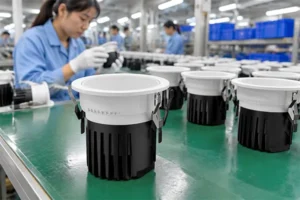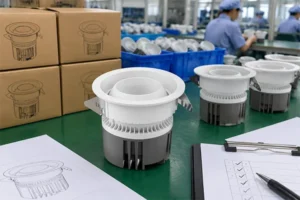

Finding reliable LED lighting manufacturer suppliers in China can feel difficult when many cities, factories, product claims, and price levels appear similar online. A poor sourcing decision can lead to inconsistent samples, delayed deliveries, certification gaps, or costly rework. In my experience, buyers get better results when they compare manufacturing clusters and verify individual factories carefully.
Zhongshan is often the most practical starting place for overseas buyers looking for LED lighting manufacturer suppliers in China, especially for commercial LED downlights, track lights, and linear office lights.1 However, the best city depends on the required product, customization level, order quantity, compliance needs, and delivery expectations. Buyers should evaluate the factory—not only the city—through samples, specifications, quality controls, certificates, and communication performance.
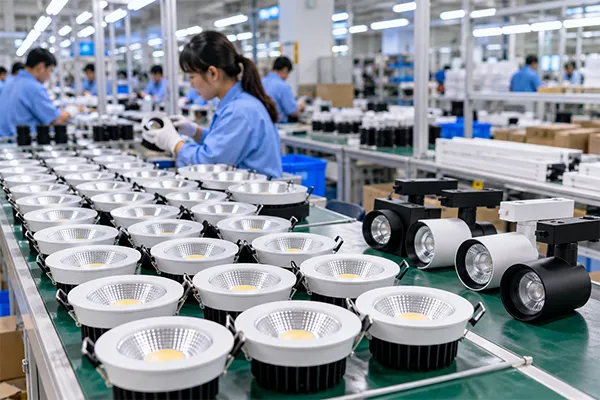
I have worked in Zhongshan’s LED lighting industry since our company was established in 2009. I have seen how a strong local supply chain can make sourcing easier, but I have also seen buyers make mistakes by assuming that a well-known lighting city automatically means every supplier is qualified. The real advantage comes from knowing what to verify.
Why Is Zhongshan a Strong Starting Point for LED Lighting Manufacturer Suppliers in China?
Many buyers need a supplier that can offer common commercial products, respond quickly, and adapt to changing project requirements. The challenge is that suppliers may use similar product names while offering very different materials, drivers, LED chips, quality controls, and service levels. Zhongshan gives buyers a broad starting point, but selection still requires discipline.
Zhongshan is a strong sourcing starting point because it has a concentrated commercial lighting ecosystem for products such as LED downlights, track lights, and linear lights2. Buyers can often compare more product options, OEM/ODM capabilities, component sources, and quotation structures in one region. Still, each factory’s specialization, quality system, and delivery reliability must be verified separately.
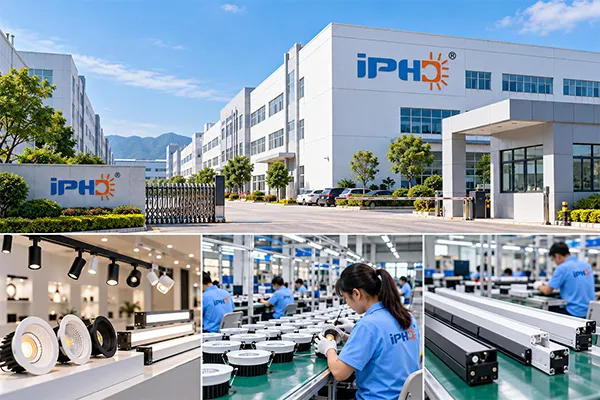
A Practical Cluster for Commercial Lighting
Zhongshan, particularly the Guzhen-area lighting cluster, is widely recognized by buyers as a practical place to begin commercial lighting sourcing. I believe its greatest value is not a city label. Its value is the concentration of lighting-related resources that can support product development, purchasing, assembly, packaging, and shipment coordination.
For overseas importers and project buyers, this can create useful sourcing efficiencies:
- A wider selection of standard commercial lighting formats
- Faster comparison of downlight, track light, and linear light designs
- Better access to suppliers willing to discuss OEM or ODM requirements
- More opportunities for small-batch trial orders3
- Easier coordination between lighting factories and component suppliers
- Shorter communication loops when specifications change
At Upward Lighting, I regularly receive requests from customers who need to adjust one or more basic parameters before ordering. These may include:
- Color temperature: such as 3000K, 4000K, or 6500K
- Wattage: based on lumen targets, ceiling height, and energy requirements
- Beam angle: for accent lighting, general lighting, or aisle coverage
- CRI: often 80, 90, or a project-specific requirement
- Surface finish: black, white, silver, gold, or customized colors
- Dimming compatibility: depending on the driver and market application
These requests are common in commercial lighting procurement. A regional cluster can make these conversations easier, but buyers should not assume all factories can implement customization consistently.
Why Product Breadth Matters
A buyer sourcing a hotel renovation, retail store chain, office building, or electrical distribution program may need multiple products from one supplier. For example, a project could require recessed downlights for general lighting, track lights for display areas, and linear office lights for workspaces.
This is where Zhongshan can be useful. Buyers can assess whether one qualified supplier can cover several product categories or whether they should use separate specialists.
| Product Requirement | What Buyers Should Confirm | Why It Matters |
|---|---|---|
| LED downlights | Cutout size, wattage, CCT, glare control, driver | Small dimensional changes can affect installation4 |
| LED track lights | Track adapter type, beam angle, CRI, aiming stability | Retail and gallery projects need accurate light direction |
| Linear office lights | Length, linking method, mounting type, UGR considerations | Office layouts need consistent installation and appearance |
| Customized finishes | Color code, finish sample, scratch resistance | A finish can differ between sample and mass production |
| Project packaging | Label, barcode, carton markings, manuals | Importers often need local-market-ready packaging |
I advise buyers to use Zhongshan as a place to create a supplier shortlist, not as the final reason to award an order.
Does a Lighting Manufacturing Cluster Guarantee a Reliable Factory?
A famous lighting city can create confidence too quickly. Buyers may see many catalogs, low quotations, and attractive showroom products, then assume the supplier has stable production capability. That assumption can create problems when the final goods do not match the approved sample or when project deadlines become tight.
No, a lighting manufacturing cluster does not guarantee that every factory is reliable. LED lighting manufacturer suppliers in China should be evaluated by their actual product specialization, quality process, engineering support, certification documentation, production capacity, and communication quality—not by location alone. A city can provide options, but the factory must prove suitability.
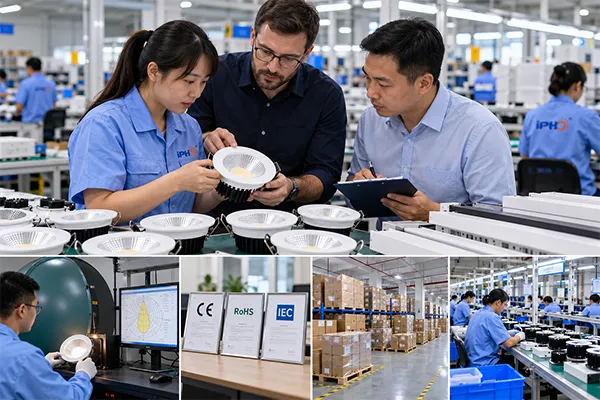
A Cluster Is an Advantage, Not a Quality Certificate
I often encourage overseas buyers to separate two questions:
- Is this city suitable for sourcing my product category?
- Is this specific factory suitable for my order?
The first question helps a buyer identify a useful manufacturing ecosystem. The second question protects the buyer’s budget, brand reputation, and project schedule.
A factory may be located in a strong lighting cluster but still have limitations. For example, one supplier may be good at entry-level residential downlights but not at commercial-grade anti-glare downlights. Another may offer many product photos but rely heavily on outsourced assembly. A third may quote quickly but struggle to maintain color consistency across repeat orders.
These factors should be reviewed before a purchase order is issued.
What I Would Verify Before Selecting a Supplier
When I speak with an importer, distributor, or project contractor, I recommend a structured factory evaluation. The buyer should request evidence, not only marketing statements.
A useful verification checklist includes:
- Product focus: Does the factory regularly manufacture the product type you need?
- Specification understanding: Can the supplier explain wattage, lumen output, CCT, beam angle, CRI, driver type, and installation method clearly?
- Sample consistency: Does the production sample match the approved sample?
- Component transparency: Can the factory identify key LED, driver, housing, optic, and cable specifications?
- Quality controls: Are incoming materials, assembly, aging, and final inspections documented?
- Customization ability: Can the supplier handle labels, packaging, finishes, and product parameters?
- Certificate documentation: Can the supplier provide relevant and current documents for buyer review?
- Delivery planning: Can the supplier explain lead times, production scheduling, and shipment readiness?
- Communication speed: Does the sales or project team answer technical questions accurately and promptly?
At Upward Lighting, we conduct a 100% aging test for 4 to 8 hours before shipment as part of our own production process. We use this process to check product operation before goods leave our facility. Buyers should treat this as an example of a factory practice to verify, not as a universal standard across all suppliers in Zhongshan or China.
I have learned that a supplier’s response to detailed questions is often more useful than its first quotation. A qualified supplier should be willing to clarify what is included, what is optional, and what requires further testing or approval.
How Should Buyers Compare LED Lighting Manufacturer Suppliers in China?
Low unit prices can look attractive at the quotation stage, especially for wholesalers and project buyers managing tight budgets. However, price comparisons become misleading when suppliers quote different drivers, LED configurations, materials, packaging, warranty terms, or certification scopes. Buyers need a like-for-like comparison method.
Buyers should compare LED lighting manufacturer suppliers in China using one detailed specification sheet and one consistent quotation format. The best comparison includes product parameters, approved samples, component details, testing practices, certificates, packaging, lead time, payment terms, and after-sales responsibilities. This approach reveals value and risk more clearly than unit price alone.
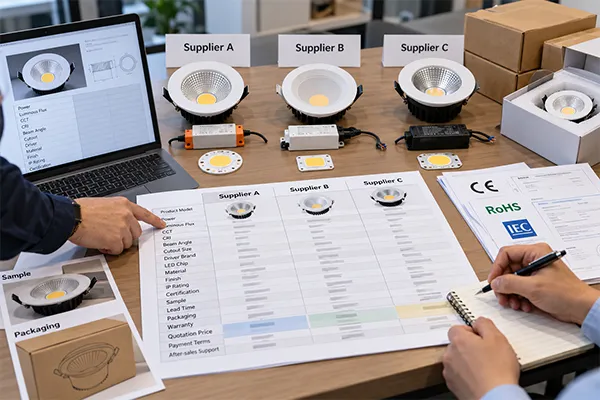
Start With a Clear Product Brief
A factory cannot provide a dependable quotation if the buyer provides only a product photo and a target price. A photo can show a general appearance, but it cannot define performance, safety requirements, material thickness, light quality, or installation details.
I recommend that buyers prepare a product brief before contacting suppliers. Even a simple spreadsheet can improve quotation accuracy.
| Specification Item | Example Buyer Requirement |
|---|---|
| Product category | Recessed LED downlight |
| Wattage | 12W |
| Input voltage | AC 220–240V |
| Color temperature | 3000K and 4000K |
| CRI | CRI 90 minimum |
| Beam angle | 36° |
| Finish | Matte black |
| Dimming | Triac dimming required |
| Installation | Recessed, cutout size specified |
| Certificate requirement | Verify applicable CE/RoHS documentation |
| Quantity | 500 units for initial order |
| Target delivery date | Required shipment-ready date |
| Branding | Private label and customized carton |
A detailed brief helps buyers identify suppliers that understand the application. It also reduces disputes later.
Compare Total Procurement Value
I recommend buyers avoid asking only, “Who has the lowest price?” A better question is, “What exactly am I receiving at this price?”
For example, two 20W track lights may have very different configurations:
| Comparison Area | Supplier A | Supplier B | Buyer Risk if Not Confirmed |
|---|---|---|---|
| LED source | Not specified | Identified in quotation | Inconsistent color or brightness |
| Driver | Generic description | Driver model listed | Dimming or reliability issues |
| CRI | “High CRI” | CRI 90 stated | Product may not meet project expectation |
| Housing | No material detail | Aluminum grade clarified | Thermal performance may vary |
| Warranty terms | General statement | Written warranty scope | Unclear responsibility after delivery |
| Packaging | Standard export carton | Carton details and labels confirmed | Higher damage or relabeling cost |
| Lead time | “Fast” | Production timeline listed | Delivery uncertainty |
A quote should be reviewed alongside the technical sheet, sample, and written commercial terms. If a supplier cannot explain the difference between options, I would consider that a warning sign.
Use Samples as a Procurement Gate
Samples are one of the best risk-control tools available to buyers.5 A buyer should evaluate more than whether the product turns on.
For commercial LED lighting, I suggest checking:
- Appearance and finish quality
- Size, cutout, and mounting compatibility
- Light color consistency
- Beam distribution and glare
- Heat management after operating time
- Driver noise or dimming behavior where relevant
- Label accuracy
- Packaging protection
- Installation accessories
- Consistency among multiple sample units
A buyer may also consider third-party laboratory testing or independent inspection when the project, market, or product risk justifies it. Application-specific decisions should be evaluated by qualified technical and compliance professionals.
What Quality and Compliance Questions Should Buyers Ask Suppliers?
Commercial lighting buyers often face pressure from contractors, end customers, local regulations, and procurement teams. A product may look suitable in a catalog but still fail to meet the exact requirements for a target market or installation. Clear questions help buyers identify gaps before production starts.
Buyers should ask LED lighting manufacturer suppliers in China about specifications, aging tests, inspection records, component traceability, certification documents, labeling, and delivery controls. Certificates such as CE and RoHS should be reviewed as documents relevant to the intended market and product configuration, rather than accepted as broad proof that every version of a product is compliant.6
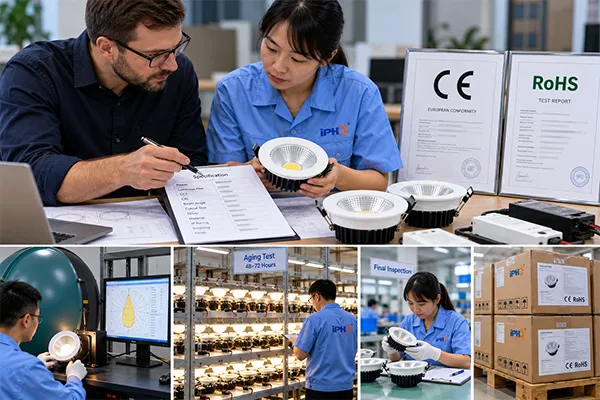
Ask About Quality Control in Practical Terms
Terms such as “high quality” and “strict inspection” are too broad to guide a purchasing decision. Buyers should ask what the factory actually does and what records it can provide.
At our facility, we perform a 100% aging test lasting between 4 and 8 hours before shipment. This is part of our own quality-control approach for our commercial lighting products. We use it to identify operational issues before packing. However, every buyer should ask each prospective factory to explain its own aging, inspection, and release process.
Useful questions include:
- How long is the aging test, and which products receive it?
- Is every unit tested, or is testing based on sampling?
- What checks occur before aging and after aging?
- How are defects recorded and handled?
- How does the factory control CCT and appearance consistency?
- Can the factory provide pre-shipment inspection photos or reports?
- What happens if the buyer finds a confirmed quality issue after delivery?
The answers should be specific. A factory that can explain its process clearly is easier to manage than one that gives only broad assurances.
Verify Certificates for the Exact Product
Certification is important, but buyers should verify the relevance and validity of documents. A certificate may apply only to a specific model, component combination, voltage range, or product version. A customized order may differ from the version described in the documentation.
At Upward Lighting, our products hold CE and RoHS certifications for relevant market-entry requirements. Buyers should still review the applicable documents for their selected model and target market. A buyer should also confirm whether a project requires additional testing, declarations, labels, or technical files.
Buyers should request:
- Certificate copies and report references
- Product model numbers covered by the document
- Issue dates and issuing organization details
- Voltage and frequency coverage
- Applicable standards or directives
- Product labels and declarations where relevant
- Confirmation that the ordered configuration matches the documentation
I recommend that buyers consult qualified compliance professionals when the installation, country, tender, or end-use environment has special requirements. This is particularly important for public projects, hospitality projects, healthcare facilities, and regulated electrical markets.
How Can Buyers Reduce Delivery and Communication Risk?
A suitable product is only part of a successful sourcing relationship. Delayed approvals, unclear packaging instructions, slow technical replies, and unrealistic production promises can affect a launch or project schedule. Buyers need to evaluate how the supplier manages communication before committing to a larger order.
Buyers can reduce delivery risk by confirming specifications, sample approval, production lead time, packaging requirements, inspection timing, and shipment documents in writing. Fast and accurate communication from LED lighting manufacturer suppliers in China is a meaningful indicator of supplier coordination7, but buyers should also request realistic schedules and clear responsibilities.
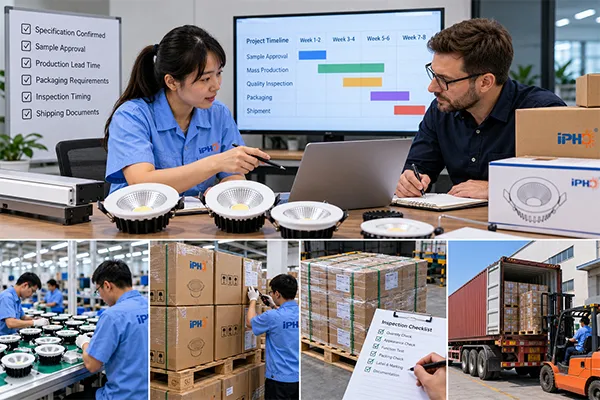
Test Communication Before You Place a Large Order
I believe communication is a practical supplier qualification tool. Before placing a large purchase order, buyers can observe how the supplier handles ordinary questions:
- Does the supplier reply within a reasonable timeframe?
- Does the supplier answer the exact technical question?
- Does the quotation match the requested specifications?
- Does the supplier identify unclear requirements instead of guessing?
- Does the supplier explain any price change caused by customization?
- Does the supplier provide clear sample and production timelines?
At Upward Lighting, we emphasize quick responses and quotation turnaround because buyers often need to make decisions quickly. Still, I always believe that accuracy matters more than speed alone. A fast but incomplete answer can create more problems than a slower, well-documented response.
Confirm the Order Path Before Production
A clear order workflow reduces misunderstandings. I suggest using a sequence like this:
- Finalize the specification sheet.
- Confirm the quotation and commercial terms.
- Approve physical samples or signed sample records.
- Confirm packaging, labels, manuals, and branding.
- Issue the purchase order with final details.
- Agree on production and inspection timing.
- Review pre-shipment information before balance payment or shipment release.
- Confirm shipping documents and destination requirements.
For repeat business, buyers should also track whether the supplier maintains the same product configuration. A reliable long-term supplier should manage approved specifications carefully, especially when a buyer has private-label requirements or multiple market versions.
Small-batch orders can be useful at the beginning of a relationship.8 They allow buyers to evaluate product consistency, service, packaging, and real delivery performance before expanding volumes. This approach may cost more per unit initially, but it can reduce expensive long-term risk.
Frequently Asked Questions
Is Zhongshan the best city for all LED lighting products in China?
No. Zhongshan is often a practical starting point for commercial downlights, track lights, and linear lights, but it is not automatically the best choice for every product type or buyer. Buyers should select a manufacturing cluster and factory based on their product specifications, certification needs, order size, and quality expectations.
Why do LED lighting quotes from Chinese suppliers vary so much?
Quotes can vary because suppliers may use different LED sources, drivers, aluminum housings, optics, CRI levels, dimming options, packaging, and quality-control processes. Buyers should compare quotations against one detailed specification sheet to ensure that products are genuinely comparable.
Should I request a sample before ordering LED lights from China?
Yes. A sample helps buyers assess product appearance, dimensions, lighting effect, beam angle, color temperature, installation, packaging, and functional performance. For larger or higher-risk projects, buyers may also consider independent inspection or professional technical evaluation before mass production.
Are CE and RoHS certificates enough for LED lighting imports?
CE and RoHS documents may be relevant for certain markets and product requirements, but they are not a universal answer for every destination or installation. Buyers should verify that documents apply to the exact product model and consult qualified compliance professionals for market-specific requirements.
What should I ask an OEM LED lighting supplier before placing an order?
Buyers should ask about product parameters, customization options, minimum order quantities, sample lead time, aging tests, inspection procedures, certificate coverage, packaging, production lead time, payment terms, and after-sales handling. Clear written confirmation reduces misunderstandings during production.
Conclusion
The best location for LED lighting manufacturer suppliers in China is not simply the city with the strongest reputation. Zhongshan is often an effective first stop for commercial lighting buyers because it offers broad product availability, OEM/ODM flexibility, and practical sourcing coordination. However, I recommend that every buyer verify the individual factory through detailed specifications, sample testing, quality-process questions, certificate review, and realistic delivery planning. If you are sourcing LED downlights, track lights, or linear office lights, I invite you to contact Upward Lighting for a clear quotation and a product discussion based on your project requirements.
"Ever wondered where the world buys its lights? Guzhen ...", https://www.facebook.com/FudanUni/posts/ever-wondered-where-the-world-buys-its-lights-guzhen-a-small-town-in-zhongshan-c/122279231144167255/. Industry-cluster research documents that the Guzhen area of Zhongshan contains a concentrated lighting manufacturing and supporting supply-chain ecosystem, providing context for its use as a sourcing location for lighting products. Evidence role: general_support; source type: research. Supports: The scale and concentration of lighting manufacturing, trading, and supporting supply-chain activity in the Zhongshan/Guzhen area.. Scope note: Evidence of cluster concentration does not establish that Zhongshan is the best or most practical city for every buyer, product, or order. ↩
"Guzhen, Guangdong", https://en.wikipedia.org/wiki/Guzhen,_Guangdong. An institutional profile of the Guzhen lighting cluster supports the presence of a geographically concentrated lighting-production and supply network in Zhongshan. Evidence role: general_support; source type: institution. Supports: The existence of a concentrated lighting industry and associated suppliers in Guzhen, Zhongshan.. Scope note: A cluster profile may not verify the production capability or specialization of every individual factory or every listed product type. ↩
"An Empirical Study of Flexibility in Manufacturing", https://sloanreview.mit.edu/article/an-empirical-study-of-flexibility-in-manufacturing/. Research on industrial clusters explains that dense networks of specialized firms can improve buyer–supplier matching and production flexibility, a mechanism that may facilitate trial sourcing arrangements. Evidence role: mechanism; source type: paper. Supports: How dense industrial clusters can improve supplier matching and production flexibility through specialized firms and local linkages.. Scope note: This mechanism does not directly demonstrate that Zhongshan lighting factories offer small-batch trial orders or specify their minimum order quantities. ↩
"How to Install Recessed Lighting: Complete Step-by- ...", https://amicolight.com/blogs/news/how-to-install-recessed-lighting-complete-step-by-step-guide?srsltid=AU7gw4XPVOCpPKlJFTgQKxJVqbWFF4PzoOdiQZMJPGdwTUOhAEAVwBRE. Luminaire installation guidance specifies required cutout dimensions and mounting clearances for recessed products, supporting the conclusion that dimensional variation can affect installation compatibility. Evidence role: mechanism; source type: institution. Supports: That recessed luminaires require specified mounting openings, clearances, and installation arrangements.. Scope note: Exact installation effects depend on the luminaire design, ceiling construction, mounting hardware, and applicable local electrical requirements. ↩
"First article inspection", https://en.wikipedia.org/wiki/First_article_inspection. Quality-management guidance recognizes verification and inspection of product outputs as controls for confirming conformity with specified requirements before acceptance or release. Evidence role: mechanism; source type: institution. Supports: The role of product verification, inspection, and approval of production outputs in controlling conformity risk before release or procurement.. Scope note: Sample approval reduces but cannot eliminate production risk, because mass-produced goods may differ from a sample without effective process controls and inspection. ↩
"Compliance FAQs: CE Marking", https://www.nist.gov/standardsgov/compliance-faqs-ce-marking. European Commission guidance explains that CE marking and RoHS compliance depend on applicable legal requirements, conformity assessment, and supporting technical documentation for the product placed on the market. Evidence role: mechanism; source type: government. Supports: That CE marking is based on applicable EU requirements and manufacturer conformity assessment, while RoHS obligations apply to electrical and electronic equipment within the directive's scope.. Scope note: This support concerns EU regulatory frameworks and does not determine compliance obligations in non-EU markets or verify any supplier's documents. ↩
""Information Sharing, Buyer-Supplier Relationships and Firm ...", https://oasis.library.unlv.edu/mib_fac_articles/14/. Supply-chain research associates timely, accurate information exchange between trading partners with improved coordination and operational performance, supporting communication quality as a supplier-assessment signal. Evidence role: mechanism; source type: paper. Supports: The relationship between information sharing, communication quality, coordination, and supply-chain performance.. Scope note: Communication responsiveness is only one indicator and cannot independently establish a supplier's manufacturing quality, financial stability, or delivery performance. ↩
"Risk factors in the assessment of suppliers - PMC - NIH", https://pmc.ncbi.nlm.nih.gov/articles/PMC9342744/. Research on supplier qualification and pilot production indicates that limited initial engagements can provide information about supplier performance before larger commitments are made. Evidence role: mechanism; source type: research. Supports: That staged supplier qualification and pilot production can generate performance information before a buyer commits to larger-scale purchasing.. Scope note: A small initial order may not reveal all risks that emerge at scale, including capacity constraints, long-term component changes, and repeat-order consistency. ↩