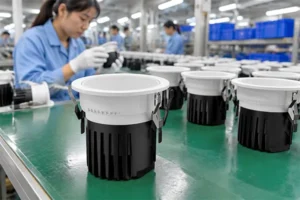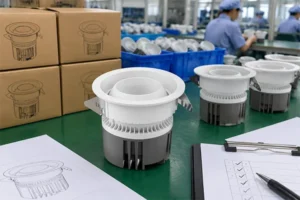

Wholesale lighting fixtures can be difficult to source when every supplier claims to offer factory pricing, fast delivery, and customization. I often see buyers lose time comparing incomplete quotes or choosing suppliers that cannot support repeat orders. I recommend choosing a sourcing route based on application, market requirements, order volume, and long-term supply risk.
Wholesale lighting fixtures are available from direct manufacturers, trading companies, B2B marketplaces, international trade fairs, and local distributors.1 I believe the best option depends on the buyer’s required product category, target-market documentation, expected quantity, customization needs, delivery timeline, and ability to verify product quality and supplier capabilities before placing an order.
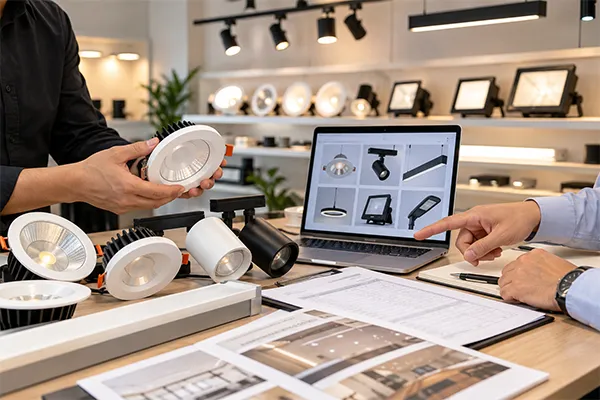
I work with overseas wholesalers, contractors, importers, and local lighting brands from our base in Zhongshan, China. In many conversations, I find that the real question is not simply where to buy lighting. The better question is which supplier model can reduce procurement surprises after the first quotation.
Where Can I Find Wholesale Lighting Fixtures From Direct Manufacturers?
Many buyers want lower unit prices and direct access to technical teams, but they worry about factory verification, communication, and export coordination. I understand this concern because a direct manufacturer can be an excellent fit, yet not every factory is suited to every order or market.
I suggest sourcing wholesale lighting fixtures directly from manufacturers when buyers need stable repeat supply, product customization, clearer technical communication, or higher-volume purchasing. A manufacturer can often provide more control over specifications and production, but buyers should verify its actual product range, quality process, export experience, and documentation capabilities.
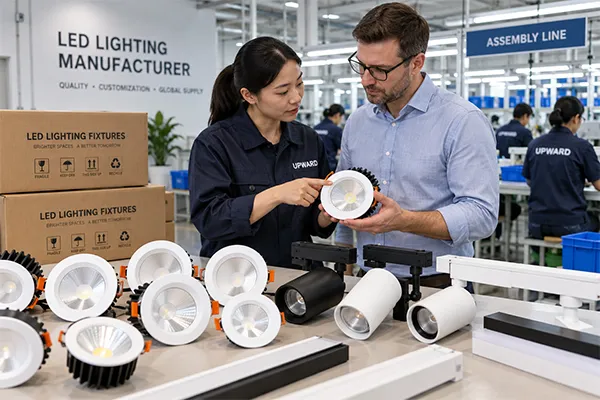
When a Direct Lighting Manufacturer Makes Sense
I usually recommend a direct manufacturer for buyers who have a defined purchasing plan rather than a one-time requirement. This route can fit:
- Importers building a repeatable product range
- Local lighting brands seeking OEM or private-label products
- Wholesalers ordering standard LED downlights, track lights, or office linear lights regularly
- Contractors with consistent project specifications
- Distributors that need controlled packaging, finishes, or product parameters
- Buyers that need engineering feedback before committing to a large order
For example, I regularly receive requests that begin with, “Please send your lowest price for a 12W downlight.” I can provide a quote, but that question alone does not establish whether the buyer needs a recessed downlight for retail, hospitality, office, residential, or another application. Beam angle, color temperature, cutout size, driver type, CRI, glare control, housing finish, and packaging may all affect the suitable option.
What Buyers Should Verify Before Working Directly
A factory-looking website or polished catalog does not prove that a supplier manufactures the quoted product.2 I encourage buyers to verify the operating role before comparing prices.
| Verification point | Why I consider it important | Questions I would ask |
|---|---|---|
| Product specialization | A supplier may assemble some products and source others. | Which product categories do you make or control directly? |
| Production process | Production visibility helps buyers understand consistency risks. | Can you show production, assembly, aging, and packing processes? |
| Quality-control process | A quote does not explain how defects are controlled. | What checks occur before shipment? Is aging testing performed? |
| Sample consistency | A sample should represent the agreed production specification. | Will mass production follow the approved sample and BOM? |
| Export capability | Export documents and shipping coordination affect delivery. | Which documents can you provide, and what is the normal export process? |
| Repeat-order control | A competitive first order is not enough for a distributor. | How do you maintain specifications for repeat orders? |
At Upward Lighting, I explain that our LED lighting products undergo a 100% aging test of approximately four to eight hours before shipment3 as part of our stated process. However, I still advise buyers to define their own acceptance criteria and verify whether that process aligns with their application, contractual requirements, and destination-market expectations.
I believe a direct manufacturer should be evaluated as a long-term production partner, not only as a source of an initial low quotation.
Are B2B Platforms the Best Place to Find Wholesale Lighting Fixtures?
B2B platforms make supplier discovery faster, but they also make it easy to confuse listings with verified manufacturing capability. I often hear from buyers who assume that every supplier on a marketplace is a factory. That assumption can create problems when technical questions, customization, or shipment issues arise.
I see B2B platforms as useful tools for finding wholesale lighting fixtures, comparing product categories, and creating an initial supplier shortlist. However, I do not treat a platform profile as proof that a seller is a manufacturer, controls quality, owns the product design, or can meet the buyer’s compliance and delivery requirements.4
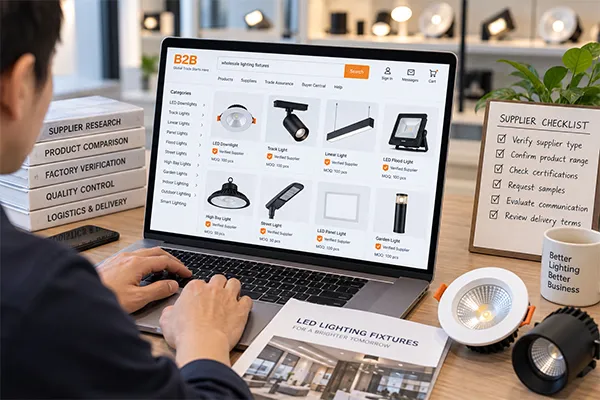
Use Platforms for Discovery, Not Final Approval
I think B2B platforms can be especially useful when buyers need to understand the market quickly. They can help buyers identify typical product designs, common wattage ranges, packaging approaches, and broad price bands for commercial LED lighting.
Still, marketplace price comparisons often become misleading because listings may differ in ways that are not visible in the headline price:
- One listing may include a driver while another excludes it.
- One supplier may quote a lower CRI or a different LED configuration.
- One product may have a thinner housing or a different thermal design.
- One quote may use a basic inner box, while another includes retail-ready packaging.
- One seller may quote EXW, while another may quote FOB or another trade term.5
- One supplier may offer documents for review, while another may not have relevant documentation available.
A Practical Marketplace Screening Process
When I source or evaluate suppliers, I would not send the same one-line request to twenty companies. I would prepare a concise request for quotation with enough detail to compare responses fairly.
I recommend including:
- Product category: such as recessed LED downlight, LED track light, or office linear light.
- Application: retail shop, office, hotel corridor, residential project, warehouse, or another installation environment.
- Required parameters: wattage, color temperature, beam angle, CRI, voltage, dimensions, finish, and mounting method.
- Destination market: so the supplier can identify which documentation or marking discussions may be relevant.
- Expected order volume: sample quantity, trial order, project quantity, or annual estimate.
- Customization request: logo, color, packaging, power, CCT, beam angle, or a new design requirement.
- Requested trade term and destination port: if the buyer needs a comparable shipping quotation.
I have seen buyers receive ten prices and still have no real comparison because each supplier quoted a different product configuration. I would rather compare three complete quotations against one written specification than compare twenty incomplete offers.
Should I Buy Wholesale Lighting Fixtures From a Trading Company?
Some buyers avoid trading companies because they assume a trading company always adds unnecessary cost. I think that view is too simple. A capable trading company can be helpful when a buyer needs mixed categories, consolidated purchasing, local coordination, or easier communication across several factories.6
I recommend considering trading companies for wholesale lighting fixtures when buyers need to combine products from multiple categories or factories, want one purchasing contact, or lack the time to manage supplier coordination themselves. Buyers should still confirm the trading company’s supplier controls, product knowledge, quality process, and responsibility for post-sale issues.
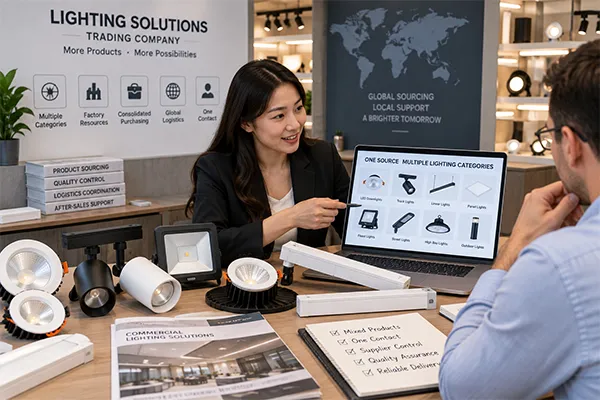
Manufacturer and Trading Company: Different Roles, Different Risks
I do not consider manufacturers and trading companies interchangeable. Their roles can overlap, but their controls are different.
| Supplier type | Potential strengths | Potential limitations | Best fit |
|---|---|---|---|
| Direct manufacturer | Product knowledge, specification control, OEM/ODM discussions, production visibility | May focus on a limited product range | Repeat buyers, brands, larger projects, focused product lines |
| Trading company | Mixed-product sourcing, consolidated communication, supplier coordination | May have less direct production control | Buyers needing multiple lighting categories or related accessories |
| Local distributor | Faster local availability, local language support, smaller quantities | Higher unit pricing and limited customization may apply | Urgent replenishment, local projects, low-volume purchases |
| Marketplace seller | Fast discovery and broad supplier access | Operating role may be unclear | Initial research and supplier shortlisting |
Questions I Would Ask a Trading Company
A professional trading company should be able to answer practical questions clearly. I would ask:
- Which factories produce the proposed items?
- Does the company conduct incoming, in-process, or pre-shipment inspections?
- Who approves changes in components or specifications?
- Can the company provide consistent models for repeat orders?
- Who is responsible if an agreed specification is not met?
- Can it support mixed-container orders or consolidated packaging?
- Can it provide samples from the proposed production source?
I have seen situations where a buyer needs LED downlights, track lighting, linear office lights, emergency accessories, and decorative products in one shipment. Managing several direct factories may be efficient for an experienced procurement team, but it can create complexity for a smaller importer. In that case, a qualified trading company may offer value through coordination rather than simply through product pricing.
How Do I Compare Wholesale Lighting Fixtures Beyond Unit Price?
The lowest quote can look attractive, especially when margins are tight. Yet I often find that buyers discover major differences only after samples arrive, packaging changes, lead times extend, or repeat orders do not match the first shipment. A lower unit price does not automatically mean lower total procurement cost.7
I compare wholesale lighting fixtures by total procurement risk, not unit price alone. Buyers should assess product specification, documentation availability, MOQ, packaging, quality-control methods, payment terms, production lead time, spare-part support, and repeat-order consistency before selecting a supplier.
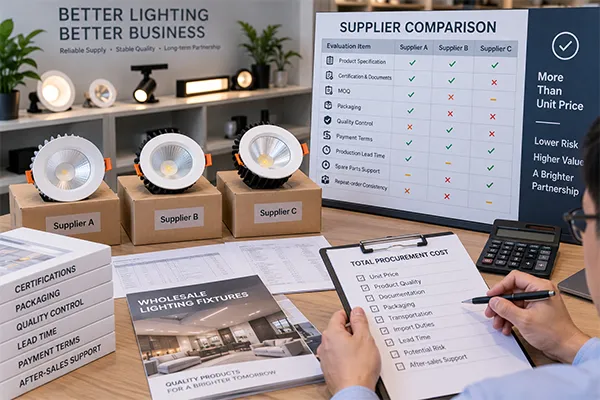
Build a Like-for-Like Quote Comparison
I suggest that buyers create a comparison sheet before negotiating. This approach makes hidden differences visible and gives suppliers a fair basis for quoting.
| Comparison item | What I would confirm | Risk if ignored |
|---|---|---|
| LED and driver configuration | Brand, model, electrical input, replacement policy | Output, lifetime, and consistency may differ |
| Light quality | CCT, CRI, beam angle, glare considerations, binning approach | Installed appearance may not meet project expectations |
| Mechanical details | Material, dimensions, cutout, track adapter, finish | Installation issues or inconsistent appearance |
| Packaging | Inner box, master carton, labels, drop protection | Transit damage and retail presentation problems |
| MOQ | Standard MOQ, color MOQ, custom packaging MOQ | Order cost can rise unexpectedly |
| Lead time | Sample lead time and mass-production lead time | Project schedules can be affected |
| Documentation | Available test reports, declarations, and certificates for buyer review | Market-entry or tender requirements may not be met |
| Warranty terms | Scope, exclusions, remedy process | Post-sale disputes can become costly |
Compliance Documents Need Verification
I advise buyers to avoid treating a logo, statement, or uploaded certificate image as final proof of suitability. Requirements vary by destination market, product category, application, importer responsibility, and project requirement.8
At our company, we state that products hold certifications such as CE and RoHS. However, I would still encourage every buyer to review relevant documents, confirm that they apply to the exact product configuration, check validity and scope, and obtain qualified advice where application-specific decisions are required.
A project buyer may need different evidence than a distributor. A tender may request particular documents. A local importer may have its own legal obligations. I cannot responsibly give a universal country-specific approval conclusion without reviewing the destination market and the exact product.
Think About Replenishment Before the First Order
I believe repeat orders reveal more about a supplier than a first sample order9. I would ask how the supplier manages component substitutions, CCT consistency, finish consistency, and packaging changes over time.
For a distributor, a downlight that looks acceptable today but changes slightly in trim color or cutout dimension six months later can create stock and customer-service problems. I would therefore include repeat-order controls in the procurement discussion from the beginning.
What Should I Define Before Searching for Wholesale Lighting Fixtures?
A broad search creates broad, inconsistent quotations. I often receive requests for “customizable lights” without a product drawing, installation condition, quantity forecast, or delivery target. Suppliers cannot give reliable answers when the purchasing brief is not sufficiently defined.
Before searching for wholesale lighting fixtures, I recommend defining the installation application, target market, required lighting parameters, expected quantity, budget position, customization scope, and replenishment plan. This information helps buyers select suitable supplier types and receive quotations that can be compared accurately.
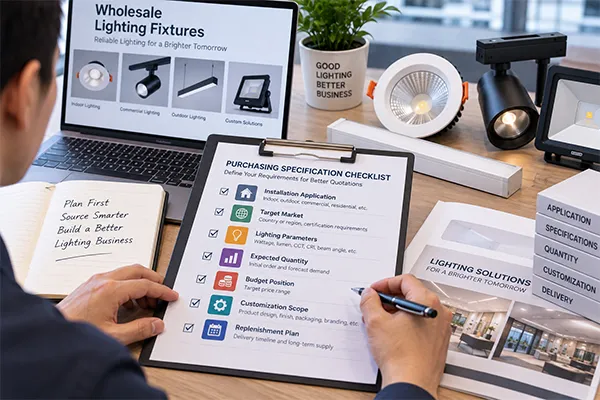
Start With the Installation Context
Technical specifications matter only when they fit the project or sales channel. I would begin with the location and installation purpose.
For example:
- A retail track light may need focused beam options, good color rendering, controlled glare, and a compatible track adapter.
- An office linear light may require a specific mounting method, length, optical distribution, and visual comfort considerations.
- A recessed LED downlight may require a defined cutout, ceiling depth, beam angle, trim color, and driver arrangement.
- A hospitality installation may prioritize consistent warm color temperature, finish quality, and dimming compatibility.
- A wholesale stock item may prioritize a stable, popular specification that can be replenished efficiently.
I have found that buyers make faster progress when they can describe the application in one or two precise sentences. “We need 1,500 recessed downlights for a chain-store renovation, with a consistent black finish and a defined cutout,” is far more actionable than “Please quote your best downlight.”
Customization Should Be Specific
I work with OEM and ODM requirements, including requests for color temperature, wattage, beam angle, CRI, surface finish colors, and packaging. Still, I always explain that “customizable” is not the same as “available immediately.”
- Feasibility: Some changes need new components, tooling, optics, or driver validation.
- MOQ: A custom finish or package may require a higher minimum order quantity.
- Lead time: New artwork, samples, approvals, and material preparation can extend the schedule.
- Cost: Small-batch customization may carry setup or material costs.
- Responsibility boundaries: Buyers and suppliers should agree on drawings, approved samples, labels, and final specifications.
My Pre-Sourcing Checklist
Before I begin supplier outreach, I would prepare the following checklist:
- Product type and installation method
- Project or resale application
- Required dimensions and cutout, where relevant
- Wattage, CCT, CRI, beam angle, and voltage requirements
- Dimming or control requirements, if applicable
- Target market and documentation requirements to verify
- Standard versus custom product requirements
- Sample quantity and estimated first-order quantity
- Forecast for repeat orders
- Packaging, labeling, logo, and barcode needs
- Required delivery date and requested trade terms
This preparation does not remove every sourcing risk, but it turns an uncertain search into a structured purchasing process.
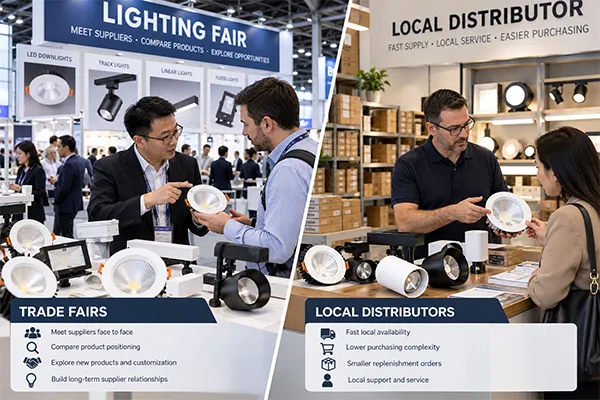
Can Local Distributors and Trade Fairs Help Me Source Wholesale Lighting Fixtures?
Some buyers need goods quickly, want to inspect products in person, or prefer local service. Others need to build direct overseas relationships and compare many suppliers within a short time. I see local distributors and trade fairs as useful routes, but each serves a different procurement purpose.
I recommend local distributors for fast local availability, lower purchasing complexity, and smaller replenishment orders. I recommend trade fairs for meeting suppliers, comparing product positioning, and beginning deeper verification. Neither route removes the need to confirm specifications, documents, pricing terms, and supplier responsibility.
When Local Distribution Is Worth the Premium
A local distributor may provide stock availability, local invoicing, language support, and a familiar returns process. I think this can be valuable for contractors facing urgent deadlines or businesses testing a new product category with low quantities.
However, local stock may limit the buyer’s choice of wattage, finish, beam angle, packaging, or branding. Unit prices may also be higher because the distributor carries inventory, provides local service, and manages its own risk.11
I would choose a local distributor when:
- The installation deadline is urgent.
- The order quantity is too low for efficient import.
- The buyer needs local stock replacement.
- The product is standard and does not require customization.
- The buyer values simplified purchasing over direct-factory control.
How I Would Use a Trade Fair
Trade fairs can help buyers evaluate product presentation, communication quality, and category depth. A buyer can compare commercial lighting suppliers face to face, inspect physical samples, and ask more detailed questions than a marketplace chat usually supports.
Still, I would not place a large order based only on a booth visit.12 I would use the event to create a shortlist, then continue with documentation review, samples, specification confirmation, and commercial due diligence.
At a fair, I would ask suppliers:
- Which products are standard production models?
- Which items are made directly versus externally sourced?
- What is the usual MOQ for standard and customized orders?
- How does the company manage aging, inspection, and packing?
- What documents are available for the exact models under discussion?
- What lead times apply after sample approval?
- How are repeat orders controlled?
I have found that a productive supplier conversation usually becomes more specific after the buyer explains the installation context and expected volume. The goal is not merely to collect catalogs. The goal is to identify suppliers whose operating model fits the buying plan.
Frequently Asked Questions
Is it cheaper to buy wholesale lighting fixtures directly from China?
I find that direct sourcing can reduce some layers of distribution, particularly for repeat orders and defined specifications. However, buyers should include sampling, freight, duties, documentation, inspection, packaging, communication, and inventory risks in the full calculation. The lowest factory quote does not always produce the lowest landed cost.
How can I tell whether a lighting supplier is a real manufacturer?
I would ask about product specialization, production processes, quality checks, factory location, sample control, and repeat-order management. I would also request evidence appropriate to the purchasing decision, such as factory information, production photos or video discussions, product documents, and samples. A platform listing alone is not enough.
What is the typical MOQ for wholesale LED lighting?
MOQ varies by product, configuration, packaging, and customization level. Standard LED downlights or track lights may support lower trial quantities than products with custom colors, branded packaging, special drivers, or new tooling. I recommend confirming MOQ separately for samples, standard orders, and customized production.
Do I need custom lighting fixtures for my project?
I would only choose customization when a standard product cannot meet the application, brand, installation, or sales-channel need. Customization can improve fit, but it may increase MOQ, cost, development work, and lead time. Buyers should first compare suitable standard options against the actual project requirement.
What documents should I request from a wholesale lighting supplier?
I recommend requesting documents relevant to the exact product and target market, such as specifications, drawings, test reports, declarations, and available certification documents. Buyers should verify document scope, model references, validity, and destination-market suitability. Qualified professional guidance may be needed for project-specific or market-specific compliance decisions.
Conclusion
I believe the best place to find wholesale lighting fixtures depends on how a buyer plans to sell, install, replenish, and support the products after purchase. Direct manufacturers, trading companies, platforms, trade fairs, and local distributors can all serve useful roles. I recommend that buyers define the application and specifications first, verify each supplier’s operating role, and compare total procurement risk instead of headline price alone. If you need an OEM/ODM discussion for LED downlights, track lights, or office linear lights, I welcome you to contact Upward Lighting for a clear quotation and specification review.
"Trade Shows - International Trade Administration", https://www.trade.gov/trade-shows. International trade guidance describes direct supplier relationships, intermediaries, trade events, distributors, and online business platforms as common channels through which firms identify and procure goods across borders. Evidence role: general_support; source type: government. Supports: International buyers use direct suppliers, intermediaries, trade events, distributors, and digital marketplaces as procurement and supplier-discovery channels.. Scope note: The source may address international sourcing generally rather than lighting fixtures specifically. ↩
"Perform Due Diligence - International Trade Administration", https://www.trade.gov/perform-due-diligence. Trade due-diligence guidance indicates that supplier identity and capability should be verified through information beyond online marketing materials, such as business records, site verification, references, and product documentation. Evidence role: general_support; source type: government. Supports: Supplier due diligence should rely on verification beyond marketing materials and online representations.. Scope note: Such guidance supports the need for verification but does not establish that every polished supplier website misrepresents manufacturing status. ↩
"[PDF] Stress Testing of Organic Light-Emitting Diode Panels and Luminaires", https://www.energy.gov/sites/prod/files/2018/05/f51/ssl_oled-stresstest_2018.pdf. Reliability literature on LEDs and electronic systems describes burn-in or aging procedures as methods used to screen for early-life failures and evaluate performance stability before deployment. Evidence role: mechanism; source type: research. Supports: Burn-in or aging procedures are used in electronics and LED-product quality practices to identify early-life failures and assess performance stability.. Scope note: This evidence supports the general purpose of aging tests, not the company's stated 100% coverage or its specific four-to-eight-hour procedure. ↩
"[PDF] The Role of Digital Platforms in the Collection of VAT/GST on Online ...", https://www.oecd.org/content/dam/oecd/en/publications/reports/2019/06/the-role-of-digital-platforms-in-the-collection-of-vat-gst-on-online-sales_3896ff29/e0e2dd2d-en.pdf. Research on electronic B2B marketplaces finds that online listings can facilitate supplier discovery while leaving information asymmetries concerning supplier capability, product quality, and transaction performance. Evidence role: mechanism; source type: paper. Supports: Online B2B marketplace information can reduce search costs but does not eliminate information asymmetry regarding supplier capabilities and transaction performance.. Scope note: The evidence concerns B2B marketplaces generally and does not assess any particular platform or lighting seller. ↩
"Know Your Incoterms - International Trade Administration", https://www.trade.gov/know-your-incoterms. Incoterms guidance defines EXW and FOB as different delivery rules, with differing allocations of transport arrangements, costs, export-related responsibilities, and transfer of risk between buyer and seller. Evidence role: definition; source type: institution. Supports: EXW and FOB are distinct Incoterms that allocate delivery obligations, costs, and risk differently between seller and buyer.. ↩
"[PDF] Import Uncertainty and Export Dynamics - World Bank Document", https://openknowledge.worldbank.org/bitstreams/e65b8a2c-eae0-4f55-95bc-7e785f2df75a/download. Research on trade intermediaries shows that intermediaries can connect buyers with multiple producers and provide coordination services that lower search, communication, and transaction-management burdens. Evidence role: general_support; source type: research. Supports: Trade intermediaries can reduce coordination burdens by connecting buyers with multiple producers and handling aspects of cross-border transactions.. Scope note: The evidence describes intermediary functions in general and does not demonstrate that any individual trading company will provide effective quality control or post-sale support. ↩
"Application of Mathematical Modeling in Cost Control of Medical ...", https://pmc.ncbi.nlm.nih.gov/articles/PMC9283075/. Public-procurement and total-cost-of-ownership guidance recognizes that acquisition decisions may require consideration of costs and risks beyond the quoted unit price, including logistics, quality, operation, and lifecycle factors. Evidence role: general_support; source type: government. Supports: Procurement evaluation may account for costs beyond the initial purchase price, including logistics, quality, maintenance, and supply-related risks.. Scope note: The relevant cost categories vary by product, contract terms, and buyer circumstances. ↩
"CE marking - Internal Market, Industry, Entrepreneurship and SMEs", https://single-market-economy.ec.europa.eu/single-market/goods/ce-marking_en. Regulatory guidance on electrical products explains that applicable conformity obligations depend on the relevant legal framework, the product placed on the market, and the responsibilities assigned to manufacturers, importers, and distributors. Evidence role: general_support; source type: government. Supports: Electrical-product conformity requirements and importer obligations depend on applicable legislation, product characteristics, intended market, and the economic operator's role.. Scope note: Requirements must be checked for the specific destination jurisdiction and product configuration; this general guidance is not a legal determination for a particular fixture. ↩
"[PDF] Use of quality assurance systems in the fastener industry", https://nvlpubs.nist.gov/nistpubs/Legacy/IR/nistir6001.pdf. Quality-control guidance explains that acceptance of individual samples cannot by itself assure continuing production conformity, which depends on controlled processes, monitoring, and appropriate inspection methods. Evidence role: mechanism; source type: government. Supports: Product quality assurance requires process control and ongoing monitoring because a sample inspection does not fully characterize continuing production output.. Scope note: The principle is general quality-management evidence and does not measure the performance of a particular lighting supplier. ↩
"Why Focusing on Lead Time, Not Just Efficiency and Cost ...", https://interpro.wisc.edu/lead-time-drives-manufacturing-success/. Manufacturing research on mass customization finds that increased product variety can require additional engineering, setup, coordination, and production planning, with potential effects on cost and lead time. Evidence role: mechanism; source type: paper. Supports: Customization increases product and process variety and can require additional engineering, setup, coordination, and production planning.. Scope note: The size of these effects depends on the design change, production technology, order volume, and supplier capabilities. ↩
"Retailer Inventory and Pricing Behavior During Supply ...", https://www.congress.gov/crs-product/R48916. Distribution-channel literature identifies inventory holding, logistics, customer service, financing, and risk bearing as functions performed by wholesalers and distributors, each of which contributes to channel cost. Evidence role: mechanism; source type: education. Supports: Wholesalers and distributors perform inventory, logistics, financing, service, and risk-bearing functions that add costs within distribution channels.. Scope note: This explains why distributor pricing may differ from factory pricing but does not establish that every local distributor is more expensive. ↩
"Perform Due Diligence - International Trade Administration", https://www.trade.gov/perform-due-diligence. Export and procurement guidance treats trade fairs as useful venues for identifying and meeting prospective suppliers, while recommending further verification of capability, product requirements, commercial terms, and business credentials before major transactions. Evidence role: general_support; source type: government. Supports: Trade shows can support supplier discovery and initial assessment, while substantial commercial commitments require additional verification and contractual due diligence.. Scope note: The appropriate depth of due diligence depends on transaction value, product risk, jurisdiction, and the buyer's existing relationship with the supplier. ↩