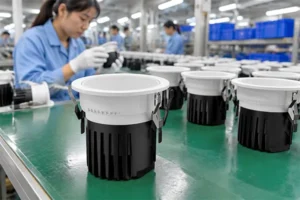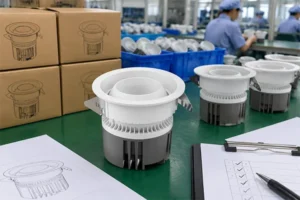

LED wholesale supply can be difficult to evaluate because many buyers see similar product photos, low prices, and quick replies from very different suppliers. A poor match can lead to inconsistent specifications, delayed shipments, or products that do not fit the target market. I recommend matching the source, product requirements, and verification process before comparing quotations.
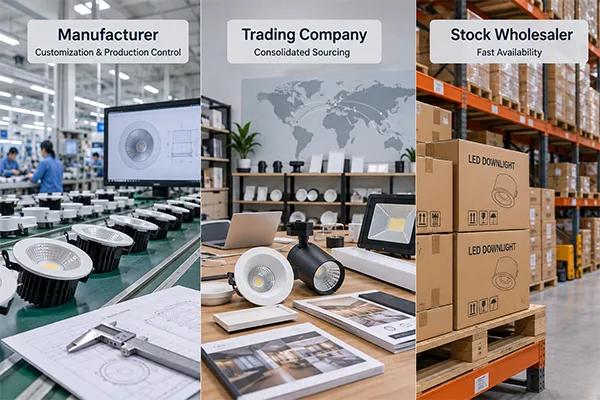
The best place to find LED wholesale supply is through a supplier type that fits your commercial needs: a manufacturer for customization and production control, a trading company for consolidated sourcing, or a stock wholesaler for fast availability1. Buyers should then verify product specifications, quality-control evidence, delivery capability, and market-specific compliance documents before placing an order.
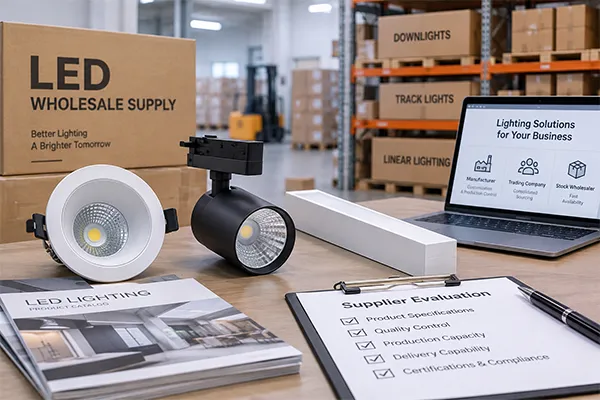
In my conversations with overseas importers, contractors, distributors, and lighting brands, I have found that the real question is rarely “Which website has LED products?” The more useful question is: Which supplier can deliver the right product, consistently, at a commercially workable level of risk? That requires a more structured sourcing approach.
Which Type of LED Wholesale Supply Source Fits Your Business?
When buyers begin searching for LED wholesale supply, they often compare all suppliers as if they offer the same service. That creates confusion. A factory, a trading company, and a local stock wholesaler may all quote an LED downlight, but their pricing model, lead time, customization options, and production control can be very different.
Manufacturers are generally suitable for buyers who need stable specifications, OEM/ODM support, and repeatable production. Trading companies can help buyers consolidate multiple categories, while stock wholesalers may suit urgent or lower-volume requirements. The right LED wholesale supply source depends on your order size, customization needs, target delivery date, and ability to manage supplier verification.2
Manufacturers: Better for Product Control and Customization
A direct LED manufacturer may be a practical choice when a buyer wants more control over product parameters and long-term supply. This is especially relevant for local lighting brands, importers, and project procurement teams buying recurring ranges of:
- LED downlights
- LED track lights
- Linear office lights
- Commercial recessed lighting
- Custom-finished architectural fixtures
At Upward Lighting, I regularly receive requests to adjust color temperature, wattage, beam angle, CRI, and surface finish. These are common OEM/ODM discussion points, but a buyer should not assume every factory has the same engineering resources, component supply stability, or minimum order policy.
A manufacturer can often offer clearer production information because it is closer to the assembly and quality-control process. However, a factory relationship also requires buyers to define specifications carefully. A vague request for “a 20W black track light” may receive a quotation, but it may not establish the driver brand, lumen output, track adapter type, beam angle, CRI, dimming method, or required certification documentation.
Trading Companies: Better for Consolidated Purchasing
Trading companies can be useful when a buyer needs several categories from different factories. For example, an electrical wholesaler may want downlights, track lights, LED strips, switches, and related accessories in one shipment.
The benefit is convenience. The risk is that the buyer may have less direct visibility into who makes each item and how each factory controls quality.3 I suggest asking a trading company whether it can identify the product manufacturer, provide product-specific documents, and explain how it handles incoming inspection.
Stock Wholesalers: Better for Speed, Not Always Continuity
Stock wholesalers can offer quick access to standard lighting products that are already available locally or in a regional warehouse. This can help contractors who need replacements or distributors testing a small product category.
Still, stocked products may have limits:
| Supply Source | Typical Strength | Potential Limitation | Best-Fit Buyer |
|---|---|---|---|
| LED manufacturer | Customization, production visibility, repeat supply | Longer setup and verification process | Brands, importers, project buyers |
| Trading company | Multi-category sourcing and consolidation | Less direct production visibility | General wholesalers, mixed-product buyers |
| Stock wholesaler | Speed and small immediate purchases | Limited customization and stock continuity | Contractors, urgent replenishment buyers |
A low unit price does not automatically make one source better. I encourage buyers to include inspection costs, freight planning, rework exposure, communication time, and stock continuity in their comparison4.
How Should You Evaluate an LED Wholesale Supply Supplier?
A supplier can reply within minutes, hold a strong marketplace ranking, or offer the lowest quotation, yet still be a poor fit for a commercial lighting program. The risk becomes clear later, when a shipment arrives with inconsistent color temperature, different drivers, incomplete documentation, or unclear responsibility for defects5.
Buyers should evaluate LED wholesale supply through evidence rather than marketing claims. The most useful checks include specification consistency, production capability, quality-control procedures, sample quality, document validity, quotation clarity, and delivery communication. A reliable supplier should answer detailed technical and commercial questions in a clear, consistent way.
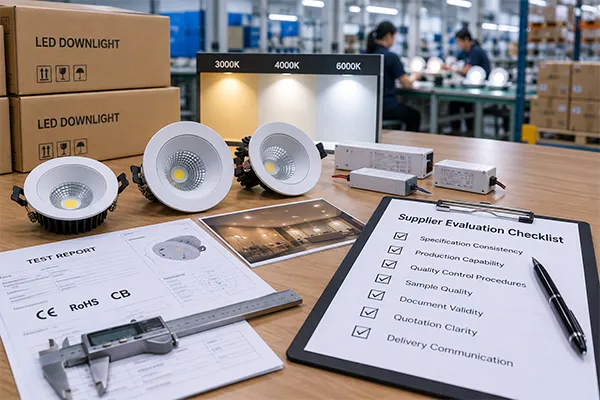
Start With Specification Consistency
Specification consistency is one of the most important quality-control concepts in LED procurement. A catalog may show a product family with multiple wattages and sizes, but buyers need to confirm the exact configuration that will be quoted and produced.
For each product, I recommend asking for a product specification sheet that identifies:
- Model number and product dimensions
- Rated wattage and input voltage
- Color temperature, such as 3000K, 4000K, or 6500K
- Beam angle
- CRI requirement
- Lumen output and efficacy information
- Driver configuration and dimming requirement
- Housing material and finish color
- IP rating, where applicable
- Required marks, reports, or compliance documents
This level of detail reduces the chance that the sample, quotation, purchase order, and final production differ from one another.6
In our quotation conversations, I find that detailed RFQs usually lead to more useful supplier comparisons. They also reveal whether a supplier understands the buyer’s intended application.
Ask About the Actual Quality-Control Process
A supplier’s statement that it “has strict quality control” is not enough. Buyers should ask what steps happen before shipment and how those steps are recorded.
For example, Upward Lighting states that products undergo a 100% aging test for 4 to 8 hours before shipment. That is part of our process, but I would still encourage a buyer to verify the scope of the test, the applicable product configuration, and any agreed inspection criteria for the specific order. Aging tests are valuable quality-control measures, but they are not universal proof that every project requirement or country regulation has been met.7
Useful supplier questions include:
- Is every finished unit aged, or is testing sample-based?
- How long does the aging test last for this model?
- What electrical and visual checks occur before packing?
- How are nonconforming units identified and handled?
- Can the supplier share inspection records or photos from the order process?
- What packaging checks protect the fixtures during export transport?
- Can the buyer arrange third-party pre-shipment inspection?
Review Documentation With Care
Many buyers require CE, RoHS, or other documents as part of supplier selection. These documents can be important, but buyers should verify that they are current, applicable to the specific product, and suitable for the intended market.8
A certificate or report may relate to a different wattage, driver, product revision, or product family. Market access requirements also vary by country, customer channel, installation type, and project specification.9
| Verification Area | Question to Ask | Why It Matters |
|---|---|---|
| Product identity | Does the document match the exact model? | Avoids relying on unrelated documents |
| Issuing body | Who issued the certificate or test report? | Supports document due diligence |
| Product configuration | Does it cover the selected driver and input voltage? | Electrical parts can affect applicability |
| Validity | Is the document current and complete? | Requirements and products can change |
| Target market | Is it accepted in my destination market? | Compliance is market-specific |
I recommend involving a qualified compliance professional, local authority, or project consultant when the application has specific regulatory, safety, or installation requirements.
How Can an RFQ Help You Find Reliable LED Wholesale Supply?
Many buyers treat a request for quotation as a price request. I see it differently. A well-prepared RFQ is also a supplier-screening tool.10 It shows whether a supplier can read requirements carefully, identify missing details, offer practical options, and make realistic delivery commitments.
An effective LED wholesale supply RFQ should state the product type, technical specifications, quantity, customization requirements, target market, packaging needs, and expected delivery timing. Buyers should compare not only the quoted price but also the accuracy, completeness, and speed of each supplier’s response.
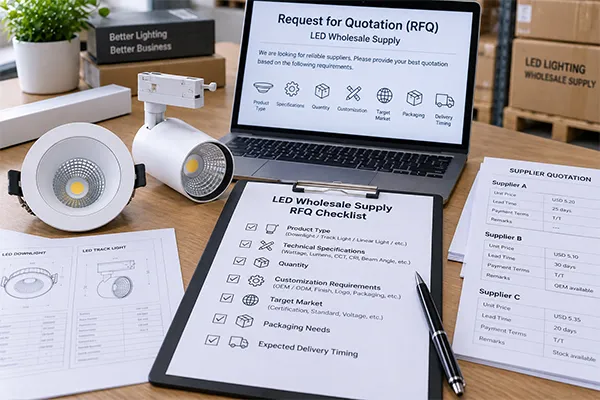
Include the Details That Affect the Quote
A quotation becomes much more dependable when the buyer provides enough information to define the requested product. This does not mean every RFQ must be technically perfect. It means the buyer should state what is known and ask the supplier to clarify what is missing.
For LED downlights, LED track lights, and office linear lighting, I suggest including the following information:
| RFQ Item | Example Information |
|---|---|
| Product category | Recessed LED downlight, track spotlight, suspended linear light |
| Quantity | 300 pieces, 1,000 pieces, annual estimate if available |
| Wattage | 10W, 20W, 30W, or requested range |
| Color temperature | 3000K, 4000K, tunable white, or mixed quantities |
| Beam angle | 24°, 36°, 60°, or application-specific requirement |
| CRI | CRI 80, CRI 90, or project requirement |
| Finish | White, black, silver, custom powder-coated finish |
| Dimming | Non-dimmable, TRIAC, 0–10V, DALI, or other requirement |
| Market | UAE, UK, Canada, EU, Australia, or another destination |
| Delivery expectation | Sample date, bulk order deadline, port or delivery address |
| Branding | Neutral packaging, private label, logo printing, custom box |
I have seen buyers save significant communication time simply by attaching a marked-up product photo, a previous specification sheet, or a basic bill of quantities. These materials help a supplier understand the commercial intent behind the request.
Evaluate the Response, Not Just the Number
A precise supplier response often signals a more workable business process. I would not treat response speed as the only measure. A fast but generic reply can create more work later.
When comparing quotations, buyers can score each supplier against practical criteria:
- Did the supplier confirm the exact model and configuration?
- Did the supplier identify unclear details instead of making assumptions?
- Did it state MOQ, sample policy, lead time, packaging, and payment terms?
- Did it explain available customization options?
- Did it distinguish between standard and custom versions?
- Did it provide product-specific photographs, drawings, or specifications?
- Did it clearly state what is included and excluded in the price?
- Did it respond consistently across sales, technical, and quality questions?
Use Samples and Pilot Orders Strategically
A sample is not merely a visual approval tool.11 It is an opportunity to check the details that will influence customer satisfaction and installation outcomes.
For a sample or small-batch order, buyers may inspect:
- Exterior finish and housing quality
- Dimensions and cutout accuracy
- Color temperature consistency
- Beam distribution and glare level
- Driver label and wiring configuration
- Dimming performance, if requested
- Packaging protection
- Product label content
- Documentation included with the shipment
At Upward Lighting, we support small-batch orders in suitable situations, but buyers should always confirm the MOQ, production conditions, and price impact for the exact product. Small orders can be useful for market validation, but they may not always have the same unit economics or lead time as a repeat bulk program.
A pilot order also gives both parties a chance to test communication. In my view, reliable communication is part of product quality because unclear answers can delay approvals, shipments, and problem resolution.
How Do You Build a Long-Term LED Wholesale Supply Relationship?
A one-time purchase may solve an immediate stock need, but most importers and lighting distributors need a supply relationship that can support changing customer demand. That relationship depends on more than product price. It requires predictable specifications, transparent change control, workable lead times, and clear responsibility when issues arise.
Long-term LED wholesale supply works best when buyers and suppliers agree on product specifications, approval samples, quality expectations, forecast information, and communication procedures. Buyers should monitor supply consistency over time and review any component, packaging, or lead-time changes before they affect downstream customers.
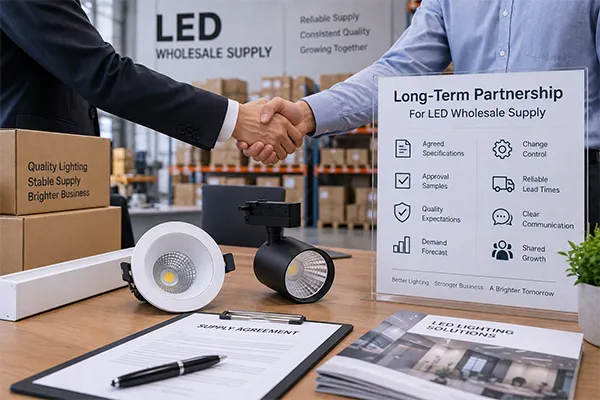
Create a Product Approval Baseline
A product approval baseline is a set of documents and reference samples that define what the buyer expects. It can prevent confusion when orders repeat months later.
A practical baseline may include:
- Approved product sample or retained reference sample
- Final specification sheet
- Product photos and dimension drawings
- Packaging artwork and carton markings
- Agreed quality criteria
- Required documentation list
- Approved color and finish standard
- Purchase order terms and delivery schedule
This approach is especially useful for lighting brands that sell under private labels. It also helps distributors avoid mixing different product versions under the same internal stock code.
Discuss Change Management Early
LED components can change because of availability, cost movements, or product updates.12 Buyers should ask how the supplier manages such changes. A responsible process should not rely on assumptions.
I recommend asking:
- Will the supplier notify us before changing LEDs, drivers, housings, finishes, or packaging?
- Which changes require a new sample or written approval?
- How will the supplier maintain model identification and revision control?
- Can the supplier maintain the same key parameters across repeat orders?
- What happens if a previously specified component is unavailable?
No supply chain is completely free from change. The goal is to make changes visible and manageable before they reach your warehouse, project site, or customer network.
Balance Price Against Total Commercial Cost
The lowest quoted price can be attractive, but it may not be the lowest total cost. Buyers should consider the financial effect of inconsistent product quality, late containers, extra inspections, replacement claims, customer complaints, and staff time spent resolving unclear specifications.
I encourage purchasing teams to compare landed value rather than only ex-works pricing. A commercially useful supplier relationship should support:
- Reasonable and understandable pricing
- Stable quality standards
- Clear lead-time commitments
- Responsive quotation handling
- Scalable order capacity
- Flexible customization where needed
- Documentation support for buyer verification
- A practical process for issue resolution
For buyers seeking LED downlights, track lights, or linear office lights from China, a direct manufacturer can be a valuable partner when its process matches the buyer’s requirements. Still, every buyer should conduct appropriate supplier due diligence, product evaluation, and market-specific compliance verification.
Frequently Asked Questions
Where is the best place to find LED wholesale supply?
The best source depends on your purchasing model. Manufacturers may suit buyers needing OEM/ODM customization and repeat production. Trading companies may help with multi-category orders, while stock wholesalers can support urgent purchases. Buyers should verify specifications, quality procedures, delivery capability, and documentation regardless of source.
Should I buy LED lighting directly from a manufacturer?
Direct manufacturer purchasing can offer better access to customization, production discussions, and long-term supply planning. However, buyers need clear specifications and must manage supplier verification carefully. I recommend reviewing samples, quality-control procedures, lead times, and the exact scope of any certifications or reports.
What should I include in an LED lighting RFQ?
Your RFQ should include product type, model or photos, wattage, color temperature, beam angle, CRI, finish, quantity, dimming requirements, target market, packaging needs, customization requests, and delivery expectations. A detailed RFQ helps suppliers quote accurately and helps you compare their responses fairly.
Are CE and RoHS documents enough for LED wholesale purchasing?
CE and RoHS documentation can be relevant, but they are not automatic confirmation that a product meets every market, project, or installation requirement. Buyers should verify that documents apply to the exact product configuration and consult qualified professionals for market-specific compliance decisions where necessary.
Why is an LED aging test important?
An aging test can help identify early electrical or assembly issues before shipment. At Upward Lighting, we conduct 100% aging tests lasting 4 to 8 hours before shipment. Buyers should still confirm the test scope for their specific product and agree on additional inspection requirements when needed.
Conclusion
Finding dependable LED wholesale supply is not simply a matter of choosing the lowest-priced listing or the fastest reply. I recommend first selecting the right supply source, then checking specification consistency, quality-control evidence, documentation, sample performance, delivery communication, and long-term change management. A detailed RFQ gives you a stronger basis for supplier comparison. If you are sourcing LED downlights, track lights, or office linear lighting with OEM/ODM requirements, contact Upward Lighting to discuss your specifications, order quantity, and wholesale supply plan.
"5.1 Stakeholders in the supply chain | OpenLearn - Open University", https://www.open.edu/openlearn/money-business/leadership-management/supply-chain-sustainability/content-section-5.1. Supply-chain references distinguish manufacturers, which produce goods, from wholesalers and other intermediaries, which commonly aggregate, distribute, or hold inventory for downstream buyers. Evidence role: definition; source type: education. Supports: Definitions of manufacturers, wholesalers, and intermediaries and their typical roles in distribution and sourcing.. Scope note: These definitions describe typical channel functions and do not establish that every supplier follows the same model. ↩
"Supplier selection and order allocation: a literature review - PMC", https://pmc.ncbi.nlm.nih.gov/articles/PMC8127846/. Supplier-selection research commonly treats quality, delivery performance, capacity, cost, and flexibility as material criteria when matching suppliers to purchasing requirements. Evidence role: expert_consensus; source type: paper. Supports: Supplier-selection literature commonly evaluates criteria such as quality, delivery performance, production capability, cost, and flexibility.. Scope note: The literature provides a general decision framework rather than a prescriptive ranking for a particular LED purchase. ↩
"OECD Due Diligence Guidance for Responsible Business ...", https://www.oecd.org/content/dam/oecd/en/publications/reports/2018/02/oecd-due-diligence-guidance-for-responsible-business-conduct_c669bd57/15f5f4b3-en.pdf. Due-diligence guidance on multi-tier supply chains notes that indirect purchasing arrangements can limit visibility into upstream suppliers and their operating practices. Evidence role: mechanism; source type: institution. Supports: Multi-tier and intermediary-based supply chains can make it harder for purchasers to identify upstream entities and assess their practices directly.. Scope note: Reduced visibility is a potential structural risk, not evidence that a particular trading company lacks manufacturer disclosure or quality controls. ↩
"Analyzing Costs Using Total Cost of Ownership", https://psep.smeal.psu.edu/short-courses/supply-chain-accelerator/advanced-procurement-analyzing-costs-using-total-cost-of-ownership. Procurement and total-cost-of-ownership frameworks evaluate suppliers using costs beyond purchase price, including logistics, quality failures, administration, and other lifecycle expenditures. Evidence role: general_support; source type: research. Supports: Total-cost approaches incorporate acquisition, logistics, quality, and post-purchase costs rather than unit price alone.. Scope note: The relevant cost categories and their financial weight depend on the buyer's contract, logistics route, and quality requirements. ↩
"[PDF] LED Luminaire Reliability: Impact of Color Shift - Department of Energy", https://www.energy.gov/sites/prod/files/2017/04/f34/lsrc_colorshift_apr2017.pdf. Technical guidance on LED lighting explains that chromaticity consistency and driver performance are relevant to the appearance, output, and reliable operation of LED luminaires. Evidence role: mechanism; source type: government. Supports: LED color consistency and driver characteristics affect the light output and operating performance of LED lighting products.. Scope note: This support explains why these parameters matter technically; it does not show that any named supplier's products are inconsistent. ↩
"[PDF] Procedure for Purchasing and Supplier Evaluation - NIST", https://www.nist.gov/document/procedure-supplier-evaluation-20180101pdf. Quality-management standards require organizations to communicate purchasing and acceptance requirements clearly so that externally provided products can be controlled against specified criteria. Evidence role: mechanism; source type: institution. Supports: Documented purchasing specifications and acceptance requirements help communicate requirements and control externally provided products.. Scope note: Clear specifications reduce ambiguity but cannot by themselves prevent production errors, unauthorized substitutions, or inspection failures. ↩
"[PDF] Stress Testing of Organic Light-Emitting Diode Panels and Luminaires", https://www.energy.gov/sites/prod/files/2018/05/f51/ssl_oled-stresstest_2018.pdf. Reliability engineering literature describes burn-in or aging as a method for screening certain early-life failures; such testing is distinct from demonstrating conformity with all applicable safety, performance, or market-access requirements. Evidence role: mechanism; source type: research. Supports: Burn-in and aging are reliability-screening practices intended to expose some early-life failures, whereas conformity depends on the applicable requirements and assessment evidence.. Scope note: The effectiveness of an aging test depends on its duration, stress conditions, failure mechanisms, and the product configuration tested. ↩
"EU - EU Legislation and CE Marking", https://www.trade.gov/country-commercial-guides/eu-eu-legislation-and-ce-marking. Official product-compliance guidance states that conformity assessment and technical documentation must address the applicable requirements for the product being placed on the relevant market. Evidence role: general_support; source type: government. Supports: Conformity documentation must relate to the applicable legal requirements and the product placed on the relevant market.. Scope note: Applicable obligations differ by jurisdiction, product category, intended use, and the economic operator's role. ↩
"2-CE Marking | BETA - International Trade Administration", https://beta.trade.gov/article?id=CE-Marking. International market-access guidance recognizes that electrical products may face different technical regulations, standards, and conformity-assessment procedures across national and regional markets. Evidence role: general_support; source type: institution. Supports: Electrical and lighting products are subject to differing national or regional technical regulations, standards, and conformity-assessment systems.. Scope note: This general variation does not determine the exact requirements for a specific luminaire, installation, or destination. ↩
"[PDF] Supplier Selection - umich.edu", https://www-personal.umich.edu/~dbeil/Supplier_Selection_Beil-EORMS.pdf. Public-procurement guidance describes RFQ processes as structured requests that enable purchasers to compare suppliers' pricing and responsiveness to defined specifications and commercial conditions. Evidence role: general_support; source type: government. Supports: RFQ processes collect comparable supplier information and can assess responsiveness to stated specifications, terms, and delivery requirements.. Scope note: An RFQ response indicates proposal quality and stated capability; it does not independently verify actual manufacturing performance. ↩
"What kinds of Lot Acceptance Sampling Plans (LASPs) are there?", https://www.itl.nist.gov/div898/handbook/pmc/section2/pmc22.htm. Quality-control and acceptance-inspection guidance treats samples as evidence that specified product attributes—including physical, functional, labeling, and packaging characteristics—can be checked before broader acceptance. Evidence role: general_support; source type: institution. Supports: Inspection and acceptance practices can evaluate product attributes such as dimensions, function, labeling, and packaging against defined requirements.. Scope note: A sample or pilot batch cannot fully establish consistency across later mass production without continuing process controls and inspection. ↩
"SP 800-128, Guide for Security-Focused Configuration ...", https://csrc.nist.gov/pubs/sp/800/128/upd1/final. Electronics supply-chain and configuration-management guidance recognizes that component availability, obsolescence, and design revisions can necessitate controlled product changes and updated technical records. Evidence role: mechanism; source type: government. Supports: Component availability, obsolescence, and engineering changes can require controlled changes to electronic products and their documentation.. Scope note: This establishes a general change-management risk and does not prove that a component change will occur in a particular LED product line. ↩