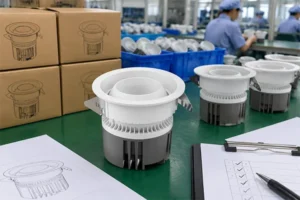

LED downlight wattage is often the first number buyers ask for, but wattage alone does not tell us whether a fixture will create the right result. A poor choice can cause glare, uneven lighting, oversized cutouts, unnecessary energy use, or costly revisions. I recommend starting with the room, lighting task, ceiling conditions, and required output before choosing a wattage.
The best wattage for LED downlights depends on the space, ceiling height, lighting purpose, fixture layout, beam angle, and verified lumen output. A lower-wattage downlight may suit a corridor or residential room, while a higher-wattage model may be appropriate for higher ceilings or task-focused commercial areas. Buyers should compare lumens, optics, dimensions, and installation requirements—not wattage alone.
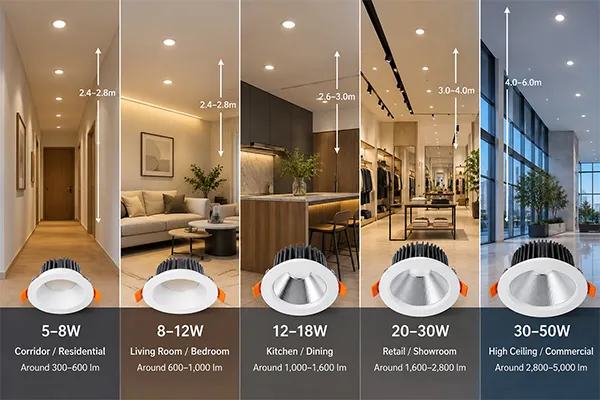
In my work with OEM and ODM lighting inquiries, I often see buyers request “10W” or “20W” before they share a floor plan, ceiling height, or target use. That approach is understandable, but it leaves too much risk in the quotation stage. The sections below explain how I would evaluate LED downlight wattage more practically.
Why Is LED Downlight Wattage Not a Complete Selection Criterion?
Buyers can run into trouble when they assume that the same wattage always creates the same brightness and visual comfort. That assumption can lead to inconsistent product comparisons, unexpected lighting results, and project changes after samples arrive. I encourage buyers to look beyond watts before approving a downlight specification.
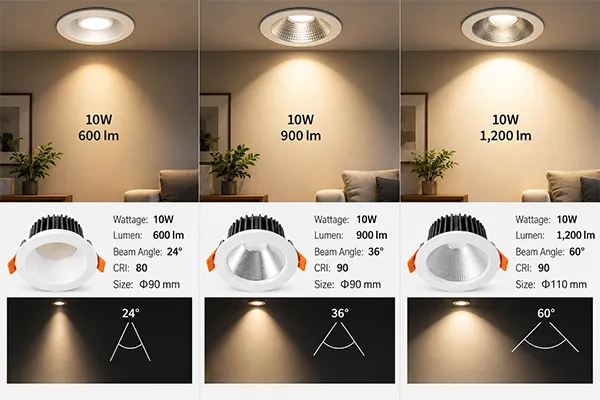
LED downlight wattage measures electrical power consumption, not guaranteed brightness, beam quality, or project suitability.1 Two downlights with the same wattage can differ in lumen output, beam angle, driver performance, thermal design, CRI, glare control, and physical size.2 Buyers should request verified product-specific technical data and compare the complete specification.
Watts Describe Input Power, Not the Entire Lighting Result
Wattage tells us how much electrical power a fixture is designed to consume. It remains useful for calculating total connected load, energy planning, circuit capacity, and product positioning. However, wattage does not independently tell us whether a downlight will be bright enough, comfortable enough, or appropriate for a specific ceiling.
For example, two nominal 12W LED downlights may have different results because of differences in:
- LED source selection and binning
- Driver efficiency and output stability
- Heat dissipation structure
- Optical lens or reflector design
- Beam angle
- Recessed depth and anti-glare construction
- Diffuser type
- Color temperature and CRI configuration
A narrow-beam downlight can create higher intensity on a smaller area than a wide-beam unit with similar electrical power.3 Meanwhile, a deep anti-glare design may provide improved visual comfort but distribute light differently from a basic flat-panel style.
What I Ask Before Discussing a Wattage Range
When I receive a request for LED downlight wattage, I usually need more details before I can offer a responsible product suggestion. A useful initial inquiry includes the following information:
| Information to provide | Why it matters for selection |
|---|---|
| Room type | A lobby, retail shelf, corridor, office, and residence have different lighting needs. |
| Ceiling height | Higher mounting positions may require a different output and beam distribution.4 |
| Ceiling type | Plasterboard, concrete, and suspended ceilings affect installation options. |
| Cutout size | The ceiling opening limits the available downlight dimensions. |
| Lighting purpose | General lighting, accent lighting, circulation lighting, and task lighting need different approaches. |
| Fixture spacing | Spacing affects uniformity and the required quantity of fittings. |
| Color temperature | Warm, neutral, and cool options can change the visual perception of brightness.5 |
| Required certifications | Buyers should verify certificates and market-specific compliance documents. |
| Target order quantity | This affects available customization and commercial planning. |
I have seen projects where a buyer initially asked for a single higher-wattage fixture to reduce quantity. Once we discussed glare, spacing, and ceiling details, the buyer decided that more moderately powered fixtures would create a better layout. The final decision should always be confirmed by qualified lighting professionals for the specific application.
Procurement takeaway: I would treat wattage as one line in the specification sheet, not as the entire product specification.
What LED Downlight Wattage Fits Different Rooms and Tasks?
A room can feel underlit when the selected downlights do not support the activities taking place there. At the same time, a high-wattage solution can make a small room feel harsh or uncomfortable. I find that buyers get stronger results when they define the lighting task before selecting a fixture’s power range.
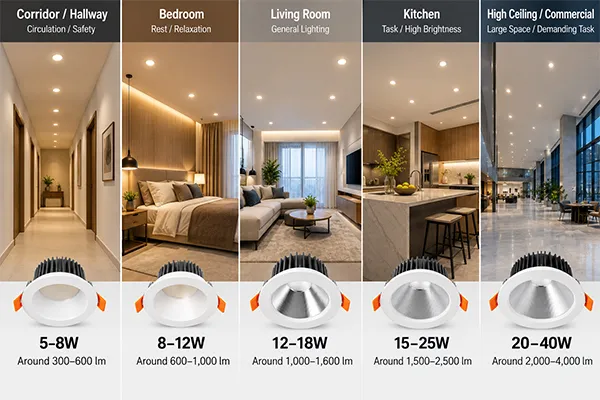
The suitable wattage for LED downlights changes by application. Lower-power models may be considered for decorative or circulation areas, while higher-output products may be evaluated for taller spaces or demanding tasks. The final wattage should be based on a lighting plan, verified lumen data, fixture count, and local project requirements.
Start With the Function of the Space
I recommend that buyers first identify what people need to do in the space. This simple step improves both procurement communication and product selection.
Common lighting purposes include:
-
Ambient lighting
This provides general visibility and an overall sense of brightness. Residential living spaces, hotel corridors, and reception areas often need balanced ambient lighting. -
Task lighting
This supports specific activities, such as reading, working, preparing food, applying makeup, or handling products. A downlight layout alone may not always provide the best task lighting. -
Accent lighting
This draws attention to merchandise, artwork, architectural features, or wall textures. Beam angle and aiming capability can become more important than simply increasing LED downlight wattage. -
Circulation lighting
This supports safe movement through corridors, stairs, entrances, and passageways. Uniformity and glare control often matter significantly in these areas.6
Use Typical Ranges Only as a Starting Point
The table below is not a universal prescription. I use it as a discussion framework when buyers have not yet completed a lighting calculation or project layout. Actual choices depend on the product’s verified output, beam angle, mounting height, surface reflectance, local codes, and design goals.
| Application | Initial product discussion | Important factors beyond wattage |
|---|---|---|
| Residential bedrooms | Lower to moderate output downlights may be considered | Comfort, dimming, warm color temperature, beam softness |
| Living rooms | Moderate-output fixtures or layered lighting may be evaluated | Furniture layout, decorative lighting, glare control |
| Corridors | Lower or moderate output may be suitable | Spacing, uniformity, ceiling length, emergency-lighting requirements |
| Retail areas | Moderate to higher output options may be considered | Accent versus ambient lighting, merchandise colors, beam control |
| Offices | A coordinated downlight and linear-light plan may be appropriate | Screen glare, workplane requirements, uniformity |
| Hotel lobbies | A layered approach is often evaluated | Ceiling height, décor, visual comfort, feature areas |
| Restaurants | Moderate output with dimming options may be useful | Mood, table lighting, color temperature, glare |
Avoid the “More Watts Must Be Better” Trap
Higher LED downlight wattage may seem safer, especially when a buyer worries about insufficient brightness. However, overspecifying can create avoidable problems:
- Uncomfortable glare7 for occupants and guests
- Higher connected load8 across a large installation
- Higher product and operating costs
- Larger fixture dimensions that may not fit the ceiling design
- More visible light spots on floors and walls
- Reduced flexibility if the project later needs a softer atmosphere
I usually recommend a review of the full layout before increasing wattage. A better beam angle, a revised fixture spacing, or a different quantity may solve the problem more effectively than selecting the largest available downlight.
How Do Ceiling Height and Layout Affect LED Downlight Wattage?
A well-made downlight can still perform poorly when fixture spacing and ceiling height are ignored. Buyers sometimes select a product from a catalog first and design the layout afterward. That sequence can create dark zones, overlapping hot spots, or an installation that exceeds the project budget.
Ceiling height and fixture layout strongly affect the appropriate LED downlight wattage because they influence how light reaches the intended surface. Higher ceilings, wider spacing, and narrower beams can change the required output and quantity. Buyers should evaluate wattage together with mounting height, beam angle, spacing, and the complete lighting layout.
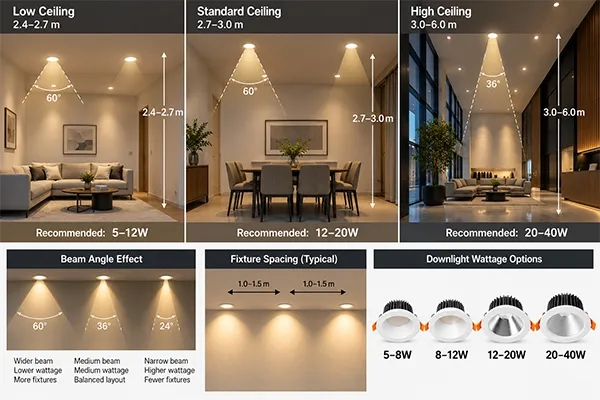
The Relationship Between Height, Beam Angle, and Spacing
A downlight mounted in a 2.6-meter ceiling does not behave visually the same way as the same fixture installed in a 5-meter lobby. The distance between the fixture and the target surface changes. Beam distribution also changes the area that receives light.
A wider beam angle generally spreads light over a larger area. A narrower beam generally concentrates light into a smaller area. Neither option is automatically superior.
| Layout variable | If it increases | Selection issue to review |
|---|---|---|
| Ceiling height | Light travels farther | Review output, beam spread, and fixture quantity |
| Fixture spacing | Gaps between fixtures become wider | Review uniformity and potential dark areas |
| Beam angle | Light spreads more broadly | Review brightness at the target surface and overlap |
| Number of fixtures | More light points are added | Review total load, ceiling appearance, and cost |
| Ceiling depth | Installation cavity changes | Confirm fixture height, driver location, and heat management |
Calculate the Whole System, Not Just One Fitting
In procurement, I advise buyers to calculate total project requirements alongside single-fixture parameters. For example, a project team should compare:
- Total number of downlights
- Wattage per fixture
- Total connected load
- Driver type and dimming method
- Cutout diameter
- Fixture outer diameter
- Recessed depth
- Ceiling insulation or ventilation conditions
- Beam-angle options
- Maintenance access
A simple connected-load calculation is:
Total connected load = fixture quantity × rated wattage per fixture
This calculation is useful, but it does not replace a lighting design. The project team still needs to assess whether the layout provides suitable brightness, visual comfort, and consistency.
Installation Limits Can Change the Product Choice
I have handled inquiries where the buyer liked a higher-output downlight but later found that the ceiling void was too shallow for the proposed heat sink or driver arrangement. In other cases, the specified cutout size did not match the available product housing.
These practical constraints can influence the best LED downlight wattage choice because higher-power designs may require different thermal structures and dimensions.9 I recommend that buyers confirm the following before ordering samples or issuing a purchase order:
- Finished ceiling cutout diameter
- Maximum installation depth
- Ceiling material and thickness
- Driver placement space
- Accessibility for future replacement
- Local installation rules
- Ambient temperature and ventilation conditions
A qualified electrical and lighting professional should assess site-specific thermal, wiring, and installation conditions. Manufacturer specifications can support that process, but they cannot replace an application-specific evaluation.
How Should Buyers Compare LED Downlight Wattage From Different Suppliers?
Comparing supplier quotations only by wattage and unit price can create hidden quality and performance risk. A lower quotation may omit important details, while a higher quotation may include different optics, drivers, materials, testing procedures, or customization options. I believe buyers should use a like-for-like comparison method.
Buyers should compare LED downlight wattage across suppliers by reviewing verified lumen output, beam angle, dimensions, driver specifications, thermal design, sample results, quality-control processes, and documentation. A 15W label alone is not enough to establish that two fixtures offer equal brightness, reliability, or suitability for the same project.10
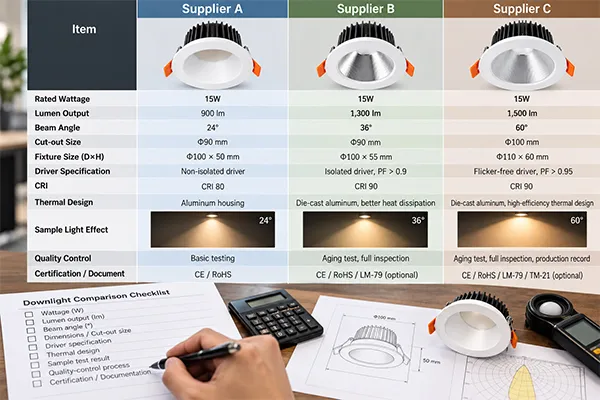
Build a Comparable Specification Sheet
I suggest placing each supplier’s proposal into one comparison table. This helps purchasing teams identify gaps before they focus on price.
| Comparison item | What buyers should request |
|---|---|
| Rated LED downlight wattage | Nominal rated power and allowable tolerance, where provided |
| Lumen output | Product-specific tested or declared output and test conditions |
| Luminous efficacy | Supporting context for power and output comparison |
| Beam angle | Available optic options and the quoted configuration |
| Color temperature | Exact CCT option, such as 3000K, 4000K, or 6500K |
| CRI | Declared CRI level and applicable documentation |
| Driver | Brand or specification, input voltage, dimming compatibility |
| Cutout and dimensions | Cutout size, outer diameter, height, and driver dimensions |
| Housing material | Aluminum construction, finish, and heat-dissipation design |
| Warranty terms | Written scope, exclusions, and claim procedure |
| Certifications | Relevant documents that buyers should verify for their destination market |
| Quality process | Aging test, inspection process, and sample approval procedure |
| Lead time | Sample lead time, production lead time, and delivery terms |
Review Quality Control Before You Commit
At Upward Lighting, we perform a 100% aging test for 4 to 8 hours before shipment as part of our stated production process. I consider this type of process information helpful for buyers, but I also encourage each customer to define its own acceptance criteria. An aging test is one quality-control step; it does not remove the need for sample approval, incoming inspection, and application-specific review.11
For larger or repeat orders, I recommend that buyers establish a documented approval process:
- Confirm the product specification and drawing.
- Approve a physical sample in the required configuration.
- Confirm lumen, CCT, beam angle, CRI, and driver details.
- Verify required certification documents for the destination market.
- Agree on packaging, labels, and carton markings.
- Define inspection requirements and acceptable quality limits.
- Confirm production lead time and shipment terms.
Ask Better Questions During OEM and ODM Discussions
As a manufacturer handling custom inquiries, I find that the best projects begin with a complete brief rather than a one-line request for “best LED downlight wattage.” For OEM or ODM projects, buyers may also need to specify:
- Private-label branding requirements
- Custom surface finish colors
- Required wattage options for a product range
- CCT and CRI requirements
- Desired beam-angle combinations
- Packaging language and artwork
- Small-batch or trial-order needs
- Target retail, wholesale, or project market
- Annual forecast or expected reorder plan
I can customize parameters such as wattage, color temperature, beam angle, CRI, and finish color within feasible product-development and order conditions. However, I always recommend validating the final configuration through samples and qualified project review before a large rollout.
Can a Lower LED Downlight Wattage Reduce Total Project Risk?
Many procurement teams focus on the unit cost of one fixture. That focus can miss the wider cost of revisions, installation conflicts, unnecessary power consumption, customer complaints, and replacement work. A balanced LED downlight wattage strategy can help buyers manage these risks more effectively.
A lower LED downlight wattage can reduce project risk when it supports a well-designed layout, suitable visual comfort, and practical installation. However, lower wattage is not automatically better either. Buyers should compare total fixture quantity, required output, layout performance, installed cost, and maintenance considerations before making a decision.
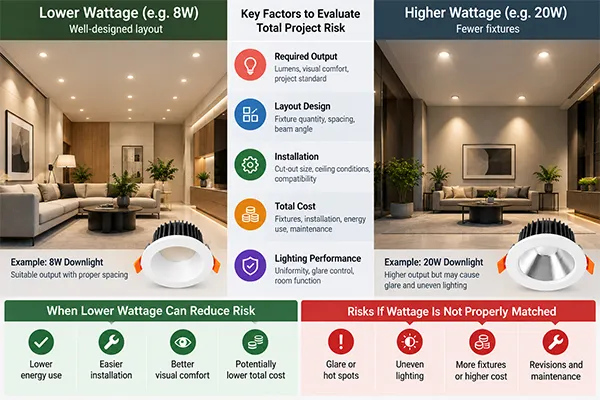
Consider Total Cost Rather Than Unit Price
The lowest-priced or highest-wattage fixture is not always the lowest-risk selection. I recommend considering the complete project cost.
| Cost or risk area | Questions to ask |
|---|---|
| Product cost | Does the quoted fixture include the specified driver, finish, optics, and accessories? |
| Installation cost | Does the fixture fit the ceiling cutout and available depth? |
| Energy planning | What is the total connected load for the planned quantity? |
| Layout revisions | Has the fixture spacing been reviewed before installation? |
| Customer satisfaction | Is glare control appropriate for the intended environment? |
| Maintenance | Can installers access the driver and replace the fixture if needed? |
| Supply continuity | Can the supplier maintain the approved configuration for repeat orders? |
Use Samples to Reduce Uncertainty
A product sample does not reproduce every site condition, but it helps buyers assess key aspects before committing. I recommend that project teams review samples for:
- Physical appearance and finish quality
- Cutout compatibility
- Installation depth
- Color temperature consistency
- Beam appearance
- Glare perception
- Dimming compatibility, if required
- Packaging and labeling
- Basic functional operation
For major projects, a mock-up area can be more valuable than reviewing a single fixture on a desk. A qualified lighting designer or engineer can then assess the actual ceiling height, reflectance, spacing, and visual conditions.
I once saw a customer change from a single high-output option to a mixed layout after reviewing an early sample area. The team used one type of downlight for general illumination and another optic for visual emphasis. That approach added planning work at the beginning, but it helped the customer avoid an expensive change after installation.
Frequently Asked Questions
Is 10W LED downlight wattage enough for a room?
A 10W LED downlight may be suitable for some rooms, but I would not judge it by wattage alone. The correct choice depends on verified lumen output, ceiling height, fixture spacing, beam angle, room size, wall colors, and whether the fixture provides ambient, task, or accent lighting.
Is a 15W LED downlight brighter than a 10W downlight?
A 15W LED downlight may produce more light than a 10W model, but buyers should verify the product-specific lumen output. Different LED sources, drivers, optical designs, and thermal structures can create different results. The beam angle also affects how bright the illuminated area appears.
How many LED downlights do I need in a room?
The number of LED downlights depends on room dimensions, ceiling height, target lighting level, beam angle, fixture output, and desired uniformity. I recommend using a lighting layout or consultation with a qualified lighting professional rather than selecting quantity from wattage alone.
Does higher LED downlight wattage mean better quality?
Higher wattage does not automatically indicate better quality. Product quality also involves driver performance, heat management, materials, optical control, assembly consistency, aging procedures, documentation, and supplier reliability. I recommend comparing approved samples and complete technical specifications before making a purchasing decision.
What should I send a supplier when requesting an LED downlight quotation?
I recommend sending the application, ceiling height, cutout size, target quantity, preferred wattage range, CCT, CRI, beam angle, dimming requirement, destination market, and required certifications. A floor plan or reference image can also help a supplier provide a more relevant proposal.
Conclusion
The best LED downlight wattage is not a universal number. I recommend selecting it only after reviewing the lighting task, room dimensions, ceiling height, beam angle, fixture spacing, installation limits, and verified lumen data. A higher wattage may be appropriate in some situations, but it can also introduce glare, cost, and installation risk. If you are sourcing LED downlights for a project or product line, send Upward Lighting your drawings, target parameters, and market requirements so I can help prepare a practical OEM or ODM proposal.
"Purchasing Energy-Efficient Light Bulbs", https://www.energy.gov/cmei/femp/purchasing-energy-efficient-light-bulbs. Watts are a measure of electrical power, whereas lumens measure visible light output; consequently, wattage alone is not a complete indicator of a lamp or luminaire's brightness. Evidence role: definition; source type: government. Supports: That watts measure electrical power while lumens measure the quantity of visible light emitted, and that LED products with similar wattage can have different light output.. ↩
"LED Luminaire Reliability: Impact of Color Shift", https://www.energy.gov/sites/prod/files/2017/04/f34/lsrc_colorshift_apr2017.pdf. LED luminaire output and optical performance are affected by component efficiency, driver operation, thermal management, and optical design, so equal rated power does not ensure equivalent photometric performance. Evidence role: mechanism; source type: research. Supports: That LED luminaire performance depends on interacting electrical, thermal, optical, and photometric design factors in addition to input power.. ↩
"CALiPER Application Summary Report 20: LED PAR38 Lamps", https://www1.eere.energy.gov/buildings/publications/pdfs/ssl/caliper_20_summary.pdf. Beam angle describes the spread of a luminaire's light distribution; narrower beams concentrate light into a smaller field and can yield greater intensity or illuminance on the target area than wider beams with comparable output. Evidence role: mechanism; source type: education. Supports: That a luminaire's beam angle controls the spatial distribution of its light and that narrower distributions concentrate luminous intensity over a smaller area.. Scope note: Actual target illuminance also depends on mounting distance, aiming, delivered lumens, and surface geometry. ↩
"Inverse Square Law for Light - HyperPhysics", https://hyperphysics.phy-astr.gsu.edu/hbase/vision/isql.html. Because illuminance decreases as the distance from a source increases, mounting height and luminaire distribution are key inputs when selecting output and arranging luminaires for a target surface. Evidence role: mechanism; source type: education. Supports: That illuminance at a surface changes with distance from a light source and that mounting height must be considered with luminaire distribution in lighting design.. Scope note: Real indoor results also reflect multiple fixtures, room-surface reflectance, and the luminaire's measured intensity distribution. ↩
"Human-centric virtual lighting: Effects of color temperature ...", https://pubmed.ncbi.nlm.nih.gov/40729899/. Lighting research reports that correlated color temperature and spectral composition can influence perceived brightness, even when measured photometric quantities are held comparable. Evidence role: general_support; source type: paper. Supports: That spectral characteristics and correlated color temperature can influence brightness perception under controlled lighting conditions.. Scope note: Perceived brightness varies with adaptation level, surrounding surfaces, illuminance, observer characteristics, and the particular spectra being compared. ↩
"Subject: Recommendation for Comprehensive Lighting Study", https://www.utah.gov/pmn/files/1361828.pdf. Guidance for circulation routes and stairways recognizes adequate, reasonably uniform illumination and glare control as factors supporting visibility and safe movement. Evidence role: general_support; source type: government. Supports: That adequate lighting for circulation routes and stairways should support safe movement and avoid conditions that impair visibility.. Scope note: Specific illumination and uniformity requirements vary by jurisdiction, building type, and applicable local code. ↩
"Glare and Diffuse Sources", https://www.energy.gov/sites/prod/files/2021/02/f82/ssl-rd21-schwade-glare.pdf. Discomfort glare is visual discomfort associated with bright luminaires or excessive luminance contrast in the field of view; luminaire output, shielding, placement, and viewing geometry affect its likelihood. Evidence role: definition; source type: research. Supports: That discomfort glare is visual discomfort caused by excessively bright sources or high luminance contrasts within the field of view.. Scope note: A higher wattage rating alone does not determine glare, because glare depends on the complete luminaire and installation. ↩
"Commercial and Industrial Lighting Evaluation Protocol", https://www.energy.gov/documents/53827-2pdf-1. Connected lighting load is based on the rated power of installed luminaires; for a fixed number of fixtures, increasing rated wattage increases the calculated connected load. Evidence role: definition; source type: government. Supports: That connected lighting load is calculated from the rated power of installed equipment and that total rated load rises with wattage and fixture count.. Scope note: Connected load is not the same as actual energy consumption, which also depends on operating hours, controls, dimming, and driver behavior. ↩
"DOE Solid-State Lighting CALiPER Program 2009 Roundtable", https://www1.eere.energy.gov/buildings/publications/pdfs/ssl/2009_caliper_roundtableproceedings.pdf. LED performance and lifetime are sensitive to junction temperature, making thermal pathways and heat-sink design important elements of luminaire engineering; higher-power configurations may therefore require different thermal provisions. Evidence role: mechanism; source type: research. Supports: That LED junction temperature affects output and reliability and that thermal pathways, heat sinks, and fixture construction are important design considerations.. Scope note: Physical size is product-specific and is not determined by wattage alone, since materials, efficacy, driver design, and housing geometry also matter. ↩
"Purchasing Energy-Efficient Light Bulbs", https://www.energy.gov/cmei/femp/purchasing-energy-efficient-light-bulbs. Comparative evaluation of LED luminaires relies on measured or declared photometric and electrical data, including light output, efficacy, distribution, color characteristics, and operating conditions; rated wattage alone does not establish product equivalence. Evidence role: general_support; source type: institution. Supports: That meaningful LED luminaire comparisons use tested photometric and electrical performance data rather than rated wattage alone.. Scope note: Reliability assessment additionally requires evidence concerning components, thermal conditions, testing methods, and the intended operating environment. ↩
"1C. Quality Assurance vs. Quality Control", https://nvlpubs.nist.gov/nistpubs/SpecialPublications/NIST.SP.1500-28pt1C.pdf. Quality-assurance practice treats testing as one component of a broader verification and acceptance process that may also include specification review, inspection, sampling, and validation for the intended application. Evidence role: general_support; source type: institution. Supports: That inspection and testing are components of quality assurance and that product acceptance commonly requires defined specifications, verification activities, and appropriate inspection controls.. Scope note: The appropriate test and inspection plan depends on the product, contractual requirements, regulatory obligations, and the buyer's risk tolerance. ↩