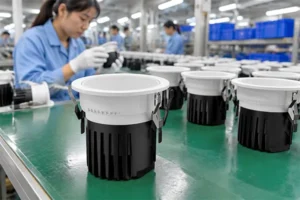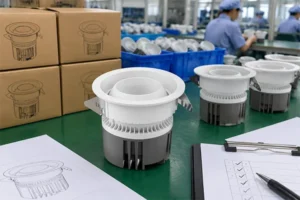

A professional LED downlight factory can look convincing on a website, offer an attractive sample, and provide a low quotation, yet still create expensive problems after a bulk order begins. Specification mismatches, inconsistent batches, unclear compliance documents, and missed delivery dates can affect your reputation. I recommend evaluating how a supplier documents and executes your exact requirements.
A professional LED downlight factory should be selected based on its ability to turn your confirmed specification into repeatable bulk production, not on price, sample appearance, certificates, or factory size alone. Buyers should verify product specifications, quality-control records, component consistency, compliance documents, communication processes, and delivery planning before placing an order.
When I support overseas buyers through quotation discussions and specification confirmations, I find that the best questions are rarely about a supplier’s showroom. The most useful questions reveal whether the factory can control details after the purchase order is issued. This checklist will help you evaluate that execution risk step by step.
Can a Professional LED Downlight Factory Produce Your Exact Specification Repeatedly?
A factory may say that it can customize LED downlights, but vague customization can become a problem when production starts. If the buyer’s required wattage, CCT, beam angle, CRI, trim color, and packaging are not clearly documented, the sample and the delivered goods may not match.
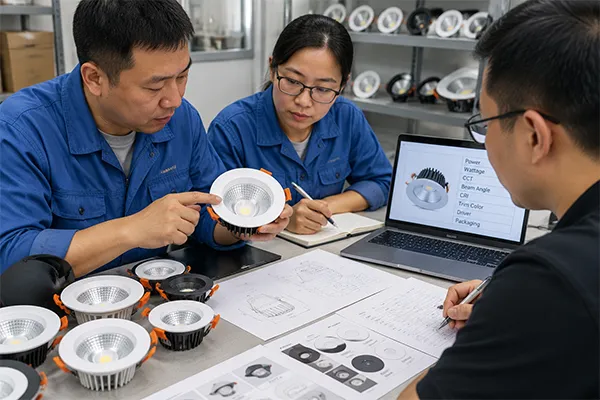
A professional LED downlight factory should be able to convert your requested product parameters into a written specification sheet, approved sample record, bill of materials, and production instructions. Buyers should confirm which details are fixed, which details can vary, and how changes will be controlled before mass production.
Start with a Complete Product Specification Sheet
A quotation is not always a technical specification. In my experience, buyers often begin with a simple request such as “12W recessed downlight, 4000K, white housing.” That is a useful start, but it leaves many production-critical details open.
A supplier should be able to clarify the following points before you approve a bulk order:
| Specification area | What buyers should define | Risk if it is not defined |
|---|---|---|
| Wattage | Nominal power, allowable tolerance, driver input | Incorrect energy-use or brightness expectations |
| CCT | 2700K, 3000K, 4000K, 5000K, or customized range | Visible color variation between batches |
| CRI | CRI 80, CRI 90, or another agreed requirement | Product may not suit retail, hospitality, or residential applications |
| Beam angle | 15°, 24°, 36°, 60°, or other optics | Incorrect light distribution in the project |
| Cutout size | Exact ceiling opening and trim dimensions | Installation delays or site rework |
| Finish | White, black, silver, gold, custom color | Inconsistent visual appearance |
| Dimming | Non-dimmable, Triac, 0–10V, DALI, or other system | Compatibility issues with controls |
| Packaging | Inner box, master carton, labels, barcode needs | Shipping damage or retail-channel complications |
A detailed specification sheet does not guarantee a successful order. However, it gives both sides a common reference when questions arise. I suggest that buyers ask for the document in writing and check whether the quoted model number matches the product drawing, sample, packaging artwork, and compliance documents.
Ask How Changes Are Managed
Changes are common in OEM and ODM LED lighting procurement. A buyer may change a trim color, carton design, beam angle, or driver requirement after reviewing a sample. Those changes should not remain in an email thread without formal confirmation.
A capable supplier should explain its change-control process. Buyers should ask:
- Will the factory issue a revised specification sheet or proforma invoice?
- Will the revised product receive a new internal model number or revision reference?
- Which documents will be updated after the change?
- Will the sample approval remain valid, or is a new sample needed?
- Does the change affect price, minimum order quantity, lead time, or certificates?
I view clarification questions as a positive signal. A supplier that asks precise questions about cutout size, driver type, packaging, or target market may be reducing ambiguity before it becomes a production problem.
A smaller manufacturer can sometimes manage these details better than a larger one if its internal communication is disciplined. Buyers should therefore evaluate documentation and responsiveness instead of assuming that factory scale alone proves reliability.
How Does a Professional LED Downlight Factory Control Bulk Quality?
A good-looking pre-production sample can create confidence, but it does not show how a supplier will control thousands of units across multiple shifts, component deliveries, and packing days. Bulk quality depends on process discipline, not only on sample presentation.1
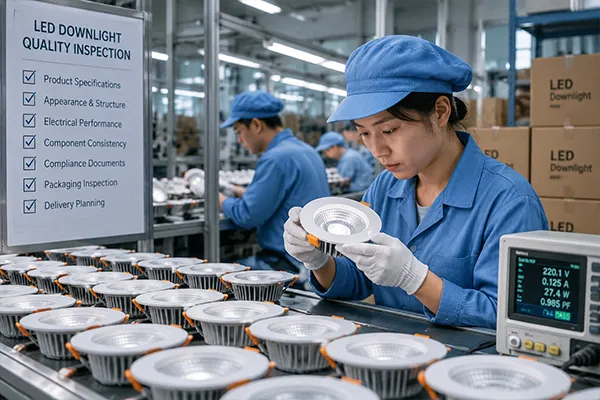
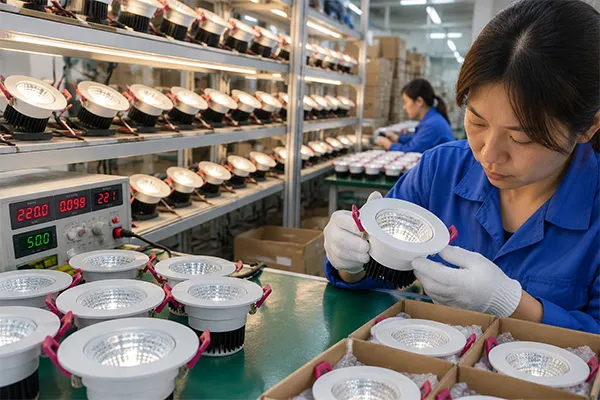
A professional LED downlight factory should be able to explain how it controls incoming materials, assembly, electrical checks, aging, appearance inspection, and final packing. Buyers should request evidence of the actual controls used for their quoted product, then have qualified personnel assess whether those controls fit the intended application.
Review the Quality-Control Flow, Not Just a Claim
Many lighting suppliers describe their products as “100% tested.” That phrase can mean different things. It may refer to a basic power-on check, an aging test, a visual inspection, or several steps combined. Buyers should ask exactly what is tested, when it is tested, how long the test lasts, and how failures are recorded.
At Upward Lighting, we perform a 100% aging test before shipment, typically lasting 4 to 8 hours. This is one part of our production control process, not a standalone guarantee of lifetime performance. I encourage buyers to ask any supplier for similar operational detail rather than relying on a general aging-test claim.
A practical LED downlight quality-control flow may include:
- Incoming inspection: Check LED chips, drivers, heatsinks, reflectors, housings, springs, cables, and labels against the approved requirement.
- In-process inspection: Review assembly quality, wiring, soldering, optical parts, and physical dimensions during production.
- Electrical function check: Confirm that the unit powers on and operates as intended.
- Aging test: Operate the downlight for an agreed duration to identify obvious early failures.
- Appearance inspection: Check surface finish, scratches, color consistency, logo position, and trim condition.
- Final inspection and packing check: Confirm carton markings, accessories, quantities, and package condition.
Ask for Evidence That Connects to Your Risk
The best verification question depends on your sales channel and end use. A wholesaler may focus on batch consistency and return rates. A project contractor may focus on cutout dimensions, delivery timing, and dimming compatibility. A lighting brand may focus on packaging, labeling, and repeatable appearance.
Buyers can request the following evidence:
| Buyer risk | Evidence to request | Practical question |
|---|---|---|
| Color inconsistency | CCT binning information2, sample comparison process | “How do you control color consistency between repeat orders?” |
| Driver failure | Driver specification, incoming inspection records, aging process | “Which driver model is quoted, and can it be changed without approval?” |
| Installation mismatch | Dimension drawing, cutout tolerance, spring details | “What cutout range is allowed for this model?” |
| Surface defects | Inspection standard or approved finish sample | “What defects are acceptable or rejectable?” |
| Shipping damage | Packaging drawings, drop-test approach if available, carton photos | “How many units are packed per carton, and how are trims protected?” |
| Wrong labeling | Artwork approval and final packing checklist | “Who checks barcodes, labels, and carton marks before shipment?” |
I recommend including critical acceptance points in the purchase order, approved sample record, or inspection plan. Buyers can also appoint a qualified third-party inspection provider when the order value or project risk justifies it. A factory’s internal process is useful evidence, but independent verification may add another layer of confidence.
Are the LED Downlight Certificates Valid for Your Market and Product Configuration?
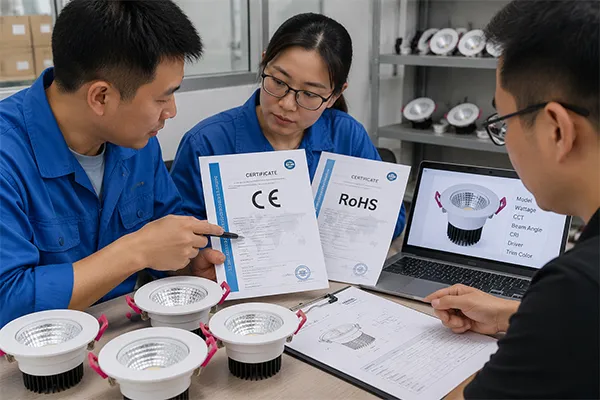
Certificate logos can make a supplier appear ready for export, but a document is useful only when it applies to the actual product configuration, destination market, and intended use. A CE or RoHS document for one model does not automatically establish compliance for every wattage, driver, trim, or customized version.3
A professional LED downlight factory should be able to provide relevant compliance documents, identify the covered model or configuration, and explain any limits of applicability. Buyers should verify regulatory suitability with their own compliance team, importer of record, customer, or qualified specialist before placing the product on the market.
Match Documents to the Actual Quoted Model
I have seen buyers ask only, “Do you have CE?” A more useful approach is to ask whether the available document matches the exact downlight you plan to import.
For example, a customized product may differ from the original certified version in important ways:
- The wattage may change from 10W to 15W.
- The driver may change to support Triac, 0–10V, or DALI dimming.
- The LED board may have a different CRI or CCT configuration.
- The housing may be modified for a new cutout size.
- The product may be supplied with a different input voltage.
- The target market may have requirements beyond the documents initially shared.
The buyer should request the certificate or test report reference, the covered model number, issue date, issuing organization, and product description. The buyer should also compare those details with the quotation and product specification.
Treat CE and RoHS as Documents to Verify
At Upward Lighting, our products hold CE and RoHS certifications intended to support relevant market-entry requirements. However, I would not advise a buyer to treat any certificate logo as automatic proof of compliance for every order. The importer, brand owner, and project party may each have separate responsibilities depending on the market and product application.4
Buyers should ask:
- Which exact models and configurations are covered by this document?
- Does the report list the same electrical rating and driver type as the quotation?
- Is the document current and issued by an identifiable organization?
- What declarations, labels, technical files, or importer obligations apply in the destination market?
- Does the application require additional standards, such as emergency lighting, IP protection, dimming compatibility, or building-specific approvals?
Validate Technical Claims with Qualified Personnel
A supplier may provide photometric data, thermal information, lumen figures, IP ratings, or lifetime claims. These documents can help a buyer compare options, but they should be assessed by qualified technical personnel for application-specific decisions.
For example, thermal performance depends on factors beyond the luminaire itself, including ceiling void conditions, insulation, ambient temperature, installation method, and operating duration.5 Optical suitability also depends on mounting height, spacing, surface reflectance, and glare requirements.6
A careful buyer should avoid asking only, “Is this downlight good?” Better questions include:
- “Can your technical team provide the photometric file and product drawing?”
- “What driver and LED components are used in this quoted version?”
- “What installation conditions should our project engineer review?”
- “Can the product be evaluated against our required dimming system?”
- “Which claims are based on your supplied documentation, and which require our own validation?”
This approach helps separate marketing language from evidence that can be reviewed.
Can the Factory Support Quotations, Delivery Changes, and Post-Order Communication?
A supplier relationship becomes most valuable when the order is no longer simple. A revised delivery date, custom packaging request, component shortage, or last-minute labeling change can expose weak communication processes. Poor coordination can cause delays even when the product itself is acceptable.
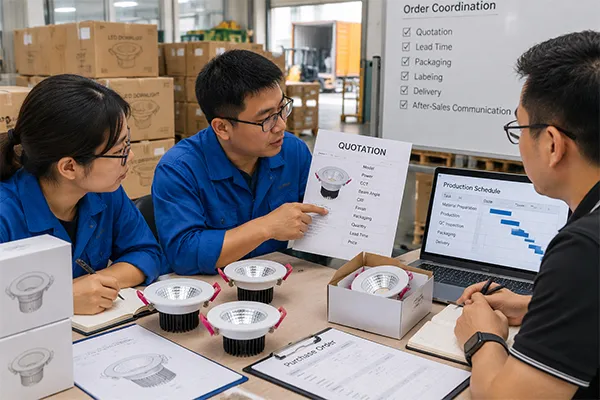
A professional LED downlight factory should provide clear quotations, ask relevant clarification questions, communicate realistic lead times, and document changes during production and delivery coordination. Buyers should evaluate response quality before ordering, because early communication often indicates how issues may be handled later.
Measure Quote Accuracy Before You Measure Reply Speed
Fast replies matter, especially for distributors and project contractors working under deadlines. However, a fast but incomplete quote may create more work later. I believe a useful quotation should make the commercial and technical assumptions visible.
A well-prepared LED downlight quotation should clarify:
- Product model and image or drawing reference
- Unit price and currency
- Minimum order quantity
- Required quantity for custom finishes or packaging
- Product parameters, including wattage, CCT, CRI, beam angle, and dimming option
- Included accessories and excluded items
- Sample cost and sample lead time
- Mass-production lead time
- Packaging details
- Payment terms and shipping terms
- Validity period of the offer
When I work through an inquiry, I find that the buyer’s clearest requests usually receive the most accurate initial quotation. Still, the factory should identify missing information instead of silently making assumptions.
Evaluate Lead-Time Planning
Buyers should not accept a delivery estimate without understanding what it includes. Lead time may depend on material availability, customized components, driver selection, packaging artwork approval, seasonal production load, inspection arrangements, and shipment booking.
Ask these questions:
| Delivery question | Why it matters |
|---|---|
| “Is the lead time counted from deposit, artwork approval, or sample approval?” | Prevents different assumptions about the starting date |
| “Which components have the longest procurement cycle?” | Identifies supply-chain exposure |
| “What happens if a custom driver is delayed?” | Shows whether alternatives and approvals are controlled |
| “When can inspection be arranged?” | Helps plan third-party inspection or buyer review |
| “How will you notify us about a delivery risk?” | Tests communication discipline |
A realistic lead time is usually more valuable than an optimistic one. Buyers should also ask whether the factory has a process for approving substitutions. Component substitutions can affect output, color, driver behavior, or compliance documentation7, so they should not be made without buyer approval when they affect the agreed specification.
Consider Small-Batch and Repeat-Order Capability
Small-batch orders can be important for local lighting brands, market testing, project variations, and replacement stock. Yet small quantities may affect pricing, material availability, and production scheduling. A supplier should explain those limits clearly.
At Upward Lighting, we support small-batch orders and OEM/ODM customization where the product and supply conditions allow it. I still recommend that buyers ask for the exact MOQ by configuration rather than assuming every finish, driver, or package option is available in low quantities.
For repeat orders, buyers should ask how the supplier maintains consistency. Useful questions include:
- “Will the same bill of materials be used for a repeat order?”
- “How will you tell us if an approved component becomes unavailable?”
- “Can you retain an approved sample or color standard?”
- “What order history and revision records do you maintain?”
- “What is your process if we report a quality concern after delivery?”
The answers do not need to be perfect. What matters is whether the supplier has a clear, documented, and practical process.
Frequently Asked Questions
What is the most important thing to check in a professional LED downlight factory?
The most important factor is whether the factory can repeatedly produce your approved specification at bulk scale.8 Buyers should verify documentation, component control, quality checks, lead-time planning, and change management rather than relying only on a sample, price, audit photo, or certificate logo.
How can I verify LED downlight quality before placing a bulk order?
Buyers should review the approved sample, specification sheet, product drawings, quality-control flow, aging-test process, packing details, and inspection standards. For higher-risk orders, buyers can arrange a qualified third-party inspection or have technical personnel review electrical, optical, and thermal documentation.
Is CE certification enough for importing LED downlights into Europe?
CE documentation may be relevant, but it is not automatically enough for every LED downlight configuration or market situation.9 Buyers should verify that the documentation matches the quoted model, driver, electrical rating, and intended use. Importers should consult qualified compliance professionals when necessary.
What should I ask an LED downlight factory about aging tests?
Buyers should ask how long the aging test lasts, whether every unit is tested, what operating conditions are used, what failures are checked, and how failed units are recorded. An aging test can help identify early issues, but it does not alone guarantee long-term performance.10
How do I compare LED downlight supplier quotations fairly?
Buyers should compare more than unit price. Check the exact product parameters, driver type, LED specification, dimming option, certifications, packaging, MOQ, tooling needs, sample charges, lead time, payment terms, and shipping terms. A lower price may reflect a different configuration or unlisted assumption.11
Conclusion
Choosing a professional LED downlight factory is a risk-management decision, not simply a price comparison. I recommend that buyers focus on documented specifications, bulk quality controls, applicable compliance evidence, realistic delivery planning, and disciplined communication. A polished sample and low quote can be useful starting points, but they should lead to deeper verification. If you are sourcing customized LED downlights, track lights, or office linear lighting, contact our team to discuss your specifications, target market requirements, and order plan.
"Quality and Consistency of Machined Components and ...", https://www.nist.gov/system/files/documents/oles/2-Donmez-Alkan-Manufacturing-2012-07-10-MSSFFA.pdf. Quality-management guidance describes controlled and monitored production processes as necessary for maintaining product conformity in repeated manufacture; approval of an individual sample alone does not establish ongoing process consistency. Evidence role: expert_consensus; source type: institution. Supports: Recognized quality-management guidance explains that process control, monitoring, and documented production controls are used to maintain conformity in serial production.. Scope note: This supports the general manufacturing principle, not the quality performance of any particular LED-downlight supplier. ↩
"LED Color Characteristics", https://www.energy.gov/sites/prod/files/2016/08/f33/led-color-characteristics-factsheet.pdf. LED color-binning guidance explains that grouping LEDs by chromaticity helps control perceptible color variation among luminaires and production batches. Evidence role: mechanism; source type: government. Supports: Technical guidance should explain that LED binning groups products by chromaticity or related color characteristics to manage visible color variation.. Scope note: The degree of visible consistency also depends on optics, drive conditions, thermal behavior, and the manufacturer’s binning tolerance. ↩
"Compliance FAQs: CE Marking", https://www.nist.gov/standardsgov/compliance-faqs-ce-marking. European Commission guidance states that conformity assessment and supporting technical documentation must relate to the product placed on the market and the applicable legal requirements; material product changes may require reassessment. Evidence role: general_support; source type: government. Supports: European Commission guidance should support that conformity assessment and technical documentation must correspond to the product placed on the market and its applicable requirements.. Scope note: Whether a particular wattage, driver, or housing change requires new testing or documentation depends on the applicable legislation and the nature of the modification. ↩
"EU - EU Legislation and CE Marking", https://www.trade.gov/country-commercial-guides/eu-eu-legislation-and-ce-marking. EU product-compliance guidance assigns different obligations to manufacturers, importers, and distributors, including obligations concerning conformity documentation, traceability, and market placement. Evidence role: general_support; source type: government. Supports: EU market-surveillance guidance should identify distinct obligations for manufacturers, importers, distributors, and other economic operators.. Scope note: Project parties and brand owners may have additional or different duties under national law, contracts, and sector-specific rules. ↩
"Impact of Thermal Dissipation on the Lighting Performance ...", https://pmc.ncbi.nlm.nih.gov/articles/PMC8776062/. LED-luminaire thermal research shows that ambient conditions and the thermal path created by the installed enclosure can affect operating temperature, which in turn influences light output and component reliability. Evidence role: mechanism; source type: research. Supports: Lighting and thermal-management sources should show that ambient temperature, enclosure conditions, insulation, and installation configuration affect LED-luminaire temperature and performance.. Scope note: The effect size depends on the specific luminaire construction, driver, ceiling system, and operating environment. ↩
"Mounting Height & Glare: Optimizing High Bay Lighting", https://hi-hyperlite.com/blogs/comprehensive-guides/mounting-height-glare-high-bay-lighting?srsltid=AU7gw4Xv6M0cSh7izcUzihKNCqn4g8grKLmNKWazujlLctljJNMV9VXz. Lighting-design guidance identifies luminaire location, mounting height, spacing, room reflectances, and glare control as factors affecting illumination distribution and visual comfort. Evidence role: mechanism; source type: institution. Supports: Lighting-design references should establish that illuminance distribution and visual comfort are influenced by mounting geometry, spacing, surface reflectance, and glare control.. Scope note: A project-specific determination requires photometric data and calculations for the actual room and task. ↩
"LED Luminaire Reliability: Impact of Color Shift", https://www.energy.gov/sites/prod/files/2017/04/f34/lsrc_colorshift_apr2017.pdf. LED-luminaire performance depends on interacting components such as the LED source, driver, optics, and thermal system; changing these components can alter measured electrical or photometric characteristics and may affect the applicability of conformity evidence. Evidence role: mechanism; source type: paper. Supports: Technical literature should show that LEDs, drivers, optics, and thermal components influence luminaire electrical and photometric performance, while regulatory guidance addresses changes to conformity evidence.. Scope note: The consequences of a specific substitution must be determined by comparison, testing, and review of the applicable regulatory requirements. ↩
"Quality Management System Implementation", https://www.nist.gov/mep/successstories/2023/quality-management-system-implementation. Quality-management guidance treats an organization’s demonstrated capability to consistently provide products meeting specified requirements as a central basis for supplier evaluation and control. Evidence role: expert_consensus; source type: institution. Supports: Quality-management and supplier-evaluation guidance should support assessing a supplier’s capability to consistently meet specified requirements in ongoing production.. Scope note: The relative importance of production consistency versus price, capacity, compliance, or delivery performance varies with the buyer’s application and risk tolerance. ↩
"CE marking", https://en.wikipedia.org/wiki/CE_marking. European Commission guidance explains that CE marking signifies the manufacturer’s declaration that a product conforms to applicable EU requirements; the applicable requirements and evidence depend on the product and the legislation governing its placement on the market. Evidence role: definition; source type: government. Supports: European Commission materials should explain that CE marking is a declaration of conformity with applicable EU requirements, rather than a universal certificate covering all variants and circumstances.. Scope note: Additional national rules, installation requirements, and customer specifications may apply beyond CE-marking obligations. ↩
"LED Systems Reliability Consortium", https://www.energy.gov/cmei/ssl/led-systems-reliability-consortium. Reliability engineering distinguishes burn-in or early-failure screening from lifetime qualification: screening may detect some initial defects but does not alone demonstrate long-term field performance. Evidence role: mechanism; source type: research. Supports: Reliability literature should distinguish early-failure screening from lifetime prediction and long-term reliability assessment.. Scope note: Long-term performance assessment requires appropriate life testing, failure analysis, and consideration of actual use conditions. ↩
"Competitive Procurement - University Policies", https://universitypolicies.columbia.edu/content/competitive-procurement. Procurement guidance recommends evaluating bids against clearly defined specifications and relevant non-price factors, because prices are not directly comparable when the offered scope, assumptions, quality, or lifecycle costs differ. Evidence role: general_support; source type: government. Supports: Public-procurement guidance should support comparing offers against defined requirements and considering non-price factors and total cost rather than price alone.. Scope note: This principle does not establish that any particular low-priced quotation is incomplete or unsuitable. ↩