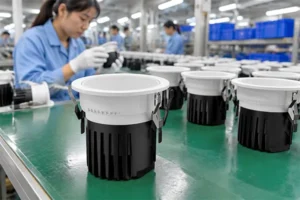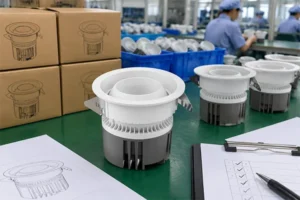

Choosing an LED downlight manufacturer can feel difficult when many suppliers quote similar wattage, lumen output, and prices. A low initial quote may hide unanswered questions about installation, dimming, documentation, quality control, or delivery. I recommend using practical supplier questions to confirm whether a factory can turn your requirements into a repeatable production order.
Before ordering, you should ask an LED downlight manufacturer about the intended application, installation dimensions, technical configuration, customization options, certification documents, quality-control process, MOQ, lead time, and order documentation. The best supplier is not simply the one with the lowest unit price; it is the one that can clearly confirm your approved specifications and produce them consistently for your target market or project.

I have found that strong LED downlight procurement starts before the formal quotation stage. Buyers who share complete requirements early usually receive more useful recommendations, clearer samples, and fewer revisions later. The questions below can help you compare suppliers on capability rather than marketing claims alone.
Should You Start With the LED Downlight Application Instead of the Price?
Many buyers ask for a price first, but price alone does not show whether an LED downlight will fit the ceiling, work with the dimming system, or meet the desired visual effect. This can create delays after samples arrive. I suggest starting with the installation and application requirements.
Yes, you should begin with the application before comparing prices from an LED downlight manufacturer. The installation location, ceiling cutout, ceiling depth, beam angle, color temperature, dimming requirement, trim finish, and required light level determine which configuration is suitable.1 A meaningful quotation depends on a clear product requirement.
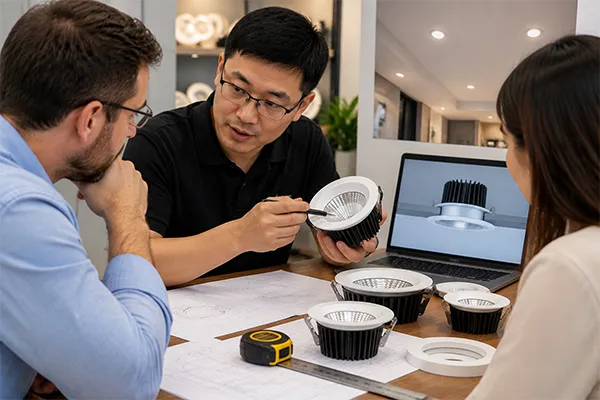
Define the installation environment
An LED downlight that works well in a retail ceiling may not be the right selection for an office, corridor, hotel room, residential project, or humid location. The application affects the product design, optics, driver requirements, glare expectations, and maintenance access.
Before requesting a quotation, I encourage buyers to provide as much of the following information as possible:
- Installation type: recessed, surface-mounted, trimless, or adjustable
- Ceiling cutout size: for example, 75 mm, 90 mm, 120 mm, or another required dimension
- Ceiling depth: especially important where ceiling void space is limited
- Application: residential, hospitality, retail, office, public area, or commercial project
- Required quantity: sample order, trial order, phased project order, or container-level purchasing
- Target market: where the product will be sold or installed
- Expected delivery date: including whether partial shipment is acceptable
I often see inquiries begin with a short message such as “Need 12W downlight, please quote.” That is a useful starting point, but it does not tell an LED downlight manufacturer enough to recommend a reliable configuration. A 12W product can have different body sizes, cutouts, beam angles, drivers, color temperatures, CRI levels, trims, and packaging options.
Ask about lighting performance in context
Wattage is not a complete measurement of lighting suitability.2 Buyers should also discuss the desired lighting effect. For example, a narrow beam angle may suit accent lighting, while a wider beam can be more appropriate for general illumination.3
Useful questions include:
- What beam angle is available for this LED downlight model?
- What color temperatures can the factory produce?
- Is CRI 80 or CRI 90 available for this configuration?
- What is the rated lumen output for the selected wattage and color temperature?
- Is the product designed for a specific dimming method?
- What driver option is proposed, and what are its input requirements?
I do not advise buyers to select an LED downlight only from a catalog image or a wattage label. A qualified local lighting designer, electrical engineer, or project consultant should review application-specific requirements such as lighting calculations, installation conditions, emergency requirements, and local electrical rules.
Compare quotations on the same basis
When I compare inquiry details with the final order confirmation, the biggest differences often involve details added after the first quote: a specific trim color, a dimmable driver, a revised cutout, or customized packaging. These details affect both cost and lead time.
A practical comparison table can help purchasing teams evaluate quotations fairly:
| Comparison Point | Question for the Supplier | Why It Matters |
|---|---|---|
| Model and dimensions | What are the outer diameter, height, and cutout dimensions? | Confirms installation compatibility |
| Electrical configuration | What wattage, input voltage, and driver are included? | Prevents mismatched power requirements |
| Light output | What lumen output, CCT, CRI, and beam angle apply? | Supports lighting selection |
| Dimming | Which dimming system is supported? | Reduces compatibility risk |
| Finish | What trim colors and surface treatments are available? | Maintains project appearance |
| Unit price | What configuration is included in the quote? | Prevents price comparisons between unequal products |
How Will the LED Downlight Manufacturer Document the Final Requirements?
A sample can help buyers inspect appearance and basic function, but a sample alone does not define every detail for mass production. Without written confirmation, assumptions can enter the order process. I recommend asking how the supplier will document the approved configuration before production begins.
A capable LED downlight manufacturer should document the final order through a specification sheet, quotation, approved sample reference, purchase order confirmation, and packaging details. These records should identify the model, wattage, CCT, CRI, beam angle, cutout, driver, finish, quantity, labeling, and agreed acceptance criteria before mass production starts.

Build a specification sheet that purchasing and production can both use
The most useful order document is clear enough for a buyer, sales team, production planner, and quality inspector to understand. It should not rely on vague phrases such as “same as before” unless a specific approved reference is attached.
At Upward Lighting, I would normally encourage customers to confirm the key product parameters before the order moves into production. This helps our team align the material preparation, assembly process, aging test arrangement, packaging, and shipment planning.
A robust LED downlight specification sheet should include:
- Product model number
- Product photo or technical drawing
- Wattage and rated input voltage
- Color temperature
- CRI requirement
- Beam angle
- Cutout size and fixture dimensions
- Driver brand or driver performance requirements, where applicable
- Dimming type, if required
- Trim color and body finish
- Packaging method and carton markings
- Quantity by model or variant
- Labeling requirements
- Applicable document requests
- Target lead time and shipping terms
Use samples correctly
Samples are valuable, but I advise buyers not to treat an approved sample as an automatic guarantee that every future batch will be identical. Production orders require written specifications, confirmed materials, process controls, and ongoing communication.
For example, a buyer may approve a sample with a white trim and later request a black trim for the production order. That visual change may involve different surface treatment or material scheduling. Similarly, a buyer may initially review a non-dimmable sample but later need a dimmable product. The driver configuration must then be confirmed again.
I view the sample as an important reference point, not a replacement for a detailed production confirmation.
Define acceptance criteria before shipment
Buyers should also ask what quality checks will be applied and how issues will be communicated. The answer should be practical rather than absolute. No responsible manufacturer should promise zero defects or claim perfect consistency without qualification.
Questions to ask include:
- What visual inspection points are used for the fixture and trim?
- How is product function checked before packing?
- Is an aging test included, and for how long?
- How are incorrect labels or packaging errors prevented?
- What photos, reports, or inspection information can be provided before shipment?
- How will the supplier handle an agreed quality issue after delivery?
At Upward Lighting, our stated process includes a 100% aging test of 4 to 8 hours before shipment. Buyers should still confirm how that process applies to their selected model and order configuration. They should also define any third-party inspection needs before production and shipment are scheduled.
What Technical Questions Should You Ask an LED Downlight Manufacturer?
Technical terms can make LED downlight purchasing seem more complicated than it needs to be. However, skipping technical questions can lead to unsuitable drivers, incorrect cutouts, inconsistent appearance between product variants, or installation difficulties. I recommend focusing on the specifications that affect the actual project.
You should ask an LED downlight manufacturer about dimensions, cutout, wattage, lumen output, color temperature, CRI, beam angle, driver type, dimming compatibility, input voltage, and thermal design. These questions help buyers verify whether the proposed LED downlight matches the intended ceiling, electrical system, lighting effect, and maintenance expectations.
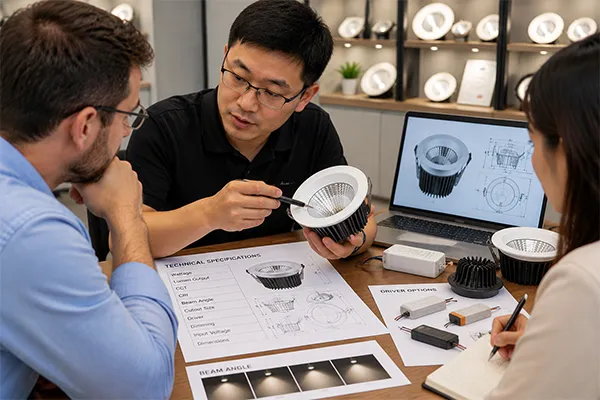
Prioritize dimensions and installation compatibility
The physical product is the first technical issue to confirm. A downlight may look similar in a product photo yet require a different ceiling cutout or recess depth. This is especially important for renovation projects, where existing cutouts often limit product choice.
I suggest buyers request a technical drawing that shows:
- Outer diameter
- Cutout diameter
- Fixture height
- Heat sink size
- Spring clip dimensions
- Driver dimensions
- Cable length, where relevant
- Recommended ceiling thickness range, if available
These details help project teams determine whether the fitting can be installed as intended. Local installers and engineers should confirm that the selected product is appropriate for the site conditions.
Verify the lighting configuration
For repeatable procurement, buyers should ensure that each performance requirement is stated clearly. “Warm white,” for example, may not be sufficiently precise if the project requires a specific color temperature.
| Technical Item | What to Confirm | Procurement Risk if Unclear |
|---|---|---|
| Wattage | Rated wattage for the selected configuration | Incorrect energy or brightness expectation |
| Lumen output | Rated output at the selected CCT and CRI | Inaccurate comparison between suppliers |
| CCT | 2700K, 3000K, 4000K, 5000K, or other option | Inconsistent visual atmosphere |
| CRI | CRI 80, CRI 90, or project requirement | Unsuitable color rendering |
| Beam angle | Narrow, medium, or wide beam option | Poor light distribution |
| Driver | Non-dimmable or specified dimming driver | Electrical compatibility problems |
| Input voltage | Required voltage range | Market or project mismatch |
Ask directly about dimming
Dimming is one of the areas where clear communication matters most. A buyer should not assume that “dimmable” means compatibility with every dimmer on the market. Dimming performance depends on the driver, dimming protocol, control equipment, wiring conditions, and installation environment.4
I recommend asking:
- Which dimming method does this driver support?
- Is the quoted version non-dimmable, triac-dimmable, 0–10V, DALI, or another option?
- Is the dimming driver included in the quoted price?
- Can the supplier provide the relevant driver data sheet?
- Does the supplier recommend compatibility testing with the intended control system?
A manufacturer can provide product information, samples, and driver documentation. However, application-specific dimming compatibility should be evaluated by qualified professionals using the actual local control system.
Are Certification Documents Applicable to Your Exact LED Downlight Configuration?
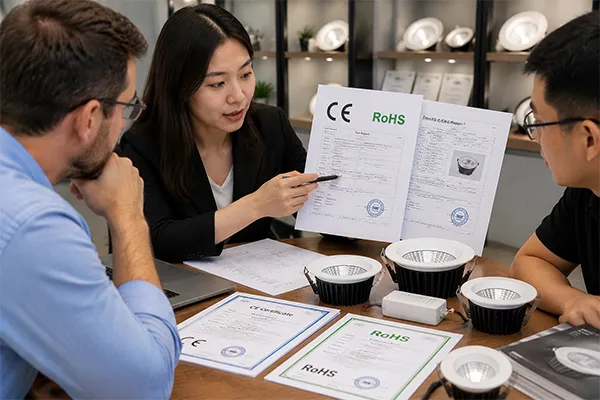
Certification claims can be reassuring, but buyers should treat documents as records to review rather than universal proof that every product version is approved everywhere. The wrong assumption can create market-entry, project approval, or compliance issues later. I recommend asking precise questions about document scope.
You should ask whether certification and test documents apply to the exact LED downlight model, driver, voltage, and configuration you plan to order. Documents such as CE and RoHS may support market requirements5, but buyers must verify their validity, scope, and suitability for the destination market, customer specification, and customized product version.
Request documents early
Many customers ask for datasheets, sample information, and certification documents before proceeding with an order. I consider this a sensible part of supplier qualification. It allows purchasing teams to identify potential document gaps before they commit to a production schedule.
At Upward Lighting, we state that our products hold certifications such as CE and RoHS. I would still encourage every buyer to verify the documents for the selected product and target market. A document associated with one model, driver, or configuration may not automatically apply to every customized version.6
Buyers can ask for:
- Product datasheet
- Technical drawing
- Declaration or certificate copy, where available
- Test report information, where applicable
- Driver documentation
- Product label examples
- Packaging label examples
- Factory information needed for supplier qualification
Check the scope, not just the logo
A logo on a catalog page or fixture label does not answer all compliance questions.7 Buyers should review the document name, issuing organization, model reference, date, product description, and whether the electrical configuration matches the intended order.
Use this checklist during document review:
- Does the document identify the same LED downlight model?
- Does it cover the required input voltage?
- Does it include the intended driver or electrical configuration?
- Does it reflect the version being customized?
- Does it meet the project’s stated requirement?
- Is it suitable for the destination market?
- Does the buyer need additional local testing, registration, or approval?
Involve qualified local specialists
Manufacturers can support the document collection process, but we are not a substitute for local certification bodies, testing laboratories, electrical engineers, or regulatory consultants. Requirements differ between countries, sales channels, and project types.8
For this reason, I suggest that importers, local brands, and project purchasers consult qualified local professionals when requirements are unclear. This step is especially important for large installations, public projects, regulated channels, and products with specialized control requirements.
Can the LED Downlight Manufacturer Support Customization and Repeat Orders?
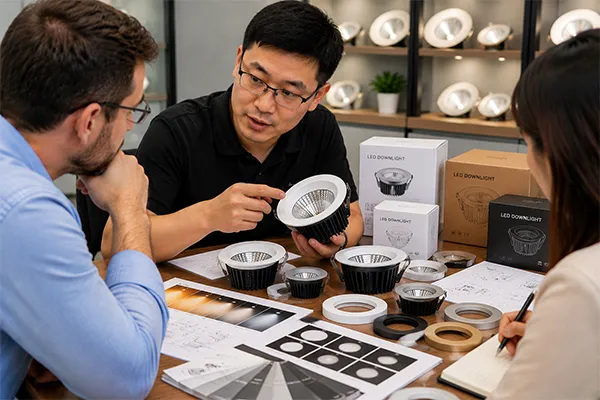
Customization can help a brand or project meet specific market needs, but it also introduces more variables into purchasing. Buyers may need a special color temperature, wattage, beam angle, trim finish, packaging design, or private label. The key question is whether the supplier can manage those changes in a controlled way.
A reliable LED downlight manufacturer should explain which OEM and ODM options are feasible, what minimum order quantities apply, how samples are handled, and how customized details will be controlled in mass production. Buyers should confirm feasibility, cost impact, documentation, and lead time for every customized requirement before placing an order.
Ask what can be customized
Not every requested change requires a completely new product design. Some requirements can be managed through existing product platforms, while others may require new materials, testing, artwork, tooling, or longer preparation time.
At Upward Lighting, our OEM/ODM service can include customization of parameters such as:
- Color temperature
- Wattage
- Beam angle
- Color Rendering Index
- Surface finish colors
- Packaging presentation
- Product labeling, subject to confirmation
I recommend that buyers describe the business purpose behind customization. For example, a distributor may need a black trim for a modern retail line, while a project contractor may need a specific cutout size to fit an existing ceiling plan. This context helps the LED downlight manufacturer propose a practical solution.
Confirm MOQ and sample conditions
Small-batch orders can be useful for market testing, showroom displays, product evaluation, or phased projects. However, MOQ may vary depending on the model, driver, finish, packaging, and customization level.9
Ask these questions:
- What is the MOQ for the standard model?
- What is the MOQ for custom CCT, wattage, trim color, or packaging?
- Can the factory support a sample order before mass production?
- Will sample charges be credited against a future order?
- Does customization require a new material purchase or artwork approval?
- What lead time applies to standard versus customized versions?
I have seen buyers improve their sourcing decisions by separating standard requirements from special requirements. They can first confirm a stable base model, then decide which customized elements are commercially necessary.
Evaluate communication for long-term supply
Long-term procurement depends on more than product specifications. Buyers should also assess how clearly the supplier communicates during quotation, sampling, production, inspection, and shipment preparation.
A practical supplier evaluation may include:
| Capability Area | Question to Ask | Positive Evidence |
|---|---|---|
| Quotation speed | How quickly can the supplier confirm a configuration? | Clear quotation with assumptions stated |
| Technical response | Can the supplier provide drawings and data sheets? | Complete and consistent documentation |
| Customization | What changes are feasible for this model? | Defined options, MOQ, and lead time |
| Production updates | When will order status be communicated? | Agreed production milestones |
| Quality process | What checks occur before shipment? | Clear process explanation |
| Shipment readiness | Can labels, cartons, and quantities be confirmed? | Packing list and shipment documentation |
What Should You Ask About Quality Control, Lead Time, and Shipment Readiness?
A product can be technically suitable and still cause purchasing problems if quality checks, packaging, quantity control, or shipment details are not confirmed. These operational questions help buyers assess whether the supplier can support a dependable order process from deposit to dispatch.
You should ask an LED downlight manufacturer how it controls materials, assembly, aging, functional testing, appearance inspection, packaging, quantity verification, and shipment documentation. You should also confirm the production lead time, communication schedule, shipping terms, and what information will be available before the goods leave the factory.
Understand the quality-control process
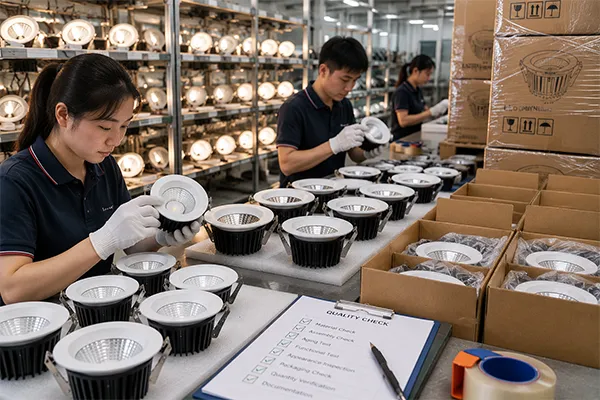
The phrase “quality control” can mean different things at different factories. Buyers should ask for a straightforward explanation of actual process steps rather than relying on broad claims.
At Upward Lighting, every product undergoes a 100% aging test lasting between 4 and 8 hours before shipment, according to the selected production process. This aging step is intended to support functional verification and lumen-maintenance-related quality expectations.10 It does not eliminate the need for agreed inspection standards, correct product documentation, and buyer-side evaluation.
Questions worth asking include:
- Is the incoming material checked before assembly?
- Is the driver matched to the selected product configuration?
- Is every unit functionally tested?
- How long is the aging test for this model?
- Is visual inspection performed before packing?
- How are carton quantities checked?
- Can pre-shipment photos or inspection records be shared?
Confirm lead time realistically
Lead time should be discussed as a production and supply-chain question, not as a number copied into an email without context. The final timeline can depend on material availability, customization, order quantity, packaging approval, payment timing, and booking arrangements.11
I recommend confirming:
- Sample lead time
- Mass-production lead time
- Lead time after deposit and artwork approval
- Whether raw materials are already available
- Whether the order includes customized drivers, finishes, or packaging
- Estimated shipment-ready date
- Shipping method and Incoterms
- Required export documents
Check packaging and shipment details
Packaging protects the product and supports warehouse handling, retail presentation, and project distribution. A wholesaler may need barcode labels and standardized cartons, while a contractor may prioritize mixed-model packing lists for site receiving.
Before shipment, buyers should verify:
- Product quantity by SKU
- Carton quantity and carton dimensions
- Net and gross weight
- Inner-box requirements
- Product labels and carton marks
- Pallet requirements, if applicable
- Packing list details
- Invoice and shipping document requirements
I believe shipment readiness is a final quality checkpoint, not only a logistics task. A correct LED downlight in incorrect packaging or with the wrong label can still create avoidable problems for a distributor or project team.12
Frequently Asked Questions
What is the most important question to ask an LED downlight manufacturer?
The most important question is whether the proposed LED downlight fits your actual application. I suggest confirming the installation method, cutout size, ceiling depth, wattage, light output, CCT, CRI, beam angle, dimming requirement, finish, target market, and required quantity before comparing price.
Should I request samples before placing a bulk LED downlight order?
Yes, I recommend requesting samples when practical. Samples allow buyers to review appearance, dimensions, installation fit, and basic function. However, buyers should also approve written specifications, packaging, quantities, and acceptance criteria because an approved sample alone does not define every mass-production detail.
How can I verify LED downlight certification documents?
You should review whether the document identifies the exact model, electrical configuration, and intended product version. You should also check whether it meets your destination market or project requirement. I recommend consulting qualified local certification, testing, or regulatory professionals for application-specific decisions.
What details should be included in an LED downlight purchase order?
An LED downlight purchase order should include the product model, dimensions, cutout, wattage, voltage, CCT, CRI, beam angle, driver type, dimming requirement, trim finish, quantity, packaging, labels, document requirements, price, payment terms, lead time, and shipping terms.
Can an LED downlight manufacturer support small customized orders?
Some manufacturers can support small-batch orders, but feasibility depends on the model and customization type. Buyers should ask about MOQ, sample cost, material availability, packaging requirements, and lead time. Custom wattage, driver, finish, or branded packaging may have different minimum quantities than standard products.
Conclusion
The best questions for an LED downlight manufacturer go beyond wattage, lumens, and unit price. I recommend starting with the application, then documenting technical specifications, verifying certification documents, confirming customization feasibility, and reviewing quality and shipment processes. These steps help buyers evaluate whether a supplier can support repeatable procurement rather than only provide an initial quotation. If you need LED downlights, track lights, or office linear lighting with OEM/ODM support, contact Upward Lighting to discuss your product requirements, sample needs, and order plan.
"Lighting Specification Guidance for Schools", https://www.energy.gov/sites/default/files/2024-12/lighting-spec-guidance-school_nov24.pdf. Lighting-design guidance recognizes that luminaire selection must account for installation geometry, light distribution, color characteristics, controls, and the intended visual task or application. Evidence role: general_support; source type: institution. Supports: Lighting-design guidance explaining that luminaire selection depends on mounting geometry, light distribution, color characteristics, controls, and the intended application.. Scope note: The source supports the general selection principle; exact product suitability still requires project-specific photometric and installation review. ↩
"Purchasing Energy-Efficient Light Bulbs", https://www.energy.gov/cmei/femp/purchasing-energy-efficient-light-bulbs. Watts measure electrical power consumption, whereas lumens measure visible light output; therefore wattage alone does not characterize a lamp or luminaire's lighting performance. Evidence role: definition; source type: government. Supports: Authoritative consumer or technical guidance distinguishing watts, which measure electrical power, from lumens, which quantify emitted visible light.. Scope note: Lumens alone also do not capture distribution, glare, color quality, or performance in a particular space. ↩
"Lighting Design for Interiors: Layers, Sources, and Strategies", https://www.idi.edu/blog/lighting-design-for-interiors. Lighting-design references commonly associate narrow beam distributions with accenting objects or areas and wider distributions with broader ambient or general illumination. Evidence role: general_support; source type: education. Supports: Lighting-design material describing beam spread and the conventional use of narrow distributions for emphasis and broader distributions for ambient or general lighting.. Scope note: Appropriate beam spread depends on mounting height, spacing, reflectances, target geometry, and required illuminance. ↩
"LED Dimming: What you need to know", https://www1.eere.energy.gov/buildings/publications/pdfs/ssl/dimming_webcast_12-10-2012.pdf. LED dimming behavior depends on the interaction of the driver and control method and can be affected by system compatibility and installation conditions. Evidence role: mechanism; source type: institution. Supports: Technical guidance explaining that LED dimming behavior depends on compatibility between the LED driver and control system, as well as circuit and installation factors.. Scope note: A general compatibility guide cannot verify performance for a specific driver, dimmer, circuit, or installed project. ↩
"RoHS Directive - Environment - European Commission", https://environment.ec.europa.eu/topics/waste-and-recycling/rohs-directive_en. In the European Union, CE marking indicates that a manufacturer declares conformity with applicable Union requirements, while the RoHS framework restricts specified hazardous substances in covered electrical and electronic equipment. Evidence role: definition; source type: government. Supports: Official European Union information on CE marking as a conformity-marking framework and RoHS restrictions on specified hazardous substances in electrical and electronic equipment.. Scope note: Applicability depends on the product category, applicable legislation, and the conditions under which the product is placed on the market. ↩
"CE marking – obtaining the certificate, EU requirements", https://europa.eu/youreurope/business/product-rules-compliance/general-product-compliance/ce-marking/index_en.htm. Conformity documentation is intended to describe and support the product placed on the market; relevant design or configuration changes may require the manufacturer to reassess applicable compliance obligations and documentation. Evidence role: general_support; source type: government. Supports: Conformity-assessment guidance indicating that technical documentation and conformity evaluation must correspond to the product placed on the market and may need reassessment after relevant changes.. Scope note: Whether a particular customization is relevant enough to require new testing or assessment depends on the applicable legal requirements and technical change. ↩
"CE marking - Internal Market, Industry, Entrepreneurship and ...", https://single-market-economy.ec.europa.eu/single-market/goods/ce-marking_en. CE marking forms part of a wider conformity-assessment system that may require technical documentation and a declaration of conformity; the mark alone does not provide the underlying compliance record. Evidence role: general_support; source type: government. Supports: Official guidance stating that CE marking is accompanied by manufacturer obligations such as conformity assessment, technical documentation, and an EU declaration of conformity where required.. Scope note: Documentation obligations vary by applicable EU legislation and product category. ↩
"Standards for Trade-Hong Kong & Macau", https://www.trade.gov/country-commercial-guides/standards-trade-hong-kong-macau. Electrical products may be subject to jurisdiction-specific technical regulations, conformity-assessment procedures, and installation rules, so market-access requirements cannot be assumed to be identical across countries. Evidence role: general_support; source type: institution. Supports: International standards or trade guidance showing that market-access rules, conformity-assessment procedures, and national electrical requirements can differ by jurisdiction.. Scope note: The source provides general regulatory context and does not identify the requirements for a particular destination or project. ↩
"Supply Chains Built for Speed and Customization", https://sloanreview.mit.edu/article/supply-chains-built-for-speed-and-customization/. Production minimums are commonly linked to setup costs, batch-size economics, material procurement, and the complexity of product variants, which can make customized configurations subject to different order thresholds. Evidence role: mechanism; source type: paper. Supports: Operations-management research explaining that minimum production quantities can arise from setup costs, batch production, material purchasing, and configuration complexity.. Scope note: A supplier's actual MOQ is a commercial decision and cannot be inferred from general production-economics research. ↩
"LED Replacement Lamps: Current Performance and the ...", https://www1.eere.energy.gov/buildings/publications/pdfs/ssl/replacement-lamps_webcast_slides.pdf. Short-duration burn-in testing may help screen for early functional failures, whereas LED lumen maintenance is characterized through standardized long-term measurement procedures such as IES LM-80. Evidence role: mechanism; source type: institution. Supports: IES or DOE material distinguishing short-duration burn-in or screening from standardized long-term LED lumen-maintenance measurement, such as LM-80 testing.. Scope note: A production aging test can provide process-level screening but does not by itself demonstrate a product's rated lifetime or lumen-maintenance performance. ↩
"Why Focusing on Lead Time, Not Just Efficiency and Cost ...", https://interpro.wisc.edu/lead-time-drives-manufacturing-success/. Manufacturing lead time is shaped by material availability, production scheduling and batch size, engineering or approval activities, and downstream logistics coordination. Evidence role: mechanism; source type: research. Supports: Supply-chain research identifying material availability, production scheduling, batch size, approvals, and logistics as contributors to manufacturing lead time.. Scope note: The relative importance of these factors varies by factory capacity, product design, supplier network, and shipping route. ↩
"Standards for Foodservice and Retail Grocery", https://www.gs1us.org/industries-and-insights/food-and-retail-grocery. Accurate product identification and packaging information support traceability, receiving, inventory control, and distribution, so labeling or packing errors can disrupt downstream handling even when the product is technically correct. Evidence role: general_support; source type: institution. Supports: Supply-chain standards guidance on the role of accurate product identification and packaging information in traceability, receiving, inventory, and distribution processes.. Scope note: The operational impact depends on the buyer's warehouse systems, labeling specifications, and project receiving procedures. ↩