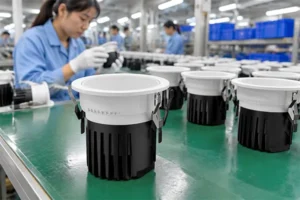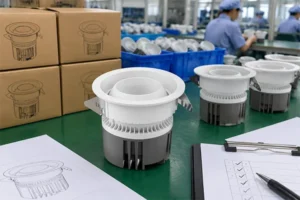

Choosing an LED downlight manufacturer can feel simple when every supplier shows bright samples, competitive prices, and familiar certificates. The real problems often appear later: inconsistent batches, unclear documents, delayed replenishment, or specifications that change between sample and production. We believe buyers reduce these risks by evaluating the supplier’s process, not just the product photo or unit quote.
A good LED downlight manufacturer is one that can repeatedly convert an agreed project specification into consistent samples, transparent pricing, applicable compliance documents, stable production quality, and dependable delivery.1 Buyers should compare suppliers on specification accuracy, batch consistency, communication, change control, and service scope—not only price, wattage, lumen output, or certificate logos.
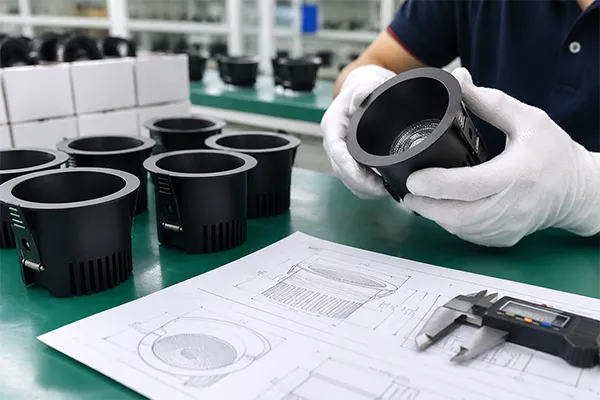
The best supplier is rarely identified by one email or one showroom sample. In our experience, a reliable purchasing decision comes from testing how a manufacturer responds when details become specific: application, beam angle, color temperature, trim finish, required documents, target delivery date, and repeat-order expectations.
How Should We Compare an LED Downlight Manufacturer Beyond Price?
A low quotation can attract attention quickly, especially when a project budget is tight. However, price alone does not show whether an LED downlight manufacturer understands the required product, can maintain the same specification across batches, or can support future replenishment. We encourage buyers to compare risk as carefully as they compare cost.
Buyers should compare LED downlight manufacturers by reviewing the full commercial and technical offer: product specification, materials, driver configuration, sample consistency, documentation, lead time, customization scope, packaging, and after-sales process. A lower price may be valid, but buyers should understand what is included, excluded, or assumed before selecting a supplier.
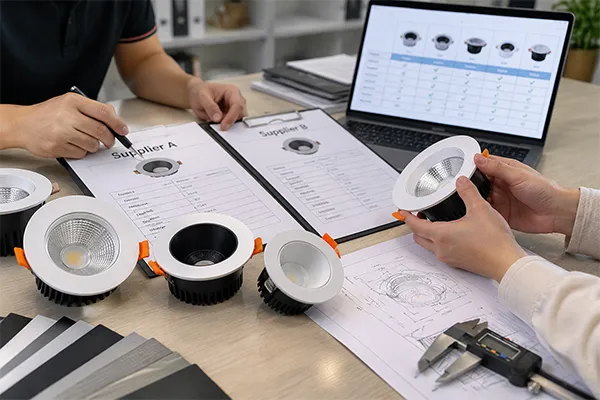
Start With One Detailed Request for Every Supplier
We often see buyers send short inquiries such as “Please quote 12W downlights” or “Need recessed LED light, best price.” These inquiries are understandable, but they leave too much room for different assumptions.
One supplier may quote a basic driver. Another may quote a higher-specification driver with a different warranty arrangement. One may use a standard white finish, while another includes custom powder coating. Both quotations may say “12W LED downlight,” yet they may not represent the same product.2
We recommend sending the same written specification package to each potential supplier. This creates a more useful comparison.
Your request can include:
- Installation type: recessed, surface-mounted, adjustable, or fixed
- Application: office, retail, residential, hotel, corridor, or commercial project
- Wattage and target light output
- Input voltage and driver requirements
- Color temperature, such as 3000K, 4000K, or 6500K
- CRI requirement, for example CRI 80 or CRI 90
- Beam angle and anti-glare expectations
- Cutout size and outer diameter
- Housing material and surface finish
- IP rating, where relevant
- Required market documentation
- Packaging, labels, barcode, and brand requirements
- Expected order quantity and replenishment plan
Compare the Consistency of the Supplier’s Reply
The strongest early-stage evaluation is often not the first price. It is whether the proposal is internally consistent.
For example, we suggest checking whether the supplier’s quoted lead time matches its stated customization level. If a supplier offers several custom parameters but gives the same lead time as a ready-stock standard product, buyers can ask how the schedule will be managed. A short lead time may be achievable, but it should be supported by available materials, approved components, and a realistic production plan.
| Evaluation Area | Useful Buyer Question | Risk It Can Reveal |
|---|---|---|
| Product specification | Does the quotation list the exact model and parameters? | Unclear or substituted configurations |
| Pricing | What materials, driver, packaging, and service are included? | Hidden scope differences |
| Sample | Will the production product match the approved sample? | Sample-to-production inconsistency |
| Lead time | Is the lead time based on stock, components, or confirmed production capacity? | Delivery uncertainty |
| Documents | Which exact model does each document cover? | Incorrect certification assumptions |
| Repeat orders | Can the supplier maintain the approved configuration? | Replenishment inconsistency |
Price differences do not automatically mean that one supplier is poor and another is good. They may reflect order volume, material choices, service level, tooling, packaging, customization, payment terms, or who carries particular supply-chain risks. We find that buyers make stronger decisions when they ask each supplier to explain the differences clearly.
A useful quotation is not merely the lowest number. It is a document that helps both sides understand exactly what will be supplied.
Can an LED Downlight Manufacturer Turn Specifications Into Repeatable Production?
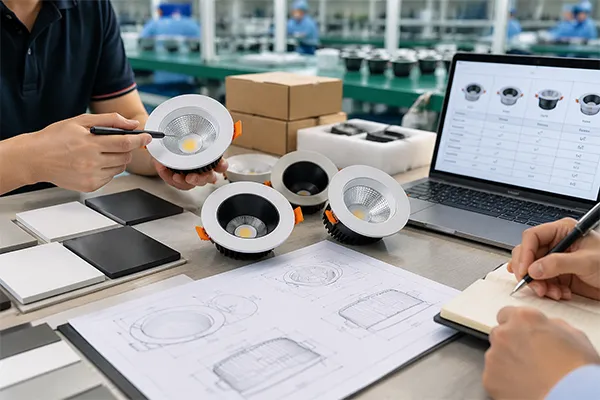
Customization sounds straightforward until a buyer needs the same product six months later. A sample can look correct because it was assembled carefully for approval.3 The more important question is whether the LED downlight manufacturer has a clear process to reproduce that approved configuration during mass production and future orders.
A capable LED downlight manufacturer should confirm the application, technical parameters, customization boundaries, sample approval process, and production controls before starting volume orders. Buyers should request written confirmation of the approved model, bill-of-material assumptions, labels, packaging, and any changes that require renewed approval.
Define the Application Before Finalizing the Product
In our daily communication, buyers often begin with wattage, lumens, or price. These details matter, but we usually need to understand where the downlight will be installed before we can recommend a suitable configuration.
An office ceiling, a retail display area, a hotel corridor, and a residential kitchen may require different priorities. One project may focus on visual comfort and a lower-glare design. Another may need a particular cutout size to match an existing ceiling opening. A local lighting brand may require distinctive trim colors, retail packaging, and stable repeat availability.
We recommend discussing:
- The installation environment. Is the ceiling shallow? Is moisture resistance needed? Is maintenance access limited?
- The lighting purpose. Is the product for general illumination, accent lighting, display lighting, or task lighting?
- The target customer or market. Does the buyer need a standard wholesale product, a branded retail item, or a project-specific solution?
- The expected order pattern. Is this a one-time tender order or a product line that requires recurring purchases?
- The customization level. Are changes limited to packaging and trim color, or do they involve wattage, CCT, beam angle, CRI, driver, or housing design?
Make Sample Approval a Controlled Step
An approved sample should become a controlled reference4, not just an informal expression of preference. We believe buyers should keep a record of the final sample specification and clarify which characteristics are essential.
For an OEM or ODM LED downlight project, that record may include:
- Product model number
- Approved wattage and input voltage
- Color temperature and CRI
- Beam angle
- Cutout size and dimensions
- Driver brand or driver performance requirements
- Housing and heat-sink material
- Trim color and finish
- Logo location and printing artwork
- Inner box and master carton details
- Required labels and documentation
At Upward Lighting, we handle OEM/ODM discussions by confirming parameters before moving toward production. We know that customization often needs several rounds of clarification. A customer may initially request a 4000K product, then later need a different beam angle, black trim, or updated packaging for a channel partner. These changes are manageable when both sides record them clearly.
Control Changes Between Orders
Buyers should also ask how a supplier handles component changes. Some changes may be necessary because of component availability, updated customer requirements, or compliance needs. However, an uncontrolled substitution can create problems in appearance, installation, dimming compatibility, or performance consistency.5
A practical change-control process should clarify:
- Which changes require buyer approval
- Whether the supplier will send an updated specification sheet
- Whether a new sample is needed
- How revised packaging or labels are approved
- How the supplier identifies the production batch
- How repeat orders reference the original approved configuration
We do not believe any process removes all risk. Still, written approval and change control reduce uncertainty significantly, especially for importers, distributors, and local brands that need stable product identity across multiple sales channels.
How Can We Verify LED Downlight Manufacturer Quality Control and Certifications?
Quality-control statements and certificate lists can look reassuring, but buyers need to connect them to the exact product and target market. An LED downlight manufacturer should be prepared to explain how it checks production and what documents apply to a particular model. We advise buyers to verify rather than assume.
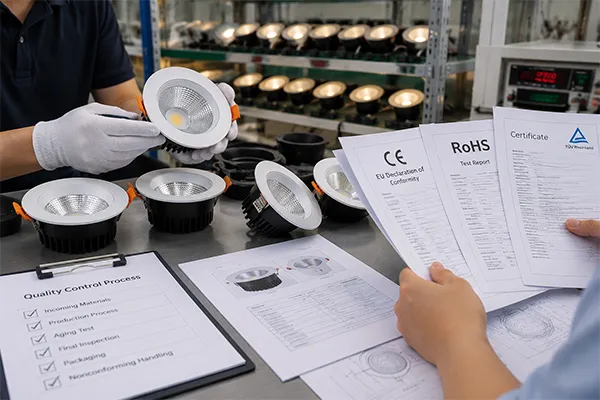
Buyers should verify quality control by asking for practical process evidence, approved samples, inspection records where available, and clear handling of nonconforming products. They should verify certifications by checking the issuing body, document validity, model coverage, applicable market requirements, and whether the supplied configuration matches the documented product.
Look for Process Evidence, Not Broad Promises
Terms such as “strict quality control” and “high quality” are common in lighting quotations. They are not meaningless, but they are too broad to guide a procurement decision. We recommend asking what the manufacturer actually checks before shipment and how those checks are recorded.
At Upward Lighting, every product undergoes a 100% pre-shipment aging test lasting 4 to 8 hours as part of our own process. We use this step to support our internal quality checks before goods leave our facility. However, we do not present this as a universal industry benchmark or as proof that every possible field issue has been eliminated. Buyers should evaluate the whole quality system, product design, application, and inspection approach.
Useful quality-control questions include:
- Is incoming material inspected before assembly?
- Are key dimensions checked, including cutout-related dimensions?
- Is appearance checked for scratches, color variation, and trim defects?
- Is the product tested for operation before packing?
- What aging or burn-in process, if any, does the supplier use?
- Are cartons checked for correct quantity, labels, and packaging condition?
- How are rejected products identified and handled?
- Can the buyer arrange third-party pre-shipment inspection if needed?
Treat Certifications as Product-Specific Documents
CE and RoHS documentation may be relevant for many buyers, but these documents should not be treated as blanket proof of universal market access, product quality, or overall supplier reliability.6 Requirements differ by market, application, product configuration, and sales channel.7
We suggest that buyers review:
| Document Review Point | Why It Matters |
|---|---|
| Exact model number | The document should cover the supplied product model or clearly applicable family |
| Issue date and validity | Older documents may need review against current requirements |
| Applicant and manufacturer details | Names should align with the proposed supply chain |
| Product description | Wattage, voltage, and product type should match the order |
| Test standard or declaration basis | Buyers should confirm relevance with qualified compliance professionals |
| Market applicability | A document may not satisfy every country, channel, or project requirement |
When a project has specific legal, electrical, or installation requirements, we recommend that buyers consult a qualified compliance professional, test laboratory, local authority, or project engineer. A manufacturer can provide documents and product information, but the final suitability decision depends on the destination market and application.
Review the Sample and Production Batch Together
A bright sample can be helpful, but it is not a complete quality assessment.8 We encourage buyers to evaluate the sample against a written checklist and then use that same checklist for pre-shipment inspection or incoming inspection.
For example, a distributor can compare:
- Trim color and surface finish
- Cutout and outer dimensions
- CCT consistency within a sample group
- Label and carton accuracy
- Driver markings
- Basic operating condition
- Requested accessories and mounting parts
This method creates a direct link between what was approved and what was delivered. It also gives both buyer and supplier a clearer basis for resolving concerns if they arise.
Why Do Delivery Reliability and Communication Matter When Choosing an LED Downlight Manufacturer?
A technically acceptable product still creates commercial problems if it arrives late, lacks the required labels, or cannot be replenished consistently. Delivery reliability depends on more than a factory’s stated capacity.9 It also depends on planning, material availability, order confirmation, communication, and the supplier’s response when conditions change.
A reliable LED downlight manufacturer should provide realistic lead times, confirm order details before production, communicate material or schedule changes early, and support repeat-order consistency. Buyers should evaluate how the supplier handles questions and exceptions, because clear communication can reduce avoidable delays and after-sales disputes.
Ask What the Lead Time Actually Means
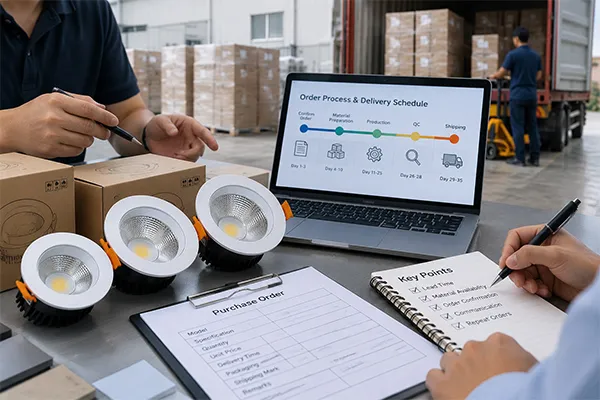
A lead time should be more than a general promise.10 Buyers should ask whether it begins after deposit receipt, artwork approval, sample confirmation, or material arrival. These details are especially important for branded products, custom finishes, nonstandard CCTs, and special packaging.
We recommend that the order confirmation identify:
- Final product model and parameters
- Quantity by item and color temperature
- Packaging and labeling instructions
- Production lead time
- Inspection timing
- Shipping terms and destination
- Required documents
- Balance-payment arrangement
- Contact person for production updates
In our experience, unclear order confirmation is one of the most common sources of later confusion. A buyer may believe that a logo is included, while the supplier may treat logo printing as pending artwork approval. Both sides benefit when these dependencies are listed before production begins.
Evaluate Responsiveness Before the First Order
Communication quality is often visible early. We suggest that buyers note whether the supplier answers technical questions directly, identifies missing information, and corrects misunderstandings rather than simply agreeing to every request.
A supplier that asks sensible questions may be trying to avoid a preventable error. For example, when we receive an inquiry for a custom LED downlight, we may need to confirm the cutout size, target voltage, CCT, beam angle, and packaging before we can provide a dependable quotation. Fast responses matter, but accurate responses matter as well.
We also recommend testing how the supplier handles practical scenarios:
- A customer requests an updated quotation.
- A project needs a small trial order.
- A brand needs revised artwork.
- A repeat order must match a previous batch.
- A shipment requires additional document copies.
- A field concern requires product traceability and a response plan.
Plan for Replenishment and After-Sales Support
For wholesalers, distributors, and local lighting brands, the first order is only the beginning. A reliable supplier relationship should support future replenishment without unnecessary changes to product appearance, installation dimensions, or commercial terms.11
Buyers can ask these questions before committing:
- Can the supplier retain the approved specification for future orders?
- Can the supplier support small-batch replenishment?
- What happens if a component becomes unavailable?
- How does the supplier identify production batches?
- What information is needed to report an after-sales issue?
- Who will coordinate the response and expected timeline?
No supplier can guarantee that global supply conditions will never change. Still, a transparent manufacturer will explain potential constraints early and discuss workable alternatives. We believe that is more valuable than an unrealistic promise.
Frequently Asked Questions
What should I ask an LED downlight manufacturer before requesting a quote?
We recommend providing the installation application, wattage, CCT, CRI, beam angle, cutout size, voltage, finish color, quantity, packaging needs, and target market. You should also ask about sample availability, lead time, certification coverage, customization limits, and repeat-order support.
Is the lowest-priced LED downlight manufacturer always a risky choice?
No. A lower price can result from higher volumes, standard specifications, simpler packaging, different materials, or a different service scope. We recommend comparing like-for-like specifications and asking each supplier to explain what is included before making a purchasing decision.
How can I check whether CE or RoHS documents apply to my LED downlight order?
You should compare the document’s product model, description, voltage, and manufacturer details with the proposed order. You should also verify market applicability and document status. For project-specific or regulated applications, we recommend consulting a qualified compliance professional or local authority.
Why is sample approval important for OEM LED downlights?
Sample approval creates a reference for production. It helps buyers confirm dimensions, color temperature, trim finish, packaging, labels, and other key requirements before volume manufacturing. We recommend keeping an approved specification sheet and clarifying how future changes will be controlled.
What is a reasonable quality-control question to ask a lighting supplier?
You can ask what checks occur before shipment, whether products undergo operational testing, how rejected units are handled, and whether batch records are available. You may also ask whether third-party inspection can be arranged for larger or higher-risk orders.
Conclusion
A good LED downlight manufacturer does more than offer an attractive sample or a low price. The right supplier helps us translate a clear requirement into an approved sample, accurate quotation, relevant documents, repeatable production, and realistic delivery plan. We recommend comparing suppliers using the same detailed specification and reviewing their consistency across every response. At Upward Lighting, we support importers, distributors, contractors, and lighting brands with OEM/ODM LED downlight solutions, responsive quotations, small-batch support, and documented production communication. Contact us to discuss your next downlight requirement.
"Northrop Grumman Corporation Trusted, Innovative, World- ...", https://www.nist.gov/document/nistusrp-northup-cyber-scrm-case-studypdf. ISO quality-management guidance describes controlled processes, documented information, and evaluation of externally provided products and services as mechanisms for promoting consistent conformity and reliable supply performance. Evidence role: general_support; source type: institution. Supports: Quality-management guidance recognizes supplier evaluation, documented processes, consistent output, and delivery performance as relevant elements of controlled supply.. Scope note: The guidance supports the procurement principle generally; it does not establish that any individual LED manufacturer meets these conditions. ↩
"Luminaires V2 0 Final.pdf", https://www.energystar.gov/sites/default/files/asset/document/Luminaires%20V2%200%20Final.pdf. U.S. Department of Energy lighting materials distinguish input power from other luminaire characteristics such as luminous output, color quality, distribution, and electrical performance, so identical wattage labels need not denote identical products. Evidence role: definition; source type: government. Supports: LED luminaires are characterized by multiple performance and construction attributes, including input power, luminous output, color characteristics, electrical configuration, and physical design.. Scope note: The source explains specification concepts and does not compare the particular supplier quotations described in the article. ↩
"Conformity Assessment Basics", https://www.nist.gov/standardsgov/conformity-assessment-basics. Conformity-assessment guidance distinguishes initial evaluation of a product from continuing production control, because an approved specimen alone does not demonstrate sustained conformity of later production. Evidence role: mechanism; source type: institution. Supports: Conformity assessment and quality-control systems distinguish initial product evaluation from ongoing production controls used to maintain conformity over time.. Scope note: The principle is general and does not prove that any specific sample or production batch differs. ↩
"Q7A Good Manufacturing Practice Guidance for Active ...", https://www.fda.gov/regulatory-information/search-fda-guidance-documents/q7a-good-manufacturing-practice-guidance-active-pharmaceutical-ingredients. Quality-management guidance emphasizes controlled documented information and production specifications so that approved product requirements can be communicated and maintained during manufacture. Evidence role: mechanism; source type: institution. Supports: Quality-management practice uses documented specifications and controlled reference standards to preserve product conformity and communicate approved requirements.. Scope note: The source supports documented control generally; it does not prescribe a single required method for retaining LED-luminaire samples. ↩
"LED Dimming: What you need to know", https://www1.eere.energy.gov/buildings/publications/pdfs/ssl/dimming_webcast_12-10-2012.pdf. U.S. Department of Energy guidance notes that LED dimming performance depends on compatibility among the luminaire, driver, and control, illustrating why component changes can affect installed behavior and performance. Evidence role: mechanism; source type: government. Supports: LED-driver and control compatibility can affect dimming behavior and luminaire performance, and changes to components can alter product characteristics.. Scope note: The guidance directly addresses compatibility mechanisms but does not establish the effect of every possible component substitution. ↩
"European Union Reduction of Hazardous Substances ...", https://www.waru.edu/artifact/european-union-reduction-hazardous-substances-rohs-and-waste-electrical-and-electronic. European Commission guidance states that CE marking indicates conformity with applicable EU requirements and is not a general quality certification; the RoHS framework separately regulates restrictions on certain hazardous substances in covered equipment. Evidence role: definition; source type: government. Supports: CE marking signifies manufacturer responsibility for conformity with applicable EU requirements, while RoHS restricts specified hazardous substances in covered electrical and electronic equipment.. Scope note: Applicability depends on the product, applicable legislation, and destination market, and the guidance does not verify a particular document or product. ↩
"Light products testing and certification | US", https://www.tuv.com/usa/en/lighting-technology.html. International and regional conformity-assessment frameworks apply requirements according to product scope and the applicable market’s regulations, so documentation relevant in one context may not establish compliance in another. Evidence role: general_support; source type: institution. Supports: Electrical-product conformity obligations are determined by applicable legal frameworks, product scope, and the market in which equipment is placed.. Scope note: This supports the general regulatory principle and does not identify all requirements for any named country or project. ↩
"Photometric Testing of White-Tunable LED Luminaires", https://www.energy.gov/sites/prod/files/2018/09/f55/caliper_23_white-tunable-led-luminaires_0.pdf. Lighting research and test guidance assess LED luminaires through photometric, electrical, thermal, and reliability-related measures in addition to visual appearance, indicating that a bright sample is not a complete quality assessment. Evidence role: mechanism; source type: research. Supports: LED-luminaire evaluation can involve photometric, electrical, thermal, reliability, and safety-related characteristics beyond visible illumination.. Scope note: The source identifies relevant evaluation dimensions but does not determine whether a particular sample passes them. ↩
"End-to-End Supply Chain Planning", https://haslam.utk.edu/gsci/news/end-to-end-supply-chain-planning/. Supply-chain research links delivery performance not only to capacity but also to material availability, production planning, scheduling, and coordination across the supply network. Evidence role: mechanism; source type: paper. Supports: Operations and supply-chain research identifies planning, material availability, scheduling, and coordination as determinants of delivery performance in addition to production capacity.. Scope note: These findings are general operational evidence and do not predict the delivery performance of a specific manufacturer. ↩
"Standard Purchase Order Terms and Conditions | Procurement", https://procurement.gwu.edu/standard-purchase-order-terms-and-conditions. Procurement guidance emphasizes clear purchase-order and delivery terms, including defined schedules and conditions, because ambiguous timing assumptions can create disputes and planning errors. Evidence role: general_support; source type: education. Supports: Procurement guidance treats delivery schedules and purchase-order terms as information that should be clearly defined to manage buyer and supplier expectations.. Scope note: The guidance supports clarity in commercial documentation but does not prescribe one universal calculation for manufacturing lead time. ↩
"A review of supply chain quality management practices ... - PMC", https://pmc.ncbi.nlm.nih.gov/articles/PMC10632417/. Research on supplier relationship management and configuration control identifies stable specifications and documented change processes as important supports for continuity and consistency in repeat supply. Evidence role: general_support; source type: paper. Supports: Supplier relationship management and configuration-control literature associate stable specifications and managed changes with continuity in repeat supply.. Scope note: The evidence is contextual and does not guarantee unchanged pricing, component availability, or supply conditions in future orders. ↩