
Choosing the best LED downlight brand can feel difficult when every supplier promises high lumen output, long life, and competitive pricing. A poor choice can create cutout mismatches, dimming problems, inconsistent light color, or costly replacements after installation. I recommend evaluating brands against your project risks, not their name alone.
The best LED downlight brand is the one that matches your installation conditions, lighting specification, compliance requirements, quality expectations, and long-term supply needs. I do not consider a famous label, a low unit price, or a high wattage enough evidence by itself. Buyers should compare product consistency, driver compatibility, heat management, certification documents, defect-handling procedures, and supplier reliability before selecting a downlight brand.
I have seen that the “best” choice changes from one project to another. A hotel renovation, an office fit-out, a retail store, and a distributor’s private-label range all have different priorities. The sections below explain how I would assess an LED downlight brand or OEM/ODM supplier before placing an order.
Why Is There No Single Best LED Downlight Brand?
Many buyers start with a brand shortlist because they want to reduce risk. However, a brand that performs well in one application may create installation or maintenance issues in another. I encourage buyers to define the project first, then compare the available LED downlight brand options against that specification.
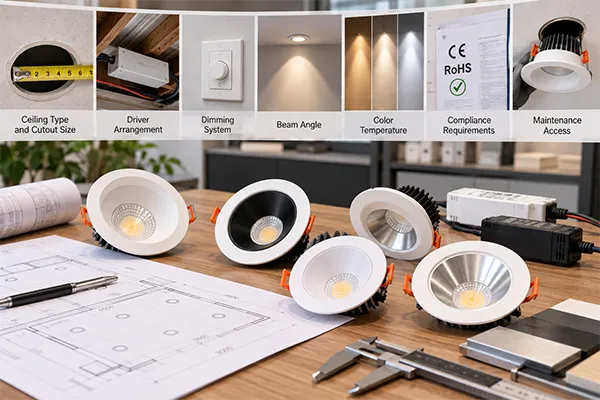
There is no universally best LED downlight brand because downlight suitability depends on the ceiling type, cutout size, driver arrangement, dimming system, beam angle, color temperature, local compliance requirements, and maintenance access.1 A technically capable product can still be the wrong choice when it does not fit the actual project conditions.
A Brand Name Does Not Replace a Project Specification
I often receive quotation requests that contain only a photograph, wattage, and a request for “the best quality.” Those details are a starting point, but they do not define a usable downlight. Before I can recommend a configuration, I need to understand how and where the product will be installed.
For example, I would normally ask questions such as:
- What is the ceiling cutout diameter?
- How much space is available above the ceiling?
- Is the ceiling gypsum board, metal, concrete, or another material?
- Does the project require a dimmable LED downlight?
- Which dimming method will be used: phase-cut, 0–10V, DALI, or another control system?
- What color temperature does the project specify: 2700K, 3000K, 4000K, or 6500K?
- Does the application need high CRI for retail, hospitality, artwork, or residential interiors?
- Is the light intended for general illumination, accent lighting, or task lighting?
- Will maintenance teams have access to the driver after installation?
A global lighting brand may have a strong product portfolio. Yet, its standard model may not provide the exact cutout, finish, wattage, or driver option required by a project. In the same way, an OEM/ODM supplier may offer useful customization but may not be the appropriate choice if the buyer needs an already-approved named product for a particular specification.
I Focus on Failure Prevention First
When I discuss an LED downlight brand with procurement teams, I reframe the question:
“What failure or procurement risk must this downlight prevent in this project?”
That question leads to a more useful evaluation. For a contractor, the main risk may be rework caused by the wrong cutout. For an importer, it may be inconsistent supply across repeat orders. For a local lighting brand, it may be maintaining a consistent appearance and color temperature across a private-label product range.
| Project Risk | What I Would Check | Why It Matters |
|---|---|---|
| Cutout mismatch | Cutout tolerance, spring design, ceiling thickness | Prevents installation delays and ceiling damage |
| Uneven appearance | Color temperature binning, trim finish, batch consistency | Supports a uniform ceiling appearance |
| Flicker or dimming issues | Driver specification and dimmer compatibility | Reduces commissioning and user complaints |
| Premature failures | Driver design, thermal structure, aging process | Helps buyers evaluate reliability controls |
| Supply interruption | Lead time, component availability, repeat-order process | Supports long-term maintenance and expansion |
| Compliance concerns | Relevant certification documents and local requirements | Helps buyers verify market-entry needs |
I do not believe buyers should eliminate famous brands or OEM/ODM manufacturers based on category alone. I believe buyers should select the partner that can document how its product fits the intended application.
How Should Buyers Compare an LED Downlight Brand Beyond Price?
Unit price can make a quotation look attractive, especially on large projects. Yet, the lowest initial price can become expensive if installation crews need to replace fittings, change cutouts, troubleshoot drivers, or source discontinued products later. I recommend looking at the full procurement cost.
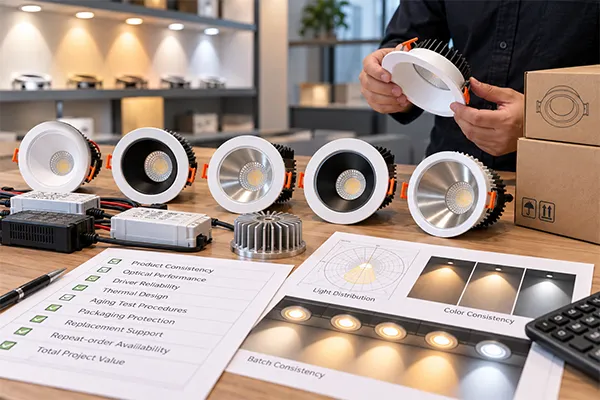
Buyers should compare an LED downlight brand by total project value rather than wattage, lumens, or unit price alone. I would assess product consistency, optical performance, driver reliability, thermal design, aging-test procedures, packaging protection, replacement support, and repeat-order availability alongside the quoted price.
Compare Like for Like
A 10W LED downlight from one supplier is not automatically comparable with a 10W model from another. The housing material, LED source, driver type, diffuser, heat sink, optical design, and quality-control process can all differ. Even products with similar catalog images may have different internal structures.
I suggest that buyers request a detailed comparison sheet. At minimum, the sheet should identify:
- Rated wattage and input voltage
- Lumen output and efficacy
- Color temperature and tolerance
- CRI requirement
- Beam angle
- Cutout size and external diameter
- Driver type and dimming option
- IP rating, where relevant
- Housing and heat-sink material
- Trim color and surface finish
- Warranty terms and exclusions
- Packaging quantity and carton dimensions
Look at Consistency Across the Order
In my experience, buyers rarely face problems because one sample looks poor. The more difficult issues often appear when products are installed in quantity. A sample can look acceptable, while multiple production batches may show visible differences in trim color, output, or color temperature if specifications and controls are not stable.
For this reason, I would ask suppliers how they manage:
- LED color consistency between production batches.
- Driver sourcing and incoming inspection for key components.
- Aging tests before shipment.
- Finished-product inspection and sampling standards.
- Defect reporting and replacement procedures.
- Specification changes when materials or components become unavailable.
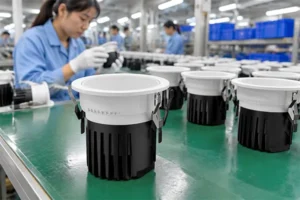
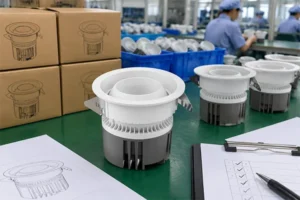
At Upward Lighting, we state that each product undergoes a 100% aging test for approximately 4 to 8 hours before shipment. I view this as one quality-control step, not as a guarantee that every downlight will suit every installation or operate identically in every environment. Buyers should still review the product specification, test samples in representative conditions, and agree on defect-handling expectations before ordering.
Consider the Cost of Rework
I have found that buyers can make stronger decisions when they calculate the cost of a possible replacement event. The fitting cost may represent only a small part of the final installed cost.
| Cost Element | Low Unit-Price Focus | Total-Cost Evaluation |
|---|---|---|
| Product purchase | Prioritizes lowest fixture price | Compares fixture value and expected consistency |
| Installation labor | Often excluded | Includes installation and access labor |
| Ceiling repair | Often ignored | Considers risk of wrong cutout or spring fit |
| Replacement stock | Purchased later | Planned as part of the project strategy |
| Commissioning | Assumed to be simple | Includes dimming and control compatibility checks |
| Future supply | Not considered | Confirms repeat-order continuity |
A good LED downlight brand should help buyers reduce avoidable uncertainty before the goods arrive on site.
What Technical Details Should an LED Downlight Brand Provide?
Technical brochures can contain many numbers, but not every number helps a procurement decision. Buyers can become frustrated when a product looks compliant on paper but does not work properly with the ceiling, driver location, or control system. I recommend verifying the specifications that affect real installation performance.
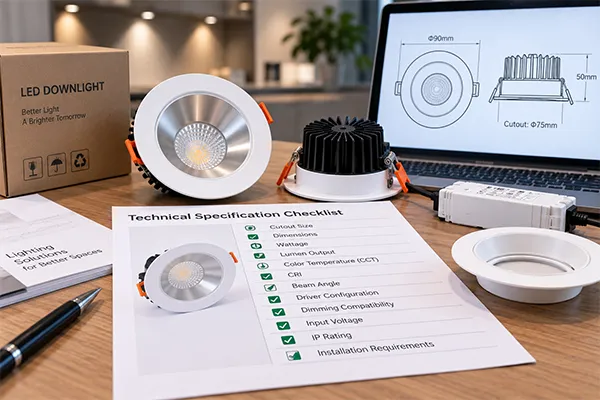
A reliable LED downlight brand should provide clear, verifiable specifications for cutout size, dimensions, wattage, lumen output, color temperature, CRI, beam angle, driver configuration, dimming compatibility, input voltage, IP rating, and installation requirements. I also recommend checking whether those specifications remain stable across repeat orders.
Cutout and Ceiling Space Come First
The ceiling cutout is one of the first details I check. A downlight that does not fit the existing opening can create immediate problems. Contractors may need to enlarge a hole, add a conversion plate, replace the fixture, or adjust the installation plan.
I have seen customers ask whether a 75 mm cutout downlight can replace a 90 mm cutout model2. The answer depends on the trim diameter, the visible ceiling finish, and the installation standard. A wider trim may cover the opening, but it may not create the desired appearance. A conversion ring may solve the fit issue, but the buyer should approve the visual effect before ordering.
I also ask about available ceiling void depth. Some recessed LED downlights use an integrated driver, while others use an external driver. The driver needs safe positioning, adequate space, and suitable access where maintenance is required.3
Driver and Dimming Compatibility Need Written Confirmation
Dimming problems are among the most common concerns that buyers raise during specification discussions. A dimmable downlight is not universally compatible with every dimmer.4 Phase-cut dimming, 0–10V dimming, and DALI systems have different requirements.5 The dimmer brand, load range, wiring arrangement, and quantity of fittings on the circuit can affect performance.6
I recommend that buyers verify:
- The exact dimming protocol
- Compatible dimmer models, where available
- Minimum and maximum load guidance
- Expected dimming range
- Potential flicker behavior at low output
- Driver placement and wiring requirements
- Site testing before full-scale installation
I do not advise assuming that “dimmable” on a catalog page solves these questions. I advise requesting the driver data and conducting a qualified application-specific evaluation.
Light Quality Should Match the Space
A higher lumen output is not always better. Excessive brightness can create glare, while a narrow beam angle may leave dark areas between fittings.7 Color temperature also shapes the visual result. A warm 3000K downlight may suit hospitality or residential environments, while 4000K is common in many commercial and office applications.8 The right choice depends on the design intent and local preference.
| Specification | Procurement Question I Would Ask |
|---|---|
| Color temperature | Does the project require 3000K, 4000K, or another defined CCT? |
| CRI | Does the space need stronger color rendering for retail or display areas? |
| Beam angle | Is the goal broad general lighting or focused accent lighting? |
| UGR/glare control | Does the project have visual comfort requirements? |
| Lumen output | Does the lighting plan support the required illuminance level? |
| Trim finish | Does the finish match the ceiling and interior design? |
A qualified lighting designer, electrical engineer, or project consultant should evaluate application-specific lighting calculations and installation decisions where required.
Are OEM/ODM Suppliers a Good LED Downlight Brand Alternative?
Some buyers assume that only a globally recognized label can provide dependable downlights. Others assume that an OEM/ODM supplier will always be cheaper and more flexible. I do not consider either assumption reliable. The correct choice depends on the buyer’s technical, commercial, and branding requirements.
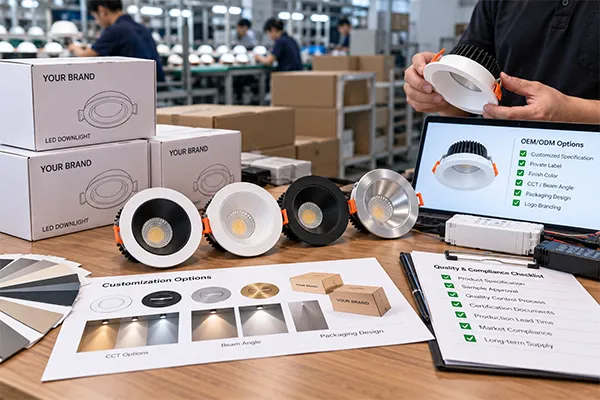
OEM/ODM suppliers can be a strong LED downlight brand alternative when buyers need customized specifications, private labeling, manageable order quantities, responsive quotations, and continuity of supply. However, buyers should still audit quality controls, verify certification documents, approve samples, and confirm that the supplier can support the intended market and application.
When OEM/ODM Creates Value
I find that OEM/ODM production can be particularly useful for local lighting brands, distributors, wholesalers, and project-focused importers. These buyers may need products that fit a defined market niche rather than a fixed global catalog.
For example, a buyer may want to customize:
- Color temperature for a regional market
- Wattage for a specific lighting plan
- Beam angle for a retail or hospitality project
- CRI for a higher-end product line
- White, black, gold, or other trim finishes
- Retail packaging and brand labeling
- Product labels, manuals, and carton markings
- Cutout sizes that match commonly used local ceiling openings
At Upward Lighting, we provide OEM/ODM services for LED downlights, track lights, and office linear lighting. We can discuss parameters such as CCT, wattage, beam angle, CRI, and surface finish colors. I believe this flexibility is valuable when it solves a defined procurement need, not simply because customization sounds attractive.
What I Would Verify Before Selecting an OEM/ODM Partner
Customization can introduce complexity. Every change in a driver, LED source, housing, finish, or package should be communicated clearly and approved through samples or documented specifications. I recommend that buyers maintain a controlled product file for every SKU.
A practical supplier-evaluation checklist includes:
- Factory identity and communication: Can the supplier explain the product structure and production process clearly?
- Specification control: Does the quotation define the exact wattage, CCT, cutout, driver, and finish?
- Sample approval: Can the buyer inspect samples before mass production?
- Quality process: Does the supplier describe incoming checks, aging tests, and final inspection?
- Certification documents: Can the supplier provide relevant documents for buyer verification?
- MOQ and lead time: Are the minimum order quantity and delivery schedule practical?
- Replacement process: Is there a documented method for handling verified quality issues?
- Supply continuity: Can the supplier support repeat orders and communicate component changes in advance?
Certifications Are Important, but They Are Not the Whole Decision
At Upward Lighting, our products hold certifications such as CE and RoHS.9 I regard these documents as important for buyers evaluating market-entry, safety, environmental, and regulatory requirements. However, I do not present them as proof that every product is automatically suitable for every country, building code, dimming system, or project environment.
Buyers should independently verify:
- Whether the certification applies to the exact product model
- Whether the document is current and issued by an appropriate body
- Whether local regulations require additional approvals
- Whether the installation method meets project requirements
- Whether the product configuration changes affect documentation
The best LED downlight brand decision combines documentation with careful product, installation, and supplier evaluation.
Frequently Asked Questions
Is a famous LED downlight brand always better?
A famous LED downlight brand may be a suitable choice, especially when a project requires an approved product line, local service network, or established specification. However, I would still verify cutout fit, driver compatibility, lighting performance, certifications, lead time, and replacement support for the exact model.
What should I ask an LED downlight supplier before ordering?
I recommend asking for the full specification sheet, cutout dimensions, driver details, dimming compatibility, color temperature tolerance, CRI, beam angle, relevant certification documents, warranty terms, production lead time, sample process, aging-test procedure, and defect-handling policy. I also suggest approving samples before mass production.
Does a CE certificate prove an LED downlight is suitable for my project?
No. A CE document can be relevant to market-entry and compliance considerations, but it does not confirm that the downlight fits your ceiling, works with your dimming system, meets the lighting design, or satisfies every local requirement.10 I recommend separate technical and installation checks.
How important is an LED downlight aging test?
An aging test is an important quality-control measure because it can help identify certain early product or driver issues before shipment.11 At our factory, we conduct 100% aging tests for 4 to 8 hours. Still, I do not treat aging alone as a complete reliability assessment or a replacement for project testing.
Can I order customized LED downlights in small quantities?
Some OEM/ODM suppliers support small-batch orders, but available quantities depend on the requested customization, component availability, packaging needs, and production planning. I recommend asking for the MOQ at the quotation stage and confirming which changes require a higher order quantity.
Conclusion
The best LED downlight brand is not simply the most famous, the brightest, or the cheapest option. I believe the strongest choice is the product and supplier that reduce your specific risks around installation, dimming, color consistency, compliance, maintenance, and repeat supply. Buyers should compare documented specifications, inspect samples, verify relevant certifications, and assess quality-control practices before committing to a project order. If you need an OEM/ODM LED downlight quotation or a specification review, I invite you to contact Upward Lighting with your project requirements.
"[PDF] CALiPER Application Summary Report 20: LED PAR38 Lamps", https://www1.eere.energy.gov/buildings/publications/pdfs/ssl/caliper_20_summary.pdf. Lighting-selection guidance identifies application requirements, optical distribution, color characteristics, controls, installation conditions, and maintenance as relevant considerations when specifying LED luminaires. Evidence role: general_support; source type: government. Supports: That LED luminaire selection requires consideration of application needs, light distribution, color characteristics, controls, installation constraints, and maintenance.. Scope note: Such guidance supports the general selection framework but does not rank individual downlight brands. ↩
"Recessed Lighting Installation Milton Ma - AdTech Windev", https://epm.cnc.stanford.edu/recessed-lighting-installation-milton-ma. Recessed-luminaire installation guidance treats the ceiling opening, mounting arrangement, and trim dimensions as interdependent factors in determining whether a fitting can be installed and whether the opening is adequately covered. Evidence role: general_support; source type: education. Supports: That recessed-luminaire installation requires the ceiling opening and trim dimensions to be evaluated together.. Scope note: The acceptability of replacing one cutout size with another depends on the exact luminaire, ceiling construction, and required finish. ↩
"[PDF] Luminaire Specification - Wisconsin Department of Transportation", https://wisconsindot.gov/Documents/doing-bus/eng-consultants/cnslt-rsrces/tools/prods/659/luminaire-spec.pdf. Electrical-safety and product-installation guidance requires LED drivers to be installed in accordance with their specified environmental, thermal, wiring, and service-access conditions. Evidence role: general_support; source type: institution. Supports: That LED drivers must be installed according to their rated environmental, thermal, wiring, and accessibility requirements.. Scope note: Applicable requirements vary by product listing, jurisdiction, building construction, and manufacturer instructions. ↩
"[PDF] LED Dimming: What you need to know - eere.energy.gov", https://www1.eere.energy.gov/buildings/publications/pdfs/ssl/dimming_webcast_12-10-2012.pdf. Technical guidance on LED controls notes that dimming performance depends on compatibility between the LED driver or lamp and the control device; not all dimmers operate satisfactorily with all LED products. Evidence role: mechanism; source type: government. Supports: That LED lamps and luminaires may require compatible dimmers and drivers for satisfactory dimming performance.. ↩
"[PDF] Controls for LED Lighting - eere.energy.gov", https://www1.eere.energy.gov/buildings/publications/pdfs/ssl/rmiller_controls_pittsburgh2012.pdf. Lighting-control references distinguish phase-cut dimming, analogue 0–10 V control, and digital DALI control as separate methods with different signaling, wiring, and compatibility requirements. Evidence role: definition; source type: institution. Supports: That phase-cut, 0–10 V, and DALI use different control methods and therefore have different system requirements.. Scope note: The distinction between protocols does not by itself establish compatibility for a particular driver, dimmer, or installation. ↩
"LED Dimming: What you need to know", https://www1.eere.energy.gov/buildings/publications/pdfs/ssl/dimming_webcast_12-10-2012.pdf. Research and technical guidance on LED dimming report that driver–dimmer interactions and load conditions can influence dimming range, stability, and visible artifacts such as flicker. Evidence role: mechanism; source type: research. Supports: That LED dimming behavior can vary with dimmer design, driver characteristics, load conditions, and circuit configuration.. Scope note: The magnitude of these effects depends on the particular driver, control device, and installation configuration. ↩
"[PDF] CALiPER Application Summary Report 20: LED PAR38 Lamps", https://www1.eere.energy.gov/buildings/publications/pdfs/ssl/caliper_20_summary.pdf. Lighting research and design guidance associate glare with excessive luminance in the visual field and recognize that luminaire beam distribution and spacing influence illumination uniformity. Evidence role: mechanism; source type: research. Supports: That glare is associated with excessive luminance and that luminaire distribution and spacing affect illuminance uniformity.. Scope note: Whether a specific installation produces glare or dark areas requires a project-specific lighting calculation and site conditions. ↩
"Understanding LED Color-Tunable Products | Department of Energy", https://www.energy.gov/cmei/ssl/understanding-led-color-tunable-products. Lighting guidance describes correlated color temperature as an application-dependent design variable: warmer light is commonly selected for ambience-oriented interiors, while neutral-white light is frequently used where commercial or office visual tasks are emphasized. Evidence role: general_support; source type: government. Supports: That correlated color temperature is selected in relation to intended atmosphere, visual task, and application, with warmer and neutral-white ranges often used in different interior contexts.. Scope note: CCT preferences vary by region, design intent, occupant expectations, and applicable project standards. ↩
"Light Fixtures Results | EPA ENERGY STAR", https://www.energystar.gov/productfinder/product/certified-light-fixtures/results. Model-specific manufacturer declarations and supporting compliance records identify the Upward Lighting products to which CE marking and RoHS-related documentation apply. Evidence role: case_reference; source type: other. Supports: That identified Upward Lighting product models are covered by current CE declarations and RoHS-related documentation.. Scope note: Documentation must be checked for the exact model, configuration, date, and destination-market requirements. ↩
"CE marking – obtaining the certificate, EU requirements - Your Europe", https://europa.eu/youreurope/business/product-rules-compliance/general-product-compliance/ce-marking/index_en.htm. European Commission guidance explains that CE marking signifies the manufacturer's declaration that a product conforms to applicable EU requirements; it is not a universal approval of a product's suitability for a particular installation, control system, or non-EU jurisdiction. Evidence role: definition; source type: government. Supports: That CE marking indicates a manufacturer's declaration of conformity with applicable EU requirements and is not a general product-approval or application-suitability determination.. ↩
"[PDF] A methodology for testing life-cycle performance of consumer products", https://nvlpubs.nist.gov/nistpubs/Legacy/IR/nbsir76-1157.pdf. Reliability literature describes burn-in and related screening procedures as methods that may expose certain early-life defects in electronic assemblies before field deployment. Evidence role: mechanism; source type: research. Supports: That burn-in or screening can reveal some early-life defects in electronic components or assemblies.. Scope note: A short aging test cannot demonstrate lifetime reliability or identify every manufacturing, installation, or environmental failure mode. ↩