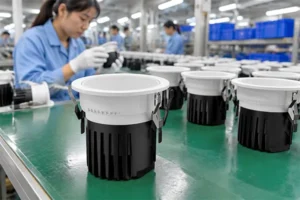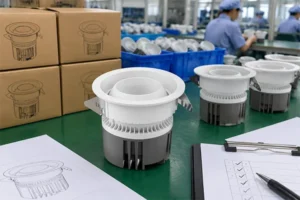

The best brand for downlights can be difficult to identify when buyers face hundreds of catalogues, similar-looking products, and broad performance claims. A poor choice can create fitting problems, inconsistent lighting, compliance delays, or costly replacements. We recommend choosing the supplier or brand that controls the specifications your application actually requires.
The best brand for downlights is not universally the most famous or lowest-priced option. For importers, contractors, and lighting brands, the best choice is the supplier that can provide the right product design, verified market documentation, consistent specifications, reliable production controls, and clear communication from sample approval through delivery.
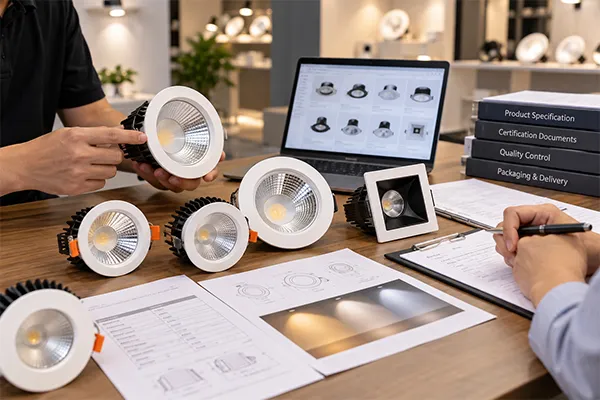
A recognizable lighting brand may offer reassurance, but B2B buyers need more than recognition. We see that the real purchasing question is usually about risk: Will the downlight fit the ceiling? Will the approved color temperature remain consistent? Will the model meet destination-market requirements? Can the supplier repeat the sample specification in mass production?
Why Is the Best Brand for Downlights Different for Every Buyer?
Many buyers start with brand names because brand recognition seems to reduce risk. However, a well-known name does not automatically solve project-specific issues. If the selected downlight has the wrong cutout, beam angle, dimming compatibility, or compliance documents1, the brand name cannot prevent delays or rework.
The best brand for downlights depends on the buyer’s market, application, installation conditions, performance target, and supply-chain needs.2 A contractor may prioritize fit and delivery reliability, while a private-label importer may prioritize stable OEM specifications, documentation, packaging, and repeatable quality across multiple orders.
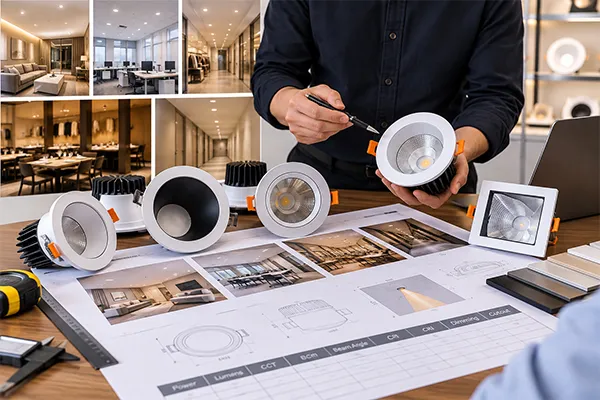
Start With the Risk You Need to Prevent
We encourage buyers to reframe the question. Instead of asking, “Which brand ranks first?” we ask, “What can go wrong if we choose the wrong downlight?”
This approach leads to a more useful supplier evaluation process. Different buyers face different risks:
- Project contractors may need correct cutout dimensions, fast delivery, and replacement availability.
- Importers and wholesalers may need stable quality across container or repeat orders.
- Local lighting brands may need customized wattage, finishes, labels, and packaging.
- Distributors may need a product range that matches local demand and regulatory requirements.
- Office or commercial project managers may need glare control, color consistency, and a defined visual effect3.
At Upward Lighting, we regularly discuss these concerns during sampling and quotation stages. In our experience, specification mismatches often cause more concern than the physical appearance of a downlight. A product may look excellent in a catalogue but still create issues if its real wattage, cutout, color temperature, or driver configuration differs from the approved sample.
Compare Brand Fit, Not Brand Fame
A buyer should evaluate whether a brand or supplier can meet the purchasing brief consistently. This is especially important when a product will be resold under a local brand or installed in a multi-location project.
| Buyer requirement | What to evaluate | Why it matters |
|---|---|---|
| Ceiling compatibility | Cutout, trim diameter, fixture height, driver position | Prevents installation conflicts |
| Lighting effect | Beam angle, CCT, CRI, glare control | Affects visual comfort and project appearance |
| Product consistency | Approved sample, production specification sheet, batch controls | Reduces variation between orders |
| Market access | Model-specific compliance documents for destination market | Supports lawful market entry |
| Commercial flexibility | MOQ, lead time, customization ability | Helps buyers manage inventory and project changes |
| After-sales planning | Spare units, model continuity, communication process | Reduces replacement risk |
We do not consider any manufacturer the right answer for every buyer. We believe the strongest choice is the one that can clearly document what it will supply, communicate limitations early, and maintain the approved specification during production.
A downlight brand should be evaluated as a supply partner, not only as a name on a product label.
How Should You Choose the Best Brand for Downlights by Application?
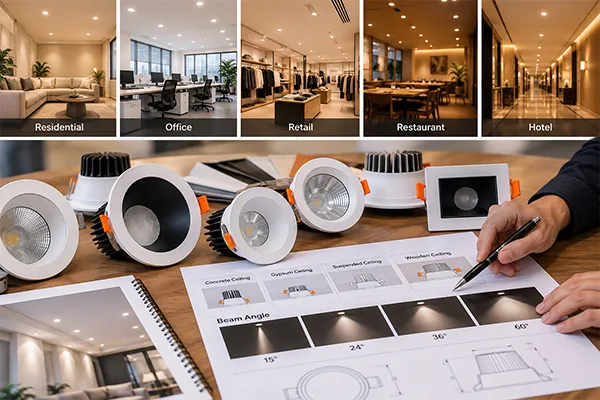
A downlight can only perform well when the product family suits the application. Buyers sometimes compare wattage or price first, but the ceiling structure, room use, beam effect, and glare tolerance often matter more. A technically acceptable product can still produce an unsatisfactory result in the wrong environment.
To choose the best brand for downlights by application, buyers should define the ceiling type, installation space, room function, beam distribution, visual comfort target, and maintenance access before comparing models. The correct downlight family should match the site conditions rather than simply offer the highest stated output.
Check the Physical Installation Conditions
The first step is usually mechanical compatibility. Recessed LED downlights require more than a ceiling hole.4 Buyers should confirm the available ceiling void, fixture height, driver dimensions, heat-management space, and access for maintenance.
For example, a shallow ceiling may require a slim recessed downlight or a separate driver design. A ceiling with limited void space may not accept a deep anti-glare fixture, even if that fixture provides a better lighting effect. In renovation work, cutout compatibility can become especially important because changing existing openings increases labor and finishing costs5.
We recommend documenting the following before requesting a quotation:
- Ceiling material: gypsum board, aluminum ceiling, concrete, wood, or another surface.
- Available ceiling depth: including potential obstructions such as ducts, pipes, and structural elements.
- Existing cutout size: if the project is a replacement or renovation.
- Required trim style: round, square, trimless, adjustable, or surface-mounted.
- Driver location: integrated driver, external driver, or remote driver arrangement.
- Environmental conditions: indoor dry location, humid area, covered exterior, or other special conditions.
Define the Lighting Result
The room purpose determines how buyers should evaluate beam angle, glare, CRI, and color temperature6.
| Application | Common purchasing priorities | Questions to ask |
|---|---|---|
| Retail display | Accent effect, CRI, beam control | Does the beam highlight merchandise without harsh glare? |
| Office | Visual comfort, uniformity, controlled brightness | Is the fixture appropriate for work areas and ceiling layout? |
| Hotel | Ambience, finish quality, warm CCT options | Does the downlight support the desired interior mood? |
| Residential development | Value, easy installation, stable appearance | Can the supplier maintain the selected model across phases? |
| Corridors and public areas | Reliability, uniform lighting, maintenance planning | Is replacement access practical after installation? |
| Restaurants | Warm atmosphere, accent lighting, glare control | Is the beam angle suitable for tables, walls, or circulation areas? |
At our factory, we can discuss customization of color temperature, wattage, beam angle, CRI, and surface finish color. However, customization should begin only after the buyer has defined the required result. A customized product is not automatically better if the project brief is unclear.
Does the Best Brand for Downlights Have the Right Compliance Documentation?
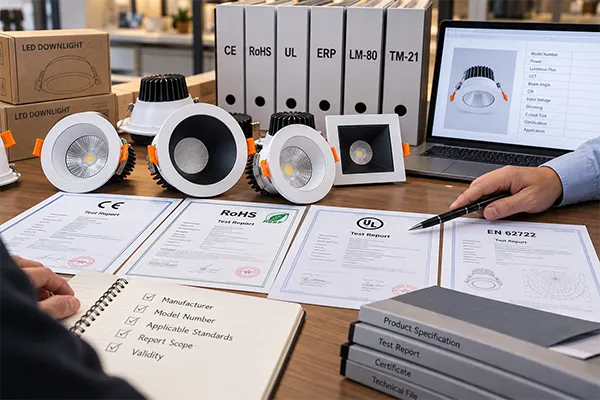
Compliance is a major reason why a familiar product name alone is not enough. A certificate shown in a catalogue may relate to a different model, a different configuration, or a different destination-market requirement.7 Buyers should review documentation for the exact product they intend to import, sell, or install.
The best brand for downlights should provide relevant, verifiable documentation for the actual model and target market. Buyers should confirm the manufacturer name, model number, applicable standards, report scope, and validity rather than assuming that a generic CE, RoHS, or test statement covers every product configuration.
Verify Documents at the Model Level
We recommend that buyers request documents early, ideally before sample approval or purchase-order confirmation. The document review should match the actual commercial product, including the light source, driver arrangement, rated input, wattage, and model designation where applicable.
At Upward Lighting, our products hold certifications such as CE and RoHS. Buyers should still verify the relevant documents for their destination market and specific model. We believe this is the responsible approach because market-entry rules can differ by country, sales channel, and application.
Buyers should ask suppliers for:
- Product specification sheets with clear model references
- Relevant declarations and certification documents
- Test reports, where appropriate to the market and product
- Product labels and packaging artwork for review
- Information about driver and LED component configuration
- Traceability details, such as batch or production references
- Confirmation of whether customization changes document applicability
Understand the Limits of Factory Quality Control
Our team performs a 100% aging test lasting approximately 4 to 8 hours before shipment8. This internal process helps us identify immediate functional issues before products leave our facility. It is part of our factory quality-control process.
However, we do not present internal aging as third-party certification, independent laboratory validation, or a guarantee of field lifetime performance. Long-term performance in an installed environment can depend on ambient temperature, electrical conditions, installation quality, operating hours, ventilation, dimming systems, and maintenance practices.9
This distinction matters for professional procurement. Buyers should separate three different topics:
| Evaluation topic | What it indicates | What it does not prove alone |
|---|---|---|
| Factory aging and QC | Pre-shipment functional screening | Full field-life performance |
| Third-party testing or certification | Assessment against a stated scope or standard | Suitability for every application |
| Field performance history | Experience in real installations | Identical results under different site conditions |
A supplier that explains these differences clearly is often easier to work with over the long term. We believe transparent documentation is more valuable than broad claims that cannot be tied to the actual product configuration.
How Can Buyers Compare Downlight Specifications Beyond the Brochure?
Brochures provide a starting point, but they do not always show how tightly a supplier controls a product from sample stage to mass production. Buyers need to compare the specifications that affect installation, appearance, purchasing continuity, and customer satisfaction.
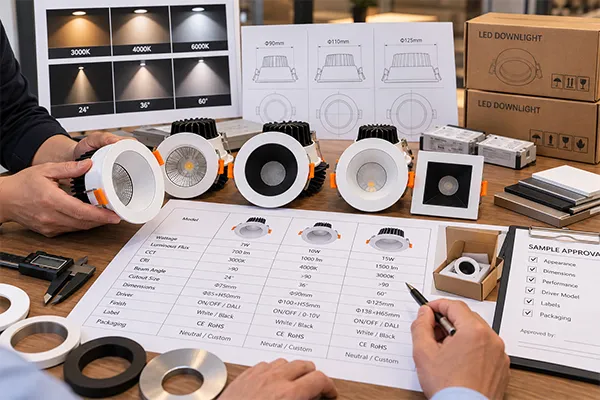
The best brand for downlights controls key specifications from approved sample through mass production. Buyers should compare color temperature, wattage, beam angle, CRI, dimensions, driver details, finish, labels, and packaging requirements through written approval documents rather than relying on general catalogue claims.
Build a Clear Sample Approval Record
In OEM and ODM discussions, we often find that a verbal agreement is not enough. A buyer may request “warm white,” “high CRI,” or “a narrow beam,” but these descriptions can still leave room for interpretation. The safest approach is to create a written sample approval record before mass production begins.
This record can include:
- Product model number and internal reference
- Outer diameter and cutout size
- Fixture height and driver dimensions
- Rated wattage and input parameters
- Target color temperature, such as 3000K, 4000K, or 6500K
- CRI requirement, such as CRI 80 or CRI 90
- Beam angle
- Housing color and surface finish
- Dimming or non-dimming driver requirement
- Connector, cable, or terminal details
- Product label and carton marking
- Approved sample photos
- Packaging configuration and quantity per carton
We recommend that buyers retain this information with the purchase order. It gives both parties a shared reference if a question arises during production, inspection, or delivery.
Watch for Specification Changes Caused by Customization
Customization can support a stronger local product line, but every change should be evaluated carefully. A new finish color, different driver, altered wattage, or changed beam angle may affect lead time, material sourcing, packaging, documentation, or minimum order quantity.10
At Upward Lighting, we support OEM/ODM customization and small-batch requirements where feasible. We also encourage buyers to ask direct questions before confirming an order:
- Which specifications are standard and which are customized?
- Does the requested change affect the product’s dimensions or installation method?
- Does the change affect applicable market documentation?
- What sample must be approved before mass production?
- What production tolerance or visual standard will be used?
- Can the supplier maintain the same configuration for future repeat orders?
- What is the estimated lead time for the customized version?
Compare Consistency, Not Just Maximum Claims
A downlight with an impressive claimed specification may not be the strongest procurement choice if the supplier cannot repeat that configuration reliably. We suggest evaluating specification consistency as a complete process.
| Specification | Why buyers should control it | Practical verification method |
|---|---|---|
| Color temperature | Affects visual uniformity across a project | Approve sample and record CCT target |
| Wattage | Affects energy planning and lighting layout | Confirm rated wattage on specification sheet and label |
| Beam angle | Changes the lighting effect and spacing plan | Review sample beam effect and technical data |
| CRI | Affects color appearance of finishes and merchandise | Request the stated CRI requirement in writing |
| Cutout and dimensions | Determines installation compatibility | Use dimension drawings and physical sample checks |
| Surface finish | Affects visual consistency in finished interiors | Approve finish sample or color reference |
| Driver configuration | Affects electrical compatibility and service planning | Confirm driver type, dimming requirement, and connections |
The best LED downlight supplier is often the one that can answer these questions precisely, not the one with the longest marketing list.
What Questions Should Importers and Contractors Ask a Downlight Supplier?
Buyers often need fast quotations, especially when a tender, private-label launch, or construction schedule is moving quickly. Speed matters, but a fast quotation should still lead to a controlled purchasing decision. The best supplier relationship begins with clear questions and documented answers.
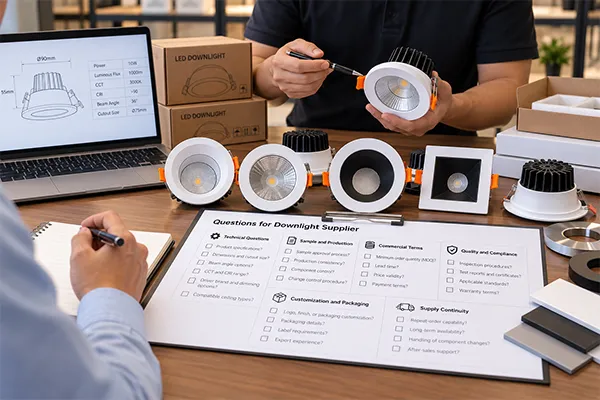
The best brand for downlights should respond clearly to technical, commercial, and quality-control questions. Buyers should ask about sample approval, production consistency, lead time, inspection procedures, documents, customization limits, packaging, and repeat-order continuity before selecting a supplier.
Use a Practical Supplier Checklist
We recommend using one evaluation checklist for all shortlisted downlight brands or manufacturers. This makes comparisons fairer and helps purchasing teams avoid selecting based on a single attractive feature.
Product and technical questions
- Does the supplier provide full dimensional drawings?
- Is the cutout range clearly defined?
- What are the available wattage, CCT, CRI, and beam-angle options?
- Is the driver integrated or separate?
- Are dimming options available if the project requires them?
- Can the supplier provide a physical sample before mass production?
Quality-control questions
- What checks occur before shipment?
- Does the supplier conduct aging, visual inspection, and functional checks?
- How are defective units handled before packing?
- Can the supplier provide inspection records when agreed?
- How does the supplier manage approved samples and production references?
Commercial and supply questions
- What is the MOQ for standard and customized products?
- What is the quotation validity period?
- What lead time applies to samples and mass production?
- Can the supplier support small-batch orders?
- Can the supplier provide branded labels, cartons, manuals, or other OEM materials?
- How will the supplier communicate if materials or schedules change?
At Upward Lighting, we focus on rapid responses, quick quotations, supply-chain coordination, and customized discussions. We know that buyers often need answers before they can finalize a tender or product launch. Still, we believe both parties benefit when urgent quotation requests include basic technical details instead of only a product photo.
Evaluate Communication as a Quality Indicator
Communication does not replace technical verification, but it is an important part of supplier selection.11 When a supplier asks useful questions about ceiling depth, target market, cutout size, beam angle, or document requirements, that supplier may be helping the buyer identify risk before production begins.
In our own production communication, we aim to clarify unclear requirements before order confirmation. This can include confirming whether “white” means matte white, gloss white, or another finish; whether “warm white” means 2700K or 3000K; and whether a project requires a specific beam angle rather than a general floodlight effect.
A supplier should be willing to say when a request needs additional confirmation. Clear limits are usually more valuable than vague promises.
Frequently Asked Questions
Is there one best brand for downlights worldwide?
No. We do not believe one downlight brand is best for every country, project, or buyer. The right choice depends on installation conditions, target-market requirements, desired lighting effect, product specification control, supply reliability, and the buyer’s commercial model.
How do I compare LED downlight suppliers for a private-label brand?
We recommend comparing sample quality, specification documentation, customization capability, packaging options, MOQ, lead time, relevant compliance documents, and repeat-order consistency. Buyers should also confirm that the approved sample and mass-production specification use the same clearly identified product configuration.
Are CE and RoHS documents enough for every downlight project?
No. CE and RoHS may be relevant for certain markets and product requirements12, but buyers should verify applicability for the destination market and exact model. We recommend qualified professional review when application-specific regulations, installation rules, or project requirements are involved.
What does a 100% aging test mean for LED downlights?
A 100% aging test means each unit undergoes a defined pre-shipment operating period as part of factory quality control. At our facility, this process lasts approximately 4 to 8 hours. It helps screen immediate issues, but it does not replace independent testing or guarantee lifetime field performance.
Which downlight specifications should I approve before placing an order?
We suggest approving dimensions, cutout size, wattage, color temperature, CRI, beam angle, driver type, dimming requirement, housing finish, labeling, packaging, and any OEM branding details. Buyers should keep these details in a written specification sheet linked to the purchase order.
Conclusion
The best brand for downlights is the one that reduces your real procurement and project risks. We recommend starting with the application, then verifying installation compatibility, market documentation, specification consistency, and supplier communication. Brand recognition can be useful, but it should not replace model-level review and sample approval. If you are sourcing LED downlights for a project, distribution channel, or private-label range, we can help you evaluate customizable options, clarify specifications, and prepare a practical quotation for your requirements.
"November 20, 2008", https://www4.wou.edu/php/get_blob_orpu.php?vfileid=5242. Lighting installation guidance recognizes that luminaire dimensions, electrical compatibility, and applicable conformity documentation must be assessed for the intended installation; mismatches can require corrective work or prevent compliant installation. Evidence role: general_support; source type: institution. Supports: Technical installation requirements and electrical compatibility are material considerations when selecting and installing luminaires.. Scope note: The operational cost or schedule impact varies by project and is not established by general guidance alone. ↩
"LED Site Lighting Performance Specifications", https://betterbuildingssolutioncenter.energy.gov/sites/default/files/attachments/led-site-lighting-performance-specification.pdf. Authoritative lighting-design guidance treats application needs, installation conditions, performance criteria, maintenance, and regulatory requirements as relevant inputs to luminaire selection. Evidence role: general_support; source type: government. Supports: Luminaire selection should account for application requirements, installation constraints, performance, maintenance, and applicable codes.. Scope note: Such guidance supports the selection framework, not the article’s particular definition of the 'best' supplier. ↩
"Measuring Discomfort from Glare: Recommendations for ...", https://www.energy.gov/eere/ssl/articles/measuring-discomfort-glare-recommendations-good-practice. Lighting research and technical guidance describe glare as a factor in visual comfort and recognize chromaticity variation among LED products as a source of perceptible color inconsistency in an installation. Evidence role: mechanism; source type: government. Supports: Glare can impair visual comfort and LED chromaticity variation can create visible color inconsistency.. Scope note: The acceptable glare and color-variation thresholds depend on the application, observer, and lighting design. ↩
"Recessed Lighting - Code Compliance Brief", https://basc.pnnl.gov/code-compliance/recessed-lighting-code-compliance-brief. Electrical and energy-efficiency guidance notes that recessed luminaires interact with ceiling cavities, insulation, and thermal conditions, so installation assessment extends beyond matching the ceiling opening. Evidence role: mechanism; source type: government. Supports: Recessed luminaires require attention to enclosure, clearance, insulation interaction, and thermal conditions during installation.. Scope note: Specific clearance and enclosure requirements are product-specific and governed by applicable local electrical codes. ↩
"Sheetrock Cost Installed", https://articulate.strayer.edu/sheetrock-cost-installed. Construction-management research identifies rework and alterations to completed building elements as sources of additional labor, material use, and cost. Evidence role: general_support; source type: paper. Supports: Construction rework and alterations to completed elements consume additional labor and can increase project cost.. Scope note: The evidence concerns construction rework generally and does not quantify the cost of changing downlight cutouts in a particular project. ↩
"CALiPER Application Summary Report 20: LED PAR38 Lamps", https://www1.eere.energy.gov/buildings/publications/pdfs/ssl/caliper_20_summary.pdf. Technical lighting references define correlated color temperature and color-rendering measures as properties of light appearance and color rendition, and treat beam distribution and glare as central considerations in lighting design. Evidence role: definition; source type: government. Supports: CCT and CRI characterize light appearance and color rendition, while distribution and glare are core lighting-design considerations.. Scope note: These metrics do not by themselves determine whether a luminaire will achieve a satisfactory result in a specific room. ↩
"CE marking – obtaining the certificate, EU requirements", https://europa.eu/youreurope/business/product-rules-compliance/general-product-compliance/ce-marking/index_en.htm. Conformity-assessment guidance explains that declarations, certificates, and test reports are tied to defined products, standards, and assessment scopes; documentation must therefore be checked against the actual product and applicable market requirements. Evidence role: general_support; source type: institution. Supports: Conformity documentation applies within a defined product scope and must be evaluated against the applicable product and regulatory requirements.. Scope note: The exact evidentiary requirements differ among jurisdictions, product categories, and conformity-assessment schemes. ↩
"The Importance of Aging Testing for LED Lighting Fixtures", https://www.grinsafe.com/news/ensuring-quality-and-reliability-the-importance-of-aging-testing-for-led-lighting-fixtures/. A manufacturer-specific claim that every unit underwent a stated pre-shipment aging period should be supported by contemporaneous quality-control records or an independent audit of the documented production procedure. Evidence role: case_reference; source type: institution. Supports: Documented inspection and production records are the appropriate evidence for a manufacturer-specific pre-shipment test claim.. Scope note: General quality-management standards describe controls for documented processes but do not verify this supplier’s stated testing duration or coverage. ↩
"LED Luminaire Reliability: Impact of Color Shift", https://www.energy.gov/sites/prod/files/2017/04/f34/lsrc_colorshift_apr2017.pdf. LED reliability research shows that junction and ambient temperature, electrical stress, driver performance, and operating conditions can influence lumen maintenance and component failure behavior in installed luminaires. Evidence role: mechanism; source type: research. Supports: Thermal and electrical operating conditions influence LED luminaire and driver reliability and useful life.. Scope note: Field lifetime also depends on the particular luminaire design and site conditions, so laboratory reliability findings cannot predict an individual installation exactly. ↩
""Why Is Configuration Management Needed For Project ...", https://www.wcu.edu/pmi/1999/MA03.PDF. Operations-management research finds that product customization and configuration changes can increase sourcing, planning, documentation, and production complexity, with possible effects on lead time and order economics. Evidence role: general_support; source type: paper. Supports: Product variety and engineering changes can increase manufacturing-planning, sourcing, and supply-chain complexity.. Scope note: The magnitude and direction of these effects depend on the supplier’s process, component availability, and order volume. ↩
"Supplier Selection and Assessment: Their Impact on Business ...", https://digitalcommons.usu.edu/cgi/viewcontent.cgi?article=1270&context=manage_facpub. Supplier-selection research commonly treats communication quality and responsiveness as relevant evaluation criteria alongside technical capability, quality assurance, delivery performance, and cost. Evidence role: expert_consensus; source type: paper. Supports: Supplier-selection literature commonly includes communication capability and responsiveness among relationship and performance criteria.. Scope note: Communication performance is a complementary selection criterion and does not demonstrate conformance of a specific product to technical or regulatory requirements. ↩
"RoHS Directive - Environment - European Commission", https://environment.ec.europa.eu/topics/waste-and-recycling/rohs-directive_en. European Commission guidance explains that CE marking applies to products covered by specified EU harmonisation legislation, while the RoHS framework restricts certain hazardous substances in covered electrical and electronic equipment. Evidence role: historical_context; source type: government. Supports: CE marking and the EU RoHS framework have defined legal roles for covered electrical and electronic products in the European market.. Scope note: CE marking and RoHS compliance do not alone establish compliance with all national installation rules, project specifications, or non-EU market requirements. ↩