

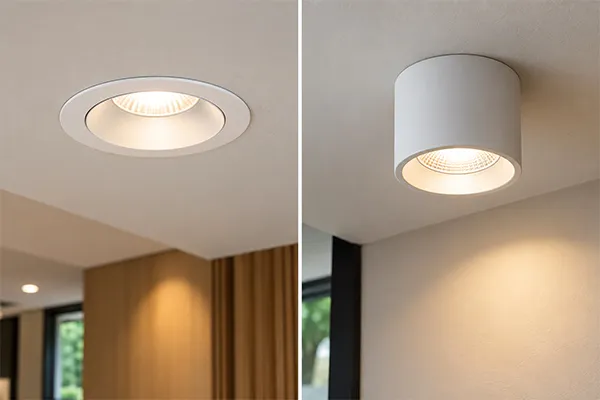
The two common types of downlights, when classified by installation method, are recessed downlights and surface-mounted downlights.1 Many buyers focus first on wattage, trim color, or beam angle, but that can create costly installation conflicts later. I recommend confirming the ceiling structure, available depth, wiring access, and mounting conditions before selecting the downlight format.
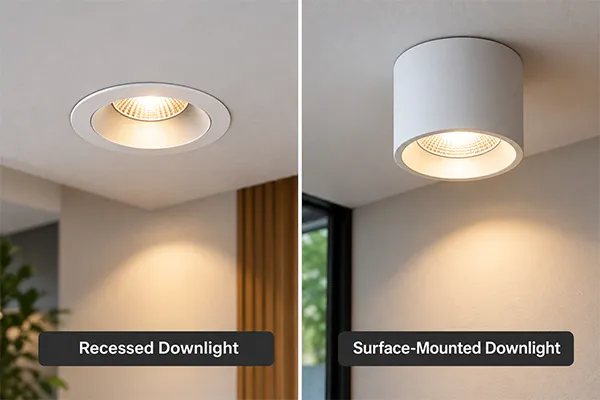
Recessed downlights fit into a ceiling cavity for a low-profile appearance, while surface-mounted downlights attach below the ceiling surface.2 The best option depends on whether the project has sufficient ceiling void, a suitable cut-out or mounting area, maintenance access, and local installation approval3—not simply on appearance, brightness, or price.
In our work as an LED downlight manufacturer, I often see buyers send a product photo before sending a ceiling drawing. The photo is useful, but the ceiling condition usually answers the more important question. Once the installation method is confirmed, we can refine the specifications through OEM/ODM options such as CCT, wattage, CRI, beam angle, and finish color.
What Are the Two Types of Downlights by Installation Method?
When buyers compare the types of downlights, they can feel overwhelmed by terms such as COB, SMD, anti-glare, adjustable, IP-rated, dimmable, and trimless. These terms matter, but they do not solve the first practical question: can the selected fixture actually be installed in the ceiling?
The two common types of downlights by installation method are recessed downlights and surface-mounted downlights. Recessed models sit partly or fully inside a ceiling cavity, while surface-mounted models are fixed beneath the ceiling. This classification helps buyers avoid choosing a product that conflicts with ceiling depth, access, or retrofit conditions.
Downlights Can Also Be Classified in Other Ways
I want to make one distinction clear: recessed and surface-mounted are not the only types of downlights. They are simply the two most useful categories when the buyer is deciding how the product will be installed.
A buyer may also classify downlights by:
- Light source: COB LED downlights, SMD LED downlights, or integrated LED designs
- Beam control: fixed beam, narrow beam, wide beam, adjustable beam, or gimbal downlights
- Ingress protection: indoor IP20 models, bathroom-oriented IP44 designs, or higher-IP models for specific environments
- Trim design: trim, trimless, deep anti-glare, reflector, or baffle structures
- Control method: non-dimmable, TRIAC dimmable, 0–10V dimmable, DALI-compatible, or smart-control versions
- Application: residential downlights, commercial downlights, hotel lighting, retail lighting, or office lighting
However, I would not start product selection with these categories. A high-CRI, narrow-beam, dimmable fixture still becomes the wrong choice if it requires a recessed cavity that does not exist.
Why Installation Method Comes First
In our OEM/ODM discussions, customers sometimes ask whether we can make a recessed product in a specific black finish or change a surface-mounted product from 3000K to 4000K. We can often support those changes, subject to project requirements and order conditions. Still, the mounting structure must come first.
I normally encourage buyers to review this sequence:
- Identify the ceiling type. Is it gypsum board, suspended ceiling, concrete, metal ceiling, wood, or another construction?
- Confirm available ceiling depth. A recessed product needs space above the visible ceiling.4
- Check cut-out and mounting conditions. Recessed models need compatible opening dimensions; surface-mounted models need a suitable fixing surface.
- Review wiring and maintenance access. The driver and connection arrangement must fit the installation plan.
- Confirm local requirements. A qualified local installer should confirm final electrical, structural, fire-safety, and compliance suitability.
- Select lighting specifications. Only then should the buyer finalize wattage, CCT, CRI, beam angle, dimming, and finish.
This process is simple, but it helps project contractors, importers, and lighting brands reduce avoidable returns and site changes.
When Should Buyers Choose Recessed Downlights?
A recessed downlight can look elegant in a finished ceiling, but it can become difficult to install if the project lacks sufficient void space or access above the ceiling. Buyers can lose time and budget when they select recessed fittings before checking drawings and ceiling construction.
Buyers should consider recessed downlights when the ceiling has adequate recess depth, a suitable cut-out plan, safe wiring access, and maintenance provisions. These downlights create a lower-profile ceiling appearance, but they require more coordination between the lighting specification, ceiling design, and installation team.
What Defines a Recessed Downlight?
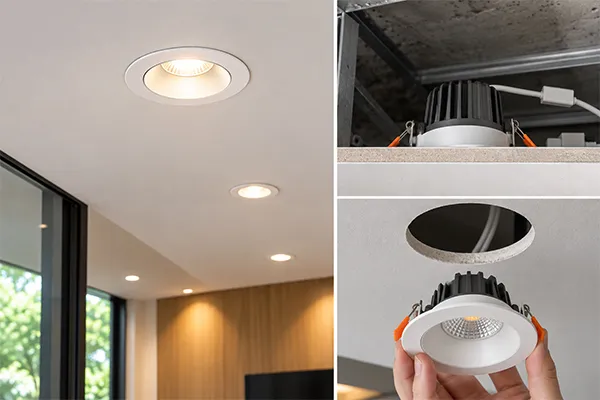
A recessed downlight is installed into an opening in the ceiling. The visible face may sit close to the ceiling plane, while the lamp body, heat sink, driver, or other components occupy space above the ceiling.
This design can support a clean visual result because the fixture does not extend far below the ceiling. However, I do not describe recessed models as automatically more premium. A surface-mounted product may be the more practical and professional choice for many renovation projects, exposed ceilings, or concrete structures.
Questions to Ask Before Ordering Recessed Downlights
When a customer sends us a drawing or installation inquiry, I look for details that affect the product body and mounting design. For example, two 10W recessed LED downlights may have different overall heights, heat-sink designs, driver positions, and cut-out sizes.
Buyers should check the following information with their project team:
| Evaluation point | Why it matters for recessed downlights |
|---|---|
| Ceiling void depth | The fixture body and driver need adequate space above the ceiling.5 |
| Cut-out diameter | The opening must match the supplier’s approved product drawing. |
| Ceiling material | Spring clips and mounting methods must suit the ceiling construction. |
| Driver location | Some drivers need separate space and accessible connection points. |
| Insulation and surrounding conditions | Heat management and installation conditions may affect product suitability. |
| Service access | Future driver replacement or inspection may require practical access. |
| Local regulations | Qualified local professionals should verify installation and compliance requirements. |
I have seen inquiries where the buyer initially requested a deep anti-glare recessed downlight because of its visual effect. After reviewing the ceiling condition, the available depth was too limited for that body structure. In that situation, the useful response is not to force the original model. It is to review a shallower recessed alternative or consider a surface-mounted option.
Recessed Downlight Specifications After Structural Approval
After the recessed structure is confirmed, buyers can focus on light quality and commercial requirements. At Upward Lighting, we can discuss OEM/ODM parameters such as:
- Color temperature: commonly 2700K, 3000K, 4000K, 5000K, or project-specific options
- Wattage: selected according to the lighting layout and target illumination plan
- Beam angle: narrow, medium, or wide distributions depending on the intended application
- CRI: standard or higher-CRI options for projects where color appearance matters
- Surface finish: white, black, silver, gold, or customized colors subject to production confirmation
- Trim style: standard, deep anti-glare, or other product-family options
I recommend that buyers treat lumen output, photometric data, and dimming compatibility as documents to review during procurement. These details should match the selected driver, test conditions, and project expectations. A qualified lighting designer or local technical professional can help confirm application-specific results.
When Are Surface-Mounted Downlights the Better Choice?
A buyer may assume that a ceiling must always be cut to use downlights. That assumption can lead to unnecessary renovation work, especially in concrete ceilings, exposed ceilings, and retrofit projects where access above the ceiling is limited.
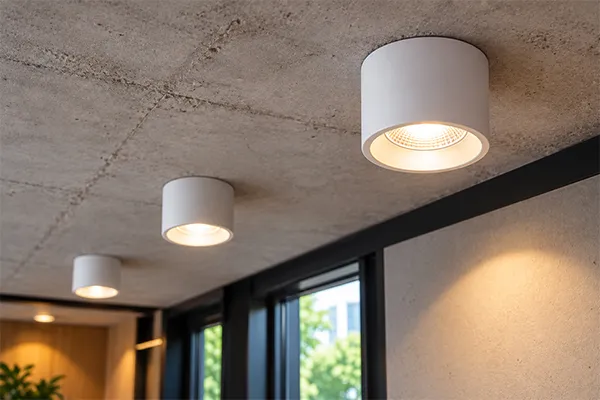
Surface-mounted downlights are often the better choice when there is no suspended ceiling, insufficient recess depth, limited access above the ceiling, or a need to simplify retrofit work. They attach below the ceiling surface and can provide a downlight appearance without requiring the same recessed cavity conditions.
How Surface-Mounted Downlights Work
Surface-mounted downlights are fixed to the visible ceiling surface. Depending on the design, the product may use a mounting bracket, base plate, screws, or another approved fixing arrangement. The fixture body remains visible below the ceiling.
This construction can be especially practical where the ceiling is solid concrete or where a project does not include a suspended ceiling.6 It can also help buyers avoid creating numerous ceiling openings during a renovation.
That said, I would not say that surface-mounted and recessed downlights perform identically just because they share a similar LED wattage or CCT. Their body designs, optical arrangements, thermal paths, driver arrangements, and installed positions may differ.7 Buyers should compare each model using its own approved specifications.
Common Applications for Surface-Mounted Models
Surface-mounted downlights can be suitable for many settings, depending on the selected product and verified installation conditions:
- Residential renovations with limited ceiling void
- Retail spaces with exposed concrete ceilings
- Corridors, utility areas, and circulation spaces
- Small commercial projects where ceiling cutting is undesirable
- Projects that need a visible cylindrical or square lighting form
- Retrofit work where maintenance access is a key concern
In one type of inquiry we receive regularly, an importer may request a recessed downlight range for a local market, then later mention that many end users have concrete ceilings. This detail changes the product-range decision. A mixed range of recessed and surface-mounted downlights may serve that market more effectively than a catalog built around only one mounting method.
Surface-Mounted Downlights and Procurement Planning
For wholesalers, distributors, and local lighting brands, surface-mounted products can reduce some inventory risks because they cover installation scenarios where recessed models cannot be used. Still, buyers should not purchase solely on the basis of flexibility.
I suggest evaluating:
- Fixture dimensions and visual projection below the ceiling
- Mounting base dimensions and approved fixing requirements
- Driver arrangement and connection space
- Available finish colors for the target market
- CCT and wattage combinations
- Beam angle and glare-control requirements
- Packaging strength for export and local distribution
- Documentation, test reports, and certifications relevant to the destination market
At our factory, every product undergoes a 100% aging test before shipment, typically lasting 4 to 8 hours. This process supports our manufacturing quality-control workflow and helps us identify issues before dispatch. However, buyers should still verify the product documentation, sample performance, and applicable certification requirements for their own market and application.
How Should Buyers Compare the Types of Downlights Before Purchase?
The biggest procurement mistake is treating all downlights as interchangeable. A recessed and a surface-mounted model may both be 12W, 4000K, and black, yet they can create very different installation demands, visual results, and maintenance experiences.
Buyers should compare the types of downlights by ceiling compatibility, installation access, maintenance needs, product dimensions, optical performance, and supplier documentation.8 Wattage and appearance are important, but they should be selected after the mounting method and project constraints are confirmed.
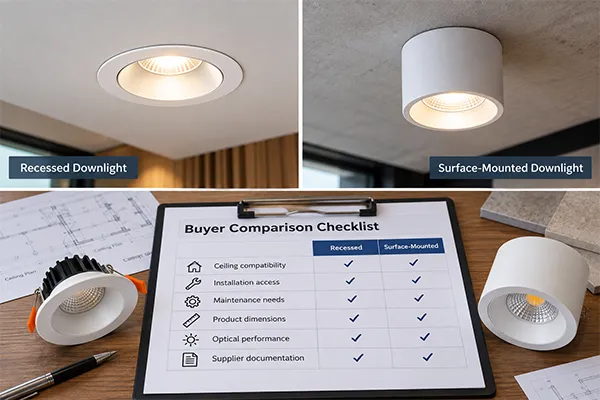
A Practical Comparison Table
| Factor | Recessed downlights | Surface-mounted downlights |
|---|---|---|
| Installation position | Inside a ceiling cavity | Below the ceiling surface |
| Ceiling void requirement | Usually required | Often less dependent on ceiling void |
| Ceiling cut-out | Usually required | Usually not required in the same way |
| Visual effect | Low-profile and integrated | Visible fixture body |
| Retrofit suitability | Depends on ceiling access and cut-out conditions | Often practical where recessing is difficult |
| Maintenance planning | May require access above or through the ceiling | Can be more direct, depending on design |
| Product selection priority | Depth, cut-out, clip compatibility | Mounting surface, base size, fixing arrangement |
| Final approval | Confirm with qualified local installer | Confirm with qualified local installer |
This table gives a starting point, not an installation instruction. Building methods and local regulations vary by country, project type, ceiling material, and electrical system. A qualified local installer should make the final decision on suitability and compliance.
Ask Suppliers for Drawings Before Placing an Order
For B2B buyers, a clear product drawing can prevent many misunderstandings. I recommend asking suppliers for:
- Overall fixture diameter, width, and height
- Recessed cut-out range, where applicable
- Driver dimensions and connection arrangement
- Net weight and packaging dimensions
- Installation diagram
- CCT, wattage, CRI, beam angle, and lumen data
- Dimming options and compatibility notes
- IP rating and intended application limitations
- Available certifications and corresponding documentation
Certifications such as CE and RoHS can be relevant to market entry requirements9, but buyers should verify valid documents, product coverage, destination-market rules, and any additional project requirements. Certification labels alone should not replace document review.
Build a Sample-Approval Process
I believe sample approval is one of the strongest controls available to importers, lighting brands, and project buyers.10 Before a large order, a buyer can inspect the selected types of downlights under realistic conditions.
A practical sample review can include:
- Confirming dimensions against the latest drawing
- Checking trim color and surface finish under the intended environment
- Reviewing CCT consistency across several samples
- Comparing beam effect and glare level in a representative space
- Checking packaging and labeling requirements
- Reviewing aging-test records or agreed quality-control documentation
- Having a qualified local installer assess installation feasibility
This approach protects both the buyer and the supplier. It also creates a clearer basis for OEM/ODM changes before mass production begins.
Can OEM/ODM Customization Change the Types of Downlights?
Many buyers want a unique downlight range for their brand or project. The challenge is that customization cannot overcome every structural limitation. A custom black finish does not make a deep recessed model fit into a shallow ceiling, and higher wattage does not solve a lack of maintenance access.
OEM/ODM customization can refine recessed or surface-mounted downlights after the mounting type is selected. Buyers can often customize CCT, wattage, beam angle, CRI, trim color, and packaging, but the chosen structure must still match the verified ceiling and installation conditions.
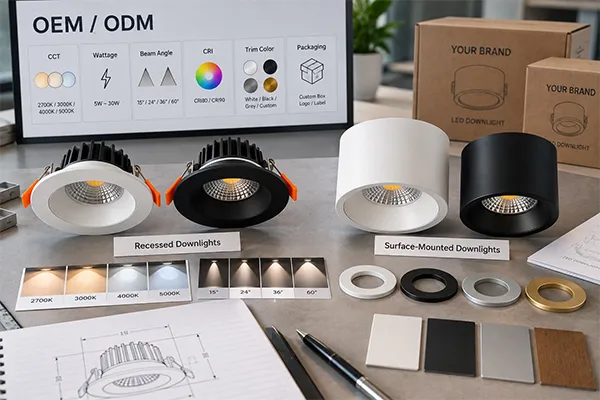
What We Can Customize After Structure Selection
As a manufacturer, we first need to understand whether the customer needs a recessed or surface-mounted structure. Then we can evaluate the requested specifications within the suitable product platform.
Common customization requests include:
- 3000K for hospitality or residential projects
- 4000K for offices, corridors, and commercial environments
- Different wattage options within a product family
- Narrower beams for accent lighting or wider beams for general lighting
- Higher-CRI options for selected applications
- White, black, or customized finish colors
- Brand labels, logo printing, packaging, and instruction materials
- Small-batch orders for market testing, subject to product requirements
I have found that the most productive customer inquiries include a ceiling photo, reflected ceiling plan, basic dimensions, target market, and estimated quantity. This information helps us provide a faster and more relevant quotation.
Keep Customization Tied to Quality Control
At Upward Lighting, our production process includes a 100% aging test of 4 to 8 hours before shipment. We use this as part of our standard pre-shipment quality-control process. For customized products, buyers should also agree on the approved sample, specifications, finish reference, packaging requirements, and inspection criteria.
A good OEM/ODM order starts with a confirmed mounting format and ends with a documented approved specification.
This discipline matters because customized products can be harder to redirect to another customer if the original project changes. A clear approval process reduces the risk of mismatched inventory, avoidable claims, and delayed delivery.
Frequently Asked Questions
Are recessed and surface-mounted the only types of downlights?
No. Recessed and surface-mounted are the two common types of downlights by installation method. Downlights can also be classified by light source, beam adjustment, IP rating, trim design, dimming method, and intended application.
Which is better: recessed or surface-mounted downlights?
Neither type is always better. Recessed downlights suit ceilings with adequate cavity depth and cut-out conditions. Surface-mounted downlights can be more practical for concrete ceilings, exposed ceilings, or retrofit projects. A qualified local installer should confirm final suitability.
Do surface-mounted downlights need a false ceiling?
Surface-mounted downlights are often selected where there is no false ceiling or insufficient space above the ceiling. However, the mounting surface, wiring route, fixing method, and local installation requirements still need review by a qualified installer.
What should I check before buying recessed downlights?
Buyers should check ceiling depth, cut-out size, ceiling material, driver dimensions, wiring access, maintenance access, and local requirements. After these conditions are confirmed, buyers can select wattage, CCT, beam angle, CRI, finish, and dimming options.
Can I customize recessed and surface-mounted downlights for my brand?
Yes, many LED downlight manufacturers can support OEM/ODM customization after the installation type is chosen. Common options include wattage, CCT, beam angle, CRI, finish color, logo, and packaging. Buyers should approve samples and drawings before mass production.
Conclusion
The two common types of downlights by installation method are recessed downlights and surface-mounted downlights. Recessed models need suitable ceiling void, cut-out planning, and access, while surface-mounted models can help where recessing is impractical. I recommend choosing the mounting structure first, then confirming lighting specifications and customization details. If you are sourcing LED downlights for a project, distribution range, or private-label brand, contact Upward Lighting with your drawings, ceiling details, and target specifications for a practical OEM/ODM evaluation.
"abbreviations", https://www.yccd.edu/wp-content/uploads/2024/04/Updated-Drawings-YCCD-Lake-County-Campus-Addendum-No.-1.pdf. Lighting technical terminology distinguishes recessed luminaires, whose housing is set into a ceiling or wall opening, from surface-mounted luminaires, which are fixed to the exposed surface. Evidence role: definition; source type: institution. Supports: Technical lighting terminology distinguishing recessed luminaires installed within a ceiling from surface-mounted luminaires attached to its surface.. ↩
"Measure Guideline: Air Sealing Attics in Multifamily Buildings", https://www1.eere.energy.gov/buildings/publications/pdfs/building_america/measure_guide_air_sealing_attics.pdf. A recessed luminaire is installed into an opening so that much of its housing is above the finished ceiling plane, whereas a surface-mounted luminaire is attached to the finished surface. Evidence role: definition; source type: government. Supports: The physical installation distinction between recessed and surface-mounted lighting fixtures.. ↩
"2025 SFCM Chapter 6 - California Energy Commission", https://www.energy.ca.gov/filebrowser/download/8638. Electrical-installation standards and luminaire instructions generally require equipment to be installed on suitable supports and in accordance with applicable wiring, access, and safety requirements. Evidence role: general_support; source type: institution. Supports: Luminaire installation must follow manufacturer instructions and applicable electrical and building requirements, including suitable mounting and service conditions.. Scope note: The exact approval, access, and mounting requirements depend on the jurisdiction, ceiling construction, luminaire listing, and project design. ↩
"Upgrading Linear Fluorescent Fixtures to LED in Schools", https://www.energy.gov/eere/ssl/articles/upgrading-linear-fluorescent-fixtures-led-schools-guide-november-2024. Because a recessed luminaire housing is placed within the ceiling assembly, its installation requires sufficient above-ceiling volume and any clearances specified by the luminaire manufacturer or safety listing. Evidence role: mechanism; source type: government. Supports: Recessed luminaires are installed within the ceiling assembly and require space for the housing, wiring, and thermal clearances as specified for the fixture.. Scope note: Required depth and clearances vary by fixture design, driver arrangement, insulation-contact rating, and applicable electrical code. ↩
"Recessed Downlights V1.0 Draft 1 Specification", https://www.energystar.gov/sites/default/files/asset/document/Recessed%20Downlights%20V1.0%20Draft%201%20Specification_0.pdf. Research on LED luminaires and electronic drivers shows that operating temperature and heat dissipation affect component performance and service life, making the manufacturer-specified installation space and clearances relevant. Evidence role: mechanism; source type: paper. Supports: LED driver reliability and luminaire thermal performance are affected by operating temperature and installation conditions.. Scope note: Thermal behavior cannot be inferred from fixture depth alone and must be assessed for the particular luminaire, driver, insulation condition, and ambient environment. ↩
"abbreviations", https://www.yccd.edu/wp-content/uploads/2024/04/Updated-Drawings-YCCD-Lake-County-Campus-Addendum-No.-1.pdf. Surface-mounted luminaires are fixed to the exposed building surface, so they can be used where a ceiling cavity for a recessed housing is unavailable, subject to approved fixing and wiring methods. Evidence role: general_support; source type: education. Supports: Surface-mounted luminaires are installed on the finished ceiling surface and therefore do not depend on a concealed ceiling cavity in the way recessed luminaires do.. Scope note: Concrete ceilings may still require project-specific assessment of anchors, concealed or surface wiring routes, load capacity, and local electrical requirements. ↩
"Impact of Thermal Dissipation on the Lighting Performance ...", https://pmc.ncbi.nlm.nih.gov/articles/PMC8776062/. LED luminaire performance is determined by the combined optical system, thermal path, control gear, and installation environment; equal nominal wattage and correlated color temperature do not establish equivalent light distribution, temperature, or reliability. Evidence role: mechanism; source type: research. Supports: Luminaire performance depends on the integrated optical, thermal, electrical-driver, and mechanical design rather than nominal wattage or correlated color temperature alone.. Scope note: A general design principle does not determine the performance of a specific product; product-level photometric and thermal documentation remains necessary. ↩
"Purchasing Energy-Efficient Commercial and Industrial ...", https://www.energy.gov/cmei/femp/purchasing-energy-efficient-commercial-and-industrial-led-luminaires. Public lighting-specification guidance commonly evaluates luminaires using photometric performance, installation constraints, serviceability, and documented product characteristics rather than nominal wattage alone. Evidence role: general_support; source type: government. Supports: Lighting specifications and procurement evaluations commonly consider photometry, physical installation constraints, maintenance, and technical documentation.. Scope note: The relative importance of each criterion depends on the application, procurement rules, building design, and applicable regulations. ↩
"RoHS Directive - Environment - European Commission", https://environment.ec.europa.eu/topics/waste-and-recycling/rohs-directive_en. European Union guidance explains that CE marking applies where relevant harmonised EU legislation requires it, while the RoHS Directive restricts specified hazardous substances in electrical and electronic equipment placed on the EU market. Evidence role: general_support; source type: government. Supports: EU requirements concerning CE marking and the restriction of hazardous substances in electrical and electronic equipment, including relevant lighting products.. Scope note: Whether a particular product may be lawfully marketed depends on its precise product category, applicable directives or regulations, conformity assessment, technical documentation, and the destination market. ↩
"Manufacturing and Inspection Plan", https://nstx.pppl.gov/DragNDrop/Science_Groups/core/TSGs/energetic_particles/archive/2013/Documents%20referenced%20ITER%20ECE%20SOW/Requirements_for_Preparing_and_Implement_22MDZD_v2_1.pdf. Quality-management practice uses verification and inspection of representative or first-article products to confirm that supplier outputs meet documented requirements before routine acceptance or full-scale delivery. Evidence role: general_support; source type: institution. Supports: Supplier-quality systems use verification, inspection, and approval of supplied or first-article products to confirm requirements before broader production or acceptance.. Scope note: Sample approval reduces but does not eliminate risk; continued process controls, inspection plans, and contractual acceptance criteria remain necessary. ↩