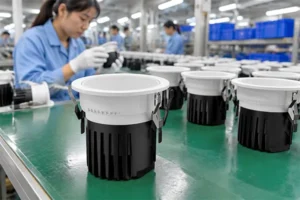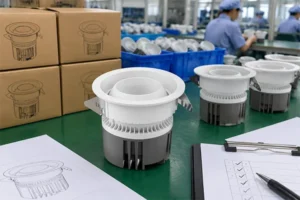

Lighting manufacturers in China can look similar in an online search, yet their real capabilities can vary widely by product category, quality-control process, customization model, and export experience. A poor supplier match can create delays, inconsistent specifications, and costly project risks. I recommend selecting manufacturers by fit rather than relying on a generic ranking.
There is no single list of “top lighting manufacturers in China” that works for every buyer. The best supplier is the manufacturer whose core product category, application knowledge, quality controls, certification documentation, customization ability, and order model match your specific project or market. Buyers should shortlist suppliers through direct qualification, sample testing, and document verification rather than brand recognition alone.
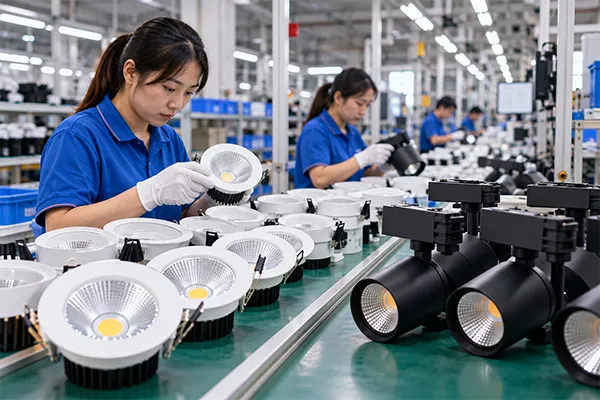
From my experience as a Zhongshan-based LED lighting manufacturer and export practitioner, I have seen overseas buyers achieve better results when they start with their sourcing requirements. The right question is not simply “Who is the biggest?” It is “Which supplier can reliably deliver the lighting product, technical parameters, and service model that my business needs?”
Why Is a Generic Ranking of Lighting Manufacturers in China Not Enough?
Many buyers begin by searching for the largest or most famous lighting manufacturers in China. This approach is understandable, but it can create a mismatch. A supplier may have a strong reputation in one category while offering limited support for the commercial lighting product, customization level, or order quantity that a buyer requires.
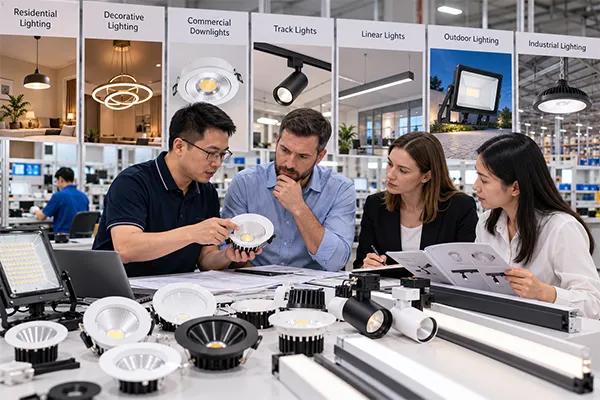
A generic ranking is not enough because Chinese lighting manufacturers serve different product segments and buyer models. One company may focus on decorative fixtures, another on outdoor lighting, and another on commercial LED downlights, track lights, or linear office lights. Buyers should evaluate category specialization and project fit before treating any supplier as a preferred option.
Start With the Procurement Task, Not the Factory Name
I encourage buyers to define the sourcing task before building a supplier shortlist. This first step sounds basic, but it prevents many avoidable problems.
For example, an importer may need a private-label range of recessed LED downlights for electrical wholesalers. A contractor may need track lighting for a retail project with a fixed installation date. A local lighting brand may need office linear lights in custom lengths, finishes, and color temperatures.
These are different purchasing tasks. They require different kinds of support.
A supplier that is suitable for a high-volume standard product may not be suitable for a small OEM order. Similarly, a manufacturer that makes attractive residential decorative lamps may not have the engineering focus needed for glare control, driver selection, beam-angle consistency, or installation details in a commercial project.
Before contacting lighting manufacturers in China, I suggest that buyers write a short sourcing brief covering:
- Product category: Downlight, track light, linear office light, panel light, decorative fixture, or another type.
- Application: Retail, office, hotel, residential, supermarket, showroom, educational facility, or public space.
- Target market: The destination country affects voltage, plug type, certification expectations, labeling, and packaging requirements.1
- Order model: Stock order, repeat wholesale order, project order, private label, OEM, or ODM development.
- Required parameters: Wattage, lumen output, color temperature, CRI, beam angle, dimming method, housing color, and IP rating.
- Commercial limits: Target quantity, expected lead time, sample budget, and target price range.
- Risk tolerance: Whether the order is a trial batch, a major tender, or a long-term product launch.
In my experience, a clear product brief produces more accurate quotations than a broad request for “your best price.”
Large Brands and OEM Factories Can Serve Different Needs
Large lighting brands can be a reasonable choice for buyers seeking established catalog products, recognizable branding, or local market support. However, size and reputation do not automatically mean that a supplier is ideal for every sourcing situation.
For instance, a large brand may prioritize its own product portfolio. Its team may have minimum order quantities that do not suit a new importer or a project buyer. Its product configuration may be standardized, which can limit changes to beam angle, color finish, packaging, or branding.
An OEM/ODM-oriented manufacturer may be more appropriate when buyers need flexibility. Still, buyers should not assume that every factory offering OEM service has the same engineering depth or quality controls.
| Buyer requirement | Possible supplier model to consider | What buyers should verify |
|---|---|---|
| Standard catalog products with minimal changes | Brand or catalog-focused manufacturer | Availability, warranty terms, local service, consistent supply |
| Private-label commercial lighting | OEM manufacturer | Logo process, packaging control, repeat-order consistency |
| Customized project lighting | ODM-capable manufacturer | Drawing approval, sample process, technical communication |
| Small initial order | Flexible export manufacturer | Minimum order quantity, sample policy, production scheduling |
| Large repeat order program | Stable production partner | Component sourcing, capacity planning, quality records |
I do not believe buyers should choose between “big” and “small” factories based on reputation alone. I believe they should choose a supplier model that supports the actual commercial task.
Which Lighting Product Categories Should Buyers Match to a Supplier?
Product specialization is one of the most important ways to assess lighting manufacturers in China. The lighting industry includes many technical and aesthetic segments. A manufacturer that performs well in one segment may not be the best choice for another.
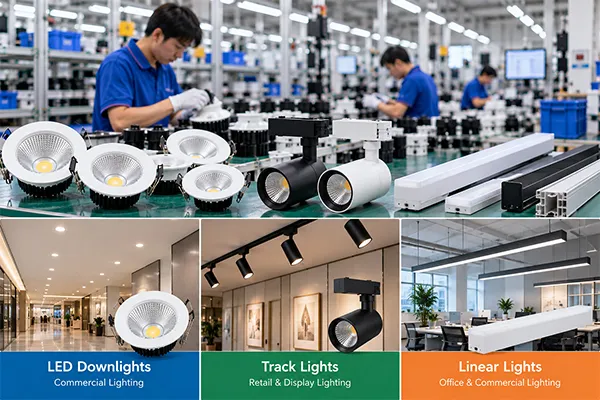
Buyers should match suppliers to the product category and application they need. For commercial projects, suppliers with established experience in LED downlights, track lights, and office linear lights may be more relevant than factories whose main output is decorative residential lighting. The product’s intended use should guide the shortlist.
Commercial Lighting Requires Application-Level Questions
Commercial LED lighting is not only about appearance. It involves light distribution, installation, visual comfort, durability, energy use, maintenance planning, and consistency across repeat orders.2
For example, a retail store may use LED track lights to create accent lighting on merchandise. The buyer may need a narrow, medium, or wide beam angle depending on ceiling height and display layout. A poorly selected beam angle can create uneven lighting or waste light outside the target area.3
An office project may use linear lighting to support general illumination over workstations and circulation zones. In this situation, buyers may need to consider glare, diffuser type, mounting method, connected lengths, emergency options, and dimming compatibility.
A recessed downlight for a hotel corridor may have different needs again. The project may require a particular cutout size, trim color, warm color temperature, and reliable driver performance over long operating hours.
When I discuss projects with overseas buyers, I find it useful to divide commercial products into practical categories:
| Product category | Typical applications | Important evaluation points |
|---|---|---|
| LED downlights | Hotels, homes, corridors, retail, restaurants | Cutout, beam angle, glare control, wattage, trim finish |
| LED track lights | Retail, showrooms, galleries, supermarkets | Track compatibility, aiming angle, beam control, CRI |
| Office linear lights | Offices, schools, meeting rooms, workspaces | UGR considerations, joining system, diffuser, mounting |
| Surface-mounted lights | Corridors, utility areas, renovations | Installation depth, heat management, surface finish |
| Decorative lighting | Homes, hospitality, restaurants | Design consistency, materials, finish durability, packaging |
Ask About the Manufacturer’s Core Output
I advise buyers to ask direct questions instead of accepting a broad statement that a factory “makes all lighting products.” A wide catalog can be useful, but it does not prove that every product category receives the same attention.
Helpful qualification questions include:
- Which products represent your core production range?
- Which applications do you support most often?
- Can you provide product drawings, photometric files, installation instructions, and test information?
- Which LED chips, drivers, optics, and housing materials do you normally use?
- How do you maintain consistency when I place repeat orders?
- Can you produce a sample using my target wattage, CCT, beam angle, or color?
- What changes require a new mold, engineering charge, or longer lead time?
At Upward Lighting, our core range includes LED downlights, LED track lights, and office linear lights. We support OEM/ODM requirements where they align with the product design, expected order model, and application needs. I would still encourage every buyer to review samples and specifications independently, because the final choice should reflect the buyer’s own market and project conditions.
How Should Buyers Evaluate Quality Control at Lighting Manufacturers in China?
Buyers often worry about quality when sourcing lighting products from overseas. This concern is reasonable because LED fixture quality depends on more than the visible housing. Components, assembly, wiring, thermal design, driver performance, optics, and testing all influence the finished product.4
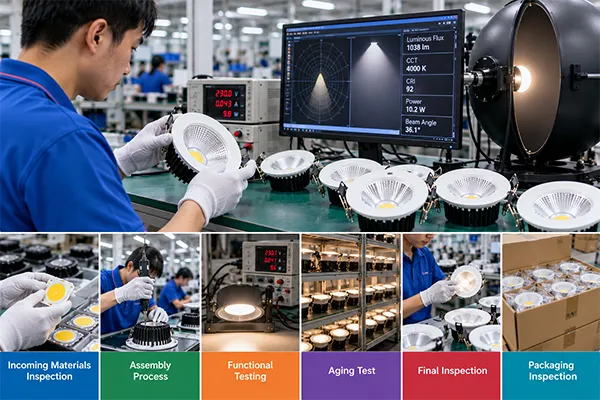
Buyers should evaluate quality control by asking for a documented process, inspecting samples, and defining acceptance criteria before production. Strong lighting manufacturers in China should be able to explain how they manage incoming materials, assembly checks, aging tests, packaging inspections, and repeat-order consistency. Claims should be supported by records where possible.
Look Beyond a Product’s Exterior
A product photograph may show an attractive finish, but it cannot confirm internal construction or long-term performance.5 I recommend that buyers inspect the full product specification and sample build.
For commercial LED fixtures, a practical review can include:
- Housing material and thickness
- Heat sink design and thermal path
- LED chip brand or binning specification
- Driver supplier, input voltage, power factor, and dimming method
- Wiring quality and connector arrangement
- Lens or reflector material
- Color consistency between units
- Actual wattage and lumen output
- Beam-angle performance
- Mounting hardware and installation instructions
- Packaging protection for export transport
Buyers should also agree on what “acceptable quality” means before placing an order. This step helps prevent disputes caused by vague language such as “high quality” or “premium grade.”
Verify the Testing Process
At our company, every product undergoes a 100% aging test of approximately 4 to 8 hours before shipment, depending on the product and production arrangement. We use this process as part of our internal quality-control approach to identify obvious functional issues before packing.
However, buyers should view any manufacturer’s testing statement as a starting point for verification, not as a substitute for their own evaluation. The appropriate testing method depends on the product, application, destination market, and contractual requirements.
A useful quality-control plan may include the following checkpoints:
| Production stage | Buyer question | Evidence to request or inspect |
|---|---|---|
| Pre-production | Has the approved sample been confirmed? | Signed sample, specification sheet, approved artwork |
| Incoming materials | How are key parts checked? | Incoming inspection records or process explanation |
| Assembly | What checks occur during production? | Work instructions, in-process inspection method |
| Aging test | Is each fixture tested before packing? | Test process description, production records where available |
| Final inspection | What does the final inspection cover? | AQL plan, inspection checklist, photos or video |
| Shipment | How is export packaging controlled? | Carton specification, drop-test approach, loading photos |
I have learned that buyers get better outcomes when they identify critical-to-quality points early. For a track light, the buyer may prioritize beam angle, CRI, and driver compatibility. For a linear office light, the buyer may prioritize straightness, diffuser consistency, and installation alignment.
Use Third-Party Inspection for Higher-Risk Orders
For large orders, new suppliers, or project-critical deliveries, an independent pre-shipment inspection can provide another level of review.6 An inspection company can check quantity, appearance, carton markings, dimensions, selected functional tests, and compliance with an agreed specification.
A third-party inspection does not guarantee lifetime performance.7 Still, it can reduce the risk of receiving products that differ visibly from the approved sample or purchase order.
I recommend that buyers put the following details into the purchase order:
- Approved product code and revision
- Color temperature tolerance
- Wattage and voltage
- Dimming method
- Housing finish
- Labeling and carton marks
- Required documents
- Inspection method and acceptable quality level
- Delivery date and shipment terms
This level of detail makes supplier comparisons more meaningful and protects both sides of the transaction.
What Should Buyers Verify About Certifications and Export Readiness?
Certifications are important in lighting procurement, but they should be handled carefully. Buyers need documents that match their intended market, product configuration, and applicable regulations. A certificate name alone does not confirm that every version of a fixture meets every local requirement.8
Buyers should verify certifications directly with the issuing body or qualified compliance professionals when needed. Lighting manufacturers in China may offer CE, RoHS, or other documentation, but buyers must confirm that the documents apply to the exact product model, electrical configuration, and destination market before importing or installing products.

Certification Is a Document Review Process
In export lighting, I have seen buyers use the word “certification” to mean several different things. It may refer to a test report, a declaration, a component approval, a market-access document, or a customer-required compliance file. These are not always interchangeable.
For European-market products, buyers may request CE-related documentation and RoHS information.9 The exact obligations can depend on the product and the responsible economic operator. Other markets may have separate safety, electromagnetic compatibility, energy-efficiency, or labeling requirements.
At Upward Lighting, we provide products with CE and RoHS documentation for relevant market-entry requirements. Buyers should independently verify the validity, scope, issuing organization, product model, and current regulatory applicability of all documents before making an import decision.
I recommend that buyers ask the following questions:
- Does the document show the exact product model or a clearly linked model family?
- Does the stated voltage match the ordered fixture?
- Does the report cover the intended driver and LED configuration?
- Is the test report current and issued by an identifiable laboratory?
- Does the document apply to the destination country?
- Does the packaging require specific labels, warnings, or importer details?
- Does the project consultant require additional compliance documents?
Export Readiness Also Includes Communication and Packaging
Compliance documents are only one part of export readiness. A reliable supplier should also communicate clearly about order status, technical revisions, lead times, and packing arrangements.
I believe buyers should assess the supplier’s operational response during the quotation and sampling stage. Slow or unclear communication at this stage can become a larger issue during production.
A practical export-readiness checklist includes:
- Quotation clarity: Does the quotation state the model, configuration, quantity, unit price, trade term, and validity period?
- Technical clarity: Does the supplier provide drawings, dimensions, cutout sizes, and installation details?
- Sample control: Is the sample identified clearly and aligned with the final order specification?
- Packaging: Is the inner box and master carton suitable for the shipment method?
- Documentation: Can the supplier provide packing lists, invoices, product labels, and requested compliance files?
- Delivery management: Does the supplier explain production lead time and possible component-related risks?
- Repeat-order control: Does the supplier maintain records for approved configurations?
When I work with international buyers, I try to make the quotation stage as specific as possible. This process helps us identify issues before production rather than after the container has shipped.
How Can Buyers Shortlist Lighting Manufacturers in China More Safely?
The safest sourcing process is usually gradual. Buyers do not need to commit to a large order after one online conversation. A structured shortlist, technical comparison, sample review, and controlled trial order can reveal much more than a supplier ranking page.
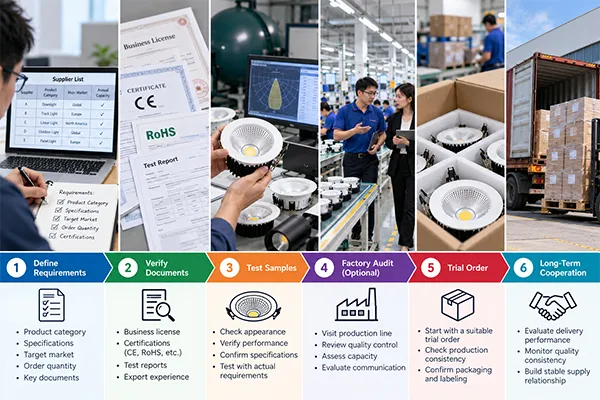
Buyers can shortlist lighting manufacturers in China more safely by comparing suppliers against the same written requirements, verifying their business and compliance documents, testing samples, and starting with an appropriate trial order. A consistent evaluation method reduces decisions based only on low pricing or attractive marketing claims.
Build a Comparable Supplier Scorecard
I suggest that buyers compare each candidate using the same criteria. This method avoids a common problem: one factory appears cheaper because its quotation excludes a driver, dimming feature, packaging level, or testing requirement included by another supplier.
Here is a simple supplier scorecard that buyers can adapt:
| Evaluation area | Suggested weighting | Questions to ask |
|---|---|---|
| Product and application fit | 25% | Does the supplier understand the required product use? |
| Quality-control process | 20% | Can the team explain testing and inspection procedures? |
| Customization capability | 15% | Can the supplier adjust CCT, wattage, beam angle, CRI, or finish? |
| Compliance documentation | 15% | Can the supplier provide relevant, verifiable documents? |
| Communication and response | 10% | Are quotations and technical answers complete and timely? |
| Delivery and supply stability | 10% | How does the supplier manage lead times and repeat orders? |
| Commercial terms | 5% | Are MOQ, payment, warranty, and pricing clear? |
Price matters, especially for wholesalers and competitive distributors. Yet the lowest price does not always produce the lowest total cost. A lower-priced fixture may lead to extra costs from rework, freight claims, delayed installation, missing documentation, or inconsistent repeat supply.10
Use Samples as a Decision Tool
A sample is not only a product preview. It is a test of the supplier’s communication, configuration control, packaging, and responsiveness.11
I recommend that buyers evaluate samples under realistic conditions whenever possible. A contractor can install the product in a mock-up area. A distributor can compare it with existing stock. A lighting brand can review the product against its own design and performance standards.
During a sample review, buyers should check:
- Does the delivered sample match the requested specification?
- Is the color temperature acceptable?
- Does the beam angle suit the application?
- Is the housing finish consistent?
- Are mounting accessories complete?
- Is the product easy to install?
- Is the packaging sufficiently protective?
- Does the product label match the required market information?
I often tell buyers that a supplier’s handling of one small sample order can reveal how that supplier may handle a larger repeat order.
Plan for Long-Term Supply, Not Only the First Purchase
For many importers and brands, repeat-order consistency matters more than the first shipment. A fixture that is acceptable today but changes in appearance, driver design, or installation size later can cause serious problems in the buyer’s market.12
Buyers should ask whether the supplier has a process for managing approved samples and bill-of-material changes. They should also discuss what happens if a key component becomes unavailable.
At Upward Lighting, we serve global customers including contractors, brands, wholesalers, importers, traders, distributors, and building-material channel partners. We support small-batch orders and OEM/ODM customization within practical production conditions. I believe this model is most useful when a buyer needs commercial LED lighting with direct factory communication and controlled configuration options. Each buyer should still conduct independent due diligence based on the product’s intended use and market requirements.
Frequently Asked Questions
Are the largest lighting manufacturers in China always the best choice?
No. Large manufacturers may be suitable for standard products and high-volume programs, but they may not offer the flexibility needed for small orders, private labeling, custom specifications, or project support. Buyers should select suppliers based on product fit, service model, and independently verified capabilities.
What should I ask a Chinese LED lighting manufacturer before requesting a quote?
I recommend asking about the core product category, customization options, minimum order quantity, lead time, quality-control process, sample availability, certification documents, and repeat-order management. You should also provide a clear specification including wattage, CCT, beam angle, CRI, dimensions, and target application.
How can I verify a lighting manufacturer’s certifications?
Buyers should request the relevant documents, confirm that they apply to the exact model and configuration, and verify the issuing organization where appropriate. For market-specific compliance decisions, buyers should consult qualified testing laboratories, regulatory specialists, or local professionals.
What is a reasonable aging test for LED lighting products?
The appropriate aging test depends on the product type, production process, and buyer requirements. Some manufacturers conduct 100% functional aging before shipment, while others use different protocols. Buyers should ask for the documented testing method and define any required acceptance criteria in the purchase order.
Can Chinese lighting manufacturers provide OEM and ODM services?
Many lighting manufacturers in China offer OEM or ODM services, but their actual flexibility differs. Buyers should confirm whether the supplier can customize parameters such as color temperature, wattage, beam angle, CRI, finish color, packaging, and product labeling without compromising lead time or repeat-order consistency.
Conclusion
The best lighting manufacturers in China are not defined by a universal ranking. The right choice depends on the buyer’s product category, application, customization needs, quality expectations, compliance requirements, and order model. I recommend that buyers compare suppliers through a written scorecard, detailed samples, document checks, and clear purchase specifications. If you are sourcing LED downlights, track lights, or office linear lights for an OEM, wholesale, or project requirement, I invite you to share your specifications with Upward Lighting for a practical factory-fit discussion.
"Preparing Product for Export", https://www.trade.gov/preparing-product-export. Market-access rules for electrical products may vary by destination and can include conformity assessment, labeling, and responsible-operator requirements. Evidence role: general_support; source type: government. Supports: That product-market requirements can differ by destination and may include electrical conformity, labeling, and importer obligations.. Scope note: Specific voltage, plug, packaging, and certification rules must be checked for the particular destination and product. ↩
"Purchasing Energy-Efficient Commercial and Industrial LED ...", https://www.energy.gov/cmei/femp/purchasing-energy-efficient-commercial-and-industrial-led-luminaires. Commercial lighting evaluation commonly considers light distribution, visual conditions, energy performance, installation, and maintenance in addition to fixture appearance. Evidence role: general_support; source type: government. Supports: That commercial lighting decisions commonly consider distribution, visual conditions, energy use, installation, and maintenance.. Scope note: The relative importance of these factors depends on the space type, applicable code, and project brief. ↩
"Arena Lighting Design: Lux, Uniformity, Glare and Beam Angle ...", https://reitalight.com/arena-lighting-design-lux-uniformity-glare-beam-angle-guide/. A luminaire's beam spread determines how light is distributed on the illuminated surface; an unsuitable distribution can reduce uniformity or direct light beyond the intended target. Evidence role: mechanism; source type: education. Supports: That luminaire beam spread determines the distribution of light on a target plane and affects uniformity and spill.. Scope note: The resulting illumination pattern also depends on mounting height, aiming, spacing, reflectances, and the surrounding environment. ↩
"LED Luminaire Reliability: Impact of Color Shift", https://www.energy.gov/sites/prod/files/2017/04/f34/lsrc_colorshift_apr2017.pdf. LED luminaire performance and service life are affected by thermal management, driver behavior, optical design, component quality, and manufacturing controls. Evidence role: mechanism; source type: research. Supports: That LED-system performance and reliability are influenced by thermal conditions, drivers, optical systems, components, and manufacturing quality.. Scope note: The contribution of each factor varies by luminaire design, operating environment, and duty cycle. ↩
"Considerations and Standards - for Visual Inspection", https://nvlpubs.nist.gov/nistpubs/Legacy/IR/nbsir76-1142.pdf. Visual review can identify certain external defects, but internal construction and long-term reliability generally require specification review, inspection, and performance testing. Evidence role: general_support; source type: institution. Supports: That visual inspection has limited ability to establish hidden construction characteristics and long-term product reliability.. Scope note: The types of defects detectable by visual inspection depend on the product and inspection method. ↩
"Preshipment Inspection", https://ustr.gov/trade-agreements/wto-multilateral-affairs/wto-issues/customs-issues/preshipment-inspection. Pre-shipment inspection is a trade-control practice used to examine consignments before export against specified requirements, including quantity and observable quality characteristics. Evidence role: general_support; source type: institution. Supports: That pre-shipment inspection is used to examine goods before export against defined requirements such as quantity and quality.. Scope note: Such an inspection is limited to its agreed scope and sampling plan and does not establish lifetime product performance. ↩
"6.2.1. What is Acceptance Sampling?", https://www.itl.nist.gov/div898/handbook/pmc/section2/pmc21.htm. Acceptance and pre-shipment inspections provide evidence about a shipment within a defined scope and sampling method; they cannot guarantee the lifetime performance of every unit. Evidence role: mechanism; source type: government. Supports: That sampling-based acceptance inspection provides evidence about a lot under defined conditions but cannot prove that every item will perform throughout its service life.. Scope note: The confidence provided depends on the inspection plan, sample size, test methods, and defect criteria. ↩
"Compliance FAQs: CE Marking", https://www.nist.gov/standardsgov/compliance-faqs-ce-marking. Conformity documentation must be assessed against the applicable legislation and the product placed on the market; a document title alone does not establish compliance for all variants or jurisdictions. Evidence role: general_support; source type: government. Supports: That conformity documentation must relate to the applicable product and legal requirements, and manufacturers remain responsible for compliance.. Scope note: The documents and conformity procedures required depend on the product, its configuration, and the destination market. ↩
"RoHS Directive - Environment - European Commission", https://environment.ec.europa.eu/topics/waste-and-recycling/rohs-directive_en. For electrical and electronic equipment within their scope, EU product rules include conformity obligations associated with CE marking and restrictions on specified hazardous substances under RoHS. Evidence role: definition; source type: government. Supports: That applicable EU rules for electrical and electronic equipment include CE-related conformity obligations and RoHS restrictions on certain hazardous substances.. Scope note: Applicability and documentation requirements depend on the product category, exemptions, and the economic operator's role. ↩
"Life-cycle costing as a tool in mainstreaming green public ...", https://www.oecd.org/en/publications/life-cycle-costing-in-public-procurement-in-hungary_8d90f627-en/full-report/component-5.html. Total-cost and lifecycle procurement approaches recognize that purchase price alone may not capture costs associated with quality failures, delivery disruption, administration, and use over time. Evidence role: general_support; source type: institution. Supports: That procurement evaluation can account for lifecycle and risk-related costs beyond initial purchase price.. Scope note: The specific costs and their magnitude must be assessed from the buyer's contract terms, logistics, and operating context. ↩
"What is Supplier Quality Management ...", https://asq.org/quality-resources/supplier-quality?srsltid=AU7gw4WWb8Z0iNQtoCse9BDwdDHuMlW12diOfbSrZG8x6c9L0WX795bb. Sample approval and supplier-evaluation processes can provide early evidence of conformance to specifications and of a supplier's ability to control the agreed configuration. Evidence role: general_support; source type: institution. Supports: That sample approval and supplier evaluation can be used to assess conformance to requirements before production release.. Scope note: One sample or pilot order does not by itself demonstrate sustained production capability or future lot consistency. ↩
"SP 800-128, Guide for Security-Focused Configuration ...", https://csrc.nist.gov/pubs/sp/800/128/upd1/final. Configuration-management practices control changes to documented product characteristics so that conformity, compatibility, and traceability can be maintained across production and replacement cycles. Evidence role: mechanism; source type: institution. Supports: That configuration management controls product changes to preserve documented requirements, compatibility, and traceability.. Scope note: The operational impact of a design or component change depends on the installation, contractual specifications, and availability of approved substitutes. ↩