
LED lighting manufacturers in China can be difficult to compare because buyers often see hundreds of factory profiles, product catalogs, and “top supplier” claims1. That creates uncertainty around quality, customization, delivery, and compliance. We believe a practical shortlist is useful, but buyers still need to match each supplier to their product category and purchasing model.
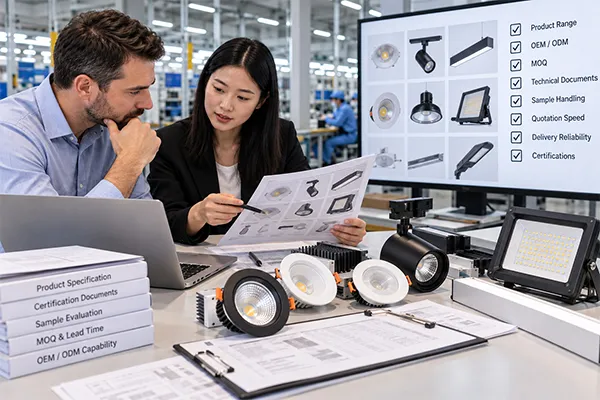
The top 10 LED lighting manufacturers in China should be treated as a market-discovery shortlist rather than a definitive quality ranking. Buyers should compare manufacturers by product category, OEM/ODM flexibility, minimum order quantity, technical documentation, sample handling, quotation speed, and destination-market requirements. The best supplier for a large commercial project may not be the best supplier for a distributor, importer, or private-label lighting brand.
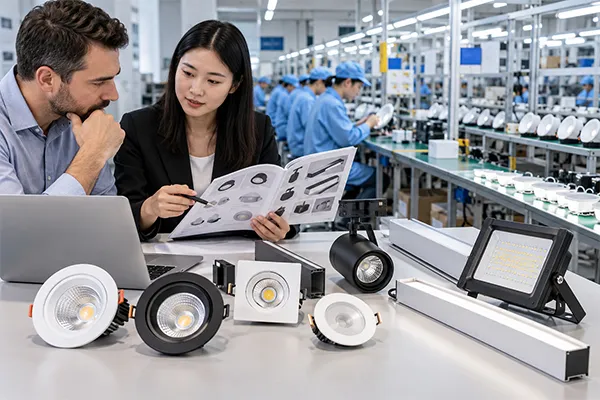
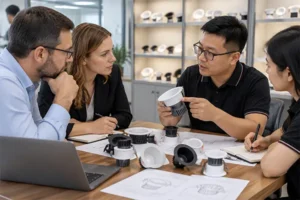
When we communicate with overseas buyers from our base in Zhongshan, we often see the same pattern. A buyer first asks for the “best LED factory in China.” After a few messages, the real questions emerge: Can the supplier customize a 3000K track light? Can it support a small first order? Can it provide stable linear light quality for an office project? Those details matter more than a broad ranking.
How Should Buyers Use a List of LED Lighting Manufacturers in China?
Buyers need a starting point when entering the Chinese lighting market, but a supplier list can create false confidence. Large names may look safe, while smaller specialized factories may better support custom orders or focused product lines. The challenge is turning a general market list into a qualified sourcing process.
Buyers should use a list of LED lighting manufacturers in China to identify potential suppliers, then conduct product-specific and commercial screening. A useful shortlist helps buyers compare market coverage, product focus, and public visibility, but it does not prove factory quality, OEM capability, pricing, delivery reliability, or certification validity for a specific order.
A “Top 10” List Is Not a Factory Audit2
We want to be clear about the limits of any ranking. We do not present ourselves as an independent laboratory, audit organization, or authority on every named company’s factory operations. We also do not claim firsthand knowledge of competitors’ current pricing, production capacity, internal quality systems, or delivery performance.
Instead, buyers can view this list as an initial market-discovery tool. We selected the companies below because they have recognizable public corporate identities, published lighting-related product information, established market presence, or widely visible distribution activity. These are useful signals for research, but they are not proof that a company is the right sourcing partner.
A good sourcing decision should include several layers of verification:
-
Product fit
Confirm that the supplier actively supports your required category, such as recessed downlights, track lighting, office linear lights, floodlights, or decorative fixtures. -
Commercial fit
Ask about MOQ, payment terms, sample charges, quotation lead time, production lead time, and willingness to support private-label projects. -
Technical fit
Review wattage, luminous flux, efficacy, beam angle, color temperature, CRI, driver brand, dimming method, IP rating, and mounting details. -
Compliance fit
Request product-specific test reports and declarations relevant to your destination market. Buyers should verify that documents match the exact model, electrical configuration, and sales region. -
Operational fit
Evaluate communication clarity, response time, packaging control, labeling, inspection procedures, and after-sales process.
A supplier can be well known and still be unsuitable for your order volume, product design, customization request, or delivery schedule.
In our experience, the most productive buyer conversations begin after the buyer defines the buying model. A contractor may need consistent project specifications and technical documents. A distributor may need fast-moving models, attractive packaging, and stable replenishment. A local lighting brand may need custom finishes, labels, and differentiated product specifications. These are three different supplier-selection exercises.
Which 10 LED Lighting Manufacturers in China Are Worth Researching?
Buyers often need names to begin their research, yet an alphabetical shortlist is safer and more useful than claiming a universal rank. Market position changes over time, and each company may serve different channels, product categories, and regions. Buyers should always verify current information directly with each business.
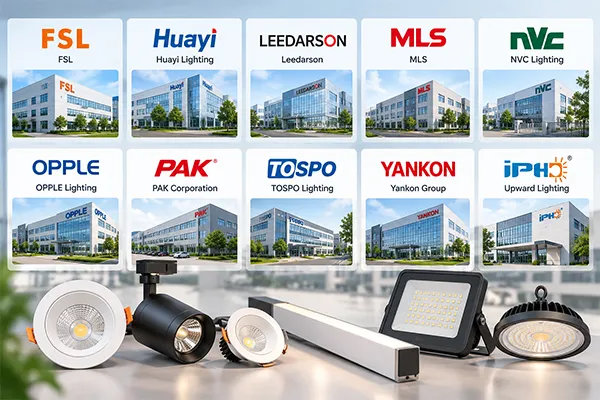
The following 10 LED lighting manufacturers in China are commonly visible in the broader lighting market and may be worth researching: FSL, Huayi Lighting, Leedarson3, MLS, NVC Lighting, OPPLE Lighting4, PAK Corporation, TOSPO Lighting5, Yankon Group, and Zhongshan-based OEM/ODM manufacturers such as Upward Lighting. This is not a quality ranking or endorsement.
An Indicative Manufacturer Shortlist
The table below is organized alphabetically, not by quality, sales volume, export performance, factory size, or OEM suitability. Public company information can change, so buyers should confirm current corporate details, product availability, and commercial terms before making decisions.
| Manufacturer or Brand | Public Market Association | Categories Buyers May Research | What Buyers Should Confirm |
|---|---|---|---|
| Foshan Electrical and Lighting Co., Ltd. (FSL)6 | Established Chinese lighting company | General lighting and LED lighting products | Current export model, product-specific documentation, and channel support |
| Huayi Lighting | Zhongshan-area lighting brand and manufacturer | Decorative, commercial, and project lighting | Whether the supplier’s project product scope matches your application |
| Leedarson | China-based lighting and smart-product group | Smart lighting, connected products, and LED solutions | Integration requirements, platform compatibility, and product scope |
| MLS Co., Ltd. | Chinese LED and lighting enterprise | LED components and lighting-related products | Finished-product availability and OEM project terms |
| NVC Lighting | Recognized lighting brand with commercial lighting visibility | Commercial, office, and general lighting | Regional business entity, product range, and project support process |
| OPPLE Lighting | Major Chinese lighting brand | Residential, commercial, and general lighting | Private-label flexibility, MOQ, and export-channel arrangements |
| PAK Corporation | Chinese lighting company with commercial lighting presence | Commercial and professional lighting | Current product specifications and overseas service model |
| TOSPO Lighting | Zhejiang-based lighting manufacturer | Lamps, fixtures, and general LED lighting | Factory-versus-trading role, sample process, and export documents |
| Yankon Group | Chinese lighting manufacturer | LED lamps and lighting products | Product-level certification and intended-market availability |
| Upward Lighting | Zhongshan-based LED lighting manufacturer | LED downlights, track lights, and office linear lights | OEM/ODM scope, sample process, aging test records, and order requirements |
Why We Include a Specialized Zhongshan OEM/ODM Supplier
We include Upward Lighting because we can describe our own operating scope directly. We are a Zhongshan-based LED lighting manufacturer established in 2009.7 Our core range includes LED downlights, LED track lights, and office linear lights. We work with contractors, importers, wholesalers, distributors, traders, and local lighting brands.
Our position is not that we are the best fit for every buyer. Instead, we are often relevant when a buyer needs:
- OEM or ODM customization
- Adjustable color temperature, wattage, beam angle, CRI, or surface finish
- Small-batch order support
- Fast quotation feedback
- Product focus in downlights, track lights, and office linear lighting
- A supplier familiar with export-oriented inquiry and project communication
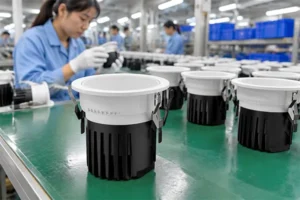
Before shipment, we conduct a 100% aging test for our products, typically lasting between 4 and 8 hours. Buyers should still define their own inspection criteria, quality agreement, and acceptance standards. We encourage customers to request specifications, samples, test data, and production details that relate directly to their intended application.
How Do LED Lighting Manufacturers in China Compare by Product Category?
Many buyers compare LED lighting manufacturers in China as if every factory produces the same products with the same strengths. This approach can lead to mismatched supplier choices. A supplier that performs well in decorative lighting may not be organized for office linear-light projects, and a lamp-focused company may not offer the right recessed fixture designs.
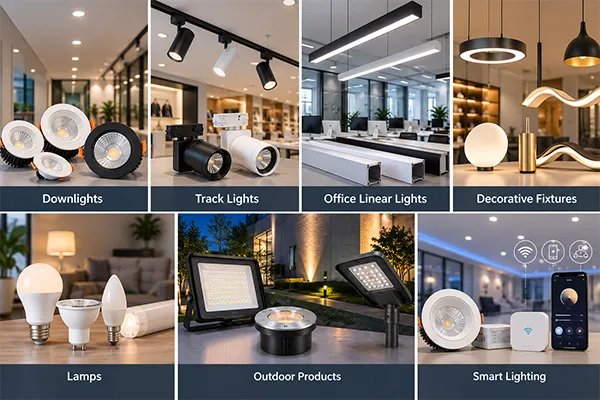
LED lighting manufacturers in China should be compared by the specific lighting category and application required. Buyers should shortlist suppliers separately for downlights, track lights, office linear lights, decorative fixtures, lamps, outdoor products, and smart lighting because each category has different technical, commercial, and quality-control requirements.
LED Downlights: Focus on Consistency and Installation
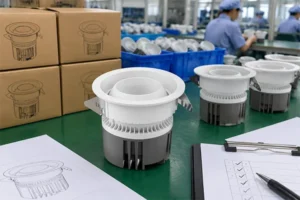
LED downlights are common in retail, hospitality, residential, and commercial interiors. However, the category contains many variations. Buyers should not compare a basic residential downlight with a high-CRI, low-glare commercial recessed fixture as if they are equivalent products.
For downlight procurement, we recommend reviewing:
- Cutout size and ceiling compatibility
- Housing material and thermal design
- Wattage and measured lumen output
- Beam angle options, such as 24°, 36°, 60°, or wider
- Color temperature consistency across batches
- CRI requirements, especially for retail or hospitality projects
- Driver configuration and dimming compatibility
- UGR or glare-control requirements where relevant
- Trim finish, including white, black, gold, or custom colors
A common issue occurs when a buyer requests “12W downlights” without defining lumen output, beam angle, or ceiling condition. Two 12W models can have very different optical performance and appearance. We usually encourage buyers to start with a detailed specification sheet or a reference sample.
LED Track Lights: Focus on Optics and Flexibility
Track lighting is often used in fashion stores, galleries, showrooms, supermarkets, and hospitality spaces. Buyers should evaluate more than wattage. The optical system and track compatibility can have a major impact on the installation result.
Key questions include:
- Which track standard will the project use?
- Does the project need 2-wire, 3-wire, or 4-wire compatibility8?
- Which beam angles suit the merchandise or display area?
- Is high CRI needed for color-sensitive products?
- Does the project require dimming, such as TRIAC, 0–10V, or DALI?
- Does the customer need black, white, or custom-finish housings?
Office Linear Lights: Focus on Uniformity and System Design
Office linear lighting requires a different evaluation method. A linear-light supplier should understand suspended, surface-mounted, recessed, and continuous-row installations. Buyers should also check diffuser quality, joint alignment, cable suspension, emergency options, sensor compatibility, and light distribution.
| Product Category | Typical Buyer Priority | Important Technical Checks | Common Sourcing Risk |
|---|---|---|---|
| LED downlights | Appearance, lumen output, installation | Cutout, CRI, beam angle, driver, thermal design | Inconsistent color or mismatched cutout sizes |
| LED track lights | Accent effect and flexibility | Beam angle, CRI, track adapter, dimming | Poor compatibility with local track systems |
| Office linear lights | Uniformity and project coordination | Length, joining system, diffuser, UGR, mounting | Incomplete accessories or inconsistent continuous runs |
| Decorative lighting | Design and finish | Materials, finish consistency, dimensions | Sample-to-production variation |
| Outdoor lighting | Durability and protection | IP rating, corrosion resistance, thermal design | Inadequate application-specific validation |
From our own discussions with buyers, we find that product-category clarity often reduces quotation revisions. When a buyer provides installation photos, ceiling dimensions, desired color temperature, target price range, and expected order quantity, we can normally recommend a more relevant configuration.
How Can Buyers Screen LED Lighting Manufacturers in China Before Ordering?
A polished catalog can make any supplier look capable, while a low unit price can hide missing specifications or weak service boundaries. Buyers need a screening process that identifies risk before they commit to samples, deposits, or a container order. The aim is not perfection; the aim is controlled decision-making.
Buyers should screen LED lighting manufacturers in China through a structured process that checks product specifications, OEM/ODM scope, MOQ, communication speed, samples, quality controls, documentation, and delivery expectations. A written comparison matrix helps buyers select suppliers based on evidence instead of broad claims or lowest-price quotations.
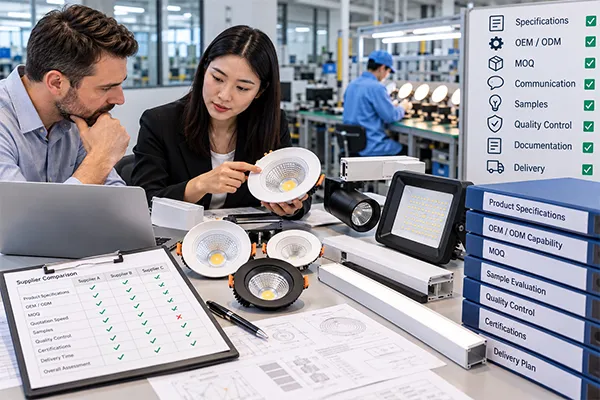
A Practical Supplier Screening Checklist
We recommend that buyers use the same questions for every shortlisted supplier. This makes quotations easier to compare and exposes unclear responses early.
1. Confirm the Exact Product Scope
Ask the supplier to quote the same product brief. Your request should include:
- Product type and installation method
- Wattage and target lumen output
- Color temperature
- CRI requirement
- Beam angle
- Dimming requirement
- Finish color
- IP rating, if required
- Quantity by model
- Packaging and labeling needs
- Destination country or region
A vague request produces vague quotations. A clear request creates a usable supplier comparison.
2. Define the OEM/ODM Requirement
OEM and ODM are often used loosely in the lighting industry. Buyers should ask exactly what can be customized and what additional cost or MOQ applies.
For example, a supplier may support:
- Logo printing on product or packaging
- Customized color boxes and instruction manuals
- Housing color changes
- Color temperature selection
- Wattage adjustment
- Beam-angle selection
- Driver or dimming changes
- New tooling or structural development
However, each option can affect lead time, testing needs, MOQ, and cost. We have seen buyers assume that logo printing and full product redesign are the same type of service. They are not. A simple private-label program may be available at a much lower threshold than a new product development project.
3. Evaluate Communication Before the First Order
Communication is a practical indicator, not a perfect quality measure. Still, buyers should notice whether the supplier asks useful technical questions, provides a complete quotation, and explains assumptions.
We recommend tracking:
| Screening Item | What Good Looks Like |
|---|---|
| Quotation response | Clear pricing, model details, MOQ, and trade terms |
| Technical response | Answers tied to specification rather than generic sales language |
| Sample process | Defined sample lead time, cost, courier method, and approval process |
| Documentation | Model-specific datasheets, drawings, and relevant test documents |
| Issue handling | Clear explanation of warranty scope and corrective-action process |
| Delivery planning | Realistic production lead time and packaging details |
4. Review Samples and Pre-Shipment Controls
Samples are essential, but a sample alone does not guarantee production consistency. Buyers should evaluate the sample against a written checklist. They should also ask how the factory controls the production order.
Useful checks include:
- Visual finish and assembly quality
- Color temperature appearance
- Dimming behavior
- Installation convenience
- Packaging protection
- Product label accuracy
- Accessory completeness
- Basic electrical and functional testing
- Aging-test process
- Pre-shipment inspection arrangement
At Upward Lighting, we perform a 100% aging test before shipment, generally for 4 to 8 hours. Buyers with project-critical requirements should still consider third-party inspections, sample approval records, and a written quality agreement. Application-specific decisions may require evaluation by qualified lighting, electrical, or project professionals.
Verify Compliance Documents for the Actual Product
Certification claims should always be checked carefully. A document may apply only to a particular model, component combination, voltage range, or production period.9 Buyers should not assume that one certificate covers every item in a supplier’s catalog.
For products intended for relevant markets, buyers may request documents such as CE- or RoHS-related materials where applicable. However, buyers should verify:
- The legal manufacturer name
- The exact model number
- The report date
- The issuing organization
- The test standard and scope
- The electrical configuration
- Whether the document applies to the destination market
This step is especially important for importers and distributors who will be responsible for local market obligations.10
Frequently Asked Questions
Are Chinese LED lighting manufacturers reliable?
Chinese LED lighting manufacturers vary widely in product focus, quality control, communication, and export experience. Reliability depends on the individual supplier and order requirements. Buyers should review samples, specifications, inspection procedures, documentation, and delivery commitments before placing a large order.
Who is the best LED lighting manufacturer in China?
There is no single best LED lighting manufacturer in China for every buyer. The right supplier depends on the lighting category, order size, target market, customization needs, budget, and delivery schedule. Buyers should build a shortlist and compare suppliers against the same written requirements.
What should I ask an LED lighting factory before requesting a quote?
Buyers should provide product type, wattage, lumen target, CCT, CRI, beam angle, dimming method, finish, quantity, packaging needs, and destination market. Buyers should also ask about MOQ, sample lead time, production lead time, customization options, and applicable product documentation.
Can I order customized LED downlights or track lights from China?
Many manufacturers support some OEM or ODM customization, such as logos, packaging, color temperature, wattage, beam angle, and housing finish. Buyers should confirm which changes are available, whether new tooling is needed, what MOQ applies, and how customization affects lead time.
How do I verify LED lighting certifications from a Chinese supplier?
Buyers should request product-specific documents and check the legal manufacturer name, model number, issue date, test scope, and issuing body. Buyers should also confirm that the document is relevant to the exact electrical configuration and destination market. Professional compliance advice may be appropriate for regulated projects.
Conclusion
A shortlist of LED lighting manufacturers in China is a useful first step, but it should never replace product-level evaluation. We recommend that buyers compare suppliers by category fit, OEM/ODM scope, MOQ, technical responsiveness, samples, inspection controls, and destination-market documentation. Brand recognition and company scale can be useful market signals, but they do not automatically prove supplier suitability. If you are sourcing LED downlights, track lights, or office linear lights for an import, distribution, or project program, contact Upward Lighting for a focused quotation and product discussion based on your actual requirements.
"6 LED Lighting Manufacturers in China for Wholesale, ...", https://www.fforder.com/post/led-lighting-manufacturers-china. Industry research characterizes China’s lighting sector as a large and fragmented supplier market, providing context for the high volume of manufacturer listings and product offerings encountered by buyers. Evidence role: general_support; source type: research. Supports: Evidence on the large number and fragmented nature of lighting manufacturers and suppliers in China.. Scope note: Such evidence describes market structure generally and does not quantify profiles or claims visible on any particular sourcing platform. ↩
"A Complete Guide to Supplier Audits", https://amtivo.com/uk/resources/insights/a-complete-guide-to-supplier-audits/. Supplier-audit guidance defines an audit as a structured evaluation of a supplier’s systems, controls, and compliance evidence; a public shortlist alone does not perform that verification. Evidence role: definition; source type: institution. Supports: Definitions and guidance distinguishing supplier assessment or auditing from preliminary supplier selection.. ↩
"ueic-20201231", https://www.sec.gov/Archives/edgar/data/101984/000010198421000009/ueic-20201231.htm. Corporate-profile and filing materials describe Leedarson as a China-based company with smart-lighting and connected-product activities. Evidence role: case_reference; source type: other. Supports: Leedarson’s corporate location and stated involvement in smart lighting and connected products.. Scope note: Stated business activities do not demonstrate compatibility with a buyer’s required platform, project, or procurement terms. ↩
"Opple Lighting", https://en.wikipedia.org/wiki/Opple_Lighting. Public company disclosures document OPPLE Lighting’s lighting business and market operations, supporting its inclusion as a prominent Chinese lighting brand. Evidence role: case_reference; source type: institution. Supports: OPPLE Lighting’s corporate identity, lighting business, and publicly documented market scale or distribution presence.. Scope note: Public scale indicators do not establish that OPPLE is the best supplier for a specific buyer, product category, or destination market. ↩
"Hengdian Group Tospo Lighting Co., Ltd.", https://www.linkedin.com/company/hengdian-group-tospo-lighting-co-ltd-. Company information identifies TOSPO Lighting as a Zhejiang-based business engaged in lighting products and manufacturing-related operations. Evidence role: case_reference; source type: other. Supports: TOSPO Lighting’s corporate location in Zhejiang and its stated lighting-manufacturing activity.. Scope note: This identification does not verify whether a particular transaction is supplied directly by a factory rather than through a trading entity. ↩
"Foshan Electrical and Lighting Co.,Ltd (200541.SZ)", https://finance.yahoo.com/quote/200541.SZ/profile/. Company and securities-disclosure records identify Foshan Electrical and Lighting Co., Ltd. as a Chinese enterprise engaged in lighting products. Evidence role: case_reference; source type: institution. Supports: The legal identity, location, and lighting business of Foshan Electrical and Lighting Co., Ltd.. Scope note: Corporate records establish identity and stated business scope, not present product quality or suitability for a particular order. ↩
"Upward Lighting Electrical Appliances Co., Ltd.", https://www.sourceready.com/supplier/detail/upward-lighting-factory. The relevant business-registration record identifies the company’s establishment date, registered location, and stated lighting-related business scope. Evidence role: case_reference; source type: government. Supports: The company’s registered identity, establishment date, location, and stated business scope.. Scope note: Registration information does not independently verify current production capacity, export experience, or product performance. ↩
"What Is 4 Wire 3 Phase LED Tracklight 2025 Ultimate Guide", https://www.xhlux.com/news/what-is-4-wire-3-phase-led-tracklight-2025-ultimate-guide/. Technical guidance for track-lighting systems shows that track and adapter configurations differ by conductor and circuit arrangement, so compatibility must be confirmed before installation. Evidence role: mechanism; source type: institution. Supports: That track-light adapters and track systems vary by conductor or circuit configuration and require compatibility checks.. Scope note: Configuration terminology and compatibility details may vary by regional standard, manufacturer, and installed track system. ↩
"A guide to EU standards and conformity assessment", https://www.govinfo.gov/content/pkg/GOVPUB-C13-07a06d81c863b5241d6249891a51fb90/pdf/GOVPUB-C13-07a06d81c863b5241d6249891a51fb90.pdf. European product-compliance guidance requires technical documentation and conformity assessment for the product placed on the market, supporting the need to match reports and declarations to the exact model and configuration. Evidence role: mechanism; source type: government. Supports: That conformity assessment and technical documentation must correspond to the product placed on the market and its applicable requirements.. Scope note: Applicable documentation requirements depend on the destination jurisdiction, product type, and legal role of the importer or manufacturer. ↩
"EU - EU Legislation and CE Marking", https://www.trade.gov/country-commercial-guides/eu-eu-legislation-and-ce-marking. EU market-surveillance guidance states that importers and distributors have defined responsibilities for ensuring that regulated products meet applicable conformity and documentation requirements before market supply. Evidence role: general_support; source type: government. Supports: The compliance, documentation, and verification responsibilities that EU importers and distributors can hold for regulated products.. Scope note: These obligations are jurisdiction-specific; requirements outside the EU and for different lighting products may differ. ↩