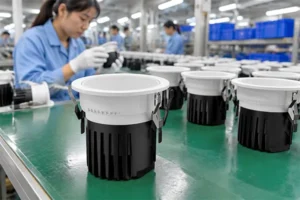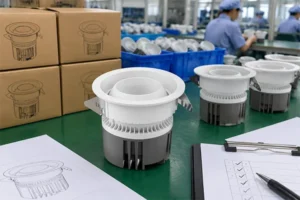

Buying LED downlights directly from a factory can feel risky when suppliers provide similar photos, unclear specifications, and widely different prices. We have seen buyers lose time through repeated revisions, unsuitable samples, and avoidable delivery confusion. A direct factory relationship can reduce that friction when buyers bring clear project requirements and verify the supplier’s process.
Buying LED downlights directly from a factory can benefit importers, contractors, brands, and distributors by creating faster communication, clearer specification control, and more practical customization options. However, factory-direct purchasing does not automatically mean the lowest price, guaranteed quality, or universal compliance. We believe the value depends on how well the buyer, factory, product requirements, testing process, and delivery plan are aligned.
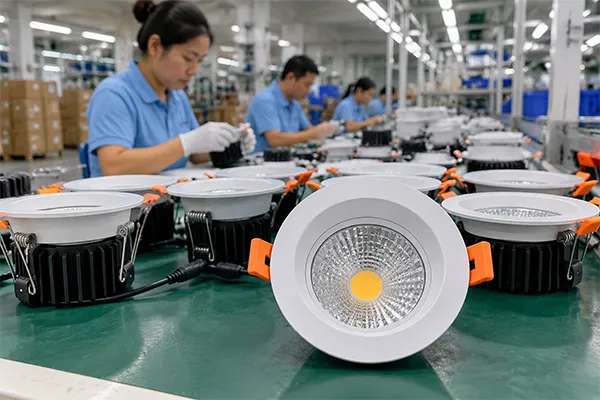
We have handled overseas LED lighting inquiries since 2009, and we have learned that the best factory-direct projects start with more than a price request. Buyers gain more control when they can discuss installation conditions, product specifications, order quantity, documentation, sampling, quality checks, and shipment timing with the production-side team.
Do Factory-Direct LED Downlights Really Reduce Sourcing Costs?
We often receive inquiries asking only, “What is your best price?” This creates a problem because a low quoted unit price may not match the required cutout, wattage, beam angle, finish, or market documentation. The buyer may then face expensive revisions, sample delays, or unsuitable stock.
Factory-direct LED downlights can reduce total sourcing costs when direct communication prevents specification mistakes, shortens quotation cycles, and reduces unnecessary intermediaries.1 We do not believe that a factory quote is always the lowest available price. Buyers should compare the complete sourcing cost, including samples, revisions, logistics, quality risk, payment terms, and internal purchasing time.
Unit Price Is Only One Part of the Cost
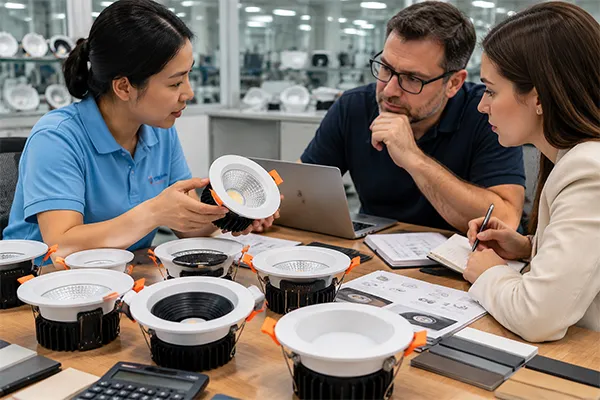
We encourage buyers to evaluate a supplier beyond the quoted price per unit. A distributor may offer immediate local stock, smaller quantities, local warranty handling, or faster replacement support.2 Those services can be valuable for urgent projects.
At the same time, factory-direct LED downlights may offer a stronger commercial fit when buyers need a repeatable product configuration or a larger planned order. Direct contact can reduce the number of handovers between the buyer and the people confirming production details.
In our experience, total sourcing friction often comes from small omissions. A buyer may request a 12W recessed downlight but not confirm whether the ceiling opening is 75 mm, 90 mm, or another size. The buyer may request warm white lighting but not state whether the project needs 2700K, 3000K, or 4000K. These details affect product selection and quotation accuracy.
We recommend comparing suppliers against the following factors:
| Sourcing factor | Why it matters | Questions we suggest asking |
|---|---|---|
| Unit price | It affects initial purchasing cost. | Does the price match the exact specification and order quantity? |
| Response time | It affects project planning and revision speed. | How quickly can the supplier confirm technical questions? |
| Sample process | It reduces risk before a larger order. | Is the sample built to the production specification? |
| MOQ | It affects inventory exposure and cash flow. | Can the supplier support a trial order or small batch? |
| Quality process | It affects consistency and claims risk. | What checks occur before shipment? |
| Delivery planning | It affects installation schedules. | What is the lead time after specification approval? |
| Documentation | It affects market and project review. | Which documents apply, and can we verify them? |
We believe the lowest apparent purchase price can become expensive if the delivered LED downlights do not fit the installation or project brief.
For buyers with stable demand, factory-direct procurement may also make pricing discussions more transparent. We can often explain which changes influence material cost, such as higher CRI requirements, special finishes, different drivers, branded packaging, or lower-volume custom production. That information helps buyers make commercial trade-offs instead of receiving a simple yes-or-no quotation.
When Does Direct Factory Communication Add Value for LED Downlights?
We have found that direct communication adds limited value when a buyer needs only a few standard replacement fittings immediately. In that case, local stock may be the simpler choice. The real challenge begins when a buyer needs a product that must suit a project, brand range, or repeated distribution plan.
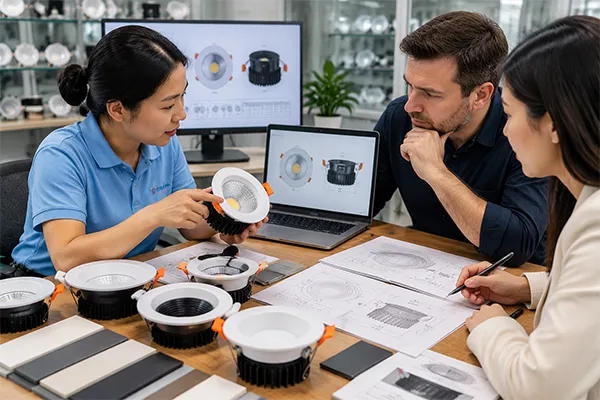
Direct factory communication adds the most value for LED downlights when buyers can define the application, installation conditions, required performance, target quantity, and delivery deadline. We can then turn those needs into a production-ready specification, identify open questions early, and reduce the chance that a quotation or sample is based on assumptions.
A Useful Inquiry Includes Real Project Information
We have seen many overseas inquiries begin with a product image and a request for a price. We understand why buyers start there, but a photo rarely provides enough information for a reliable quotation.
For example, two round recessed LED downlights may look nearly identical while using different cutout sizes, driver types, lumen outputs, trim finishes, and heat-management designs.3 A price based only on appearance can create confusion later.
We find that the following information helps us respond more accurately:
- Application: Is the product for residential interiors, retail, offices, hospitality, corridors, or another environment?
- Installation conditions: What are the ceiling material, cutout size, recessed depth, and available ceiling void?
- Electrical requirements: What are the voltage and frequency requirements for the destination?
- Lighting requirements: What wattage, color temperature, beam angle, lumen output, dimming requirement, and CRI are needed?
- Aesthetic requirements: What trim color, surface finish, shape, and anti-glare preference does the project require?
- Order plan: What is the initial quantity, estimated repeat volume, and required delivery date?
- Market requirements: Which destination market and project documents must be reviewed?
Faster Communication Does Not Mean Skipping Verification
We view direct communication as a way to ask better questions sooner. It should not replace buyer-side evaluation, sample approval, or qualified technical review. Buyers should still verify whether the LED downlights suit the installation, electrical design, applicable regulations, and project specifications.4
A contractor may need confirmation from the project engineer or consultant. A brand owner may need an internal product manager to approve the product range. An importer may need its compliance team to review documentation. We can provide product information and relevant available documents, but we cannot determine every country-specific or project-specific approval requirement on behalf of the buyer.
In our own process, we prefer to confirm important details in writing before production. This helps both sides compare the purchase order, product specification, packaging request, and agreed sample. Clear written confirmation is often more valuable than a fast message exchange alone.
How Can Buyers Customize Factory-Direct LED Downlights Successfully?
Customization can sound simple until a request reaches production. We have received OEM and ODM inquiries that ask for a “premium downlight with our brand” but do not yet define the target wattage, light color, cutout size, packaging, or order volume. We cannot responsibly treat those details as minor.
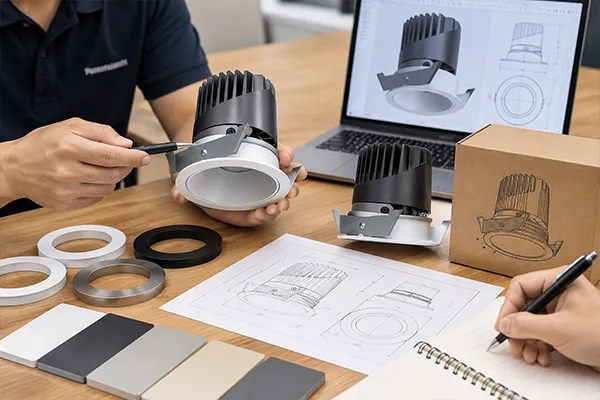
Factory-direct LED downlights can support OEM and ODM programs when buyers convert their commercial idea into measurable production requirements.5 We recommend confirming wattage, color temperature, beam angle, CRI, installation dimensions, finish, branding, packaging, documentation needs, and sample approval before mass production begins.
Make the Specification Production-Ready
We provide OEM/ODM services for items such as color temperature, wattage, beam angle, CRI, and surface finish colors. However, customization works best when the buyer distinguishes between changes that are straightforward and changes that require additional development, materials, testing, or lead time.
A basic customization checklist can include:
| Specification area | Examples of buyer decisions |
|---|---|
| Product format | Round, square, fixed, adjustable, recessed, surface-mounted |
| Cutout and dimensions | Cutout diameter, trim diameter, height, ceiling depth |
| Wattage and output | 7W, 9W, 12W, 15W, target lumen range |
| Light quality | 2700K, 3000K, 4000K, 5000K; CRI 80 or CRI 90 |
| Optical performance | Narrow, medium, or wide beam angle; glare-control preference |
| Electrical configuration | Input voltage, driver type, dimming method where required |
| Appearance | White, black, silver, gold, or another approved finish |
| Branding | Logo position, label content, product artwork, packaging |
| Packaging | Individual box, master carton, barcode, manual, inserts |
| Documentation | Documents requested for the destination market or project |
Samples Should Test the Right Questions
We recommend that buyers use samples to verify more than appearance. A sample should help the buyer review fit, color consistency, beam distribution, driver compatibility, finish quality, packaging, and installation practicality.6
I remember an inquiry where the buyer initially wanted a black trim LED downlight for a retail project. The first discussion focused on the visible trim color. After we asked about the ceiling and lighting layout, the buyer also reviewed beam angle, glare, cutout dimensions, and color temperature. The final requirement was more detailed than the original request, but it gave the buyer a more useful basis for sample evaluation.
We believe that small-batch orders can be useful for market testing, provided that buyers understand the commercial conditions. Lower quantities may have different unit pricing, material availability, or lead times than a repeat production order.7 Buyers should ask directly whether the approved sample configuration can be repeated at the planned volume.
How Should Buyers Evaluate Quality, Testing, and Compliance Claims for LED Downlights?
We understand why buyers want a simple assurance that a factory will deliver stable quality. However, we do not believe that direct factory supply alone proves quality consistency, compliance, or delivery reliability. Buyers need to examine the supplier’s documented process and match it with their own risk level.
Buyers should evaluate factory-direct LED downlights by asking how specifications are confirmed, how products are checked during production, whether aging tests are performed, and which certification documents are available for review.8 We recommend verifying document applicability against the destination market, installation type, and individual project requirements.
What We Do Before Shipment
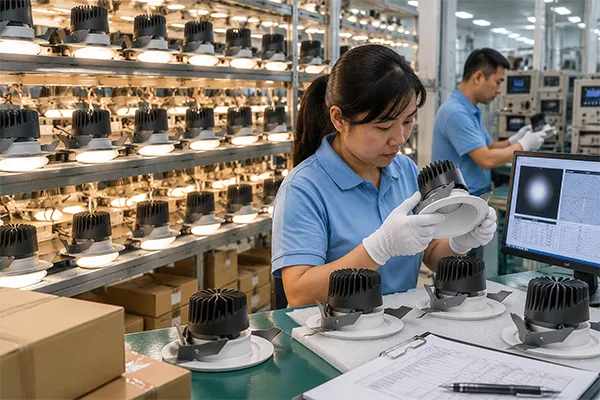
At Upward Lighting, every product undergoes a 100% aging test lasting 4 to 8 hours before shipment. We use this process as part of our internal manufacturing quality-control routine to check product operation and support our lumen-maintenance expectations.
We also coordinate production checks and pre-shipment quality review based on the agreed product specification. These are factory processes, not independent laboratory validation or a substitute for third-party inspection. Buyers with critical projects may choose to arrange their own inspection provider, request additional records, or conduct a sample-based evaluation before approving shipment.
We suggest asking a factory clear questions such as:
- How does the team confirm the final bill of materials and approved sample?
- How are wattage, color temperature, and appearance checked?
- Does the supplier conduct aging tests, and for how long?
- How are defects recorded and handled before packing?
- Can the buyer request pre-shipment photos, videos, or inspection coordination?
- How does the factory control changes after sample approval?
- What is the process if packaging or labeling must follow buyer artwork?
Certification Documents Require Project-Specific Review
Our products hold certifications such as CE and RoHS documents that support market-entry requirements for many applications and markets. However, we always recommend that buyers verify the specific documentation, product model, destination-country rules, and project requirements before purchasing.
CE and RoHS documents do not automatically mean that every LED downlight is suitable for every country, installation, tender, or building project.9 Requirements can vary based on product configuration, electrical system, local regulations, customer specifications, and the intended use of the fitting.
A careful buyer should request copies of applicable documents, confirm that the documents match the actual product model, and consult qualified compliance or technical professionals when the application requires it.10 This approach is more reliable than relying on a logo in a catalogue or a general statement in an email.
Delivery Reliability Also Needs Evidence
We believe buyers should ask about lead time as a managed process, not a promise. Production timing can depend on component availability, approved artwork, sample confirmation, order quantity, packaging requirements, and shipping arrangements.
A realistic delivery conversation should cover:
- Production lead time after deposit and specification confirmation
- Material availability for the requested configuration
- Packaging-artwork approval timing
- Inspection and aging-test scheduling
- Shipping method and port or destination requirements
- Buffer time for customs, local delivery, and site installation
Direct communication can make these discussions easier, but buyers should still build reasonable contingency time into project plans.11
Frequently Asked Questions
Is buying LED downlights directly from a factory always cheaper?
No. Factory-direct LED downlights may reduce intermediary costs and sourcing friction, but the lowest unit price is not guaranteed. We recommend comparing total cost, including MOQ, samples, freight, payment terms, customization, quality controls, local support, and the risk of specification errors.
What details should I provide when requesting an LED downlight quotation?
We recommend providing the application, cutout size, wattage, color temperature, beam angle, CRI, voltage, dimming requirements, finish color, order quantity, destination market, packaging needs, and requested delivery date. These details help us prepare a more accurate quotation and recommend suitable options.
Can a factory add my logo to LED downlights and packaging?
Yes, many factories can support OEM branding, including logos, labels, color boxes, manuals, and carton markings. We recommend confirming artwork, logo placement, packaging materials, minimum order quantities, and approval samples before mass production starts.
Are CE and RoHS documents enough for my lighting project?
Not always. CE and RoHS documentation may be relevant to many markets, but buyers should verify that documents apply to the exact product model, destination country, installation, and project requirements. We recommend consulting qualified technical or compliance professionals for application-specific decisions.
What does an LED downlight aging test check?
An aging test operates LED downlights for a planned period before shipment to identify certain early operating issues.12 At our factory, we conduct a 100% aging test of 4 to 8 hours. This internal process supports quality control, but it does not replace independent laboratory testing or project acceptance procedures.
Conclusion
Buying LED downlights directly from a factory can create practical value when buyers need faster clarification, repeatable specifications, customization support, and direct visibility into production and shipment planning. We do not present factory-direct sourcing as an automatic shortcut to the lowest price, guaranteed compliance, or risk-free delivery. Instead, we encourage buyers to compare suppliers carefully, confirm every critical requirement in writing, review samples and documents, and assess quality processes. If you are sourcing LED downlights for a project, brand, or distribution program, we welcome a detailed inquiry so we can help turn your requirements into a workable production plan.
"Managing risks in the public procurement of goods, ...", https://www.oecd.org/content/dam/oecd/en/publications/reports/2023/06/managing-risks-in-the-public-procurement-of-goods-services-and-infrastructure_b0d29f96/45667d2f-en.pdf. Supply-chain research describes how intermediary layers and information handoffs can add transaction and coordination costs, providing a mechanism by which direct supplier communication may reduce total sourcing friction. Evidence role: mechanism; source type: research. Supports: Evidence on how intermediary layers, information handoffs, and transaction costs affect procurement and supply-chain costs.. Scope note: Such evidence explains a general mechanism and does not establish that every factory-direct LED-lighting purchase is less expensive. ↩
"Understanding Distribution Channels in Business", https://www.investopedia.com/terms/d/distribution-channel.asp. Marketing and distribution references identify inventory holding, breaking bulk into smaller orders, and customer service as common functions of wholesalers and distributors. Evidence role: general_support; source type: education. Supports: General descriptions of distributor and wholesaler functions, including inventory availability, smaller-lot supply, and customer service.. Scope note: The source describes general channel functions rather than the service terms offered by any particular lighting distributor. ↩
"Application Summary Report 14: - LED Downlight Retrofit Units", https://www1.eere.energy.gov/buildings/publications/pdfs/ssl/caliper_14_summary.pdf. Technical guidance on LED luminaires identifies installation dimensions, electrical driver design, light output, optical performance, and thermal management as separate product characteristics that affect suitability and performance. Evidence role: general_support; source type: government. Supports: That LED luminaire performance and suitability depend on installation dimensions, driver/electrical design, light output, optical characteristics, and thermal management.. Scope note: This supports the relevance of these specifications generally, not a comparison of any two specific downlight models. ↩
"Work on electrical equipment, machinery or installations", https://www.hse.gov.uk/electricity/withequip.htm. Electrical-safety and installation guidance emphasizes that luminaires must be suitable for their intended installation and used in accordance with applicable electrical requirements and product instructions. Evidence role: expert_consensus; source type: institution. Supports: That luminaires should be selected and installed in accordance with applicable electrical-installation requirements, manufacturer instructions, and the intended application.. Scope note: Applicable legal and technical requirements vary by jurisdiction, building type, and installation design. ↩
"STANDARDIZED PRODUCT CHARACTERISTICS", https://www.nist.gov/system/files/documents/2019/04/05/08d_standardized-product-characteristics_mark_nielsen.pdf. Quality-management guidance treats defined design inputs and documented product requirements as essential controls for developing and producing conforming products. Evidence role: mechanism; source type: institution. Supports: That documented design and product requirements are needed to control development and production conformity.. Scope note: This supports the general manufacturing-control principle and does not demonstrate the capabilities of a specific OEM or ODM factory. ↩
"End-to-End Quality Information Framework (QIF) ...", https://nvlpubs.nist.gov/nistpubs/ir/2016/NIST.IR.8127.pdf. Quality-assurance guidance describes first-article and pre-production evaluation as methods for checking whether a product conforms to specified requirements before broader production or acceptance. Evidence role: general_support; source type: institution. Supports: That pre-production or first-article evaluation is used to verify conformance to specified characteristics before full production or acceptance.. Scope note: The precise sample tests and acceptance criteria must be defined for the particular luminaire, project, and purchasing contract. ↩
"Production Ramp-up of a Hardware Startup: Simulating ...", https://dspace.mit.edu/bitstream/handle/1721.1/107023/971136327-MIT.pdf. Manufacturing-economics literature explains that fixed setup costs and production scale can change per-unit costs and production planning, so small batches may differ commercially from repeat-volume orders. Evidence role: mechanism; source type: education. Supports: That fixed setup costs, batch size, and scale can affect per-unit manufacturing cost and production planning.. Scope note: Actual pricing, component availability, and lead times depend on the supplier, design, market conditions, and contract terms. ↩
"Use of quality assurance systems in the fastener industry", https://nvlpubs.nist.gov/nistpubs/Legacy/IR/nistir6001.pdf. Quality-management guidance frames supplier assurance around controlled requirements, verification activities, process monitoring, and documented evidence of conformity. Evidence role: expert_consensus; source type: institution. Supports: That supplier quality assurance includes documented requirements, process controls, inspection or verification, and retained information.. Scope note: The appropriate depth of supplier evaluation is risk-based and may exceed or differ from the checks listed for regulated or safety-critical projects. ↩
"CE marking – obtaining the certificate, EU requirements", https://europa.eu/youreurope/business/product-rules-compliance/general-product-compliance/ce-marking/index_en.htm. European Commission guidance states that CE marking signifies a manufacturer's declaration of conformity with applicable EU requirements; it is not a universal product-approval mark, and RoHS obligations apply within their defined legal scope. Evidence role: definition; source type: government. Supports: The legal scope of CE marking and RoHS compliance, including that CE marking indicates conformity with applicable EU requirements rather than universal approval for every application or jurisdiction.. Scope note: This explains EU regulatory concepts and does not determine compliance with non-EU rules, local installation codes, or a particular project specification. ↩
"Preparing technical documentation - Your Europe", https://europa.eu/youreurope/business/product-rules-compliance/general-product-compliance/preparing-technical-documentation/index_en.htm. Official product-conformity guidance requires manufacturers to prepare technical documentation and declarations of conformity for products subject to applicable rules, supporting model-specific review of supplied documents. Evidence role: general_support; source type: government. Supports: That conformity assessment requires documentation and declarations linked to the relevant product and applicable legal requirements.. Scope note: A document review alone may not establish suitability for a particular installation, contract, or jurisdiction outside the governing regulatory regime. ↩
"Schedule Assessment Guide", https://www.gao.gov/assets/d1689G.pdf. Project-scheduling guidance recommends accounting for uncertainty and identified risks through schedule contingency or reserve rather than relying solely on planned activity durations. Evidence role: expert_consensus; source type: government. Supports: That project schedules should account for uncertainty and risk through contingency or schedule reserve planning.. Scope note: The appropriate contingency depends on the supply route, customs environment, contract terms, and project risk assessment. ↩
"Towards Understanding Early Failures Behavior during Device Burn ...", https://tsapps.nist.gov/publication/get_pdf.cfm?pub_id=920388. Reliability literature describes burn-in and operational screening as methods that may expose certain early-life failures in electronic products before deployment. Evidence role: mechanism; source type: paper. Supports: That burn-in or screening operation can reveal some early-life electronic failures before delivery or use.. Scope note: Burn-in duration and conditions do not by themselves prove long-term luminaire reliability, lumen maintenance, or field performance. ↩