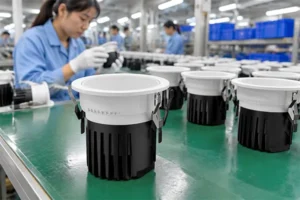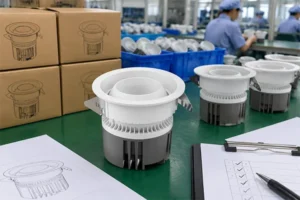

LED downlights can seem simple to buy, yet many projects run into problems when a product does not match the ceiling opening, installation depth, lighting purpose, or local compliance requirements. I have seen buyers focus on wattage and price first, then discover compatibility issues later. The practical solution is to evaluate the installation condition and application before comparing specifications.
LED downlights are ceiling light fixtures that direct light downward, usually from a recessed, surface-mounted, fixed, or adjustable housing. They are not one fully standardized product type. Buyers should first confirm the ceiling structure, cutout size, mounting method, required light distribution, and project documentation needs. Then they can compare lumen output, beam angle, color temperature, CRI, price, quality-control processes, and supplier support.
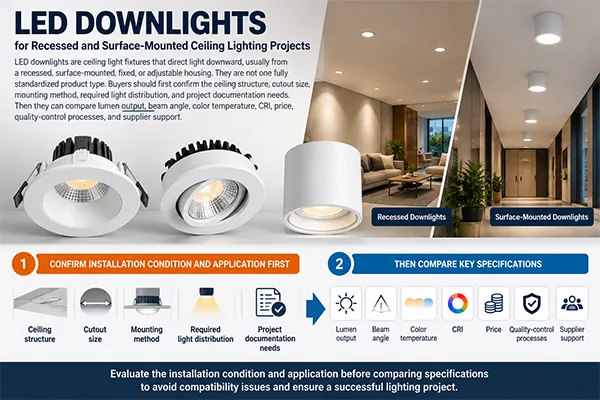
In our experience as an LED lighting manufacturer, the most important questions usually appear before production starts: Will the fixture fit the ceiling? Does the beam angle match the space? Is the selected color temperature right for the project? The answers depend on more than a catalog image or a unit quotation.
What Is an LED Downlight in Practical Terms?
When buyers hear the term “downlight,” they may expect one universal product category. That assumption can create procurement mistakes because different LED downlights can have very different housings, drivers, mounting systems, and lighting functions. I recommend that buyers define the product structure before they compare the price.
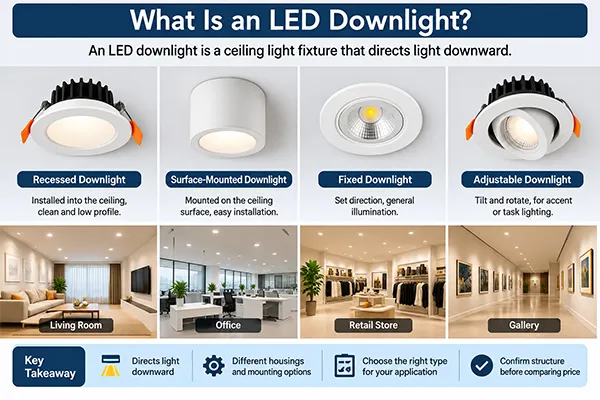
An LED downlight is a light fixture designed to cast light primarily downward from a ceiling position.1 It may be recessed into a ceiling, mounted on the surface, fixed in one direction, or adjustable for accent lighting. Each format has different installation requirements and suits different lighting tasks.
Recessed LED downlights
A recessed downlight sits partly or fully inside the ceiling cavity. This style is common in residential interiors, hotels, retail stores, offices, corridors, and many commercial projects because it can create a clean ceiling appearance.
However, a recessed product requires more than an available ceiling location. Buyers should verify:
- Cutout diameter: The ceiling hole must match the fixture’s installation requirement.
- Ceiling cavity depth: The driver, heat sink, wiring space, and fixture body need sufficient clearance.
- Ceiling material: Gypsum board, aluminum ceiling panels, wood ceilings, and other materials may require different mounting considerations.
- Access for maintenance: Some projects need future access to the driver or wiring.
- Insulation and ventilation conditions: Heat-management conditions can affect the product choice and installation method.
Surface-mounted LED downlights
Surface-mounted models attach directly to the ceiling surface. They can be useful where there is limited ceiling depth or no practical way to create a recessed cutout.
These fixtures may be cylindrical, square, slim, decorative, or more architectural in appearance. In procurement terms, a surface-mounted model can reduce cutout concerns, but buyers still need to evaluate wiring routes, mounting points, ceiling strength, visual style, and driver placement.
Fixed and adjustable downlights
A fixed downlight directs light in a set downward direction. It often suits general lighting where a uniform layout is needed.
An adjustable or gimbal downlight allows the light direction to change. This format can be useful for highlighting merchandise, wall displays, artwork, shelving, or architectural details. Yet adjustability does not automatically make a product better. It can introduce different visual, spacing, glare, and installation considerations.
In our OEM and ODM discussions, I often find that customers use the word “downlight” for several structurally different products. I always encourage them to confirm the housing type first, because two products with similar wattage can still require completely different installation conditions.
For a product line, wholesalers and lighting brands may choose several downlight formats instead of treating one model as a complete solution. For example, a range may include recessed fixed models for standard ceilings, deep anti-glare models for premium interiors, and surface-mounted versions for renovation projects.
How Do Ceiling Conditions Affect LED Downlight Compatibility?
A visually suitable fixture can still be incompatible with the site. Buyers may invest time in selecting a color, wattage, and beam angle, only to find that the ceiling cutout is wrong or the cavity is too shallow. I have seen this happen most often when projects move quickly from drawings to installation.
Ceiling conditions affect LED downlight compatibility because the cutout size, ceiling depth, mounting method, wiring space, and ceiling material determine whether the fixture can be installed safely and correctly2. Buyers should verify these details before finalizing a downlight model or purchase order.
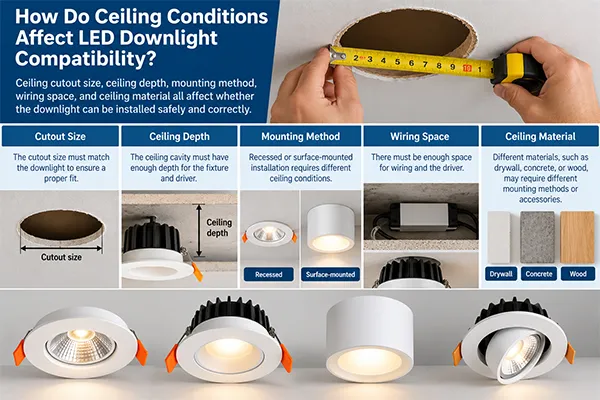
Start with the ceiling cutout
For recessed LED downlights, the cutout size is a critical purchasing detail. A 75 mm cutout fixture will not properly fit a 90 mm opening without an appropriate solution. Likewise, a fixture intended for a large opening may not fit into a smaller existing hole.
Buyers should request the following information in product-specific drawings:
| Installation Detail | Why It Matters | What Buyers Should Confirm |
|---|---|---|
| Cutout size | Determines whether the fixture fits the ceiling opening | Exact cutout diameter or dimensions |
| Outer diameter | Affects ceiling coverage around the opening | Whether the trim covers the cutout properly |
| Fixture height | Determines cavity compatibility | Available depth above the ceiling |
| Driver dimensions | Affects wiring and maintenance space | Driver length, width, and height |
| Mounting clip range | Affects holding performance | Supported ceiling thickness |
| Cable length and connector | Affects installation convenience | Required wiring arrangement |
A practical procurement process should not rely only on a product photo. I recommend that buyers ask for a dimensional drawing and compare it against site measurements, construction drawings, or existing ceiling openings.
Consider ceiling depth and driver location
Some LED downlights use integrated drivers, while others use separate external drivers. Both structures may be appropriate depending on the product design and application, but they require different installation space.
A shallow ceiling can limit the choice of recessed products. A separate driver also needs a suitable location above the ceiling or near the fixture. If maintenance access is limited, the project team should consider how future replacement would be handled.
Check the ceiling material and mounting method
Spring clips are commonly used for recessed products, but their suitability depends on the ceiling thickness and material. A lightweight suspended ceiling, for example, may need careful evaluation of support conditions. Surface-mounted models may require screws, brackets, or other mounting hardware that must suit the ceiling substrate.
I do not treat product selection as a substitute for site-specific electrical or installation assessment. Contractors and qualified professionals should confirm the installation method for the actual project conditions.
Avoid a common specification mismatch
One recurring issue involves buyers who request “the same downlight” based on front diameter and wattage alone. The replacement fixture may look similar from below, but the heat sink depth, spring-clip position, or driver arrangement may differ.
For replacement and renovation orders, I suggest that buyers collect:
- Photos of the installed fixture from the front and side.
- Cutout dimensions.
- Ceiling cavity depth.
- Driver label information, if available.
- Required input voltage and local market requirements.
- The intended lighting result, such as general lighting or accent lighting.
These details help suppliers provide a more relevant recommendation and reduce the risk of receiving an unsuitable model.
Which LED Downlight Specifications Matter for the Lighting Task?
Specification sheets can make LED downlights appear easy to compare. Buyers often see wattage, lumens, beam angle, CCT, and CRI listed in neat columns. Yet each number affects a different decision. A higher number is not always better, and one specification should not be assessed in isolation.
The most important LED downlight specifications are lumen output, beam angle, color temperature, CRI, wattage, and glare-control design. Buyers should select these values according to the room size, mounting height, surface finishes, visual task, and desired atmosphere rather than choosing by wattage or brightness alone.
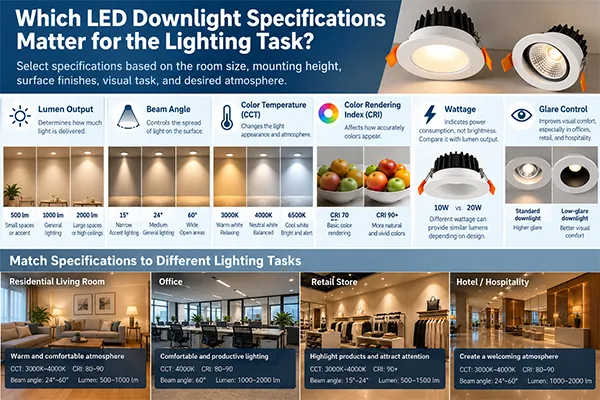
Lumens and wattage answer different questions
Wattage describes electrical power consumption. Lumens describe the light output stated for the product.3 Neither figure alone confirms whether a downlight will produce the desired result in a particular room.
For example, two 10 W downlights may have different lumen output because of LED selection, optical design, driver efficiency, thermal design, and other construction choices4. Similarly, a product with higher stated lumens may not create better visual comfort if its beam is too narrow, too wide, or poorly controlled for the application.
I encourage procurement teams to compare product-specific data and ask how the stated output is measured or documented. Project teams may also need lighting calculations from qualified professionals for application-specific layouts.
Beam angle affects coverage and emphasis
Beam angle describes how widely light spreads from the fixture.5 This choice affects spacing, brightness distribution, and visual emphasis.
| Beam Angle Range | Typical Lighting Effect | Possible Applications |
|---|---|---|
| Narrow, around 15°–24° | Concentrated light and stronger emphasis | Displays, feature walls, selected merchandise |
| Medium, around 30°–40° | Balanced spread for many applications | Corridors, retail areas, general accent lighting |
| Wide, around 50°–60° or more | Broader coverage and softer distribution | General room lighting, wider circulation spaces |
These are general descriptions, not universal design rules. Ceiling height, fixture spacing, reflectance of walls and floors, and the lighting objective all affect the final result.6
Color temperature shapes the visual atmosphere
Color temperature, usually expressed in Kelvin (K), affects whether the light appears warmer or cooler.7
- 2700K–3000K: Often selected where a warmer, more relaxed appearance is desired.
- 4000K: Often selected for balanced neutral-white environments.
- 5000K–6500K: Often selected where a cooler visual impression is required by the project brief or local market preference.
A buyer should not treat CCT as only a catalog option. A retail brand may use one CCT to support a consistent store image. A hotel project may use another CCT to support the intended atmosphere. A distributor may stock several common options to serve local demand.
CRI affects color appearance
Color Rendering Index, or CRI, indicates how faithfully colors may appear under a light source compared with a reference.8 A higher CRI option may be important for applications where product colors, finishes, food, cosmetics, textiles, or artwork need careful visual presentation.
However, buyers should define the actual need instead of simply requesting the highest CRI available. Higher-CRI configurations can affect cost, availability, and stated output.9 A reasonable procurement decision balances the visual requirement with the product positioning and budget.
Glare control deserves attention
Some downlights use deeper reflectors, baffles, recessed light sources, or other optical structures intended to reduce direct glare.10 These designs may be useful in spaces where occupants frequently look toward the ceiling, including offices, hospitality interiors, or premium retail environments.
At Upward Lighting, we can configure parameters such as beam angle, CCT, wattage, CRI, and surface finish color for applicable OEM/ODM requests. I recommend that buyers provide the project purpose and sample expectations early, because the right combination is usually more important than any single specification.
How Should Buyers Evaluate LED Downlight Quality and Suppliers?
Price pressure can lead buyers to compare LED downlights as if they are identical commodity items. That approach can overlook differences in material selection, driver configuration, optical consistency, documentation, production controls, and order support. I believe a better supplier evaluation process protects both the buyer’s reputation and the end user’s experience.
Buyers should evaluate LED downlight suppliers by reviewing product-specific specifications, samples, applicable certification documents, quality-control scope, production consistency, quotation clarity, customization capability, and delivery communication. A low unit price is only one part of the overall procurement decision.
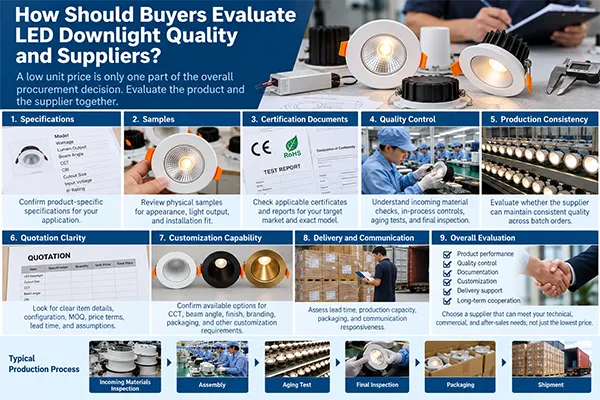
Request product-specific documentation
A supplier should be able to provide clear information for the model under consideration. Documentation needs vary by destination market, product type, and customer requirements, so buyers should verify what applies to their own purchase.
Useful documents and records may include:
- Product specification sheets
- Dimensional drawings
- Installation instructions
- Product labels and carton markings
- Applicable test reports or declarations
- CE and RoHS documentation where relevant11
- Sample approval records
- Packing details
- Quality-control information
- Warranty terms and claim procedures
Certifications should not be treated as generic marketing statements. Buyers should review the documents for the relevant product, confirm the model coverage, check validity where appropriate, and ensure they meet the requirements of the intended market. Importers and project buyers may also need independent regulatory or professional advice for their specific situation.
Understand what quality-control claims actually cover
At Upward Lighting, our stated practice is to conduct a 100% aging test lasting 4 to 8 hours before shipment. This process is part of our own production and pre-shipment quality-control approach. It should not be interpreted as an industry-wide standard, a substitute for application testing, or a guarantee of performance in every installation environment.
A buyer should ask suppliers clear questions:
- What checks are completed before shipment?
- Are all units checked, or is sampling used for some stages?
- What parameters are inspected during production?
- How are cosmetic defects handled?
- How are product changes controlled between sample approval and mass production?
- What happens if a shipment has a quality claim?
Clear answers often reveal more than broad statements such as “high quality” or “strict inspection.”
Assess supplier responsiveness and order flexibility
For wholesalers, importers, and lighting brands, commercial support can matter as much as the fixture itself. A supplier may be more suitable when it can provide rapid quotations, respond to technical questions, support small-batch orders, and maintain stable communication during sampling and production.
In our own work, we regularly receive requests for customized wattage, beam angles, CCT options, CRI levels, and finish colors. I find that customization works best when the buyer provides a defined target specification, estimated quantity, market destination, packaging expectations, and sample requirements.
Compare total procurement value
A useful supplier comparison should include more than ex-works price.
| Evaluation Area | Questions to Ask |
|---|---|
| Product fit | Does the model match cutout, depth, voltage, and application needs? |
| Optical configuration | Are CCT, CRI, beam angle, and lumen output appropriate? |
| Documentation | Are relevant product-specific documents available for review? |
| Quality process | What inspections and aging procedures does the supplier describe? |
| Customization | Can the supplier support OEM/ODM requirements? |
| Delivery | What are the sample and production lead times? |
| Communication | Are quotations, drawings, and revisions handled clearly? |
| After-sales support | Is there a defined process for quality feedback and claims? |
A reliable LED downlight procurement process is usually built on accurate technical information, approved samples, clear documentation, and consistent communication—not on price alone.12
Frequently Asked Questions
Are LED downlights the same as recessed lights?
Many recessed lights are LED downlights, but the terms are not always identical. An LED downlight may be recessed, surface-mounted, fixed, or adjustable. Buyers should review the product structure, installation method, and light direction instead of relying only on the category name.
How do I choose the right cutout size for LED downlights?
Buyers should measure the existing ceiling opening or confirm the planned cutout from project drawings. They should also review the fixture’s outer diameter, installation depth, spring-clip range, and driver dimensions. The cutout size alone does not confirm full installation compatibility.
Is higher wattage better for an LED downlight?
Higher wattage is not automatically better. Wattage describes power consumption, while the final lighting result also depends on lumen output, beam angle, mounting height, room layout, glare control, and surface reflectance. Buyers should select a configuration based on the required lighting task.
What CRI should I select for LED downlights?
The appropriate CRI depends on the application. General projects may have different needs from retail, hospitality, cosmetics, textile, food, or display areas where color appearance matters more. Buyers should balance visual requirements, budget, output expectations, and product positioning.
What should I verify before importing LED downlights?
Importers should verify product specifications, dimensional drawings, voltage requirements, packaging, applicable certification documents, labeling, sample approval, quality-control scope, and destination-market requirements. Buyers should also confirm delivery terms and clarify how the supplier manages quality feedback or claims.
Conclusion
LED downlights are not interchangeable fixtures defined only by wattage, price, or appearance. I recommend that buyers begin with the ceiling condition, installation method, and intended lighting purpose. They can then compare cutout size, depth, beam angle, lumen output, CCT, CRI, glare control, documentation, and supplier quality processes. At Upward Lighting, we support importers, contractors, distributors, and lighting brands with LED downlight manufacturing, OEM/ODM configuration, small-batch support, and responsive quotation service. Contact us with your drawings, target specifications, or sample requirements to start a more informed evaluation.
"Lighting Specification Guidance for Schools", https://www.energy.gov/sites/default/files/2024-12/lighting-spec-guidance-school_nov24.pdf. A downlight is generally defined as a ceiling-mounted light fixture designed to direct illumination downward. Evidence role: definition; source type: encyclopedia. Supports: A definition of a downlight as a ceiling light fixture that directs illumination downward.. ↩
"National Fire Protection Association Report", https://docinfofiles.nfpa.org/files/AboutTheCodes/70/70_A2025_NEC_P18_PISubmittals.pdf. Electrical-installation guidance generally requires recessed luminaires to be mounted and wired in accordance with their listed instructions, including any specified clearances and support conditions. Evidence role: general_support; source type: institution. Supports: Electrical-safety guidance requiring luminaires to be installed according to their instructions and with suitable clearances, wiring, and mounting arrangements.. Scope note: The applicable requirements vary by jurisdiction, luminaire listing, ceiling construction, and local electrical code. ↩
"Solid-state lighting metrology | NIST", https://www.nist.gov/programs-projects/solid-state-lighting-metrology. Watts measure electrical power input, while lumens measure luminous flux, the quantity commonly used to express a lamp or luminaire's emitted light output. Evidence role: definition; source type: government. Supports: The technical distinction between watts as electrical power and lumens as a measure of luminous flux.. ↩
"2019 Solid-State Lighting R&D Opportunities", https://www.energy.gov/sites/prod/files/2020/01/f70/ssl-rd-opportunities2-jan2020.pdf. LED luminaire light output at a given input power can vary with LED efficacy, driver efficiency, optical losses, and thermal management, all of which affect system efficacy. Evidence role: mechanism; source type: research. Supports: That LED luminaire output and efficacy depend on component efficiency, driver losses, optical losses, and thermal operating conditions.. Scope note: The relative contribution of each factor depends on the specific luminaire design and operating conditions. ↩
"CALiPER Application Summary Report 20: LED PAR38 Lamps", https://www1.eere.energy.gov/buildings/publications/pdfs/ssl/caliper_20_summary.pdf. In photometry, beam angle describes the angular width of a beam, commonly specified between directions where luminous intensity falls to a defined fraction of its maximum. Evidence role: definition; source type: institution. Supports: A recognized photometric definition of beam angle and its relationship to the distribution of luminous intensity.. Scope note: Published beam-angle conventions and test methods should be checked because product literature may use differing measurement conventions. ↩
"The Impact of Circadian Lighting Design Strategies on ...", https://www.energy.gov/sites/default/files/2023-01/ssl-2023_circadian-lighting-design-strategies-office-space.pdf. Interior lighting calculations account for luminaire distribution, mounting height, spacing, and room-surface reflectance because these variables influence the resulting illuminance and luminance distribution. Evidence role: mechanism; source type: research. Supports: That interior illuminance and luminance distributions are affected by luminaire photometry, mounting geometry, spacing, and room-surface reflectance.. Scope note: A general lighting-design source cannot determine the final result for a particular room without project-specific photometric calculations. ↩
"NIST Measurement Services Photometric Calibrations", https://nvlpubs.nist.gov/nistpubs/SpecialPublications/NIST.SP.250-95.pdf. Correlated color temperature, expressed in kelvin, is used to describe the perceived warm-to-cool appearance of white light sources. Evidence role: definition; source type: government. Supports: The meaning of correlated color temperature and its use in describing the warm-to-cool appearance of white light.. Scope note: Color temperature describes chromatic appearance rather than color-rendering quality or a universal preference for a particular setting. ↩
"Color rendering of light sources", https://www.nist.gov/pml/sensor-science/optical-radiation/color-rendering-light-sources. The general color-rendering index is a standardized measure derived by comparing the appearance of specified test colors under a test light source and an appropriate reference illuminant. Evidence role: definition; source type: institution. Supports: That CRI is a standardized index comparing color appearance under a test source with that under a reference illuminant.. Scope note: CRI does not fully predict color preference or the rendering of every individual color, particularly highly saturated colors. ↩
"Evaluating tradeoffs between energy efficiency and color rendition", https://www.osti.gov/biblio/1547376. LED color-quality research documents that improving color-rendering performance can entail efficacy trade-offs, depending on the spectral design and performance targets of the light source. Evidence role: mechanism; source type: paper. Supports: Research on trade-offs between color-rendering performance and luminous efficacy in LED lighting systems.. Scope note: This does not establish a fixed cost, availability, or output penalty for every high-CRI downlight model. ↩
"Lighting Specification Guidance for Schools", https://www.energy.gov/sites/default/files/2024-12/lighting-spec-guidance-school_nov24.pdf. Glare-control guidance recognizes that shielding and recessing a luminous source can reduce high-angle luminance and thereby help limit direct discomfort glare. Evidence role: mechanism; source type: research. Supports: That shielding, source recess, and optical control can reduce high-angle luminance and discomfort glare from luminaires.. Scope note: Perceived glare also depends on luminance, viewing direction, background brightness, room geometry, and the observer's task. ↩
"RoHS 2 FAQ - EU Environment - European Union", https://environment.ec.europa.eu/system/files/2021-01/FAQ%20key%20guidance%20document%20-%20RoHS.pdf. European Union guidance explains that applicable electrical and electronic equipment placed on the EU market may be subject to conformity-assessment, CE-marking, and hazardous-substance restriction obligations, supported by required technical documentation. Evidence role: general_support; source type: government. Supports: EU guidance on CE marking and RoHS-related obligations for electrical and electronic equipment placed on the EU market.. Scope note: Applicability depends on the product, its intended market, relevant EU legislation, and the economic operator's role; CE marking is not itself a universal product-quality certification. ↩
"8 Ways to Improve Your Supplier Selection Process", https://www.nist.gov/blogs/manufacturing-innovation-blog/8-ways-improve-your-supplier-selection-process. Procurement and quality-management frameworks commonly assess suppliers using technical capability, quality assurance, documentation, delivery performance, and commercial factors rather than price alone. Evidence role: expert_consensus; source type: institution. Supports: Procurement and quality-management guidance supporting multi-criteria supplier evaluation rather than selection based solely on lowest price.. Scope note: The appropriate weighting of these criteria depends on the buyer's risk tolerance, contract terms, and applicable procurement rules. ↩