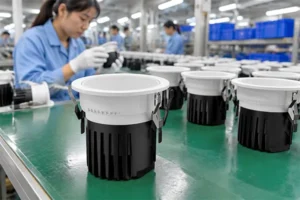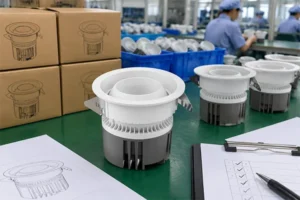

High-end LED downlights can be difficult to identify when quotations emphasize only wattage, lumens, CRI, or an attractive finish. This can lead buyers to overpay for the wrong feature or accept products that look strong in samples but create project issues later. I recommend evaluating the complete lighting solution instead.
High-end LED downlights are application-appropriate, consistently manufactured fixtures that balance optical performance, component selection, installation fit, and delivery quality. A premium price, high lumen rating, high CRI, or heavy housing alone does not prove premium performance. Buyers should compare the agreed configuration, test process, batch consistency, and supplier documentation before selecting a product.
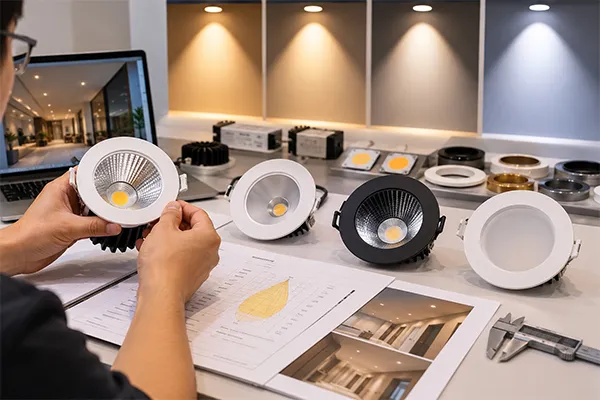
In my conversations with importers, contractors, and local lighting brands, I often see the same challenge: two downlights may look similar on paper, yet their suitability for a project can be very different. The key is to move beyond a “premium versus budget” label and assess what the project actually needs.
How Should Buyers Define High-End LED Downlights for an Application?
Many buyers begin by comparing wattage, unit price, or the brightest available model. This approach can create a mismatch between the fixture and the actual space. A downlight that is suitable for a retail display may be uncomfortable or unnecessarily expensive in a corridor, office, or residential ceiling.
Buyers should define high-end LED downlights by how reliably they meet a specific application’s lighting, installation, visual comfort, and acceptance requirements. The right product should provide the required light distribution, color quality, finish, compatibility, and consistency for the project—not simply the highest available specification.
Start With the Lighting Task
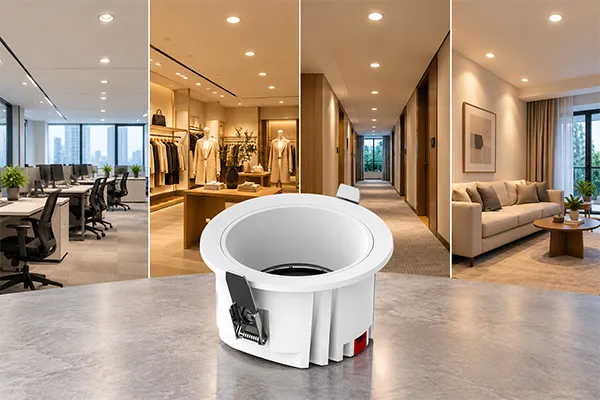
I always encourage buyers to begin with the purpose of the space. The lighting task determines which specifications deserve the most attention.
For example, a hotel lobby, office, boutique, residential kitchen, and warehouse reception area may all use recessed downlights. However, each space may require a different balance of brightness, beam angle, glare control, color temperature, and aesthetic appearance.
A practical evaluation should address these questions:
- What is the primary activity in the space? Reading, working, browsing, relaxing, displaying products, or moving through a corridor all create different lighting needs.
- What is the mounting height? A 2.6-meter residential ceiling and a 5-meter commercial ceiling require different optical planning.1
- What is the ceiling construction? Buyers should confirm cutout size, ceiling depth, driver placement, insulation conditions, and access for maintenance.
- What ambient light already exists? Daylight, track lighting, linear lighting, and decorative fixtures can change the required output.
- What will the client inspect at handover? Common acceptance points include CCT consistency, trim finish, dimming behavior, beam appearance, and visible glare.
I once discussed a quotation with a buyer who initially requested the highest wattage option because the project owner wanted a “high-end” result. After we reviewed the ceiling height and fixture spacing, the buyer recognized that a lower-wattage configuration with a more suitable beam angle could be the more appropriate choice. The project did not need maximum output. It needed controlled illumination and a clean ceiling appearance.
Turn “Premium” Into Measurable Requirements
For procurement purposes, I suggest creating a product specification sheet before requesting quotations. This gives suppliers a consistent basis for comparison and reduces the risk that each factory quotes a different configuration.
| Evaluation area | Questions buyers should define | Why it matters |
|---|---|---|
| Application | Is the fixture for residential, retail, hospitality, office, or public space use? | The intended use affects optical and appearance requirements. |
| Light output | What target illumination and fixture spacing are planned? | Higher output is not always better. |
| Beam angle | Is a narrow, medium, or wide beam needed? | Beam control affects uniformity, accent lighting, and glare. |
| Color temperature | Is 2700K, 3000K, 4000K, or another CCT required? | CCT changes the visual atmosphere and must remain consistent.2 |
| Color rendering | What CRI level does the application require? | Product, food, artwork, or interior material colors may need better rendering. |
| Installation | What cutout, ceiling depth, IP requirement, and driver arrangement apply? | A suitable fixture must fit and operate appropriately in the site conditions. |
| Acceptance criteria | What should be checked before shipment and at installation? | Clear criteria reduce disagreement and rework. |
At Upward Lighting, we can configure CCT, wattage, beam angle, CRI, and surface finish colors for OEM and ODM requirements. However, I believe customization only creates value when the buyer first defines the project need. A configurable product is not automatically a high-end product unless the final configuration is suitable and consistently delivered.
What Optical Qualities Should High-End LED Downlights Balance?
A bright downlight can appear impressive during a quick sample review, while a high-CRI model may sound premium in a catalogue. Yet neither feature tells the full story. Poor beam control, uncomfortable glare, inconsistent color, or unsuitable output can undermine the visual result even when one specification appears strong.
High-end LED downlights should balance light output, beam distribution, glare comfort, color quality, and color consistency for the intended setting. Buyers should review these factors together because a single high specification, such as lumen output or CRI, cannot confirm that the fixture will create the desired lighting experience.
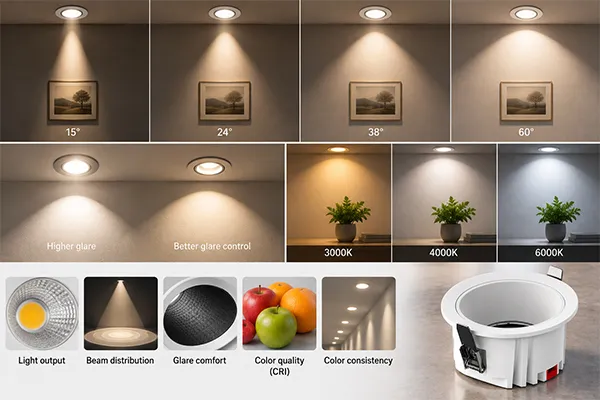
Light Output Is Only One Part of Performance
Wattage measures electrical input. Lumens describe stated light output.3 Neither measurement alone tells buyers how the light will look once installed.
A high-lumen recessed LED downlight can be useful in a high-ceilinged commercial space or when fixtures are widely spaced. However, excessive output in a lower ceiling may create harsh brightness, visual discomfort, or uneven lighting. A lower-output model with proper spacing and beam control may provide a more refined result.
Buyers should ask suppliers to clarify:
- The rated wattage and rated lumen output for the requested configuration.
- The beam angle and whether it is appropriate for the mounting height and spacing.
- The color temperature used for the stated output figure.
- The measurement conditions and tolerances, where documentation is available.
- Whether samples and production units use the same requested configuration.
I have seen buyers compare a 12W quotation to a 15W quotation and assume that the 15W version is automatically higher grade. That conclusion may not be accurate. The products may use different beam angles, CCTs, drivers, optical structures, thermal arrangements, or production configurations. The relevant question is whether each item meets the project’s lighting plan and agreed specification.
CRI Must Be Evaluated in Context
Color Rendering Index, or CRI, indicates how naturally colors may appear under a light source compared with a reference.4 A higher CRI can be important for environments where customers evaluate merchandise, finishes, food, fabrics, or interior design details.
Still, I would not treat high CRI as independent proof of quality. Buyers should consider:
- The project’s actual need for color fidelity.
- The requested CCT and its consistency across the installation.
- The beam quality and visual comfort of the fixture.
- The supplier’s ability to maintain the same LED and optical configuration in repeat orders.
- The documentation available for the specific product version.
For a fashion retailer, color presentation may deserve significant attention. For a basic service corridor, the decision may place more weight on appropriate illumination, installation compatibility, and cost control. Both projects can require dependable products, but their definitions of value differ.
Beam Control and Glare Affect Perceived Quality
The beam angle shapes how light reaches surfaces. Narrow beams support accent lighting. Wider beams can support broader general illumination.5 The wrong beam selection may create dark gaps, overly bright spots, or inefficient fixture layouts.
Glare is also important. A fixture can deliver adequate lighting while still feeling uncomfortable if the visible light source is too intense for the viewing angle or use environment.6 This is why I recommend reviewing installed samples whenever the project is sensitive to visual comfort.
External performance benchmarks, photometric reports, and application-specific glare calculations should be verified with qualified lighting professionals where needed.7 A product datasheet is useful, but a lighting plan and site conditions ultimately determine the correct choice.
Do Housing and Components Make High-End LED Downlights More Durable?
A thick aluminum body, deep reflector, black trim, or premium-looking package can influence first impressions. However, appearance alone does not show how a fixture manages heat, matches its components, or performs across a production batch. Buyers need to look behind the visible exterior.
High-end LED downlights typically require thoughtful thermal design, appropriate component matching, and controlled assembly, but no single housing material or visible feature proves long-term performance. Buyers should assess the full fixture construction, driver compatibility, installation environment, and supplier quality-control process.
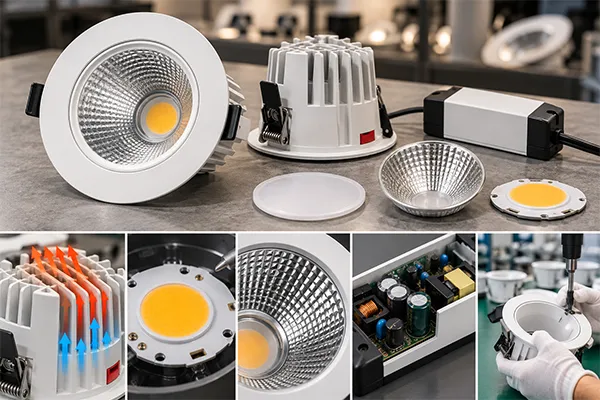
Evaluate the Complete Assembly
The housing is important because it supports the fixture, affects heat dissipation, and contributes to the finished appearance.8 Yet housing weight alone can be misleading. A heavier fixture is not necessarily better designed, and a lighter fixture is not automatically unsuitable.
I recommend reviewing the complete assembly:
- Housing and heat-management structure: Buyers should examine how the fixture is designed to dissipate heat under the planned installation conditions.
- LED light source: The selected LED should match the requested CCT, CRI, output, and consistency requirements.
- Optical components: Reflectors, lenses, and diffusers affect beam shape, glare, and visual uniformity.
- LED driver: The driver should be appropriate for the requested wattage, dimming method, voltage requirements, and installation arrangement.
- Trim and finish: Surface finish should match the project’s visual standard and resist handling damage during installation.
- Mechanical fit: Springs, cutout tolerance, cable connections, and driver dimensions should suit the ceiling system.
Installation Conditions Change the Risk
A downlight does not operate in a laboratory vacuum. Ceiling void temperature, ventilation, insulation contact, moisture exposure, access limitations, and mains conditions can all affect product suitability.9 That is why I avoid making universal claims about service life from a component list alone.
For example, a decorative recessed downlight in a ventilated living room faces different conditions from a fixture installed in a tightly enclosed commercial ceiling. Buyers should provide suppliers with relevant installation details, especially if the project includes unusual temperature, humidity, dimming, or ingress-protection requirements.
A premium-looking sample is useful, but it is not a substitute for confirming the exact production configuration and installation conditions.
At our factory, every product undergoes a 100% aging test before shipment, generally lasting 4 to 8 hours depending on the product and order requirements. We use this process as part of our own pre-shipment quality-control approach. It helps us identify certain early operational issues before goods leave the factory. It is not an industry-wide standard, and I would not present it as a lifetime guarantee.
Buyers should also ask what is documented during production and what checks are available before shipment. This creates a more meaningful conversation than simply asking whether the body is aluminum or whether the fixture feels heavy in hand.
How Can Buyers Verify High-End LED Downlights in Bulk Orders?
The biggest procurement risk is often not choosing a poor sample. It is receiving a bulk shipment that differs from the approved sample in CCT, beam pattern, finish, packaging, driver arrangement, or overall consistency.10 This can lead to site delays, replacement costs, and customer complaints.
Buyers can verify high-end LED downlights by approving a clear configuration, comparing samples with production specifications, reviewing relevant quality-control records, and defining inspection criteria before mass production. Consistent bulk delivery is often more valuable than an attractive sample with unclear production controls.
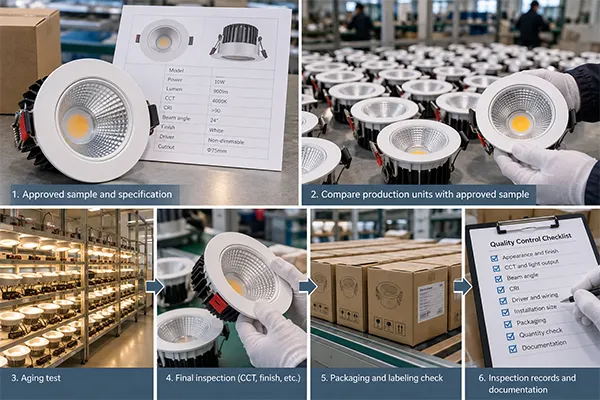
Compare Like for Like in Every Quotation
I frequently receive requests to explain why two quotations for apparently similar LED downlights differ. In many cases, the products are not directly comparable. One quotation may include a different CCT, CRI level, beam angle, driver type, finish, packaging method, or order quantity.
Before comparing price, I suggest asking each supplier to confirm the following in writing:
| Item to confirm | What buyers should request |
|---|---|
| Product model | The exact model number and product image or drawing |
| Wattage and output | The requested wattage and stated lumen information |
| CCT and CRI | The exact color temperature and CRI option |
| Beam angle | The agreed optical configuration |
| Cutout and dimensions | Installation dimensions and driver dimensions |
| Finish | Trim color, surface treatment, and visible material details |
| Driver | Driver brand or specification, dimming requirement, and input conditions |
| Certifications | Copies of applicable documents for the product configuration, where required |
| Test process | The supplier’s stated pre-shipment testing and inspection process |
| Packaging | Inner box, master carton, labels, and branding requirements |
| Delivery terms | Production lead time, quantity tolerance, and shipping arrangement |
CE and RoHS documents may be relevant for market-entry, safety, environmental, or regulatory requirements in certain markets.11 However, I advise buyers not to treat these documents as proof that a downlight is high-end. Buyers should verify whether certificates, declarations, reports, and product markings apply to the exact product and target market.
Control the Approved Sample
A well-managed sample process helps reduce surprises. I recommend that buyers retain an approved sample, photos, specification sheet, and packaging reference. These materials should be tied to the purchase order.
For OEM or ODM projects, the approval record can include:
- Brand logo placement and label artwork.
- CCT, CRI, wattage, and beam-angle selection.
- White, black, gold, or other surface finish requirements.
- Cutout size and trim dimensions.
- Driver and dimming configuration.
- Packaging design, barcode, manuals, and carton markings.
- Cosmetic acceptance criteria for visible surfaces.
- Inspection quantity and process before final payment or shipment.
At Upward Lighting, we work with customers on small-batch orders as well as ongoing OEM/ODM programs. I find that smaller initial orders can help buyers validate market response and installation feedback before expanding a product line. However, the buyer should still define the specifications carefully. A small order does not remove the need for configuration control.
Ask for a Practical Quality Plan
A supplier does not need to promise perfection to provide useful quality information. In fact, I believe clear, realistic communication is more valuable than broad marketing claims.
Buyers can ask:
- What checks occur for incoming materials, assembly, aging, and final packing?
- How are CCT, wattage, beam angle, and finish controlled for the order?
- Can the supplier provide product photos, videos, or inspection records before shipment?
- What happens if the delivered product does not match the approved specification?
- How are repeat orders referenced to the original approved configuration?
These questions help procurement teams evaluate whether a supplier can support a repeatable product line, not just one attractive quotation.
Frequently Asked Questions
Are high-end LED downlights always more expensive?
No. High-end LED downlights may cost more when they require specific optics, color quality, finishes, drivers, testing, or customization. However, price alone does not confirm value. Buyers should compare the exact configuration, delivery consistency, installation suitability, and quality-control process behind each quotation.
Is a high CRI enough to identify a premium LED downlight?
No. High CRI can be valuable where accurate color appearance matters, such as retail, hospitality, and interior-focused projects. However, buyers should also review CCT consistency, beam angle, glare comfort, output, driver compatibility, construction, and the supplier’s ability to deliver the same configuration in volume.
Do CE and RoHS certifications prove downlight quality?
CE and RoHS documentation can be relevant to market-entry, safety, environmental, and regulatory requirements, depending on the target market. They do not independently prove premium optical performance, reliability, or suitability for a specific installation.12 Buyers should verify documents for the exact product and market.
What should I check before ordering LED downlights in bulk?
I recommend confirming the model, wattage, lumen output, CCT, CRI, beam angle, cutout, dimensions, driver, finish, packaging, certifications, and quality-control requirements. Buyers should also retain an approved sample and make sure the purchase order refers to the same final configuration.
How long should LED downlights be aged before shipment?
There is no single universal aging duration that proves lifetime performance. At Upward Lighting, we conduct a 100% pre-shipment aging test of approximately 4 to 8 hours as part of our internal quality-control process. Buyers should ask each supplier to explain its own process and verify it against project requirements.
Conclusion
High-end LED downlights are not defined by one impressive number, a heavy housing, a premium finish, or a high price. I believe the strongest purchasing decision comes from evaluating the complete fixture: application fit, light output, beam control, glare comfort, color quality, component matching, installation conditions, and bulk-order consistency. Buyers should also verify certifications and testing documents for their specific market and product configuration. If you need a configurable LED downlight quotation for an OEM, ODM, wholesale, or project requirement, we at Upward Lighting can help you compare practical options clearly.
"Understanding LM-79 Reports", https://betterbuildingssolutioncenter.energy.gov/sites/default/files/attachments/understanding_lm79_reports.pdf. Lighting layouts depend on luminaire mounting height, distribution, spacing, and the illuminance required on the task plane; changing mounting height can therefore require a different optical layout. Evidence role: mechanism; source type: education. Supports: Lighting-design guidance explaining that mounting height, beam distribution, spacing, and target illuminance must be considered together.. Scope note: The source supports the design principle rather than prescribing a particular beam angle for the two example ceiling heights. ↩
"Recommended method for determining the correlated color ...", https://www.energy.gov/eere/ssl/articles/recommended-method-determining-correlated-color-temperature-and-distance. Correlated color temperature describes the apparent warm-to-cool character of white light, while color variation among LED luminaires can affect the visual uniformity of an installed lighting system. Evidence role: general_support; source type: government. Supports: That correlated color temperature characterizes the apparent warmth or coolness of white light and that color variation can be noticeable among LED products.. Scope note: Perceived atmosphere and acceptable color variation depend on the application, observer, and project specifications. ↩
"Purchasing Energy-Efficient Light Bulbs", https://www.energy.gov/cmei/femp/purchasing-energy-efficient-light-bulbs. A watt measures electrical power input, while a lumen measures luminous flux (the quantity of visible light emitted); the two metrics therefore describe different aspects of lamp performance. Evidence role: definition; source type: government. Supports: Definitions of watt as electrical power and lumen as the SI-derived unit used to quantify luminous flux.. ↩
"Color rendering index", https://en.wikipedia.org/wiki/Color_rendering_index. The general colour rendering index is a standardized measure comparing the color-rendering properties of a test light source with those of an appropriate reference illuminant. Evidence role: definition; source type: institution. Supports: The technical definition of the general color rendering index and its comparison with reference illumination.. Scope note: CRI does not by itself capture every aspect of preferred color appearance or all color-fidelity dimensions. ↩
"CALiPER Application Summary Report 20: LED PAR38 Lamps", https://www1.eere.energy.gov/buildings/publications/pdfs/ssl/caliper_20_summary.pdf. Lighting design guidance commonly uses narrower distributions to concentrate light on focal areas and broader distributions to illuminate larger general areas. Evidence role: general_support; source type: government. Supports: General lighting-design guidance relating narrow distributions to accenting and broader distributions to general-area lighting.. Scope note: The appropriate distribution still depends on mounting height, surface reflectance, spacing, and the required lighting levels. ↩
"Measuring Discomfort from Glare: Recommendations for ...", https://www.energy.gov/eere/ssl/articles/measuring-discomfort-glare-recommendations-good-practice. Discomfort glare is associated with excessively bright sources in the field of view and can impair visual comfort even when measured illumination is adequate for the task. Evidence role: mechanism; source type: government. Supports: That excessive luminance and unfavorable viewing geometry can produce discomfort glare and reduce visual comfort independently of illuminance.. Scope note: Glare perception varies with observer adaptation, background luminance, viewing direction, and the activity being performed. ↩
"The Impact of Circadian Lighting Design Strategies on ...", https://www.energy.gov/sites/default/files/2023-01/ssl-2023_circadian-lighting-design-strategies-office-space.pdf. Professional lighting design commonly relies on luminaire photometry and glare-evaluation methods to assess predicted illumination and visual comfort for the intended application. Evidence role: general_support; source type: institution. Supports: The use of photometric data and glare evaluation methods in luminaire selection and lighting design.. Scope note: Calculations model specified conditions and should be interpreted alongside actual site geometry, finishes, daylight, and installation details. ↩
"DOE Solid-State Lighting CALiPER Program 2009 Roundtable", https://www1.eere.energy.gov/buildings/publications/pdfs/ssl/2009_caliper_roundtableproceedings.pdf. LED system performance is affected by junction temperature, and luminaire thermal design is used to conduct and dissipate heat so that operating temperatures remain within component limits. Evidence role: mechanism; source type: government. Supports: That LED junction temperature and luminaire thermal design affect light output, color behavior, and useful life.. Scope note: Housing material or mass alone does not establish thermal performance; the complete thermal path and installation environment must be evaluated. ↩
"Sealing Non-Insulation Contact (IC) Recessed Light", https://sws.nlr.gov/spec/301021. Recessed luminaires are evaluated and installed with regard to environmental conditions such as ambient temperature, insulation contact, moisture exposure, ventilation, and applicable electrical ratings. Evidence role: general_support; source type: institution. Supports: That recessed luminaires have installation limitations related to ambient temperature, insulation contact, moisture location ratings, and electrical conditions.. Scope note: The applicable requirements vary by jurisdiction, product rating, installation instructions, and the specific ceiling construction. ↩
"6.2.1. What is Acceptance Sampling?", https://www.itl.nist.gov/div898/handbook/pmc/section2/pmc21.htm. Quality-management and acceptance-inspection practices use documented specifications, controlled production processes, and sampling or verification procedures to assess whether delivered products conform to agreed requirements. Evidence role: general_support; source type: institution. Supports: That controlled production, documented specifications, and inspection processes are used to verify conformity of delivered goods to agreed requirements.. Scope note: Such controls reduce, but do not eliminate, the possibility of variation between an approved sample and a production shipment. ↩
"CE marking - Internal Market, Industry, Entrepreneurship and ...", https://single-market-economy.ec.europa.eu/single-market/goods/ce-marking_en. In the European Union, CE marking indicates that a product is declared to conform to applicable EU requirements, while the RoHS framework restricts specified hazardous substances in electrical and electronic equipment. Evidence role: historical_context; source type: government. Supports: The EU role of CE marking in demonstrating conformity with applicable requirements and of RoHS restrictions on certain hazardous substances in electrical and electronic equipment.. Scope note: Whether either framework applies depends on the product, its intended market, and the applicable legislation; CE marking is not a standalone product-quality rating. ↩
"CE marking – obtaining the certificate, EU requirements", https://europa.eu/youreurope/business/product-rules-compliance/general-product-compliance/ce-marking/index_en.htm. CE marking is a conformity declaration under applicable EU legislation, and RoHS addresses restrictions on certain substances; neither designation is, by itself, a rating of optical quality, reliability, or project-specific installation fitness. Evidence role: definition; source type: government. Supports: That CE marking concerns conformity with applicable EU requirements and that RoHS concerns substance restrictions, rather than a general premium-performance designation.. Scope note: Separate test reports, product ratings, and project assessments may provide evidence for particular performance or installation questions. ↩