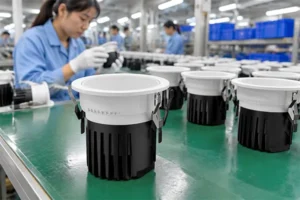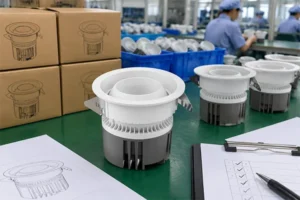

A China LED downlight manufacturer can look credible online while still creating expensive risks in product consistency, documentation, and delivery. A polished website or a quick quotation does not prove that a supplier can repeat an approved specification at order scale. I recommend a structured verification process that checks real execution evidence before buyers commit.
To verify a China LED downlight manufacturer, buyers should cross-check production capability, agreed product specifications, quality-control procedures, relevant compliance documents, and delivery records. A sample, a factory video, or a certificate scan is useful but incomplete evidence.1 The strongest approach combines document review, direct technical questions, sample-to-production controls, and independent inspection or testing where the order risk justifies it.
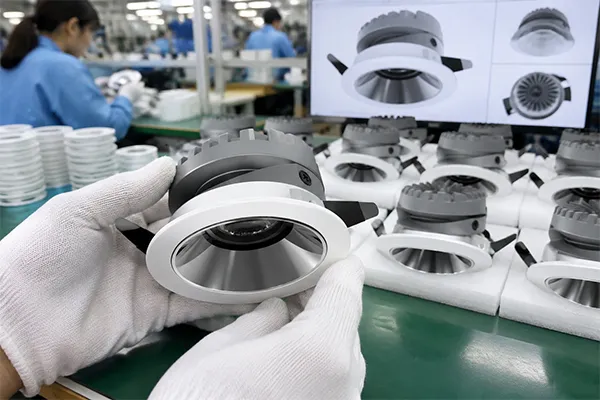
In my experience working with overseas lighting buyers, the best sourcing decisions come from asking practical questions: What exactly will be produced? How is that specification controlled? What happens before shipment? Can the supplier provide documents that match the actual product and destination market? The sections below provide a risk-reduction framework for answering those questions.
What Should You Verify Beyond a China LED Downlight Manufacturer’s Website?
A supplier’s website may show modern facilities, extensive product ranges, and reassuring quality statements. However, buyers can lose time and money if those marketing materials are not supported by operational evidence. The risk becomes larger when a project requires consistent color temperature, beam angle, dimming performance, or regulatory documentation.
Buyers should verify whether a China LED downlight manufacturer can control production, quality, specifications, and delivery—not simply whether the supplier has an online presence. Useful evidence includes legal business details, product drawings, production records, inspection procedures, supply-chain controls, and clear answers about how an approved sample becomes a repeatable batch product.
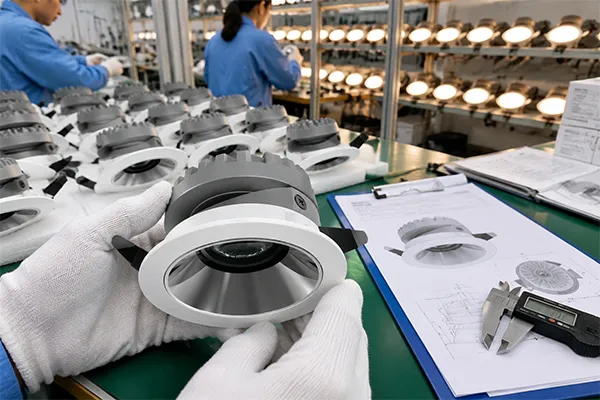
Move From “Real Factory” Questions to Capability Questions
Many buyers begin with one question: “Are you a real factory?” It is an understandable question, but it is too limited. A trading company may provide valuable sourcing support, while a factory may still lack the systems required for a demanding OEM project.
I suggest evaluating the supplier’s execution capability. This means reviewing how the supplier manages the activities that affect your order after the quotation is accepted.
A capable LED downlight supplier should be able to discuss:
- The product structure and available configurations
- Key components, such as LED chips, drivers, housings, reflectors, and diffusers
- Production flow, including assembly, aging, inspection, packing, and shipment
- How the team identifies and controls different product versions
- How the supplier handles material substitutions
- What happens when an incoming component does not meet requirements
- Typical lead times for samples, standard orders, and customized orders
- Whether the supplier can support small-batch orders or phased project deliveries
For example, a recessed downlight may look identical across several quotations, but the specification may differ significantly. One version may use a different driver, lower-grade thermal material, or a different LED package. Those changes can affect wattage tolerance, flicker, color consistency, dimming compatibility, lifetime expectations, and price.2
Evidence Buyers Can Request
I recommend asking for evidence in a staged way. Buyers do not need to request every internal document during an early inquiry. However, the evidence should become more detailed as the commercial risk increases.
| Verification area | Useful evidence to request | Why it matters |
|---|---|---|
| Business identity | Company registration details, export history references where appropriate, bank-account consistency | Helps confirm who will contract and receive payment |
| Product definition | Datasheet, dimension drawing, photometric information where available, bill-of-material summary for key components | Reduces ambiguity before sampling |
| Production capability | Factory walkthrough video, production photos, equipment list, assembly workflow | Shows relevant operations, but should not stand alone |
| Quality control | Incoming inspection process, aging-test process, final-inspection checklist, defect-handling procedure | Indicates how quality is managed before shipment |
| Supply chain | Key component brands or approved alternatives, driver sourcing approach, lead-time explanation | Helps identify substitution and delay risks |
| Delivery execution | Production schedule format, packaging specifications, shipment communication process | Supports planning for projects and repeat orders |
At Upward Lighting, we regularly receive requests for factory images, certifications, and fast price quotations. I understand why buyers ask. These are reasonable starting points. Still, I encourage buyers to connect each item to a specific purchasing risk. A production video may show that a workshop exists, but it does not prove that the same factory can maintain a 3000K, 36-degree, CRI 90 downlight specification across a larger order.
A responsible supplier should be able to explain not only what it makes, but also how it prevents the wrong version from reaching your shipment.
For higher-value orders, buyers may also consider a remote audit, onsite factory visit, or third-party inspection. These steps do not eliminate all sourcing risk, but they can provide independent evidence beyond supplier-provided materials.
How Can You Confirm China LED Downlight Manufacturer Specifications?
A product may appear simple in a catalog, yet LED downlight performance depends on several linked technical parameters. If buyers approve only a photo or a general model number, they may receive a product that fits the ceiling cutout but fails to meet the project’s lighting, electrical, or visual requirements.
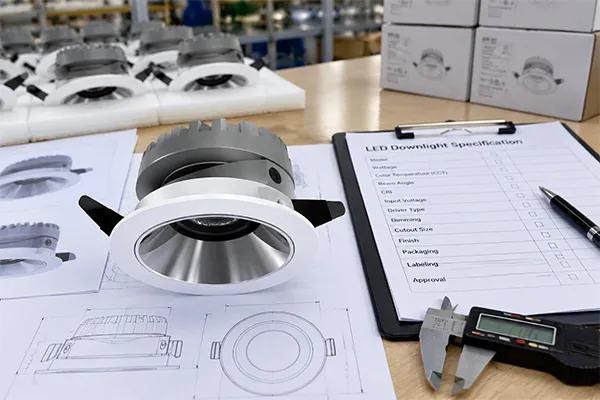
To confirm China LED downlight manufacturer specifications, buyers should create a written approval record covering the exact product version, including wattage, color temperature, beam angle, CRI, input voltage, driver type, cutout size, finish, dimming requirement, packaging, and labeling. The supplier should confirm how that approved specification will be identified and controlled during production.
Treat the Specification Sheet as a Purchase-Control Tool
I have seen that many disputes begin with vague language. A buyer may request “12W warm white anti-glare downlights,” while the supplier assumes a standard configuration. Both parties may believe they agree, but the order may still leave important questions unanswered.
A detailed specification sheet creates a shared reference point.3 It also gives the buyer, supplier, inspector, and logistics team a practical document to use when reviewing the finished goods.
Key Parameters to Lock Before Mass Production
The following table shows common specification items that buyers should clarify. Not every project needs every item, but each item can affect usability, price, or compliance.
| Specification item | Questions buyers should ask |
|---|---|
| Model and product version | What is the exact internal model code? Are there similar-looking versions? |
| Wattage | Is wattage fixed, selectable, or adjustable? What tolerance applies? |
| Color temperature | Is the requested CCT 2700K, 3000K, 4000K, 5000K, or another value? What binning approach is used? |
| CRI | Is the requirement CRI 80, CRI 90, or another target? Does the requirement apply to the shipped version? |
| Beam angle | Is the beam angle 15°, 24°, 36°, 60°, or adjustable? |
| Driver | Is the driver non-dimmable, TRIAC dimmable, 0–10V, DALI, or another type? |
| Electrical input | What voltage and frequency are required for the destination market? |
| Physical dimensions | What are the outer diameter, height, ceiling cutout, and trim dimensions? |
| Finish | Is the body white, black, silver, gold, or customized in another finish? |
| IP rating | Is the application dry indoor, bathroom, soffit, or another environment? |
| Packaging and labels | What carton marks, barcodes, instructions, and private labels are needed? |
Ask How the Supplier Controls Changes
An approved sample is important, but it proves the quality of one unit at one moment. It does not automatically prove mass-production consistency.4 I recommend asking the supplier how it connects the approved sample to the production order.
Useful questions include:
- Will the purchase order show every approved technical parameter?
- Will the factory assign a model code or revision number to the approved version?
- Who approves component substitutions if the original driver or LED source is unavailable?
- Can the supplier provide a pre-production confirmation before assembly begins?
- How will cartons and labels identify the correct product version?
- Can the buyer retain a sealed approval sample as a comparison reference?
At our factory, OEM and ODM discussions often involve adjusting color temperature, wattage, beam angle, CRI, and surface color. I have learned that speed is useful only when the final confirmation is clear. A quotation should not replace a confirmed specification. For project lighting, I advise buyers to include the approved datasheet, drawing, sample reference, and packaging requirements as attachments to the purchase order.
If the project has strict photometric, flicker, dimming, or emergency-lighting requirements, buyers should seek evaluation from qualified laboratories or technical professionals. Application-specific performance should be verified against local project requirements rather than assumed from a standard catalog description.
How Do You Evaluate Quality Control and Aging Tests?
A low defect rate is important, but buyers cannot assess quality merely by asking whether a factory “has QC.” Most suppliers will say yes. The more useful question is whether the manufacturer can describe when it checks products, what it checks, and how it handles nonconforming units.
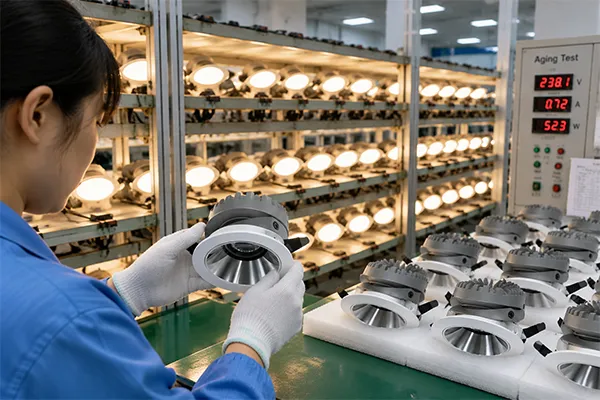
Buyers should evaluate quality control by reviewing the supplier’s inspection stages, acceptance criteria, aging-test process, records, and corrective-action approach. A 100% aging test can be a valuable control, but buyers should confirm its duration, conditions, scope, and connection to final inspection because an aging test alone does not verify every performance or installation requirement.5
Understand the Main Inspection Stages
Quality control works best as a process, not as a single final check.6 For LED downlights, the process may include incoming inspection, assembly checks, aging, final inspection, and packing inspection.
At Upward Lighting, we conduct a 100% aging test before shipment, generally lasting between 4 and 8 hours. The purpose is to identify early electrical or functional issues before products are packed and dispatched. However, I believe buyers should ask what the process covers rather than treating the phrase “100% aging” as universal proof of performance.
A typical quality-control structure may include:
- Incoming material inspection: Review of housings, drivers, LED sources, reflectors, diffusers, and packaging materials.
- In-process inspection: Checks during assembly for wiring, mechanical fit, appearance, and workmanship.
- Aging test: Continuous operation for a defined period to identify early failures.
- Final functional inspection: Verification of lighting operation, visual condition, labels, and relevant order details.
- Packing inspection: Carton quantity, inner protection, shipping marks, and accessories.
Questions to Ask About an LED Downlight Aging Test
Buyers should request practical details, especially for project orders or private-label products:
| Quality-control question | What a useful answer may include |
|---|---|
| Is every unit aged? | Whether the process is 100%, sampled, or limited to certain models |
| How long is the aging test? | A stated duration, such as 4–8 hours, and whether it varies by product |
| What operating conditions are used? | Input voltage, loading conditions, fixture setup, and ambient environment |
| What happens to failed units? | Isolation, rework rules, retesting, and defect recording |
| Are test records available? | Batch records, production logs, or inspection reports where applicable |
| What is checked after aging? | Function, appearance, labeling, packaging, and order-specific requirements |
Look for Repeatability, Not Perfect Promises
No responsible manufacturer should promise that defects are impossible. Components can vary, transport can cause damage, and installation conditions can influence field performance.7 What matters is whether the supplier has a credible method to reduce avoidable failures and respond when an issue is found.
I once discussed a downlight order where the buyer focused mainly on the unit price. Later, the buyer added a requirement for specific dimming compatibility. That requirement changed the driver selection and test process. This is a good example of why quality control must follow the final specification. A strong aging process cannot correct a product that was configured incorrectly from the beginning.
For larger orders, buyers can add independent pre-shipment inspection criteria to the contract. They may define acceptable quality limits, inspection sampling methods, appearance standards, carton-drop expectations, or functional test requirements. A third-party inspection company can provide added visibility, especially when the buyer cannot visit the facility.
How Should You Check Certificates and Market Requirements?
Certification documents can help buyers assess a product, but documents are often misunderstood. A CE or RoHS document may relate to a specific product model, component combination, test standard, or date.8 It should not be treated as automatic approval for every destination country, installation, or customer requirement.9
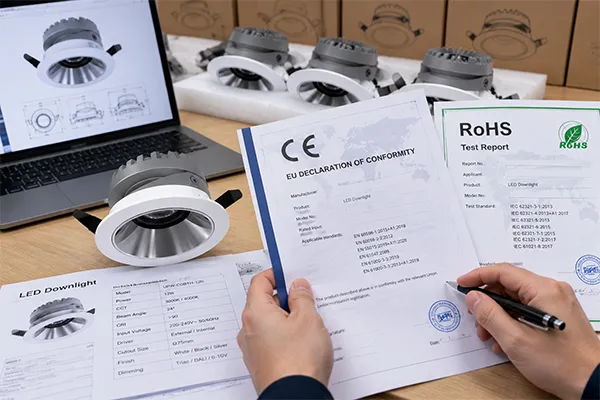
Buyers should check whether certificates from a China LED downlight manufacturer match the exact product version and intended market. They should verify model numbers, issuing bodies, applicable standards, document dates, and any technical conditions. CE and RoHS documentation may support market-entry assessments, but buyers should confirm local regulatory, project, and customer requirements with qualified professionals.
Match Documents to the Actual Product
The key principle is simple: a document is only useful if it relates to what you plan to buy. A certificate that covers a 10W downlight may not automatically cover a 20W version with a different driver. A report for a non-dimmable model may not support a DALI-dimmable configuration.
Buyers should compare the document against their order specification:
- Product model number and product description
- Rated wattage and input voltage
- Driver configuration
- Product family or variants listed in the document
- Relevant standard references
- Issuing or testing organization
- Document issue date and validity information, where applicable
- Destination-market requirements
- Customer or project-specific approval requirements
At Upward Lighting, our products hold certifications such as CE and RoHS. We provide relevant documentation to support buyer review, but I recommend that buyers verify applicability for their particular model and market. Requirements can vary by country, product category, project type, and sales channel.
Certificate Review Checklist
| Document review step | Buyer action |
|---|---|
| Confirm product identity | Match the model and configuration with the intended purchase |
| Check the scope | Review whether variants, wattages, and electrical configurations are included |
| Review the issuer | Confirm the named laboratory, organization, or declaration source |
| Check technical relevance | Compare listed standards against destination-market expectations |
| Verify document status | Check dates, revisions, and any validity information |
| Confirm project requirements | Ask whether the customer requires additional reports, marks, or local approvals |
| Keep records | Store approved documents with the purchase order and product specification |
Compliance Requires Context
A buyer selling to the UK, European Union, Middle East, North America, or another market may face different rules and customer expectations. A commercial building project may also require documents beyond what a retail product needs.10 Local electrical codes, installation conditions, energy requirements, insurance requirements, and tender specifications can all affect the decision.
For this reason, I recommend involving qualified local regulatory advisers, certification bodies, laboratories, or project engineers when the application is complex. A supplier can provide product information and documentation, but it should not replace independent legal, regulatory, or application-specific evaluation.
Can Fast Communication Predict Reliable Order Execution?
Fast replies are valuable, especially when contractors, distributors, and product managers work against a tender or launch deadline. However, a responsive salesperson does not automatically prove that the production team can maintain specifications, source components on time, or manage a shipment without errors.
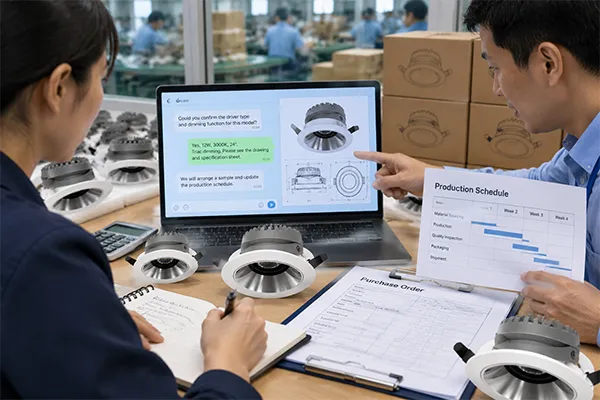
Fast communication is a positive signal, but buyers should validate it through the supplier’s order-confirmation process, technical clarity, supply-chain coordination, production updates, and handling of changes. Reliable execution becomes visible when a supplier documents commitments and communicates problems early rather than only sending quick quotations.
Test Communication During the Quotation Stage
I suggest that buyers use the early inquiry stage to evaluate how the supplier works. The goal is not to create unnecessary workload. The goal is to see whether the supplier can identify missing details and provide commercially useful answers.
A reliable response often includes:
- A clear quotation with model number, price basis, MOQ, and payment terms
- A stated lead time and explanation of what could affect it
- Technical questions when the inquiry lacks essential parameters
- Identification of standard versus customized features
- Clear communication about sample cost and sample lead time
- Notes on available documentation
- Practical alternatives when the requested configuration is not feasible
A vague response may say, “Yes, we can do everything.” A more reliable response may say, “We can provide 12W, 3000K, CRI 90, black trim, and TRIAC dimming, but the requested 68 mm height requires a different housing. Please confirm whether the 75 mm cutout is acceptable.” The second response may feel slower, but it reduces the chance of a wrong assumption.
Evaluate the Supplier’s Order Workflow
A structured order workflow helps separate sales ability from actual execution ability.
| Order stage | Evidence of reliable execution |
|---|---|
| Inquiry | Supplier asks relevant technical and commercial questions |
| Quotation | Price, MOQ, Incoterm, lead time, and scope are defined |
| Sample | Sample configuration is recorded and approved |
| Order confirmation | Purchase order reflects final specifications and packaging |
| Production | Supplier provides realistic scheduling and change communication |
| Inspection | Quality checks and aging procedures follow agreed requirements |
| Shipment | Carton marks, documents, balance payment, and shipping details are confirmed |
At our company, we aim to respond quickly because buyers often need rapid quotations. Still, I believe a fast answer is useful only when it is accurate. For customized LED downlights, we need to confirm details with production and supply-chain teams before we make firm commitments. This is especially important for OEM/ODM orders, small-batch requests, special finishes, nonstandard beam angles, or specific driver requirements.
A buyer should also assess how the supplier communicates bad news. Material shortages, shipping delays, and specification conflicts can happen in global supply chains.11 The stronger supplier is not necessarily the one that claims nothing will go wrong. It is the one that identifies risks early, explains options, and documents agreed changes.
Frequently Asked Questions
How do I know if a China LED downlight manufacturer is legitimate?
Buyers should verify more than business registration or factory photos. They should review product specifications, production capability, quality-control procedures, relevant compliance documents, and order communication. For significant orders, a remote audit, onsite visit, or independent third-party inspection can provide additional evidence.
Does an approved LED downlight sample guarantee mass-production quality?
No. An approved sample confirms one product unit or sample set. Buyers should also confirm how the supplier controls the approved model during production, including component selection, version identification, aging tests, final inspection, and packaging. A written production specification reduces the risk of mismatched batches.
Are CE and RoHS certificates enough for LED downlight imports?
CE and RoHS documents may be relevant, but they are not universal proof of compliance for every market or project. Buyers should confirm that the documents match the exact product version and destination-market requirements. Local regulatory advice or laboratory testing may be necessary for application-specific decisions.
What should I include in an LED downlight purchase order?
A purchase order should include the model number, wattage, color temperature, CRI, beam angle, input voltage, driver and dimming type, dimensions, cutout size, finish, packaging, labels, quantity, lead time, shipping terms, inspection requirements, and approved sample or drawing references.
Is a 100% aging test important for LED downlights?
A 100% aging test can help identify early functional failures before shipment. Buyers should ask about the test duration, operating conditions, records, and actions taken when units fail. Aging is one quality-control step, so it should be considered alongside incoming inspection, final inspection, and application-specific testing.
Conclusion
Verifying a China LED downlight manufacturer is a process of comparing claims with observable evidence. Buyers should define the exact product specification, confirm how samples align with mass production, review quality-control and aging-test procedures, check relevant compliance documents, and assess order execution through documented communication. No checklist can remove every sourcing risk, but a disciplined review can reduce costly surprises. If you are evaluating an LED downlight OEM or ODM project, contact Upward Lighting to discuss your required specifications, sample needs, and documentation requirements.
"What is Supplier Quality Management ...", https://asq.org/quality-resources/supplier-quality?srsltid=AU7gw4Urd42JRW-NzPbUBUq7B48o-wfJfQvwDtHrCFRzlhsw14I_ibaJ. ISO 9001 supplier-control guidance supports evaluating external providers through defined criteria and monitoring, rather than treating a single document or representation as conclusive evidence of capability. Evidence role: general_support; source type: institution. Supports: Supplier evaluation should use documented and verifiable controls rather than relying on a single form of supplier-provided evidence.. Scope note: The guidance is general quality-management guidance and does not prescribe a lighting-specific supplier-verification checklist. ↩
"Learn About LED Lighting", https://www.energystar.gov/products/learn-about-led-lighting. U.S. Department of Energy solid-state-lighting publications describe how driver behavior, thermal conditions, and component selection influence LED-system performance, flicker, and reliability. Evidence role: mechanism; source type: government. Supports: LED luminaire performance and reliability depend on the interaction of LEDs, drivers, thermal design, and optical components.. Scope note: The evidence supports the technical mechanism generally; the effect of a particular substitution depends on the specific luminaire design and operating conditions. ↩
"NIST Quality System", https://www.nist.gov/nist-quality-system. ISO 9001 requirements for documented product and service requirements support using controlled specifications as a common basis for communication and conformity verification. Evidence role: general_support; source type: institution. Supports: Documented product requirements provide a basis for communicating, reviewing, and verifying conformity in purchasing and production.. Scope note: ISO 9001 establishes a management-system framework rather than specifying the exact fields required for an LED downlight specification sheet. ↩
"6.1.2. What are Process Control Techniques?", https://www.itl.nist.gov/div898/handbook/pmc/section1/pmc12.htm. FDA process-validation guidance explains that manufacturing consistency is demonstrated through controlled processes and evidence across production, rather than by the acceptability of a single unit alone. Evidence role: mechanism; source type: government. Supports: Consistent production quality requires controlled and validated processes, not solely acceptance of an individual output sample.. Scope note: The guidance is written for regulated pharmaceutical manufacturing, so it provides a general process-control principle rather than a lighting-product requirement. ↩
"LED Systems Reliability Consortium", https://www.energy.gov/cmei/ssl/led-systems-reliability-consortium. Reliability literature on burn-in testing describes its role in screening early-life failures and distinguishes it from broader qualification testing for performance and service conditions. Evidence role: mechanism; source type: research. Supports: Burn-in or aging operation is used to screen some early-life failures, while separate tests are needed for other electrical, photometric, safety, and application-specific properties.. Scope note: The effectiveness of burn-in depends on the applied stress profile, test duration, failure mechanisms, and the product design. ↩
"1C. Quality Assurance vs. Quality Control", https://nvlpubs.nist.gov/nistpubs/SpecialPublications/NIST.SP.1500-28pt1C.pdf. ISO quality-management principles describe a process approach in which planned controls and monitoring are applied across activities to achieve consistent outputs. Evidence role: expert_consensus; source type: institution. Supports: Quality management emphasizes process controls, monitoring, and corrective action across production activities rather than reliance on final inspection alone.. Scope note: This principle does not establish that every individual inspection stage is necessary for every LED downlight product. ↩
"Impact of Thermal Dissipation on the Lighting Performance ...", https://pmc.ncbi.nlm.nih.gov/articles/PMC8776062/. LED reliability research identifies component variation and operating environment, including thermal conditions created by installation, as factors that can influence luminaire performance and lifetime. Evidence role: mechanism; source type: paper. Supports: LED luminaire reliability is affected by component characteristics and by environmental and installation conditions, particularly thermal conditions.. Scope note: Transport damage is a separate logistical risk and may require packaging and handling evidence in addition to reliability research. ↩
"CE marking – obtaining the certificate, EU requirements", https://europa.eu/youreurope/business/product-rules-compliance/general-product-compliance/ce-marking/index_en.htm. European Commission guidance on CE marking and RoHS explains that conformity declarations and technical documentation concern the manufacturer’s identified product and the applicable Union requirements. Evidence role: definition; source type: government. Supports: EU conformity assessment and RoHS compliance documentation must be supported by technical documentation for the relevant product and applicable requirements.. Scope note: Whether a particular report or declaration covers a variant depends on its stated product scope and the applicable legislation. ↩
"European Union - CE Marking and EU Standards", https://www.privacyshield.gov/ps/article?id=European-Union-Trade-Standards. European Commission CE-marking guidance states that CE marking applies within the European regulatory framework and signifies conformity with applicable EU requirements, not universal acceptance in all markets or applications. Evidence role: historical_context; source type: government. Supports: CE marking is an EU/EEA conformity framework and does not itself determine compliance with separate national-market, installation, or contractual requirements.. Scope note: Specific destination-market obligations must be determined from the laws and product rules applicable in that jurisdiction. ↩
"Register your business", https://www.gsa.gov/small-business/find-opportunities/register-your-business. Government construction-submittal guidance describes project review of product data, samples, test reports, and certificates, illustrating why project purchases may require documentation beyond ordinary retail sales information. Evidence role: general_support; source type: government. Supports: Construction procurement commonly requires submittals such as product data, samples, test reports, certificates, and installation information for review against project specifications.. Scope note: Submittal requirements vary by contract, jurisdiction, building type, and project specification. ↩
"OECD Supply Chain Resilience Review: Navigating Risks", https://www.oecd.org/content/dam/oecd/en/publications/reports/2025/06/oecd-supply-chain-resilience-review_9930d256/94e3a8ea-en.pdf. OECD and UNCTAD analyses of supply-chain disruptions document how shortages of inputs and maritime-logistics constraints can delay deliveries and affect production planning. Evidence role: general_support; source type: institution. Supports: International supply chains can experience disruptions arising from input shortages, transport constraints, and coordination failures.. Scope note: These sources provide macro-level context and do not establish the likelihood or cause of disruption for a specific LED downlight order. ↩