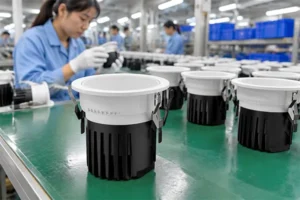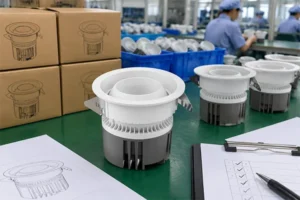

LED downlight suppliers can look similar when buyers compare catalogues, prices, and CE or RoHS documents. However, a low quote can become expensive if the model does not suit the installation, the paperwork does not match the product, or the approved sample differs from later production. I recommend a model-by-model verification process before committing to a long-term supplier.
To select LED downlight suppliers for European markets, buyers should validate a specific downlight model against its intended application, technical specification, documentation, sample approval criteria, customization needs, and delivery process. CE and RoHS documents should be checked as model-specific evidence1, while samples and production communication should confirm that the approved configuration can be repeated in mass orders.
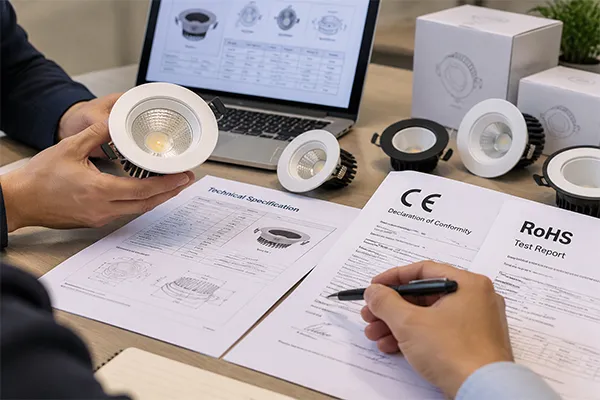
I work with European inquiries from importers, wholesalers, contractors, and local lighting brands, and I often see the same issue: buyers compare factories before they have fully defined the product they need. I believe the stronger approach is to first confirm the application, then assess whether a supplier can manufacture and document that exact model consistently.
Why Should Buyers Evaluate LED Downlight Suppliers by Specific Models?
I often receive requests that ask only for a wattage, such as “a 10W LED downlight.” That information is not enough to quote responsibly. Two 10W products can differ in cutout size, driver design, beam angle, glare control, light output, finish, and installation method. These differences can create avoidable project problems.
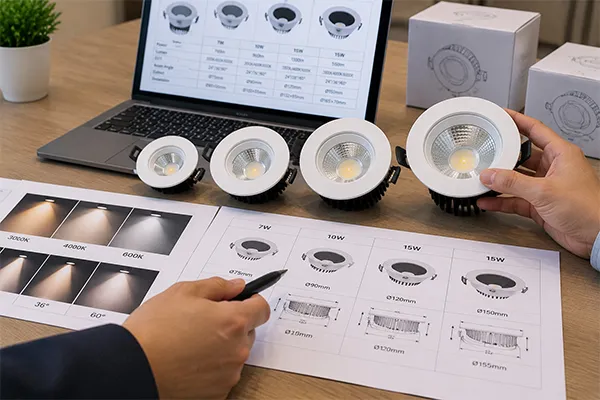
Buyers should assess LED downlight suppliers by asking whether a specific model meets the actual installation and performance requirements. The supplier should be able to confirm the model’s dimensions, cutout, wattage, lumen output, CCT, CRI, beam angle, driver arrangement, finish, packaging, and intended application before the buyer compares price or lead time.
Start With the Installation Conditions
I recommend that buyers describe the physical installation before requesting a quotation. A recessed downlight may need to fit a specific ceiling cutout, ceiling thickness, void depth, or insulation condition. A model that looks suitable in a catalogue may not fit the site once the installer begins work.
The key questions I need answered before I can confirm a model include:
- What is the required cutout diameter?
- What is the available ceiling void depth?
- Is the ceiling gypsum board, metal, wood, or another material?
- Is the fixture intended for residential, retail, office, hospitality, or another environment?
- Does the project require fixed, adjustable, trimless, surface-mounted, or anti-glare construction?
- Is the driver installed separately, integrated, or remotely located?
- Are dimming functions required?
A purchasing manager should not assume that the same housing will work for every ceiling condition. I have seen inquiries where a buyer selected a compact product based on appearance, then later discovered that the driver dimensions created an installation conflict. That issue is easier to resolve during sampling than after a container has been booked.
Evaluate Light Quality Beyond Wattage
I also encourage buyers to move beyond wattage as the main comparison point. Wattage indicates energy consumption, but it does not explain the entire lighting result.2 A buyer should ask for the specified lumen output, color temperature, color rendering index, beam angle, and tolerance expectations.
For example, a 3000K, 36-degree, CRI 90 downlight may serve a different purpose from a 4000K, 60-degree, CRI 80 model with similar wattage. Retail, hospitality, residential, and office applications may each require different light distribution and visual comfort expectations.
| Evaluation item | Why I believe it matters | Buyer verification action |
|---|---|---|
| Wattage | Indicates power consumption | Compare it with required light output |
| Lumen output | Indicates available light quantity | Request model-specific data |
| CRI | Affects color appearance of objects | Confirm the required minimum CRI |
| Beam angle | Affects spacing and light distribution | Review against ceiling height and layout |
| CCT | Shapes the visual atmosphere | Confirm 2700K, 3000K, 4000K, or another target |
| UGR or glare-related design3 | May affect visual comfort | Assess with an appropriate lighting professional |
| Finish color | Affects project appearance | Approve the exact finish sample |
I do not present a factory quotation as a lighting design calculation. I recommend that buyers use qualified lighting professionals for application-specific decisions, especially for projects with glare, spacing, emergency lighting, or local installation requirements.
How Should Buyers Check Documents From LED Downlight Suppliers?
I understand why CE and RoHS paperwork is important to European buyers. These documents are frequently requested at the beginning of an inquiry. However, I do not believe buyers should treat any document as a universal guarantee of product quality, legal suitability, or fitness for every project.
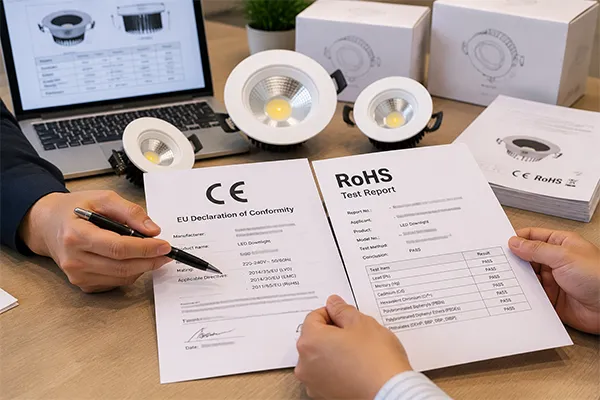
Buyers should ask LED downlight suppliers whether CE, RoHS, declarations, reports, and labels correspond to the exact product model, component configuration, target market, and intended use. Documents can support procurement review, but buyers should verify their relevance with qualified local compliance and technical advisers where necessary.
Match the Document to the Product
I recommend that buyers check the model number carefully. A document may cover a family of products, a previous configuration, or a similar housing rather than the exact product under discussion. A small change in driver, LED source, wattage, trim, or dimming arrangement may matter when the buyer reviews documentation.4
When I prepare quotations, I find it useful when the buyer provides a clear target configuration. For example:
“Recessed LED downlight, 12W, 3000K, CRI 90, white trim, 36-degree beam angle, dimmable driver, 90 mm cutout.”
This level of detail helps me confirm whether the requested documents and product configuration align. Without it, the buyer and supplier may both assume they are discussing the same model while referring to different versions.
Ask Practical Documentation Questions
I suggest that procurement teams ask for evidence rather than relying on general statements such as “we have all certificates.” Useful questions include:
- Does this document name the exact model or identifiable product family?
- Does the quoted model use the same driver and electrical configuration?
- Is the document current and legible?
- Does the product label match the agreed model, electrical rating, and importer requirements?
- Does the supplier provide a declaration that can be reviewed by the buyer’s compliance team?
- Are there project-specific or country-specific requirements that need separate review?
At Upward Lighting, we can provide CE and RoHS-related documentation for relevant products as part of the sourcing process. I would still encourage each buyer to verify document applicability for its own market, installation type, and commercial role. A manufacturer is not a substitute for an importer’s legal, regulatory, or project compliance review.
Consider Documentation as Part of Supplier Control
I see documentation review as a supplier-management task, not just a one-time entry requirement. If a buyer changes the product after initial approval, the buyer should ask whether the change affects the documentation package.
For example, changing from a non-dimmable driver to a dimmable driver may alter the product configuration. Changing the wattage, electrical input, or model code may also require additional confirmation. I recommend recording these changes in writing rather than relying on chat messages alone.
How Can Samples Reduce Risk When Choosing LED Downlight Suppliers?
A sample can reveal more than a product photo5, but I do not believe a passed sample automatically proves that every future unit will be identical. Buyers need a structured sample approval process that connects the physical sample to the written order requirements.
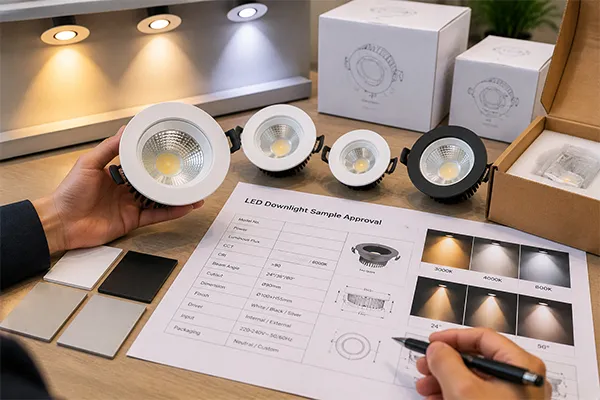
Buyers should use samples from LED downlight suppliers to confirm dimensions, appearance, operation, light characteristics, packaging, labels, and agreed customization details. The approved sample should be supported by a written specification sheet6 so that both parties can compare mass production against the same reference.
Build a Written Sample Approval Record
I recommend that buyers avoid approving a sample only by saying “looks good.” That response creates ambiguity. A more useful approval record identifies what exactly has been accepted and which items remain open.
A practical sample approval sheet can include:
- Supplier name and factory contact
- Product model number
- Wattage and input voltage
- Color temperature and CRI
- Beam angle
- Trim color and surface finish
- Cutout size and overall dimensions
- Driver type and dimming function
- Packaging method
- Product label details
- Required documents
- Sample approval date
- Any approved deviations or special notes
I have seen cases where a customer liked a black trim sample but did not specify the desired finish standard. Later, the customer expected a different black tone in mass production. I believe this type of dispute is avoidable when the buyer keeps an approved visual reference and describes the finish requirement clearly.
Test the Sample for the Intended Use
A sample should be assessed in an environment that resembles the intended installation when possible. I recommend that buyers check the following:
| Sample check | What the buyer should observe |
|---|---|
| Physical fit | Cutout, ceiling thickness, spring tension, driver placement |
| Light appearance | CCT, beam shape, perceived brightness, visible glare |
| Finish quality | Trim color, paint consistency, scratches, assembly appearance |
| Functional operation | Switching, dimming compatibility where applicable, driver behavior |
| Packaging | Carton protection, inner boxes, labels, instructions |
| Product identity | Model code and ratings aligned with the approved specification |
At our factory, we conduct a 100% aging test before shipment, typically for 4 to 8 hours7, as part of our internal process. I describe this as one production-control step, not as a guarantee that no future failure can occur. Buyers should ask each supplier how it handles aging, inspection, assembly checks, and pre-shipment confirmation, then decide whether that process meets their own risk level.
Confirm What Must Stay Consistent in Mass Production
I believe the most important question after sample approval is simple: what must remain unchanged? The answer may include the LED source, driver, heat sink, finish, packaging, printed label, or accessory set.
If a buyer allows substitutions, I recommend that the buyer define an approval process. For example, the purchase order can state that no material or specification change may be made without written buyer confirmation8. This is especially important for local brands that need consistent products across repeat orders.
What Delivery Questions Should Buyers Ask LED Downlight Suppliers?
A product can meet the desired specification and still create commercial difficulty if the delivery process is unclear. I often see buyers focus on unit price while leaving MOQ, packaging, customization lead time, and production confirmation until the final stage. That can cause rework for both sides.
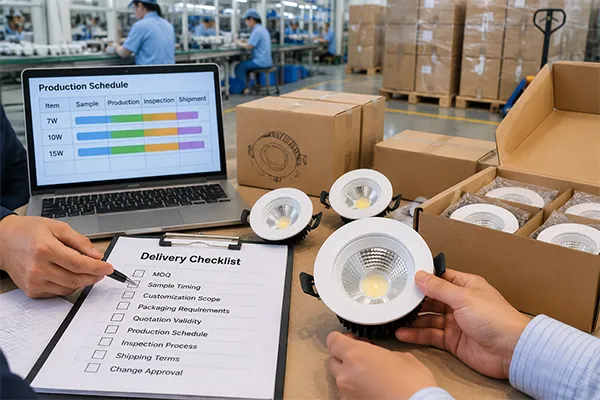
Buyers should evaluate LED downlight suppliers by their delivery communication system, not only by their stated lead time. They should confirm MOQ, sample timing, customization scope, packaging requirements, quotation validity, production schedule, inspection process, and how changes are approved before repeat or larger orders are placed.
Clarify MOQ and Customization Early
I recommend that buyers distinguish between a standard model order and a customized order. A standard white downlight from an existing range may have different requirements from a product with a special CCT, custom trim finish, branded packaging, unique beam angle, or modified driver.
At Upward Lighting, we support OEM and ODM discussions, including possible customization of color temperature, wattage, beam angle, CRI, and surface finish. However, I always need to confirm feasibility, material availability, sample requirements, and order quantity before treating a request as final.
Buyers should ask:
- What is the MOQ for the standard version?
- What is the MOQ for a custom finish or branded package?
- Does customization add sample time or production time?
- Which changes are practical within the existing product platform?
- Which changes require new tooling, new materials, or separate approval?
- Can the supplier support small-batch trial orders?
Review the Communication Process
I believe reliable delivery depends on clear handoffs. A supplier should be able to explain what happens from quotation to shipment. I recommend that buyers look for a process that includes documented checkpoints.
| Stage | Useful buyer question |
|---|---|
| Inquiry | What information is needed for an accurate quotation? |
| Quotation | Which configuration and trade terms are included? |
| Sample | What will be sent, and how will it be identified? |
| Order confirmation | Which drawing, specification, and packaging version applies? |
| Production | What is the planned production window? |
| Inspection | What checks are performed before shipment? |
| Shipment | What carton marks, documents, and shipping details are provided? |
I have found that fast replies are helpful, but speed alone is not enough. A quick quotation that is based on incomplete specifications can create a larger delay later. I prefer to clarify uncertainties before production begins, especially when a buyer has custom packaging or several product variants.
Watch for Unrealistic Lead-Time Promises
I suggest that buyers treat very short lead-time promises carefully when the order includes non-standard materials or customized packaging. Lead time can depend on component availability, production capacity, approval timing, packaging preparation, and shipping arrangements.9
A reasonable supplier should explain assumptions rather than promise certainty without details. I believe transparency is more valuable than an optimistic schedule that cannot be maintained.
What Supplier-Screening Checklist Should European Buyers Use?
I know that procurement teams need a repeatable way to compare suppliers. A checklist helps buyers move from marketing claims to evidence-based questions. It also makes internal approval easier because purchasing, product, quality, and technical teams can review the same information.
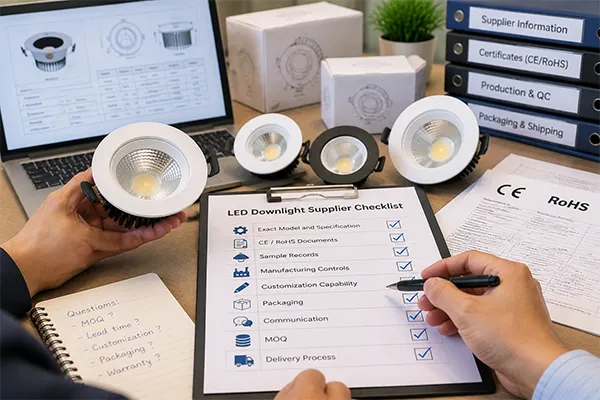
A practical LED downlight supplier checklist should verify the exact model, relevant documents, sample records, manufacturing controls, customization capability, packaging, communication, MOQ, and delivery process. Buyers should record evidence and unresolved questions before approving a supplier for repeat business.
My Recommended Supplier Evaluation Checklist
I recommend that buyers use the following checklist for each shortlisted supplier:
- [ ] The supplier has quoted an identifiable model number.
- [ ] The quotation states wattage, voltage, lumen output, CCT, CRI, beam angle, dimensions, and finish.
- [ ] The buyer has confirmed cutout size and installation constraints.
- [ ] Relevant CE, RoHS, and supporting documents have been reviewed for model relevance.
- [ ] The buyer has checked whether documents match the target market and intended use.
- [ ] The supplier has sent a sample or clear pre-production confirmation.
- [ ] The approved sample specification has been recorded in writing.
- [ ] Packaging, labels, manuals, and carton marks have been confirmed.
- [ ] The supplier has explained its production and inspection process.
- [ ] The supplier has clarified its aging-test approach or other internal quality controls.
- [ ] MOQ and pricing for standard and customized versions are understood.
- [ ] The supplier has explained how specification changes are approved.
- [ ] Production timing and shipment communication have been discussed.
- [ ] The buyer has identified who will handle local compliance, installation, and project-specific evaluation.
Compare Evidence, Not Just Quotes
I suggest scoring suppliers across several areas rather than selecting based on one price comparison. A higher unit price may include a more suitable driver, stronger packaging, lower MOQ flexibility, or clearer documentation support. A lower price may still be appropriate, but buyers should know exactly what they are comparing.
| Evaluation area | Suggested review focus |
|---|---|
| Product fit | Does the model suit the intended installation? |
| Documentation | Does evidence relate to the quoted configuration? |
| Sample consistency | Is the approval record detailed enough? |
| Customization | Can the supplier execute the requested changes? |
| Quality process | Can the supplier explain inspections and controls? |
| Commercial terms | Are price, MOQ, payment, and lead time clear? |
| Communication | Are questions answered clearly and consistently? |
I believe long-term sourcing becomes easier when the first order is treated as a controlled validation step. Buyers can begin with a defined model, written sample approval, and realistic quantity before expanding to additional variants or larger repeat orders.
Frequently Asked Questions
What documents should I request from LED downlight suppliers for Europe?
I recommend requesting model-specific CE and RoHS-related documents, declarations, product specifications, labels, and any supporting reports relevant to the quoted configuration. Buyers should verify whether these documents apply to the exact model, target market, and intended use with appropriate local compliance professionals.
Is CE marking enough to approve an LED downlight supplier?
I do not consider CE marking alone enough to approve a supplier10. Buyers should also review the specific model, supporting documentation, sample performance, product labeling, production communication, packaging, and delivery process. CE-related evidence should be examined rather than treated as automatic proof of quality or suitability.
What should I inspect in an LED downlight sample?
I recommend inspecting dimensions, cutout size, trim finish, color temperature, beam angle, brightness, driver arrangement, dimming function where required, labels, and packaging. Buyers should also create a written approval record so that mass production can be checked against the same agreed configuration.
Can LED downlight suppliers provide OEM or ODM customization?
Many LED downlight suppliers can discuss OEM or ODM options, but feasibility depends on the requested change, materials, existing product platform, order quantity, testing needs, and production timing. I recommend that buyers provide a written requirement covering wattage, CCT, CRI, beam angle, finish, branding, and packaging.
How can I reduce sample-to-mass-production inconsistency?
I suggest linking the approved sample to a detailed specification sheet, product model code, packaging requirements, and written change-control process. Buyers should state which components and visible details must remain consistent and require written approval before any substitution or specification change is made.
Conclusion
I believe that selecting LED downlight suppliers for European markets requires more than comparing prices and collecting standard paperwork. Buyers should validate a specific model for a specific application, examine documents for relevance, approve samples in writing, and review how each supplier manages customization, production, packaging, and delivery communication. At Upward Lighting, I support buyers with quotations, samples, OEM/ODM discussions, aging-test explanations, and pre-shipment confirmation for LED downlights. Contact us with your target specification if you want to begin a structured supplier evaluation.
"CE marking – obtaining the certificate, EU requirements", https://europa.eu/youreurope/business/product-rules-compliance/general-product-compliance/ce-marking/index_en.htm. EU product-compliance guidance requires manufacturers to prepare technical documentation and an EU declaration of conformity for products subject to applicable harmonisation legislation, with documentation enabling the product and its conformity assessment to be identified. Evidence role: general_support; source type: government. Supports: That EU conformity assessment requires technical documentation and an EU declaration of conformity supporting the product placed on the market under applicable legislation.. Scope note: The applicable directives, standards, and documentation requirements depend on the product category, intended use, and the economic operator's role. ↩
"LED Basics", https://www.energy.gov/cmei/ssl/led-basics. Watts express electrical power consumption, whereas lumens express visible light output; consequently, products with similar wattage can provide different illumination depending on their efficacy and optical design. Evidence role: definition; source type: government. Supports: That watts measure electrical power while lumens measure emitted visible light, so wattage alone does not establish lighting output.. ↩
"Discomfort Caused by Glare from Luminaires with a Non- ...", https://cie.co.at/publications/discomfort-caused-glare-luminaires-non-uniform-source-luminance. The Unified Glare Rating is an internationally used index for estimating discomfort glare in indoor lighting installations from luminance, geometry, and observer-position parameters. Evidence role: definition; source type: institution. Supports: That UGR is a standardized method used to evaluate discomfort glare in indoor lighting conditions.. Scope note: A reported UGR value is meaningful only for the specified room, luminaire arrangement, reflectances, and observer conditions. ↩
"EN EN - European Commission", https://webgate.ec.europa.eu/circabc-ewpp/rest/download/73f87889-a992-4cf5-af0b-810e9922f3d8. EU conformity-assessment guidance states that a product modification may require renewed assessment where the change can affect compliance with applicable legal requirements or the validity of the original conformity assessment. Evidence role: mechanism; source type: government. Supports: That changes to a product can require a new or additional conformity assessment when they may affect compliance with applicable requirements.. Scope note: The effect of a particular driver, LED, wattage, trim, or dimming change must be determined against the relevant legislation, standards, and technical file. ↩
"6.2.1. What is Acceptance Sampling?", https://www.itl.nist.gov/div898/handbook/pmc/section2/pmc21.htm. Acceptance-sampling and inspection methods are established quality-control practices for evaluating whether delivered products conform to specified requirements using observable and measurable characteristics. Evidence role: general_support; source type: research. Supports: That inspection and acceptance sampling are established quality-control methods for evaluating product characteristics against defined requirements.. Scope note: Inspection of a sample reduces uncertainty but cannot establish that every future production unit will be identical or defect-free. ↩
"ISO and Quality Management", https://www.nist.gov/mep/iso-and-quality-management. Quality-management principles emphasize documented product requirements and controlled changes so that conformity can be assessed against an agreed and traceable specification. Evidence role: general_support; source type: institution. Supports: That quality-management systems require documented requirements and controlled changes to support consistent conformity of products and services.. Scope note: A written specification improves traceability and dispute resolution but does not by itself ensure that production processes remain capable. ↩
"Stress Testing of Organic Light-Emitting Diode Panels and ...", https://www.energy.gov/sites/prod/files/2018/05/f51/ssl_oled-stresstest_2018.pdf. Burn-in and aging procedures are commonly used in reliability practice to expose certain early-life failures under controlled operating conditions before product release. Evidence role: mechanism; source type: paper. Supports: That burn-in or aging procedures can be used to screen for early-life failures in electronic and LED products.. Scope note: This general evidence does not verify the stated factory-wide 100% coverage, the four-to-eight-hour duration, or the effectiveness of a particular supplier's procedure; those facts require auditable internal records. ↩
"7.5.3 Control of Documented Information Explained [ISO ...", https://www.iso-9001-checklist.co.uk/7.5.3-control-of-documented-information-explained.htm. Quality-management practice treats changes to product requirements, materials, and production arrangements as controlled activities that should be reviewed, documented, and communicated to relevant parties. Evidence role: general_support; source type: institution. Supports: That changes affecting product requirements should be reviewed, controlled, and communicated through documented processes.. Scope note: The specific contractual requirement for buyer approval must be negotiated by the parties and may not be required by every quality-management standard. ↩
"How to Think About Planned Lead Times", https://lgoreview.mit.edu/how-to-think-about-planned-lead-times/. Operations and supply-chain research identifies material availability, capacity constraints, process coordination, and transportation arrangements as factors that influence manufacturing and delivery lead times. Evidence role: mechanism; source type: research. Supports: That manufacturing lead time is influenced by material availability, production capacity, process timing, and logistics.. Scope note: The actual lead time for a downlight order depends on the supplier's specific bill of materials, order size, production schedule, and shipping route. ↩
"CE marking – obtaining the certificate, EU requirements", https://europa.eu/youreurope/business/product-rules-compliance/general-product-compliance/ce-marking/index_en.htm. CE marking indicates that the manufacturer declares conformity with applicable EU requirements for the product; it is not, in itself, an independent certification of supplier quality or suitability for a particular project. Evidence role: definition; source type: government. Supports: That CE marking signifies a manufacturer's declaration of conformity with applicable EU requirements, rather than an independent general quality certification.. Scope note: Whether third-party assessment is required depends on the applicable EU legislation and conformity-assessment procedure. ↩