
Choosing an LED downlight exporter in China can feel risky when product photos, certificates, and prices look similar across suppliers. A wrong choice can lead to specification mismatches, delayed projects, inconsistent batches, or costly rework. I believe buyers can reduce these risks by evaluating proof of execution, not just company claims.
A reliable LED downlight exporter in China is one that can clearly confirm specifications, control sample-to-mass-production consistency, provide relevant compliance documents, and communicate realistic delivery commitments. Buyers should assess the exporter’s process for quotation, customization, aging tests, inspection, and export documentation rather than relying only on low prices, fast replies, factory size, or certificates.
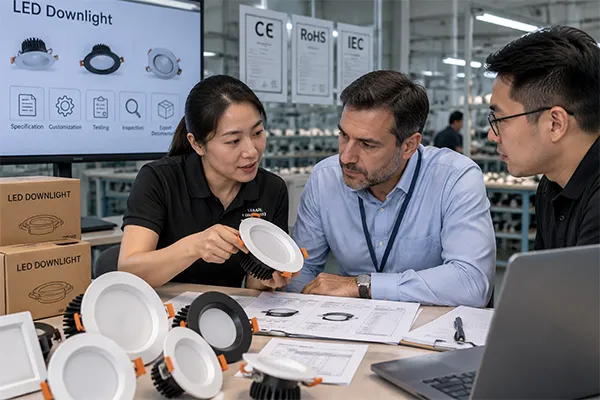
In my export communication work, I have seen that most purchasing problems begin before production starts. A buyer may assume one beam angle, finish, or color temperature, while the supplier understands another. The following checkpoints help buyers turn a supplier evaluation into a more transparent and verifiable procurement process.
Does the LED Downlight Exporter in China Confirm Specifications Before Quoting?
A vague quotation may look convenient at first, but it can create confusion later. If an exporter quotes only a wattage and unit price, buyers may not know what materials, optics, color quality, or installation details are included. I recommend treating specification clarification as the first reliability test.
A reliable LED downlight exporter in China should confirm the key technical and commercial requirements before issuing a final quotation. These requirements usually include wattage, input voltage, color temperature, beam angle, CRI, cutout size, finish, dimming option, quantity, packaging, destination market, and requested delivery date.
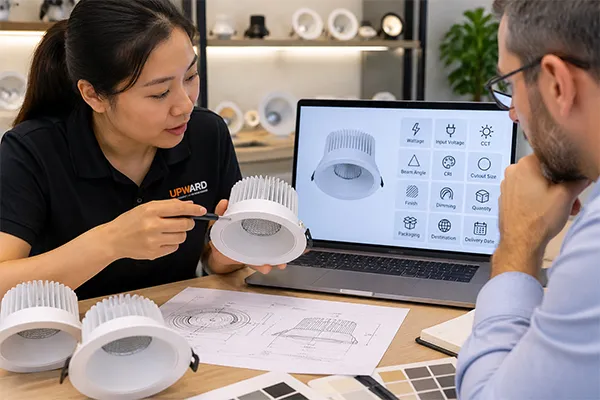
A quotation is only as useful as its specification basis
In my experience, buyers often ask for “a 12W downlight” or “a warm white recessed light.” Those descriptions are useful starting points, but they are rarely enough for a project-ready quotation. Two LED downlights with the same nominal wattage can differ in housing material, driver design, lumen output, beam distribution, dimming compatibility, color consistency, and installation dimensions.1
A dependable exporter should not simply say yes to every request. Instead, the supplier should ask questions that connect directly to purchasing risk.
For example, I would normally clarify:
- Application: Is the product for a hotel, office, retail store, residential project, corridor, or showroom?
- Installation condition: What is the ceiling cutout, ceiling depth, insulation condition, and available space above the ceiling?
- Electrical requirement: What input voltage and dimming system will the project use?
- Lighting target: What wattage, CCT, beam angle, lumen expectation, and CRI are required?
- Appearance requirement: Does the buyer need white, black, silver, gold, or another surface finish?
- Order quantity: Is this a sample order, a small trial order, or a container-level program?
- Compliance requirement: Which market will receive the goods, and which documents are requested for that exact market?
- Acceptance standard: What tolerances are acceptable for color, finish, dimensions, labeling, and packaging?
Why parameter confirmation protects both sides
A buyer may assume that a “3000K downlight” must match an earlier project batch exactly. However, color temperature is only one part of the visual result.2 A professional buyer may also need to consider chromaticity binning, diffuser type, reflector finish, and the project’s existing luminaires.
Similarly, a request for “high CRI” should be made specific. A buyer should ask whether the required minimum is CRI 80, CRI 90, or another documented target.3 The applicable requirement depends on the project, market, and installation purpose.
| Requirement area | What the buyer should confirm | Risk reduced |
|---|---|---|
| Wattage and output | Nominal wattage, expected lumen range, driver type | Under-lighting or unexpected energy use |
| CCT and CRI | 2700K, 3000K, 4000K, CRI 80/90, tolerance expectations | Visual inconsistency between batches |
| Beam angle | Narrow, medium, or wide beam requirement | Poor light distribution or glare |
| Dimensions | Cutout, trim diameter, height, driver size | Installation failure on site |
| Finish | White, black, custom paint, texture level | Mismatch with interior design |
| Dimming | Non-dimmable, TRIAC, 0–10V, DALI, or other system | Compatibility problems |
| Packaging and labels | Inner box, master carton, labels, barcodes | Channel and customs issues |
I do not view a detailed clarification process as a delay. I view it as evidence that the exporter is trying to prevent avoidable errors. A supplier that asks disciplined questions may be a better fit than one that promises every configuration immediately without reviewing feasibility.
Can an LED Downlight Exporter in China Prove Sample-to-Batch Consistency?
A polished sample can create confidence, but a sample is not the same as stable mass production. Buyers may approve one unit and later receive a batch with different components, finish quality, driver behavior, or packaging. This gap is one of the most important supplier risks to manage.
A reliable LED downlight exporter in China should use the approved sample and confirmed specification as references for mass production. Buyers should ask how the exporter records sample approval, confirms materials and parameters, manages changes, performs aging tests, and checks finished goods before shipment.
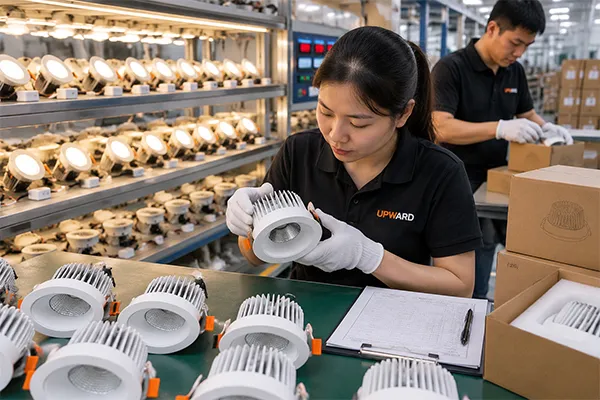
A sample approval should become a production reference
When I work with an OEM or ODM order, I see the approved sample as more than a display item. It should be connected to the production confirmation. The buyer and exporter should agree on what the sample represents, including the visible finish, key dimensions, color temperature, driver option, packaging, logo, and label content.
A buyer should also ask whether the sample is a standard catalog item, a modified item, or a fully customized version. This distinction matters. A standard sample may not demonstrate the final custom finish, custom packaging, special driver, or requested beam angle.4
Before production, I recommend confirming the following in writing:
-
Product model and configuration
Confirm the housing, trim, reflector, LED source, driver, wattage, CCT, beam angle, CRI, and dimming requirement. -
Approved appearance standard
Confirm the surface color, texture, logo position, trim shape, and visible component expectations. -
Packaging standard
Confirm inner boxes, master carton quantities, carton marks, barcode labels, manuals, and language requirements. -
Quality acceptance points
Identify which defects are unacceptable, such as scratches, incorrect labels, wrong cutout dimensions, visible color variation, or missing accessories. -
Change-control communication
Ask the supplier to notify the buyer before substituting any critical component or modifying an agreed specification.
Aging tests and inspection are process checkpoints
At Upward Lighting, we conduct a 100% aging test for 4 to 8 hours before shipment, depending on the product and order arrangement. In my view, an aging test is a useful process checkpoint, but buyers should still ask what the test covers, how records are handled, and how nonconforming units are addressed.
No single test alone proves every aspect of long-term performance.5 However, a documented process can help identify certain early issues before goods leave the factory. Buyers should discuss application-specific requirements with qualified technical professionals when their project has demanding thermal, dimming, emergency-lighting, or regulatory conditions.
A practical pre-shipment inspection discussion may cover:
- Quantity verification against the purchase order
- Product model and label verification
- Visual inspection of finish and assembly
- Cutout and key dimension checks
- Functional power-on checks
- Packaging and carton mark checks
- Random sampling approach, if agreed
- Photo, video, or inspection report requirements
In my experience, the most useful question is not “Do you inspect products?” It is “What exactly do you inspect against, and how do you show that the batch matches our confirmed requirements?”
That question shifts the conversation from general quality promises to verifiable execution.
How Should Buyers Verify Certificates From an LED Downlight Exporter in China?
Certificates can help buyers evaluate market-entry and compliance documentation, but they should not be treated as a universal quality guarantee. A document may apply to a different model, driver, voltage, configuration, or product family than the item being purchased. Buyers need to verify relevance, not just presence.
Buyers should request certificates and supporting documents for the exact LED downlight model and configuration they plan to import. A reliable LED downlight exporter in China should help identify available documents, explain the model relationship, and allow buyers to verify whether the documents match destination-market requirements.
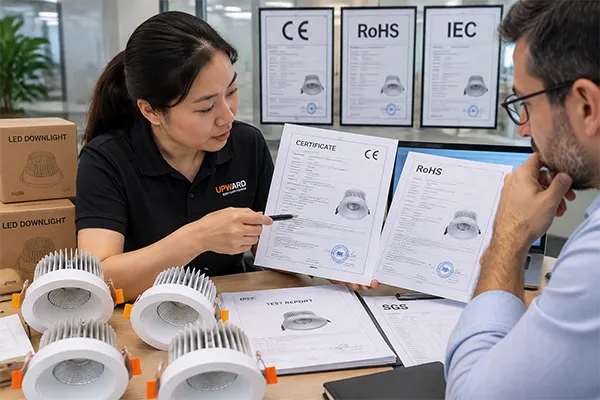
Verify the document against the actual purchase order
At Upward Lighting, our products hold documents such as CE and RoHS for relevant product ranges. However, I always encourage buyers to verify documents carefully. CE, RoHS, or another certificate should not be viewed as automatic proof that every configuration meets every destination-market obligation.6
The applicable requirement depends on the product, the destination market, the importer’s role, the installation environment, and the exact configuration supplied.
A buyer should compare the following details:
| Document check | Why it matters |
|---|---|
| Model number | The document should identify the purchased model or clearly show its relationship to the model |
| Input voltage | A 220–240V configuration may not match a 120V project requirement |
| Driver and dimming option | A different driver can affect product configuration and applicable documentation |
| Product category | Downlights, track lights, and linear lights may have different applicable standards or files |
| Issue date and issuer | Buyers should review whether the document is current and issued by an identifiable organization |
| Destination market | Market-entry requirements differ by country and channel |
| Labeling and declaration needs | Importers may need specific markings, declarations, or technical files |
Certification review is part of supplier due diligence
I recommend that buyers involve their compliance team, local importer, testing partner, or qualified professional where necessary. An exporter can provide available documentation and product information, but the buyer should not assume that a supplier’s document list replaces application-specific regulatory review.
For example, a distributor selling into one country may have different obligations from a contractor supplying a commercial project in another country. A local lighting brand may also need its own label format, packaging language, importer information, or technical file arrangement.7
A transparent supplier relationship makes this easier. The exporter should be willing to explain:
- Which model the document covers
- Whether the buyer’s requested customization changes the configuration
- Which information is available on labels and packaging
- What export documents can be prepared
- What additional verification the buyer may need independently
In export communication, I find that early document review prevents expensive surprises near shipment. If compliance documentation is critical to the purchase, buyers should request and review it before sample approval or deposit payment, not after production is complete.
Is Supplier Fit More Important Than Price or Factory Size?
Many buyers begin with a price comparison, and price is naturally important. However, the lowest offer may omit details that later affect cost, such as driver quality, finish requirements, custom packaging, inspection expectations, or delivery terms.8 Reliability depends on whether the supplier fits the actual order, not whether the company appears largest online.
The best LED downlight exporter in China for a buyer is one whose production capability, communication discipline, customization range, quality process, and delivery planning match the buyer’s project or channel needs. Supplier fit is usually more useful than comparing price, catalog size, or claimed factory scale alone.

Evaluate whether the supplier can support your buying model
A project contractor, importer, wholesaler, and local lighting brand may all buy LED downlights, but their risks differ.
A contractor may prioritize cutout accuracy, project schedule, and installation compatibility. An importer may focus on container planning, documents, packaging, and repeat-batch consistency.9 A local brand may need OEM labels, custom finishes, small trial quantities, and fast quotation support before committing to a larger program.
I recommend evaluating a potential supplier against your real commercial model.
| Buyer type | Main procurement concern | Useful supplier capability |
|---|---|---|
| Project contractor | Installation fit and delivery deadline | Clear specifications, sample confirmation, schedule visibility |
| Importer | Repeat orders and customs readiness | Stable configurations, export documents, carton planning |
| Wholesaler | Broad but manageable product range | Competitive pricing, consistent stock strategy, packaging support |
| Distributor | Channel differentiation | OEM branding, selected customization, reliable lead times |
| Local lighting brand | Brand identity and product development | ODM input, custom finish, logo and package support |
| Sourcing intermediary | Clear communication across parties | Fast clarification, documented approvals, quotation accuracy |
Ask for realistic commitments, not broad promises
In my experience, a reliable supplier does not need to claim that every request is easy. It is more useful when the supplier explains lead time, minimum order considerations, customization limits, tooling needs, sample timing, and possible trade-offs.
For instance, a custom black finish may be feasible, but the buyer should ask whether it affects lead time, minimum quantity, price, or sample approval. A special beam angle may be available, but the buyer should confirm whether it uses an existing optic or requires a different configuration. Small-batch orders may be supported, but buyers should still confirm the commercial terms and production schedule.
Useful supplier-evaluation questions include:
- Can you provide a specification sheet for the quoted model?
- What information do you need before confirming a customized quotation?
- Is the sample identical to the planned production configuration?
- How do you record approved sample and packaging details?
- What aging and inspection steps do you perform before shipment?
- Can you provide photos, videos, or an agreed inspection report?
- What is the estimated production lead time after specification confirmation?
- Which export documents can you prepare for the destination?
- How do you handle a requested change after sample approval?
I have learned that prompt replies matter, but accurate replies matter more. A fast answer that overlooks a critical detail can create more delay than a measured answer that identifies the right questions from the beginning.
Frequently Asked Questions
What should I ask an LED downlight exporter in China before ordering samples?
I recommend asking for the exact model specification, wattage, CCT, CRI, beam angle, cutout size, driver option, finish, packaging details, available documents, sample lead time, and whether the sample matches planned mass production. These points reduce later misunderstandings.
Is CE certification enough when buying LED downlights from China?
No. CE documentation may be relevant, but buyers should verify whether it applies to the exact product model, voltage, driver, and destination-market requirement.10 A buyer should also consult qualified compliance professionals when the application or local market requires additional review.
How can I check LED downlight quality before shipment?
Buyers can agree on a pre-shipment inspection plan that checks quantity, model, labels, appearance, dimensions, function, packaging, and carton marks. Buyers can also request inspection photos, videos, or third-party inspection support where appropriate.
Why can a production batch differ from an approved LED downlight sample?
A sample may differ if materials, drivers, optics, finishes, packaging, or production controls are not clearly confirmed. Buyers should connect sample approval to a written production specification and ask the exporter how changes and batch checks are controlled.
Can a Chinese LED downlight exporter support OEM or small-batch orders?
Some exporters can support OEM, ODM, and smaller trial orders, but capability varies. Buyers should confirm logo requirements, color options, packaging customization, minimum quantities, sample charges, tooling needs, and production lead times before committing to an order.
Conclusion
Finding a reliable LED downlight exporter in China requires more than comparing catalog images, prices, or certificates. I recommend focusing on proof of execution: clear specification confirmation, meaningful sample approval, controlled mass-production processes, relevant document verification, realistic lead times, and transparent communication. At Upward Lighting, we support buyers with OEM/ODM customization, quotation clarification, 4–8 hour aging tests, inspection coordination, and export-document preparation. Contact us to discuss your LED downlight requirements and build a procurement plan around your actual project or channel needs.
"CALiPER Application Summary Report 20: LED PAR38 Lamps", https://www1.eere.energy.gov/buildings/publications/pdfs/ssl/caliper_20_summary.pdf. U.S. Department of Energy guidance explains that LED lighting products should be compared using multiple performance characteristics, including light output, color quality, distribution, and controls, rather than wattage alone. Evidence role: general_support; source type: government. Supports: LED lighting products with similar power ratings can differ in light output, distribution, color quality, controls, and construction-related specifications.. Scope note: The guidance supports the general comparison principle and does not evaluate any particular downlight model. ↩
"Color and Spectrum", https://www.energy.gov/cmei/ssl/color-and-spectrum. U.S. Department of Energy lighting guidance distinguishes correlated color temperature from color-rendering characteristics, indicating that a lamp's nominal color temperature alone does not fully describe its visual effect. Evidence role: mechanism; source type: government. Supports: Color temperature and color rendering are distinct lighting attributes, and visual appearance depends on more than correlated color temperature.. Scope note: The source provides general lighting-science context rather than a direct assessment of variation in a specific project installation. ↩
"LED Basics", https://www.energy.gov/cmei/ssl/led-basics. U.S. Department of Energy materials define the color rendering index (CRI) as a measure of color-rendering fidelity and describe it as a specification used when selecting lighting products. Evidence role: definition; source type: government. Supports: The color rendering index is a standard metric used to describe how faithfully a light source renders object colors, with higher values generally indicating greater fidelity under the metric.. Scope note: CRI does not by itself establish suitability for every application and has recognized limitations as a predictor of all aspects of color preference. ↩
"Engineering Change Management Concepts for Systems ...", https://tsapps.nist.gov/publication/get_pdf.cfm?pub_id=913323. ISO 9001 quality-management principles require controlled product requirements and changes, supporting the need to verify that an approved sample represents the intended production configuration. Evidence role: general_support; source type: institution. Supports: Quality-management systems require organizations to control design and production changes and to ensure that product requirements are defined before release.. Scope note: The standard establishes a management-system framework; it does not prescribe a particular sample-approval procedure for LED downlights. ↩
"IESNA LM-80-08 and TM-21-11 - eere.energy.gov", https://www1.eere.energy.gov/buildings/publications/pdfs/ssl/msslc-sw2011_hodapp.pdf. U.S. Department of Energy LED testing guidance describes separate methods for measuring lumen maintenance, temperature effects, and other performance factors, showing that no single short-duration test establishes all long-term luminaire performance characteristics. Evidence role: mechanism; source type: government. Supports: LED performance and lifetime evaluation use distinct test methods and extrapolation approaches, and individual tests address limited aspects of product behavior.. Scope note: The source concerns testing methodology generally and does not demonstrate the reliability of any individual manufacturer's products. ↩
"Compliance FAQs: CE Marking", https://www.nist.gov/standardsgov/compliance-faqs-ce-marking. European Commission guidance states that CE marking signifies conformity with applicable EU requirements following the required conformity assessment; it is not a universal certificate of compliance for every market, product variant, or commercial obligation. Evidence role: expert_consensus; source type: government. Supports: CE marking is based on the manufacturer's conformity assessment for applicable EU requirements, while RoHS is a separate restriction-of-hazardous-substances framework with defined obligations.. Scope note: The guidance addresses the EU framework and does not determine requirements in non-EU destination markets. ↩
"EU - Import Requirements and Documentation", https://www.trade.gov/country-commercial-guides/eu-import-requirements-and-documentation. European Commission product-compliance guidance describes importer identification and technical-documentation responsibilities and notes that required product information must meet applicable language requirements in the market of sale. Evidence role: general_support; source type: government. Supports: Under EU product rules, importers may have identification and documentation obligations, while required instructions and safety information may need to be understandable to users in the relevant member state.. Scope note: Requirements vary by product legislation and member state, and the source does not establish that every packaging or branding element is mandatory. ↩
"Life-cycle costing as a tool in mainstreaming green public ...", https://www.oecd.org/en/publications/life-cycle-costing-in-public-procurement-in-hungary_8d90f627-en/full-report/component-5.html. OECD procurement guidance recognizes life-cycle costing and non-price evaluation criteria as tools for assessing value beyond the initial purchase price. Evidence role: general_support; source type: institution. Supports: Procurement evaluation can account for quality, delivery, operational considerations, and life-cycle costs in addition to initial purchase price.. Scope note: The guidance supports the procurement principle generally and does not prove that a particular low-priced offer omits specified product features. ↩
"Supply Chain Management Guidance - Public Documents", https://thedocs.worldbank.org/en/doc/1c3b517f003b53a2e2e170e93124be84-0290032023/original/World-Bank-Supply-Chain-Management-Guidance.pdf. World Bank procurement guidance identifies quality, technical compliance, delivery performance, and risk management as relevant evaluation considerations, supporting the view that procurement priorities vary with the buyer's intended use and commercial role. Evidence role: general_support; source type: institution. Supports: Supplier selection and contract management commonly consider specification compliance, quality, delivery capability, documentation, and risks relevant to the purchasing context.. Scope note: The guidance does not specifically classify lighting contractors and importers or prescribe their individual priorities. ↩
"CE marking – obtaining the certificate, EU requirements", https://europa.eu/youreurope/business/product-rules-compliance/general-product-compliance/ce-marking/index_en.htm. European Commission CE-marking guidance explains that manufacturers must identify applicable requirements, compile technical documentation, and issue an EU declaration of conformity for the relevant product before it is placed on the EU market. Evidence role: definition; source type: government. Supports: CE marking requires identification of applicable EU requirements, preparation of technical documentation, and an EU declaration of conformity for the product concerned.. Scope note: Whether a particular voltage, driver substitution, or model variation requires a new assessment depends on the applicable legislation and the nature of the change. ↩