
LED downlight suppliers in China can appear similar at first glance: comparable product photos, attractive prices, and broad claims about quality or certification. However, a poor supplier choice can lead to mismatched specifications, inconsistent production batches, delayed projects, or compliance issues1. I recommend evaluating suppliers through verified specifications, production controls, documentation, and delivery evidence—not marketing alone.
The best LED downlight suppliers in China are suppliers whose product specifications, quality controls, compliance documents, customization capability, and delivery process match your target market and purchasing risk. I suggest buyers compare like-for-like quotations, verify documents for the exact model, test production consistency beyond samples, and clarify lead-time conditions before placing a recurring or project-based order.
When I communicate with overseas importers, contractors, and lighting brands, I often see that supplier selection becomes difficult because buyers compare incomplete information. A lower quote may exclude a component, use a different driver, or reflect another quality level. The following process helps make the decision more evidence-based.
Why Should You Make LED Downlight Supplier Quotes Truly Comparable?
A quotation can look simple, but an LED downlight contains several decisions that affect cost, performance, and market suitability. I have seen buyers compare unit prices before confirming drivers, LED chips, trim materials, packaging, or warranty expectations. That creates a risk of choosing the lowest number rather than the most suitable offer.
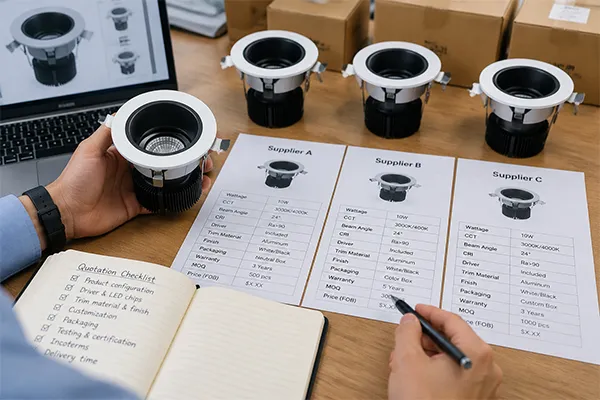
To compare LED downlight supplier quotes fairly, I recommend defining the exact product configuration, included components, customization requirements, packaging, testing expectations, Incoterms, and delivery conditions before comparing prices. A quote is only meaningful when every supplier is pricing the same technical and commercial scope.2
Start With the Product, Not the Price
In my experience, a buyer may request “a 12W recessed LED downlight” and receive five quotations that seem comparable. Yet each supplier may interpret the request differently. One quotation may include a basic non-dimmable driver, while another may include a higher-specification isolated driver. One may quote a plastic-coated iron heat sink, while another may quote die-cast aluminum. Both products may fit the same broad description, but they do not carry the same material cost or procurement risk.
I encourage buyers to create a quote comparison sheet before asking for final prices. This does not need to be overly technical. It simply needs to connect each specification to the risk it controls.
| Item to Confirm | Why It Matters to Procurement | Evidence to Request |
|---|---|---|
| Wattage and input voltage | Prevents unsuitable products for the local electrical system | Datasheet and product label artwork |
| Lumen output3 | Helps compare useful light output rather than wattage alone | Test data or declared lumen specification |
| CCT and CRI | Affects project appearance and end-user expectations | Sample, datasheet, binning approach if available |
| Beam angle4 | Influences lighting layout and application fit | Photometric file or beam-angle report where needed |
| Driver type | Affects dimming compatibility, reliability expectations, and cost | Driver brand/model and specification |
| Housing and heat sink material | Influences thermal management and product construction | Product drawing, material description, sample |
| Cutout size and dimensions | Prevents installation conflicts on site | Dimension drawing |
| Trim finish | Matters for brand consistency and interior design projects | Color sample or finish reference |
| Packaging | Affects breakage risk and retail presentation | Carton details and packing photos |
| Warranty terms | Clarifies commercial responsibility | Written warranty conditions |
Include Commercial Conditions in the Comparison
A unit price is only one part of the landed and operational cost. I suggest buyers ask whether the quotation includes:
- Product and standard accessories
- Inner box, master carton, labels, manuals, and barcode stickers
- Custom logo, laser marking, or color-box printing
- Sample charges and sample lead time
- Tooling or setup costs for special housings
- MOQ by model, color temperature, finish, or driver option
- Incoterm, port of loading, and payment terms
- Quotation validity period
- Expected production lead time after deposit and artwork approval
I have seen a price gap disappear once buyers add the cost of custom packaging, a required dimming driver, or a changed beam angle. That is why I prefer a transparent quotation over a short quote with unclear assumptions.
For recurring supply, I also recommend that buyers document any approved substitutions. A supplier should not change a driver, LED source, reflector, or finish without a defined approval process. This is especially important for a local lighting brand that needs the next purchase order to match the first approved batch.
How Can You Evaluate Mass-Production Quality Beyond a Sample?
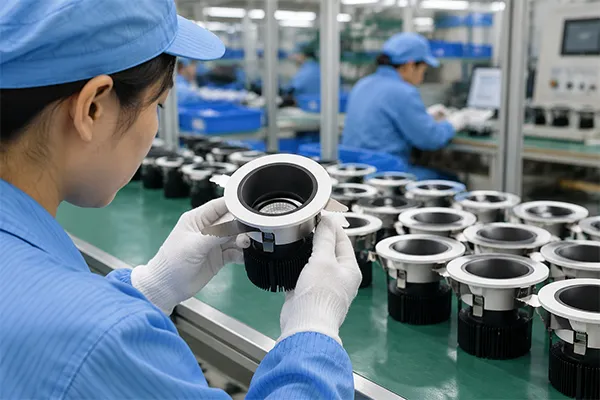
A good sample can demonstrate product appearance, basic installation, and initial light output. However, a sample does not show whether the supplier can repeat the same result across hundreds or thousands of units.5 I advise buyers to assess the system behind the sample, including incoming materials, assembly controls, aging tests6, inspection standards, and change management.
To evaluate LED downlight suppliers in China beyond a sample, buyers should ask how the supplier controls approved materials, production records, aging tests, inspections, defect handling, and changes to specifications. A sample should be treated as one verification point, while mass-production controls provide stronger evidence of consistency.
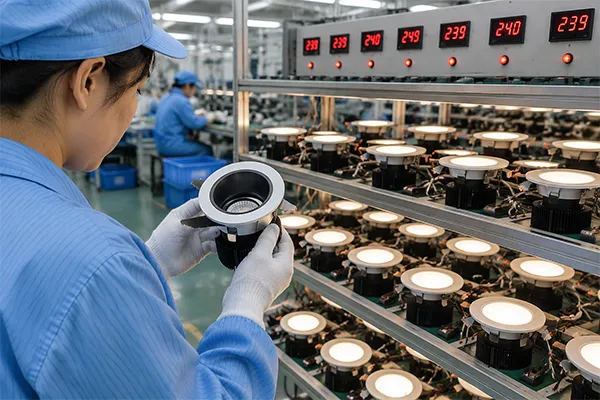
Ask What Happens Between Approved Sample and Shipment
I work with product inquiries that begin with a sample request. This is sensible. A physical sample helps a buyer check trim color, cutout fit, beam distribution, installation clips, and general construction. Still, I believe buyers should ask a second question: “How will you make sure the bulk order stays aligned with this sample?”
A capable supplier should be able to explain its normal process in practical terms. The answer does not need to be a perfect promise. It should show that the supplier understands where variation can enter production.
Useful questions include:
-
How do you confirm key components before production?
Ask whether the supplier records the approved LED source, driver model, housing version, reflector, diffuser, and finish. -
What is the aging-test process?
At Upward Lighting, we conduct a 100% aging test before shipment, typically for 4 to 8 hours. Buyers should still confirm the exact process, test conditions, and applicability for their selected model rather than assuming one statement covers every product. -
What inspections occur before packing?
Ask about visual inspection, functional testing, label verification, and packing checks. For large orders, a buyer may also consider third-party pre-shipment inspection.7 -
How are defects recorded and handled?
A supplier should explain how it separates nonconforming products, investigates recurring issues, and communicates corrective action. -
How are specification changes controlled?
This is critical for OEM LED downlights. Buyers should ask for written confirmation before any change to components, dimensions, color temperature, packaging, or labels.
Build a Practical Quality Plan
I recommend matching quality controls to the order’s risk level. A small trial order may need photos, a signed specification sheet, and a sample approval record. A major retail program or construction project may justify additional documentation and independent inspection.
| Order Type | Suggested Quality Evidence |
|---|---|
| Small trial order | Approved sample, product photos, packing photos, basic inspection records |
| Repeat wholesale order | Signed specification sheet, batch records, aging-test confirmation, pre-shipment photos |
| Private-label program | Approved golden sample, artwork approval, component list, change-control process, third-party inspection plan |
| Time-sensitive project | Installation sample, dimension confirmation, batch identification, project-specific inspection criteria |
I do not suggest that every order needs the same level of control. Instead, buyers should spend verification effort where replacement costs, compliance exposure, project delays, or brand damage would be highest.
How Should You Test Delivery Claims From LED Downlight Suppliers in China?
Fast delivery claims can be appealing, particularly for project contractors and distributors with urgent demand. Yet lead time depends on more than assembly capacity. Material readiness, customization, order size, driver availability, artwork approval, and shipping arrangements can all affect the actual schedule.8 I recommend testing the supplier’s planning process instead of relying on a broad promise.
Buyers should test delivery claims from LED downlight suppliers in China by asking about stock materials, production capacity, current order load, approval milestones, customization steps, and the events that can change lead time. A reliable delivery estimate identifies assumptions rather than offering an unconditional date.
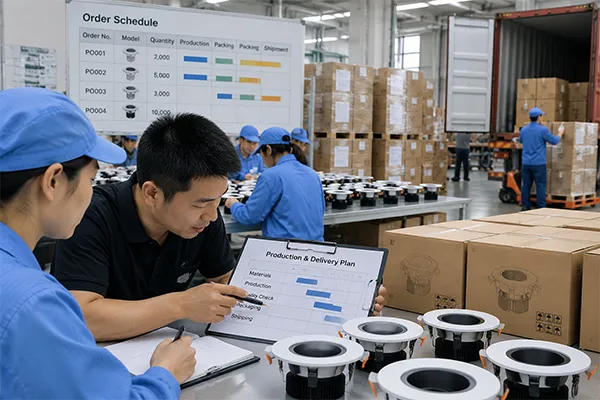
Separate “Production Time” From “Order Completion Time”
When I prepare a quotation, I find it useful to distinguish production lead time from the whole order timeline. A supplier may say production takes 25 days, but the buyer may still need to approve artwork, confirm a color sample, arrange a deposit, finalize a driver option, or book freight. Those steps can add days or weeks before goods leave China.
I suggest buyers ask for a milestone schedule such as:
- Specification confirmation
- Sample approval, if required
- Deposit receipt
- Artwork or label approval
- Material preparation
- Production start
- Aging and final inspection
- Packing completion
- Shipment booking and loading
This approach is especially important for customized LED downlights. A custom surface color, logo, carton, unusual beam angle, dimming function, or special color temperature may require extra preparation. A quick quote is valuable, but it does not prove a quick delivery process.
Questions That Reveal Planning Quality
A supplier does not need to disclose confidential commercial information. However, the supplier should be able to answer reasonable planning questions clearly.
Ask:
- Are the housing, LED source, driver, and reflector in stock or made to order?
- Which components have the longest procurement time?
- What is the monthly or weekly capacity for this product family?
- What production schedule is currently committed to other customers?
- Does the MOQ change for special CCT, CRI, trim color, or packaging?
- What happens if artwork approval arrives late?
- Can the supplier provide progress updates at defined milestones?
- What is the realistic shipping date under the agreed Incoterm?
I prefer a supplier that explains risks early over one that gives an aggressive date without conditions. A realistic plan gives the buyer time to manage alternatives, inventory, and customer expectations.
For repeat orders, I recommend measuring actual delivery performance over several purchase orders. One on-time shipment is encouraging, but recurring reliability is more useful when selecting a long-term LED downlight manufacturer.9
What Compliance Evidence Should You Verify Before Buying LED Downlights?
Certificates, catalogs, websites, and factory photos can help buyers shortlist suppliers, but none of these items proves that a specific LED downlight fits a specific market. Compliance requirements vary by country, application, electrical system, and sales channel. I encourage buyers to verify documentation against the exact model and obtain qualified local guidance where required.
Before buying LED downlights, buyers should verify that compliance documents apply to the exact model, driver configuration, target market, and intended use. CE and RoHS documents may be relevant for some markets10, but buyers should independently confirm all applicable market-entry, safety, labeling, and installation requirements.
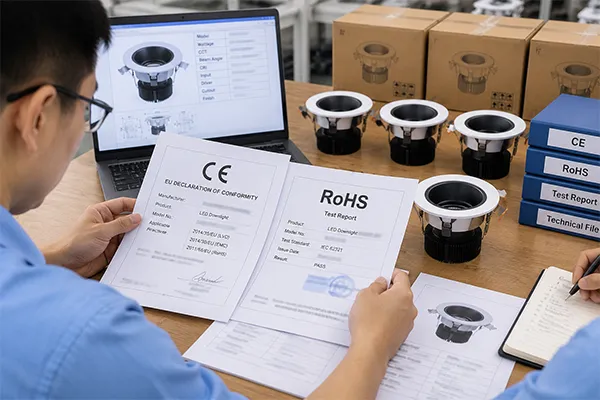
Treat Documents as Evidence to Review
At Upward Lighting, our products hold certifications such as CE and RoHS. However, I believe responsible procurement requires buyers to review whether the documents match the product they intend to import. A certificate or declaration associated with one model, driver, or product family may not automatically apply to every customized version.11
I recommend requesting and reviewing:
- Product model number shown on the document
- Manufacturer name and address
- Test report number, issue date, and issuing organization
- Product photos and technical description in the report
- Electrical ratings, input voltage, and driver details
- Relevant standards listed in the documentation
- Validity status where applicable
- Declarations of conformity and labeling requirements
Connect Compliance Checks to Real Risk
The purpose of document verification is not simply to collect PDFs. It is to reduce the risk of a shipment being unsuitable for sale, installation, or a particular customer requirement.
For example:
- A project contractor may need to verify product documentation against consultant specifications and local installation requirements.
- A lighting importer may need correct labeling, importer obligations, and market-specific records.
- A private-label brand may need to ensure its model naming and artwork do not create confusion between tested and untested configurations.
- A distributor may need documents that customers can review during tender or supplier approval.
I do not present myself as a universal regulatory authority because requirements can change and differ by jurisdiction. I recommend that buyers consult a qualified compliance professional, testing body, or local authority for application-specific decisions. A responsible supplier should support reasonable document requests and explain which documents relate to the quoted model.
Frequently Asked Questions
How do I find reliable LED downlight suppliers in China?
I suggest starting with a shortlist based on relevant product capability, communication quality, and documented experience. Then compare fully defined quotations, request samples, review quality-control processes, verify applicable compliance documents, and test how each supplier handles detailed technical and commercial questions.
What should I ask an LED downlight manufacturer before ordering?
I recommend asking about product specifications, driver and LED source options, cutout dimensions, testing process, MOQ, customization scope, lead-time assumptions, packing, warranty terms, and documentation. Each question should relate to a purchasing risk, such as installation fit, project delay, or batch consistency.
Are CE and RoHS certificates enough for LED downlights?
CE and RoHS documentation may be relevant for some markets, but I do not consider them universal proof that a product meets every local requirement. Buyers should verify that documents apply to the exact model and confirm market-specific obligations with qualified local professionals.
How can I avoid inconsistent LED downlight quality in repeat orders?
I recommend approving a written specification sheet and retaining a golden sample. Buyers should identify key components, define allowed changes, request batch-level quality information, and use pre-shipment inspection when the order risk justifies it. Consistent communication is also important for repeat purchasing.
Can Chinese LED downlight suppliers provide OEM and ODM services?
Many suppliers can offer OEM or ODM support, but the scope varies.12 I recommend confirming whether the supplier can customize wattage, CCT, CRI, beam angle, trim color, packaging, labels, and product structure. Buyers should also ask about MOQ, tooling, approval stages, and added lead time.
Conclusion
Finding the best LED downlight suppliers in China is less about identifying a universal “best factory” and more about selecting a supplier that fits your product, market, and risk profile. I recommend comparing complete specifications rather than headline prices, checking production controls beyond samples, testing delivery assumptions, and verifying compliance evidence for the exact model. If you need OEM or ODM LED downlights, our team at Upward Lighting can help you review specifications, prepare a quotation, and discuss a practical sampling and production plan.
"Supply Chain Management", https://www.nist.gov/mep/supply-chain. Quality-management guidance recognizes that organizations should control externally provided products and suppliers in order to manage risks to product conformity and delivery performance. Evidence role: general_support; source type: institution. Supports: Supplier evaluation and control are relevant to managing the quality, conformity, and delivery risks associated with externally provided products.. Scope note: The guidance establishes a general quality-management principle rather than measuring the consequences of a particular LED supplier choice. ↩
"EVALUATING BIDS AND PROPOSALS - Public Documents", https://thedocs.worldbank.org/en/doc/9dcb7971706bf29b2732779c39922b77-0290012025/original/Evaluating-Bids-and-Proposals-with-Rated-Criteria-Feb-4-2025.pdf. Public-procurement guidance generally requires bid evaluation against predefined specifications and commercial conditions, supporting like-for-like comparison of offers. Evidence role: general_support; source type: government. Supports: Procurement evaluations require bids to be assessed against stated requirements so that offers are compared on a consistent basis.. Scope note: Public tender rules may not apply directly to private purchases of LED downlights, but they illustrate the underlying comparison principle. ↩
"NIST Study Suggests Universal Method for Measuring ...", https://www.nist.gov/news-events/news/2019/12/nist-study-suggests-universal-method-measuring-light-power. Lighting guidance distinguishes lumens, which quantify emitted light output, from watts, which quantify electrical power consumption. Evidence role: definition; source type: government. Supports: Lumens measure luminous flux, whereas watts measure electrical power consumption.. ↩
"CALiPER Application Summary Report 20: LED PAR38 Lamps", https://www1.eere.energy.gov/buildings/publications/pdfs/ssl/caliper_20_summary.pdf. Lighting-design references describe beam angle as a characteristic of light distribution that affects the illuminated area and fixture-spacing decisions. Evidence role: mechanism; source type: institution. Supports: A luminaire's beam angle and distribution affect the area illuminated and are relevant to lighting layout decisions.. Scope note: Beam angle alone does not determine project performance; mounting height, room geometry, reflectance, and photometric distribution also matter. ↩
"6.2.1. What is Acceptance Sampling?", https://www.itl.nist.gov/div898/handbook/pmc/section2/pmc21.htm. Statistical quality-control guidance explains that sample inspection provides evidence about sampled items or lots, while sustained conformity depends on control of the production process. Evidence role: mechanism; source type: government. Supports: Product sampling provides limited evidence about a production lot or process and does not replace process control.. Scope note: The exact confidence supplied by a sample depends on the sampling plan, lot size, acceptance criteria, and observed defect rate. ↩
"Stress Testing of Organic Light-Emitting Diode Panels and ...", https://www.energy.gov/sites/prod/files/2018/05/f51/ssl_oled-stresstest_2018.pdf. Reliability literature describes burn-in and aging tests as methods used to screen or study early-life failures in electronic systems, including LED-based products. Evidence role: mechanism; source type: research. Supports: Burn-in or aging testing can be used to expose some early-life failures and to inform reliability assessment of electronic and LED products.. Scope note: A short aging test is not by itself proof of long-term field lifetime or of compliance with a particular reliability standard. ↩
"ISO 2859-1", https://chemistry.unt.edu/~tgolden/courses/iso2859-1.pdf. International sampling-inspection standards provide procedures for assessing product lots against defined acceptance criteria before release, a framework that can support pre-shipment inspection. Evidence role: general_support; source type: institution. Supports: Acceptance sampling and independent inspection methods can be applied to evaluate lots before release or shipment.. Scope note: Inspection outcomes depend on the agreed sampling level, defect classification, inspection scope, and independence of the inspection provider. ↩
"Availability", https://en.wikipedia.org/wiki/Availability. Supply-chain teaching materials describe order lead time as comprising supply, production, administrative, and transportation activities, each of which can affect completion dates. Evidence role: mechanism; source type: education. Supports: Manufacturing lead time is shaped by supply availability, production scheduling, order characteristics, and logistics activities.. Scope note: The relative importance of each factor varies by supplier, product design, order volume, and shipping route. ↩
"Thinking about Performance Measurement", https://www.nist.gov/baldrige/thinking-about-performance-measurement. Supplier-performance frameworks commonly use on-time delivery measures calculated across repeated orders or reporting periods, rather than treating a single delivery as a complete performance record. Evidence role: general_support; source type: research. Supports: Supplier delivery performance is commonly evaluated through recurring measures such as on-time delivery rates over multiple orders or periods.. Scope note: A multi-order record can still be affected by changing order complexity, customer-caused delays, and external logistics disruptions. ↩
"RoHS Directive - Environment - European Commission", https://environment.ec.europa.eu/topics/waste-and-recycling/rohs-directive_en. European Commission guidance explains that CE marking applies only where relevant Union harmonisation legislation requires it, while RoHS restricts certain hazardous substances in electrical and electronic equipment placed on the EU market. Evidence role: historical_context; source type: government. Supports: CE marking may be required for products covered by applicable EU legislation, and the RoHS Directive restricts specified hazardous substances in electrical and electronic equipment.. Scope note: Whether a particular downlight configuration must meet a specific legal requirement depends on its classification, destination market, and applicable legislation. ↩
"CE marking – obtaining the certificate, EU requirements", https://europa.eu/youreurope/business/product-rules-compliance/general-product-compliance/ce-marking/index_en.htm. EU product-compliance guidance indicates that manufacturers must ensure conformity assessment and technical documentation remain appropriate when product changes may affect compliance with applicable requirements. Evidence role: mechanism; source type: government. Supports: Changes to a product can require reassessment of conformity and updating of technical documentation when they affect compliance with applicable requirements.. Scope note: The need for retesting or revised documentation depends on the nature of the modification, the applicable legislation, and the assessment route. ↩
"Original design manufacturer", https://en.wikipedia.org/wiki/Original_design_manufacturer. Reference definitions distinguish OEM manufacturing from ODM arrangements by the manufacturer's role in product design as well as production. Evidence role: definition; source type: encyclopedia. Supports: OEM commonly refers to manufacturing products for another company's branding or integration, while ODM commonly involves a manufacturer designing a product that another company markets.. Scope note: Commercial usage of OEM and ODM varies across industries and contracts, so actual responsibilities should be defined in the parties' agreement. ↩