
LED downlight manufacturers can look similar on a quotation sheet, yet a weak supplier choice can create costly problems after production starts. A good sample, low price, or certificate may not show whether a factory can repeat approved specifications at volume. We recommend a structured evaluation that tests documentation, production control, communication, and delivery before a large commitment.
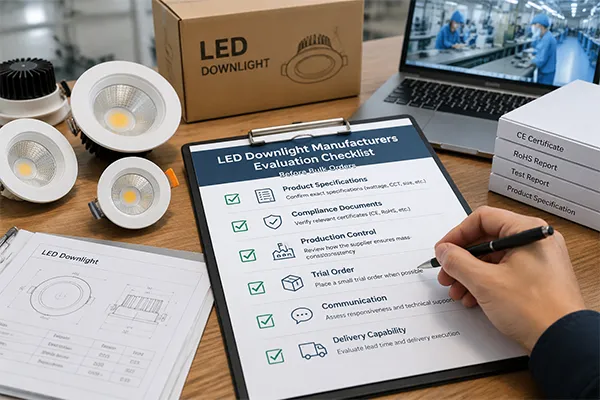
To evaluate LED downlight manufacturers before placing bulk orders, buyers should compare total procurement risk rather than unit price alone. Confirm the exact product specification, verify relevant compliance documents, review how the supplier controls mass-production consistency, and place a small trial order when possible. A trial order gives buyers practical evidence of product quality, packaging, responsiveness, and delivery execution before they scale up.
In our sales and project-communication work at Upward Lighting, we often see buyers focus first on a sample’s appearance and the quoted price. Those details matter, but bulk procurement requires more evidence. The key question is whether the supplier can reproduce the approved product, communicate clearly, and deliver commercially usable goods when the order quantity grows.
Why Should Buyers Evaluate LED Downlight Manufacturers Beyond Price?
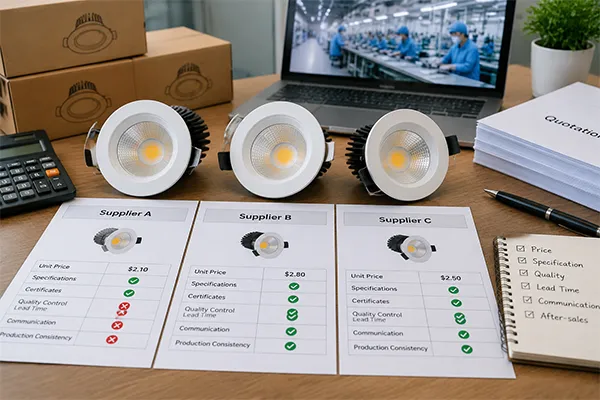
A low quote can make a purchasing decision feel easy, especially when several suppliers offer similar-looking recessed lights. However, the lowest unit price can become expensive if specifications remain unclear, responses are slow, products vary between batches, or replacement shipments are needed later.
Buyers should evaluate LED downlight manufacturers beyond price because the final cost includes product consistency, project delays, inspection effort, freight, rework, communication time, and potential replacements1. A competitive quote is valuable only when it is linked to a clear specification, reliable quality controls, realistic lead times, and documented commercial terms.
Look at total procurement cost, not only unit cost
We have seen buyers request quotations from several factories using only a photo and a wattage requirement. This approach can produce prices that appear comparable but are based on very different products.
For example, two 12W LED downlights may differ in2:
- LED chip type and binning approach
- Driver design and input-voltage range
- Aluminum housing weight and thermal design
- Diffuser material
- Color temperature tolerance
- CRI level
- Beam angle3
- Cutout size and installation method
- Packaging protection
- Warranty terms and claims process
- Inspection and aging procedures
A supplier may quote a lower price because the design uses a lighter housing, a different driver, lower-grade packaging, or a different color-rendering level. None of these choices is automatically wrong. However, buyers need to know what they are comparing.
| Evaluation area | Low-price risk to check | Evidence a buyer can request |
|---|---|---|
| Product specification | Quote does not match the intended application | Datasheet, drawings, sample confirmation |
| Components | Unclear driver, LED, or housing configuration | Bill-of-material summary or component description |
| Quality process | No defined inspection stage | QC checklist, aging-test explanation, inspection records |
| Delivery | Unrealistic production promise | Written lead-time plan and shipping terms |
| Packaging | Higher transport damage risk | Carton details, inner-box photos, packaging sample |
| After-sales handling | Unclear response if defects occur | Written warranty and claim process |
Ask what is included in the quote
We encourage buyers to ask every supplier the same questions. This creates a fairer comparison and reduces misunderstandings before the purchase order is issued.
A useful quotation review should confirm:
- The exact model number and revision.
- Wattage, CCT, CRI, beam angle, input voltage, and dimming option.
- Unit price at the proposed order quantity.
- Packaging configuration and carton quantity.
- Tooling, sample, artwork, or customization charges.
- Production lead time after deposit and artwork approval.
- Incoterms, payment terms, and destination assumptions.
- Warranty scope and the process for reporting a quality issue.
From our perspective, a careful buyer is not being difficult by asking these questions. That buyer is creating a workable basis for both sides. Clear procurement documents protect the buyer and help the manufacturer plan production accurately.
How Can Buyers Verify LED Downlight Manufacturers’ Mass-Production Consistency?
An approved sample can prove that a supplier can make one acceptable product. It does not automatically prove that the same supplier can make hundreds or thousands of matching products.4 Bulk orders require controls that connect sample approval to production, inspection, and shipment.
Buyers can verify LED downlight manufacturers’ mass-production consistency by asking how approved samples are documented and controlled during production. They should confirm component specifications, in-process inspections, aging procedures, final inspection standards, packaging checks, and the method used to identify product batches or production records.
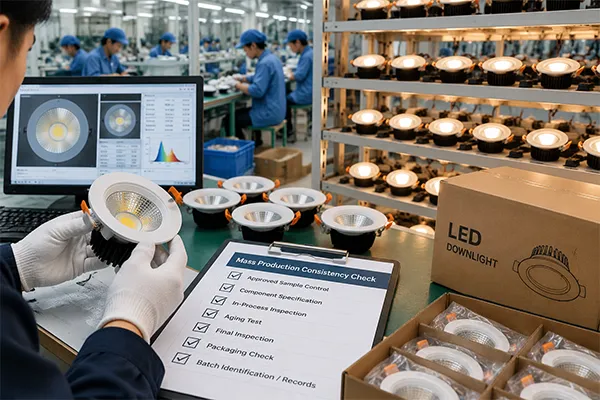
Confirm how the sample becomes a production standard
One of the most important questions we hear too rarely is: “How will this approved sample be translated into the bulk order?”
A sample should have an identifiable specification. The supplier should be able to link it to a product code, drawing, datasheet, confirmed finish, and order requirement. If the buyer approves a 3000K, 15W, 60-degree, black-finish downlight, the purchase order should not simply say “LED downlight, as sample.” It should state the relevant parameters clearly.
We recommend that buyers document at least the following items:
| Requirement | Why it matters in mass production |
|---|---|
| Model and dimensions | Prevents fitment issues with ceiling cutouts |
| Wattage and electrical input | Supports project and energy requirements |
| CCT and color tolerance expectation5 | Reduces visible variation across installed units |
| CRI | Helps align light quality with the intended environment |
| Beam angle | Affects spacing, glare, and lighting distribution |
| Finish and trim color | Prevents visual mismatch in interiors |
| Driver and dimming requirement | Supports compatibility with project controls |
| Packaging and labeling | Supports retail, distribution, and site handling |
| Acceptance criteria | Gives both sides a reference for inspection |
Review the quality-control path
At our factory, we explain our own quality path to buyers as an example of the questions they should ask any supplier. For applicable products, our process includes a 100% aging test of approximately 4 to 8 hours before shipment. This is our stated internal practice, not a universal industry standard and not independent proof that every product will suit every project.
Buyers should ask each factory to explain its actual process in plain language:
- What is checked when incoming materials arrive?
- Are key components verified against approved requirements?
- What checks occur during assembly?
- Is electrical performance tested?
- Is an aging or burn-in procedure used, and for how long?
- How are appearance, dimensions, and packaging inspected?
- How are nonconforming products identified and handled?
- Can the supplier provide batch or inspection information if a problem is reported?
A quality-control claim is more useful when it is connected to a defined product, a documented process, and evidence the buyer can review.
I remember one project discussion where a customer approved a sample quickly but had not confirmed the exact trim finish in writing. The factory had assumed a standard white finish while the project team expected a warmer custom white. The issue was resolved before bulk production, but it showed why visual requirements need a controlled reference, not only a verbal agreement.
What Compliance Documents Should Buyers Request From LED Downlight Manufacturers?
Compliance requirements can be confusing because they depend on the target market, the product configuration, and the buyer’s sales channel. Documents such as CE and RoHS may support market-entry requirements in relevant markets6, but they do not prove overall manufacturing reliability or project suitability7.
Buyers should request compliance documents that match the destination market and the exact LED downlight configuration being purchased8. They should verify the document holder, product model, applicable standards, dates, and scope. CE and RoHS documentation can support regulatory review, but buyers should not treat them as proof of mass-production consistency or application-specific suitability.
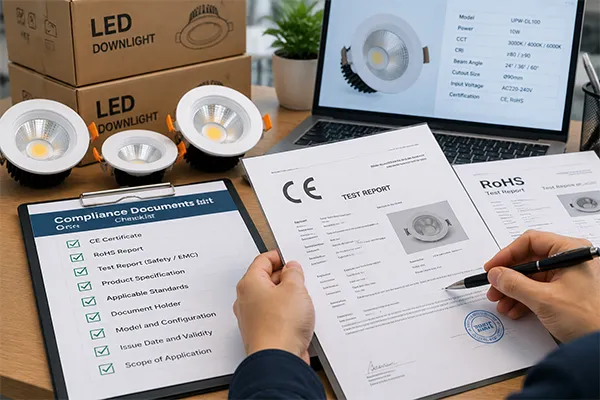
Separate market access from supplier capability
A common procurement mistake is assuming that a certificate answers every supplier-evaluation question. In reality, compliance documentation and manufacturing reliability are related but separate topics.
For example, a buyer may need documents to support import, distribution, or project approval. Yet that same buyer still needs to assess whether the manufacturer can maintain the approved wattage, CCT, driver configuration, labels, and packaging from one production batch to the next.
At Upward Lighting, our products hold certifications such as CE and RoHS. We present these documents as materials buyers should review in relation to their intended market and product configuration. We do not suggest that they replace a buyer’s own regulatory review or technical evaluation.
Use a document-verification checklist
Before accepting any compliance claim, buyers should check:
- Product identity: Does the model on the document match the quoted product?
- Configuration: Does it cover the requested wattage, voltage, driver, and variation?
- Document holder: Is the manufacturer, exporter, or another company named?
- Date and validity: Is the document current enough for the buyer’s process?
- Applicable market: Does it relate to the destination country or sales channel?
- Supporting test information: Is relevant testing available where required?
- Product marking: Will labels and packaging reflect the required information?
Buyers should also consult qualified regulatory, electrical, or project professionals when the installation has specific legal, safety, emergency-lighting, dimming, insulation-contact, or environmental requirements. A manufacturer can provide product information, but the final application decision should reflect local rules and professional evaluation.9
How Should Buyers Define OEM and ODM LED Downlight Requirements?
Vague customization requests create avoidable risk. A buyer may say, “We need a custom downlight,” while the supplier interprets that as a logo change, a different finish, or a different color temperature. OEM and ODM work becomes safer when every requested change is translated into a measurable requirement.
Buyers should define OEM and ODM LED downlight requirements through a written specification that covers performance, appearance, dimensions, packaging, labeling, and acceptance criteria. They should approve samples against that specification and confirm whether each customization affects price, minimum order quantity, tooling, lead time, certification scope, or production risk.
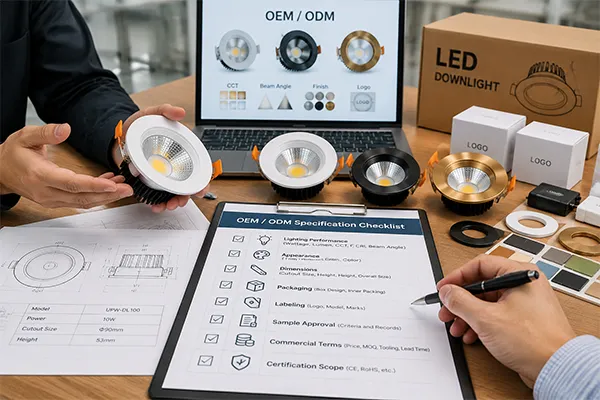
Turn customization into checkable details
Our team regularly supports discussions around CCT, wattage, beam angle, CRI, surface finishes, labeling, and packaging. The strongest projects begin when the buyer gives us a structured requirement rather than scattered messages across email or chat.
A practical LED downlight customization brief may include:
- Target model or reference image
- Ceiling cutout and external dimensions
- Wattage and lumen expectation
- CCT, such as 3000K, 4000K, or tunable options
- CRI requirement
- Beam angle
- Input voltage and frequency
- Dimming requirement, if applicable
- Trim color and surface finish
- IP rating requirement, if applicable
- Brand logo location and artwork file
- Inner box, master carton, barcode, and label rules
- Required accessories
- Inspection and acceptance standard
- Target order quantity and delivery date
Identify changes that affect the commercial decision
Not every customization has the same impact. A finish-color change may be relatively straightforward at a sufficient volume, while a new housing dimension or driver configuration can affect tooling, sourcing, test requirements, and lead time10.
| Customization type | Questions buyers should ask |
|---|---|
| CCT or wattage | Does it affect LED selection, driver choice, efficiency, or lead time? |
| CRI upgrade | What is the performance and price impact? |
| Beam angle | Is a different lens or reflector needed? |
| Surface finish | Is a color sample or color code required? |
| Branding | What artwork format, MOQ, and packaging changes apply? |
| Dimensions | Does the change require new tooling or revised drawings? |
| Dimming | Which dimmers or control protocols are compatible? |
We advise buyers to avoid approving a sample solely because it “looks close enough.” For commercial lighting, a sample should be reviewed against the intended installation, ceiling detail, control system, and visual design. A qualified lighting or electrical professional can help evaluate application-specific fit.
Why Is a Trial Order Important When Choosing LED Downlight Manufacturers?
A first bulk order is often the point where hidden process weaknesses appear. A small trial order cannot eliminate all risk, but it gives buyers a practical opportunity to assess how a supplier performs11 after the sales conversation moves into real production and delivery.
A trial order is important because it lets buyers test LED downlight manufacturers under commercial conditions before committing to larger volume. Buyers can evaluate specification accuracy, product consistency, documentation, packaging, response speed, shipment coordination, and issue handling using a manageable quantity and defined acceptance criteria.
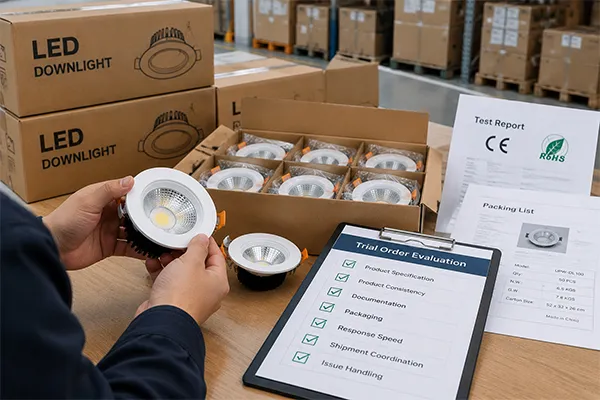
Design the trial order to test real performance
A trial order should be large enough to reveal more than a hand-built sample but small enough to limit exposure. The right quantity depends on the product and project, but the purpose is the same: test the supplier’s repeatability.
We suggest buyers use the trial order to review:
- Product match: Does the delivered product match the approved sample and written specification?
- Consistency: Are CCT, finish, dimensions, and assembly quality reasonably consistent across units?
- Packaging: Do cartons, labels, and internal protection match the agreed requirements?
- Documentation: Are invoices, packing lists, labels, and product records clear and accurate?
- Communication: Does the supplier respond promptly when questions arise?
- Lead time: Did the supplier meet the agreed production and shipping schedule?
- Issue response: If a discrepancy occurs, does the supplier investigate it clearly and propose a practical correction?
Create measurable acceptance criteria
A trial order works best when the buyer defines acceptance criteria before production begins. This helps both parties avoid subjective disputes after goods arrive.
For example, the buyer may confirm:
- Approved model number and finish
- Permitted dimensional tolerance
- CCT and CRI requirements
- Functional test expectations
- Packaging-drop or transit-protection expectations
- Label content and barcode format
- Allowable inspection level or sampling plan
- Photo or video records required before shipment
At Upward Lighting, we support small-batch orders where commercially feasible, and we see them as useful for building a working relationship. Still, buyers should treat any trial as an evaluation stage, not as an automatic guarantee of every future outcome. The next order should retain the same written controls and should address any lessons from the first shipment.
What Questions Should Buyers Ask LED Downlight Manufacturers Before Ordering?
Many supplier problems begin with questions that were never asked. Buyers do not need to overwhelm a factory with paperwork, but they should ask enough focused questions to understand the product, the process, and the commercial commitment.
Before ordering, buyers should ask LED downlight manufacturers how they control approved specifications, manage component changes, inspect production, handle customization, confirm lead times, and respond to quality claims. Clear answers supported by documents, samples, and trial-order performance are more useful than broad assurances.
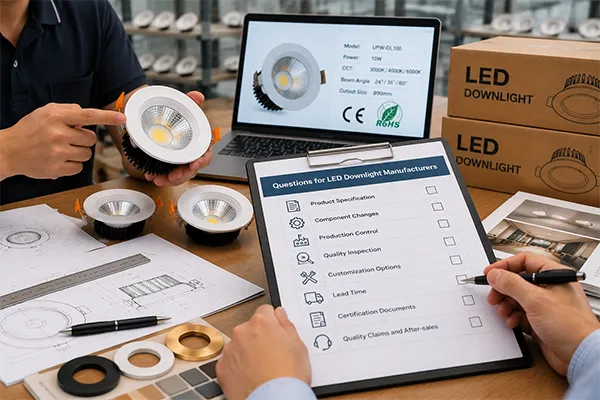
A practical supplier interview list
Here are the questions we believe provide the most useful procurement insight:
- Can you provide a complete datasheet and dimensional drawing for this configuration?
- How will you record the approved sample specification for mass production?
- Which parameters can vary, and which parameters will be controlled?
- What production checks and final inspections do you perform?
- Do you conduct aging tests or functional tests? What is the actual procedure?
- Can you support the requested CCT, CRI, beam angle, finish, and packaging?
- Will customization affect MOQ, cost, lead time, or document scope?
- What is the realistic production lead time for this quantity?
- How will you notify us if a component or production change is necessary?
- What pre-shipment photos, reports, or inspection records can you provide?
- How do you handle confirmed quality claims after delivery?
- Can we begin with a small trial order?
The quality of the answers matters as much as the answers themselves. A capable supplier should be able to explain limitations, not only promises. In our experience, a transparent “we need to confirm this with engineering” is often more valuable than an instant but unsupported answer.
Frequently Asked Questions
How do I compare quotations from LED downlight manufacturers?
Compare quotations using the same written specification, order quantity, packaging requirement, trade term, and lead-time expectation. Review the stated wattage, CCT, CRI, beam angle, driver, finish, and warranty process. A lower quote may reflect a different configuration rather than a better commercial offer.12
Is an approved LED downlight sample enough before a bulk order?
No. An approved sample is an important reference, but it does not prove mass-production consistency. Buyers should document the sample specification, ask how it will be controlled in production, and consider a small trial order to evaluate consistency, packaging, documentation, and delivery performance.
Do CE and RoHS documents prove LED downlight quality?
CE and RoHS documentation may support compliance review for relevant markets, but they do not prove production consistency, delivery reliability, or suitability for every installation. Buyers should verify the documents against the exact product configuration and consult qualified professionals for market-specific or project-specific requirements.
What should be included in an OEM LED downlight specification?
An OEM specification should include model, dimensions, cutout size, wattage, CCT, CRI, beam angle, input voltage, dimming needs, finish, labeling, packaging, accessories, and acceptance criteria. Buyers should also confirm the effect of each customization on MOQ, price, lead time, and documentation.
What is the purpose of a small trial order?
A small trial order lets buyers assess a supplier’s real execution before committing to larger volumes. It can reveal how well the factory follows specifications, protects goods in packaging, provides documents, communicates during production, and handles shipping coordination or unexpected questions.
Conclusion
Choosing among LED downlight manufacturers requires more than finding an attractive sample or the lowest quoted price. Buyers should evaluate total procurement risk by confirming specifications, reviewing relevant compliance documents, understanding quality controls, documenting customization, and testing real performance through a trial order. We believe the best supplier relationships are built on clear requirements and verifiable execution. If you are sourcing downlights, track lights, or office linear lighting, our team at Upward Lighting can help you review a practical OEM/ODM specification and prepare a quotation for your next project.
"8 Ways to Improve Your Supplier Selection Process", https://www.nist.gov/blogs/manufacturing-innovation-blog/8-ways-improve-your-supplier-selection-process. Total-cost-of-ownership approaches to procurement consider acquisition price together with quality, logistics, administration, and failure-related costs that may arise over the purchasing lifecycle. Evidence role: general_support; source type: research. Supports: A source should explain that supplier and purchasing decisions may involve lifecycle or total costs beyond the purchase price, including quality, logistics, and failure-related costs.. Scope note: The relative importance and monetary value of these cost categories depend on the product, contract, and supply chain. ↩
"Luminaires V2 0 Final.pdf", https://www.energystar.gov/sites/default/files/asset/document/Luminaires%20V2%200%20Final.pdf. LED luminaire evaluation commonly considers photometric, color-quality, electrical, thermal, and mechanical characteristics in addition to input power. Evidence role: general_support; source type: government. Supports: A source should document that LED-luminaire performance and suitability depend on multiple electrical, optical, thermal, and mechanical characteristics in addition to nominal wattage.. Scope note: This does not establish that any two particular 12 W downlights differ in every listed characteristic. ↩
"Light Fixture Beam Angles – What are they and Why ...", https://www.ledlightexpert.com/light-fixture-beam-angle?srsltid=AU7gw4VJRtoO1DShpMgC2Sa_uGH1Re-5FEhD_nqIThT1eHw_RPTD5NED. A luminaire’s beam distribution influences the area over which it delivers light and is therefore relevant to fixture spacing and visual-comfort design. Evidence role: mechanism; source type: education. Supports: A source should explain how a luminaire's beam distribution influences illuminance patterns, fixture spacing, and visual-comfort considerations.. Scope note: Glare also depends on luminaire luminance, shielding, viewing geometry, and the surrounding installation. ↩
"Manufacturing", https://www.nist.gov/manufacturing. Quality-management systems distinguish approval of an individual product sample from the ongoing control and monitoring needed to achieve consistent conformity in production. Evidence role: general_support; source type: institution. Supports: A source should support the quality-management principle that conformity in serial production requires controlled and monitored processes, not merely approval of an individual item.. Scope note: The source supports the general quality-management principle and does not assess a particular supplier's production capability. ↩
"Color Maintenance of LEDs in Laboratory and Field Applications", https://betterbuildingssolutioncenter.energy.gov/sites/default/files/attachments/2013_gateway_color-maintenance.pdf. Chromaticity specifications and tolerance limits are used in LED lighting to control color consistency among products intended to appear similar when installed together. Evidence role: mechanism; source type: government. Supports: A source should explain that chromaticity binning or tolerance limits are used to manage perceptible color variation among LED products.. Scope note: Perceived color difference depends on the tolerance applied, adaptation conditions, and the installation environment. ↩
"EU WEEE_RoHS", https://www.trade.gov/eu-weeerohs. For products within their scopes, EU rules establish CE-marking obligations under applicable harmonisation legislation and restrict specified hazardous substances in electrical and electronic equipment under RoHS. Evidence role: definition; source type: government. Supports: A source should define CE marking obligations for applicable EU-harmonised products and the RoHS restrictions applicable to electrical and electronic equipment.. Scope note: Applicability depends on the exact product, applicable legislation, and the market in which it is placed. ↩
"CE marking", https://en.wikipedia.org/wiki/CE_marking. CE marking and RoHS compliance address defined regulatory requirements; they are not, by themselves, a general certification of manufacturing reliability or suitability for every installation. Evidence role: definition; source type: government. Supports: A source should clarify that CE marking and RoHS compliance address specified legal requirements rather than a general guarantee of product quality or fitness for every use.. Scope note: Additional product, safety, and application requirements may apply depending on the intended use and jurisdiction. ↩
"EU - EU Legislation and CE Marking", https://www.trade.gov/country-commercial-guides/eu-eu-legislation-and-ce-marking. Conformity assessment begins by identifying the legal and technical requirements applicable to the specific product and the market where it will be placed. Evidence role: general_support; source type: institution. Supports: A source should show that conformity assessment requires identifying applicable requirements for the particular product and market.. Scope note: The applicable requirements cannot be determined from product category alone and may change with product features and national rules. ↩
"Title 26 Electrical Regulations", https://www.portland.gov/code/26/all. Electrical installations are governed by applicable local requirements, and work involving electrical safety should be assessed or performed by appropriately qualified persons as required by those rules. Evidence role: expert_consensus; source type: government. Supports: A source should support the principle that electrical installations are subject to applicable local requirements and should be evaluated or performed by qualified persons where required.. Scope note: Specific licensing, inspection, and design obligations vary by jurisdiction and project. ↩
"Supply Chain Management", https://www.nist.gov/mep/supply-chain. Manufacturing engineering literature recognizes that product-design changes may require tooling changes, component qualification, verification testing, and revised production schedules. Evidence role: mechanism; source type: research. Supports: A source should explain that engineering changes can propagate into tooling, supply-chain qualification, verification testing, and schedule changes.. Scope note: The scale of these effects depends on the design change, existing manufacturing capability, and supplier arrangements. ↩
"Supplier selection and order allocation: a literature review - PMC", https://pmc.ncbi.nlm.nih.gov/articles/PMC8127846/. Pilot production and initial supplier evaluation can provide evidence about process and delivery performance before a broader commitment, while leaving residual risks that require ongoing controls. Evidence role: general_support; source type: research. Supports: A source should support the use of pilot production or initial-order evaluation to obtain evidence of supplier and process performance before broader deployment.. Scope note: A limited trial may not reveal rare defects, future component changes, or performance under substantially larger volumes. ↩
"15.404-1 Proposal analysis techniques.", https://www.acquisition.gov/far/15.404-1. Sound procurement evaluation compares offers against common specifications and relevant non-price criteria, because price differences may reflect differences in what is being supplied. Evidence role: general_support; source type: government. Supports: A source should support evaluating bids against common specifications and non-price criteria so that price differences are interpreted in context.. Scope note: The appropriate evaluation method and weighting depend on the procurement rules and the buyer’s requirements. ↩