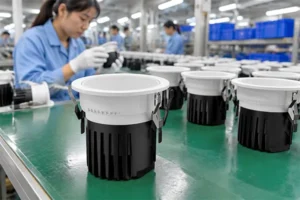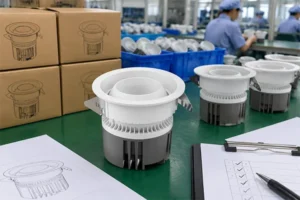

LED downlight manufacturers can look similar on a quotation sheet, yet long-term purchasing problems often appear after the first order. A low price, attractive sample, or fast promise can turn into inconsistent specifications, delayed replenishment, or unclear responsibility. I recommend comparing suppliers as long-term operational partners, not simply as product vendors.
To compare LED downlight manufacturers for long-term cooperation, buyers should assess production consistency, specification control, quality-control evidence, compliance fit, delivery communication, and total procurement cost. A good sample and low unit price are useful starting points, but they do not prove that a supplier can deliver the same approved configuration reliably across repeat orders and changing project requirements.1
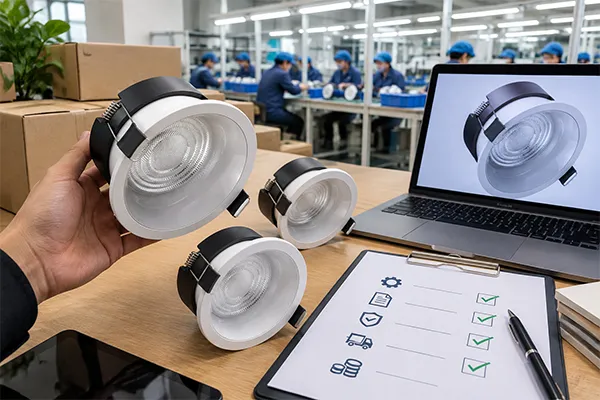
In my day-to-day discussions with overseas buyers, I see the same concern repeatedly: buyers do not only need a downlight that works today. They need a supplier that can support repeat purchasing, OEM adjustments, project schedules, and documentation requirements without creating avoidable risk.
Why Should You Compare LED Downlight Manufacturers Beyond Price and Samples?
A low quotation can create pressure to decide quickly, especially when a buyer needs to protect margin or meet a project budget. However, price-only comparisons can hide differences in component selection, production control, communication speed, and order support. I encourage buyers to look beyond the first sample and first purchase order.
Buyers should compare LED downlight manufacturers beyond price and samples because long-term supply depends on repeatable production, stable specifications, transparent lead times, and clear issue handling. A sample confirms a starting point, while a supplier’s processes indicate whether the same configuration can be maintained in mass production and future replenishment orders.
A Sample Is a Reference Point, Not a Complete Supplier Assessment
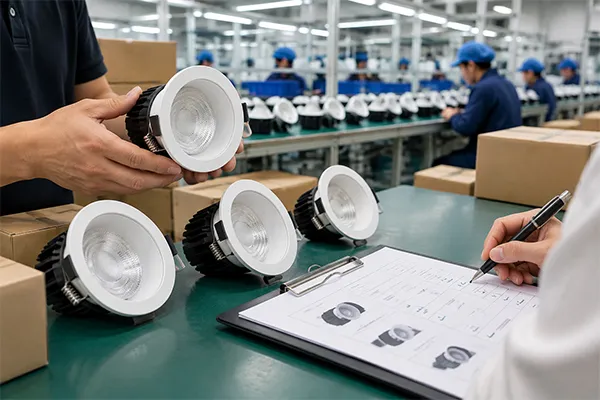
A product sample remains important. It allows me and the buyer to discuss appearance, installation, light distribution, packaging, color temperature, and perceived build quality using a physical reference. Still, one sample does not show every condition that matters in a repeat-order relationship.
For example, a buyer may approve a 12W recessed LED downlight with a 3000K color temperature, a 60-degree beam angle, and a white surface finish. The supplier must then ensure that these details remain controlled when the order moves from a few samples to hundreds or thousands of units.
A useful question to ask a supplier is:
“How do you confirm that the approved sample specification will be applied to mass production and repeat orders?”
I suggest that buyers request observable proof points rather than general assurances. These can include:
- A written product specification sheet
- An approved sample record or signed sample confirmation
- Clear product photos showing the agreed trim, finish, driver label, and packaging
- A bill of materials or controlled component description where appropriate
- Production order confirmation before manufacturing begins
- Defined procedures for handling requested changes
- Pre-shipment inspection or aging-test records where the supplier makes them available
Compare the Cost of Disruption, Not Only the Unit Price
The lowest unit price may not be the lowest total procurement cost.2 A small saving per downlight can lose its value if a supplier causes project delays, repeated communication, unsellable inventory, or an urgent air shipment.
| Cost area | Low-price-only approach | Long-term supplier comparison |
|---|---|---|
| Unit price | Focuses on the first quoted price | Reviews price alongside consistency and service scope |
| Lead time | May rely on verbal estimates | Requires written production and shipment timing |
| Replenishment | May be uncertain after the first order | Assesses repeat-order planning and component continuity |
| Specification changes | May be handled informally | Requires documented approval and version control |
| Quality disputes | May lack an agreed response route | Reviews inspection evidence and exception handling |
| Compliance | May assume certificates apply | Verifies documents against the exact market and configuration |
In our team’s recurring quotation discussions, buyers often ask for a fast price first. That is understandable. I also suggest that they ask what is included in the quote: product configuration, driver type, packaging, labeling, testing, export terms, and expected production lead time. This creates a more meaningful comparison between LED downlight manufacturers.
How Can Buyers Verify Production Consistency From Sample to Repeat Orders?
Buyers often worry that a supplier’s first sample will not match later production. That concern becomes more serious for wholesalers, local brands, and contractors who need matching light output, color appearance, trim design, and installation details across multiple orders. I believe the solution begins with documented controls.
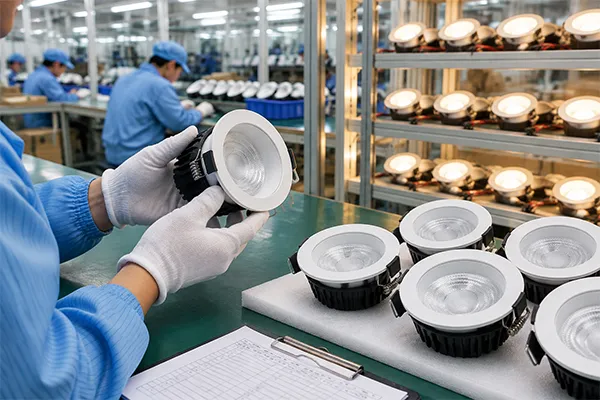
Buyers can verify production consistency by asking LED downlight manufacturers how they lock approved specifications, inspect incoming materials, conduct assembly checks, perform aging tests, and manage repeat-order records. The goal is not to demand perfection, but to understand how the supplier reduces variation and responds when an issue is identified.
Start With a Controlled Specification
Every long-term supply relationship needs a shared version of the product specification. I have found that many disagreements arise because one party considers a detail “understood,” while the other party did not record it clearly.
For an LED downlight, a specification confirmation should normally address relevant points such as:
- Product model and cutout size
- Wattage and input voltage
- Color temperature, such as 3000K, 4000K, or 6500K
- Color Rendering Index (CRI)
- Beam angle
- Lumen target or light-output requirement, if applicable
- Driver configuration and dimming requirement
- Housing material and surface color
- IP rating where required
- Trim shape and dimensions
- Packaging, labels, barcode, manuals, and carton marks
- Destination market and applicable document requirements
For OEM or ODM programs, I recommend treating this information as a controlled product file. If the buyer changes the beam angle, finish, or packaging artwork, both parties should confirm which order the change applies to.3 This protects buyers from receiving a mixture of old and new configurations.
Ask About Quality-Control Steps in Practical Terms
I do not think buyers need to act as laboratory auditors. However, they should ask suppliers to explain their normal production checks in clear commercial language.
At Upward Lighting, our team states that each product undergoes a 100% aging test of approximately 4 to 8 hours before shipment. Buyers should still ask what an aging test covers, how the supplier records it, and whether the method is suitable for their own procurement requirements. An aging test is one part of a quality-control process; it is not a complete guarantee of all field performance.4
A practical supplier discussion can cover:
-
Incoming material checks
How does the supplier check key components such as LED modules, drivers, housings, springs, reflectors, and packaging materials? -
In-process checks
At what stage does the team inspect assembly, wiring, appearance, and product labeling? -
Aging and functional checks
Does the supplier conduct aging, power-on checks, or other functional verification before shipment? -
Final inspection
How does the supplier check quantities, appearance, packaging, and carton markings before dispatch? -
Nonconforming-product handling
What happens if workers identify a visible issue or configuration mismatch during production?
Evaluate Repeat-Order Readiness
A supplier may make a successful first production run but struggle when buyers reorder six months later. Component availability, packaging stock, and internal order records can affect repeat-order consistency.5
I suggest asking:
- Can the supplier retrieve the approved specification for a repeat order?
- Will the supplier notify the buyer if a material or component needs to change?
- Does the supplier require written approval before substituting a driver, LED source, or finish?
- How does the supplier distinguish between similar models with different CCTs, wattages, or cutout sizes?
These questions help a buyer assess whether the manufacturer has processes that support stable procurement rather than one-off transactions.
What Should Buyers Check in OEM and ODM LED Downlight Manufacturers?
“Customization available” is easy to say, but meaningful OEM or ODM support requires much more than changing a color or printing a logo. Buyers need a manufacturer that can document requested changes, confirm feasibility, and control approved versions through production. I recommend evaluating the process behind the customization claim.
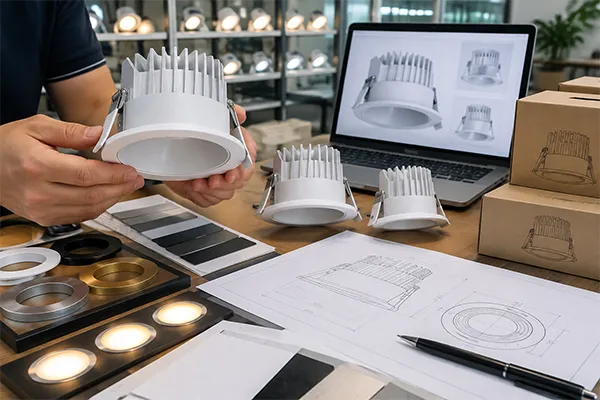
Buyers should assess OEM and ODM LED downlight manufacturers by reviewing how they document and approve changes to wattage, CCT, CRI, beam angle, finish, packaging, labels, and product markings. Reliable customization depends on written confirmation, sample approval, change management, and realistic production planning.
Define the Type of Customization Needed
Not every customized downlight program carries the same risk. A buyer should separate simple configurable options from changes that may affect tooling, sourcing, compliance documents, lead time, or minimum order quantity.
| Customization area | Typical buyer question | Procurement consideration |
|---|---|---|
| CCT | Can I order 3000K and 4000K? | Confirm labeling and separation of variants |
| Wattage | Can the output be adjusted? | Review driver and thermal design implications |
| Beam angle | Is a narrow or wide beam available? | Confirm reflector or lens configuration |
| CRI | Can the product meet a requested CRI level? | Request the exact configured product details |
| Surface finish | Can I order black, white, or custom colors? | Confirm finish samples and batch consistency |
| Branding | Can my logo appear on labels or packaging? | Approve artwork, placement, and print details |
| Packaging | Can cartons include local-language inserts? | Verify artwork version and packing method |
A useful question to ask a supplier is: “Which of these changes are standard options, and which require new development, sourcing, or approval?”
This distinction matters. For example, a standard black trim may be relatively straightforward if it is already part of the supplier’s product range. A custom housing design, private mold, or special driver requirement may require a different timeline and commercial arrangement.6
Use a Written Change-Management Process
In my experience, buyers reduce risk when they avoid informal change requests through fragmented messages. I recommend that each change be recorded in a revised specification sheet, purchase-order note, approved drawing, or email confirmation that both parties can retrieve later.
A basic change-management workflow can look like this:
- The buyer sends a written request with the exact product model and required change.
- The supplier confirms technical feasibility, commercial impact, and timing.
- The supplier issues an updated specification, drawing, photo, or sample where needed.
- The buyer approves the updated version in writing.
- The supplier applies the approved version to the identified production order.
- The supplier confirms whether the change also applies to future repeat orders.
This process may seem formal for a small batch. However, it becomes especially valuable when a distributor manages several SKUs or when a project contractor must match a schedule and approved lighting schedule.
How Should Buyers Verify Certifications and Market Compliance?
Compliance documents can influence whether goods clear customs, meet tender requirements, or fit a buyer’s sales channel. However, I do not recommend treating CE, RoHS, or any single document as automatic proof of overall product quality or universal market suitability. Buyers need to check relevance and validity.
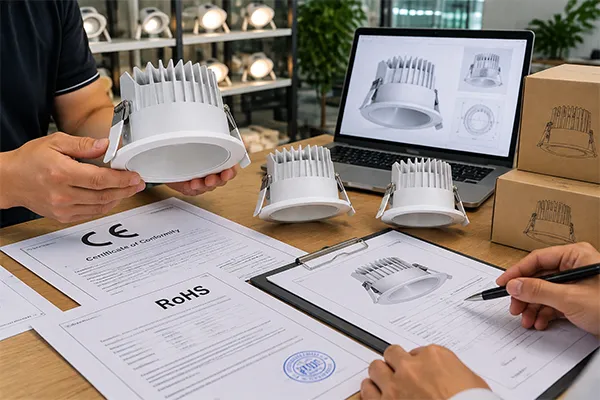
Buyers should verify certifications by matching the document, product configuration, destination market, and applicable regulatory requirements.7 LED downlight manufacturers can provide supporting documents, but buyers should confirm that certificates and declarations cover the exact product family, electrical configuration, and market-entry needs for their intended sale or installation.
Match Documents to the Exact Product
At Upward Lighting, our products hold certifications such as CE and RoHS. These documents may support relevant market-entry requirements, but each buyer should independently verify whether the available documents match the intended destination and exact product configuration.
For example, a buyer should not assume that a document for one downlight automatically applies to a different wattage, driver, dimming version, or redesigned housing.8 The buyer should ask the supplier to identify:
- The product model shown on the document
- The manufacturer or applicant name
- The issue date and document status
- The relevant standards or directives referenced
- Whether the document covers the proposed voltage and driver option
- Whether the product description matches the intended configuration
- Whether the destination market requires additional registration, labeling, testing, or local approval
Treat Compliance as a Shared Procurement Task
The manufacturer can support document collection, technical clarification, labels, and packaging information. However, importers, distributors, and project contractors often retain responsibility for ensuring that goods meet local rules and contract conditions.9
I encourage buyers to involve a qualified compliance professional, local testing body, consultant, or legal adviser when the application has specific regulatory exposure. This is particularly important for public projects, hospitality work, commercial buildings, or markets with detailed electrical and product-safety requirements.
A certificate is evidence to review, not a substitute for product-market verification.
Buyers should also consider product traceability. A carton label, product label, batch reference, or order reference can make it easier to identify which goods belong to which purchase order if a question arises later.10
Which Commercial Terms Reveal Whether a Supplier Supports Long-Term Cooperation?
Many buyers focus on technical details but leave communication and commercial terms until late in the process. This can create friction when a supplier’s quotation response is slow, the production schedule changes, or a replacement discussion becomes necessary. I consider these operational details central to supplier evaluation.
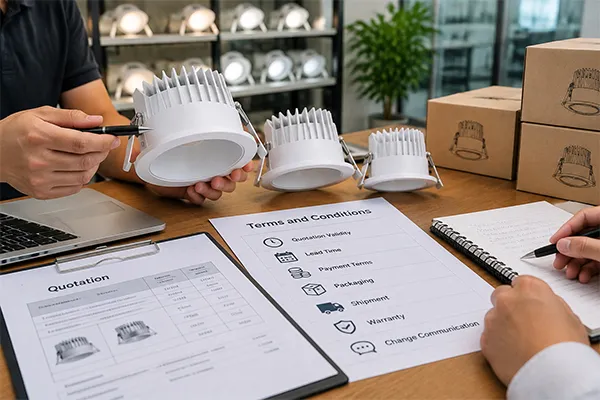
Long-term cooperation depends on commercial terms that clarify quotation validity, lead times, payment conditions, packaging, shipment responsibilities, warranty handling, and change communication. Buyers should compare LED downlight manufacturers by how clearly they explain these terms before an order, not only by what they promise after a problem occurs.
Evaluate Communication Before You Place a Large Order
I often tell buyers that the quotation stage is an early test of working style. If a supplier cannot clarify a basic product configuration before the order, that same lack of clarity may continue during production.
Buyers can observe whether the supplier:
- Responds to technical questions with specific answers
- Separates confirmed information from assumptions
- Provides a complete quotation with model, quantity, price basis, and lead-time indication
- Identifies questions that require buyer confirmation
- Explains likely constraints, such as custom packaging lead time
- Updates the buyer if material availability affects the schedule
- Maintains a consistent contact person or communication route
Fast replies alone do not prove reliability.11 Still, structured and transparent replies can show that the supplier has a workable process.
Build a Supplier Comparison Scorecard
A scorecard can help buyers avoid selecting a supplier based only on the most attractive first price. I recommend assigning weights based on the buyer’s own business model.
| Evaluation area | Example buyer evidence to request | Suggested importance |
|---|---|---|
| Product specification control | Specification sheet, sample approval process | High |
| Production and QC process | Explanation of checks, aging-test approach, inspection records | High |
| Compliance fit | Product-specific documents and market matching | High |
| Lead-time communication | Written timeline and update method | High |
| OEM/ODM capability | Change-control method and sample process | Medium to high |
| Commercial terms | Payment, Incoterms, packaging, claims process | Medium |
| Unit price | Comparable configuration and trade terms | Medium |
| Small-batch flexibility | MOQ and setup requirements | Depends on buyer model |
For a project contractor, delivery coordination and specification consistency may carry the highest weight. For a wholesaler, replenishment stability, packaging, and SKU management may matter more. For a local lighting brand, OEM documentation and controlled branding details may become central.
I recommend that buyers document the basis of their decision. This creates a clearer internal procurement record and helps teams review supplier performance after the first orders.
Frequently Asked Questions
Is a low-priced LED downlight always a poor choice?
No. A competitive price can be commercially valid when the product configuration, quality-control process, compliance documents, lead time, and order terms are clearly understood. I suggest comparing like-for-like quotations and assessing the possible cost of delays, rework, claims, and unstable replenishment.
How many samples should I request from an LED downlight manufacturer?
The right number depends on the product range and application. Buyers often need samples for appearance, installation, light effect, packaging, and customer approval. I recommend confirming whether the approved sample represents the exact mass-production configuration, including driver, CCT, beam angle, finish, and labels.
Does CE or RoHS prove an LED downlight is suitable for every market?
No. CE and RoHS documentation may be relevant evidence for certain requirements, but they do not automatically confirm suitability for every destination, installation, or product variant. Buyers should verify document scope, destination-market rules, and the exact product configuration with qualified professionals where needed.
What should an OEM LED downlight specification include?
An OEM specification should include the model, wattage, voltage, CCT, CRI, beam angle, cutout size, finish, driver type, dimming requirement, labels, branding, packaging, and approved drawings or photos where relevant. I also recommend recording effective dates for any changes.
How can I assess a supplier’s repeat-order capability?
Buyers should ask how the supplier stores approved specifications, handles component changes, confirms reorder configurations, and communicates lead-time changes. A supplier should be able to explain how it identifies the correct version of a product and how it requests approval before making material substitutions.
Conclusion
Comparing LED downlight manufacturers for long-term cooperation requires more than reviewing a sample and negotiating the lowest price. I recommend that buyers examine specification control, sample-to-production consistency, quality-control practices, certification matching, OEM change management, lead-time communication, and commercial terms. These factors help reduce procurement risk across repeat orders and project delivery. If you are evaluating a downlight supplier or planning an OEM/ODM program, I invite you to prepare a clear product brief and request written confirmation of every critical requirement before placing your next order.
"Manufacturing", https://www.nist.gov/manufacturing. ISO quality-management guidance describes the need to control production information and monitor process outputs, supporting the distinction between approval of an initial sample and evidence of continuing production conformity. Evidence role: general_support; source type: institution. Supports: Quality-management systems require controlled production information and monitoring; an initial sample alone is not evidence that subsequent production will remain conforming.. Scope note: This supports the general quality-management principle rather than evaluating any particular LED-downlight supplier. ↩
"Implementing the OECD Recommendation on Public ...", https://www.oecd.org/en/publications/implementing-the-oecd-recommendation-on-public-procurement-in-oecd-and-partner-countries_02a46a58-en/full-report/implementation-of-the-oecd-recommendation-in-member-and-partner-countries_2305bb1b.html. Public-procurement guidance on total cost of ownership explains that purchase price is only one component of procurement cost, alongside costs such as operation, logistics, maintenance, and risk. Evidence role: general_support; source type: government. Supports: Total-cost-of-ownership procurement methods consider operating, logistics, maintenance, risk, and end-of-life costs in addition to acquisition price.. Scope note: The relevant cost categories and their magnitude depend on the buyer's contract terms, product application, and supply chain. ↩
"Configuration Management (CM)", https://www.fedramp.gov/2026/reference/controls/configuration-management/. Configuration-management guidance explains that documented change control maintains an approved product baseline and records the applicability of changes to defined configurations. Evidence role: mechanism; source type: government. Supports: Configuration-management practice uses documented change control to preserve the identity and traceability of approved product versions.. Scope note: Such guidance establishes a general control method and does not prescribe the exact documents required for every lighting purchase. ↩
"8.3.1.4. Accelerated life tests", https://www.itl.nist.gov/div898/handbook/apr/section3/apr314.htm. Reliability literature distinguishes burn-in and accelerated testing from complete prediction of field life, because in-service performance depends on operating conditions, failure mechanisms, and test design. Evidence role: mechanism; source type: research. Supports: Burn-in and accelerated testing can identify some early failures and inform reliability assessment, but test results do not fully determine all real-world lifetime outcomes.. Scope note: The strength of any inference depends on the duration, electrical and thermal conditions, sample size, and documented method of the aging test. ↩
"Supply chain disruptions and resilience: a major review ... - PMC", https://pmc.ncbi.nlm.nih.gov/articles/PMC7792559/. Supply-chain and quality-management research indicates that component disruptions may require substitutions or redesigns, making controlled records and traceability important for maintaining product configuration across later orders. Evidence role: general_support; source type: research. Supports: Component disruptions can lead to substitutions or production changes, while documented production information and traceability help preserve configuration consistency.. Scope note: This evidence supports the operational risk generally and does not show that all component shortages produce nonconforming repeat orders. ↩
"How Smaller Manufacturers Can Take Advantage ...", https://www.nist.gov/blogs/manufacturing-innovation-blog/how-smaller-manufacturers-can-take-advantage-additive. Manufacturing education materials describe how custom tooling and component development add design, fabrication, testing, and qualification steps beyond those needed for an existing standard option. Evidence role: mechanism; source type: education. Supports: Custom components and tooling require design, validation, fabrication, and qualification activities that can add lead time and cost.. Scope note: Actual timing and commercial terms vary with tooling complexity, supplier capacity, certification needs, and order volume. ↩
"EU - EU Legislation and CE Marking", https://www.trade.gov/country-commercial-guides/eu-eu-legislation-and-ce-marking. The European Commission's Blue Guide states that CE marking follows assessment against the applicable Union legislation and technical documentation for the product placed on the market. Evidence role: expert_consensus; source type: government. Supports: EU conformity assessment requires manufacturers to identify applicable legislation, assess the relevant product, and maintain technical documentation supporting conformity.. Scope note: CE-marking rules address the EU framework; other destination markets may impose different testing, labeling, registration, or approval requirements. ↩
"CE marking – obtaining the certificate, EU requirements", https://europa.eu/youreurope/business/product-rules-compliance/general-product-compliance/ce-marking/index_en.htm. EU product-compliance guidance explains that technical documentation and conformity assessment must relate to the product placed on the market, with substantial modifications potentially requiring renewed assessment of applicable obligations. Evidence role: definition; source type: government. Supports: A product's conformity assessment and technical documentation must correspond to the product as placed on the market, and substantial modifications can affect conformity obligations.. Scope note: Whether a specific wattage, driver, dimming, or housing change is substantial depends on the applicable law, standards, and technical effect of the modification. ↩
"EU - EU Legislation and CE Marking", https://www.trade.gov/country-commercial-guides/eu-eu-legislation-and-ce-marking. The European Commission's Blue Guide describes due-diligence and traceability obligations for importers and distributors when products are placed or made available on the EU market. Evidence role: expert_consensus; source type: government. Supports: Under EU product law, importers and distributors have defined obligations to ensure or verify that products meet relevant conformity, documentation, and traceability requirements.. Scope note: A project contractor's duties depend on its legal role, the jurisdiction, and the contract; contractor obligations are not identical to importer or distributor obligations in every market. ↩
"Guide to Batch Number Requirements in the EU", https://www.compliancegate.com/batch-numbers-european-union/. EU product-traceability guidance identifies product type, batch or serial information, and economic-operator details as mechanisms that enable products to be identified when safety or conformity questions arise. Evidence role: mechanism; source type: government. Supports: Product identification and traceability information help economic operators identify affected goods and support corrective action or investigation.. Scope note: The required identifier and retention period depend on the product category and the law of the destination market. ↩
"Supplier Selection and Assessment: Their Impact on Business ...", https://digitalcommons.usu.edu/cgi/viewcontent.cgi?article=1270&context=manage_facpub. Multi-criteria supplier-selection research treats supplier performance as a combination of factors such as quality, delivery reliability, cost, capability, and service, rather than a single responsiveness measure. Evidence role: general_support; source type: paper. Supports: Supplier-selection research commonly evaluates suppliers using multiple criteria, including quality, delivery, cost, capability, and service, rather than response speed alone.. Scope note: The relative importance of response speed and other criteria varies by purchasing context, product criticality, and project schedule. ↩