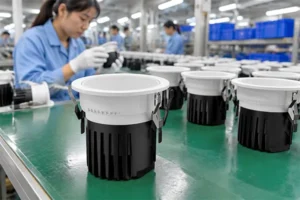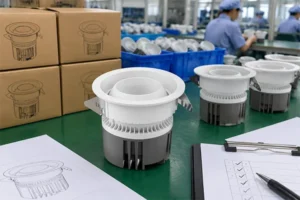

Choosing an LED downlight manufacturer can feel difficult when every supplier promises quality, customization, and competitive pricing. A low unit quote may hide coordination gaps, while direct sourcing may demand more buyer involvement. We believe the right choice depends on your product requirements, repeat-order plans, and ability to manage suppliers.
An LED downlight manufacturer is usually the better sourcing partner when you need customized specifications, private-label control, repeat-order consistency, and direct quality accountability. A trading company can be more practical when you need to consolidate products from multiple factories, place fragmented small orders, or simplify communication, logistics, and payment coordination. Buyers should compare total sourcing risk—not only the quoted unit price—before deciding.
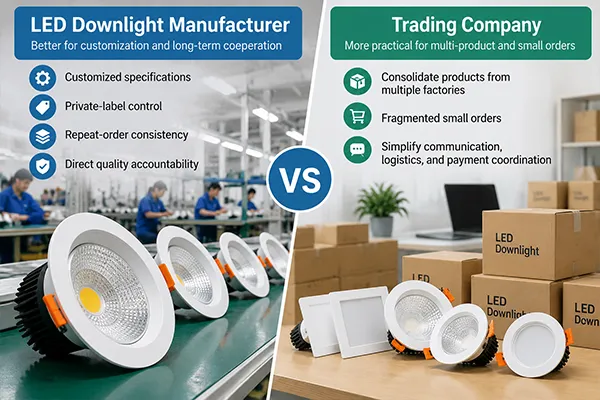
The choice is not simply “factory versus middleman.” In our experience as a Zhongshan-based lighting producer, each model can solve a different procurement problem. The key is to understand who controls specifications, who coordinates production, and who remains responsible if a batch does not match the approved sample.
When Is an LED Downlight Manufacturer the Better Choice?
Buyers often need more than a standard recessed light. They may require a different CCT, higher CRI, custom trim color, branded packaging, or project-specific wattage. Without a direct route to production, every adjustment can create extra communication steps and opportunities for misunderstanding.
An LED downlight manufacturer is generally the stronger option when a buyer needs specification changes, direct sample feedback, private-label development, and clear responsibility for production quality. Direct communication can shorten the loop between the buyer’s technical requirement, the factory’s engineering review, sample confirmation, mass production, and corrective action if issues arise.
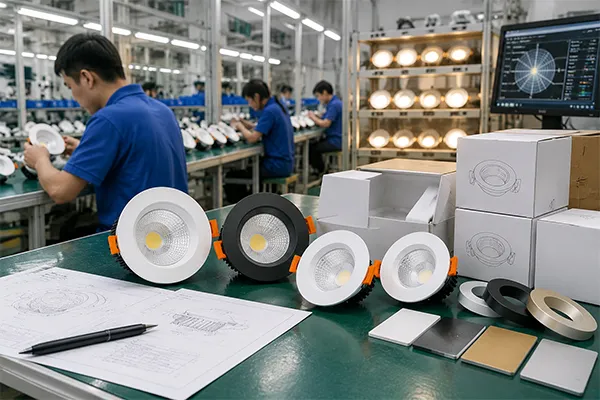
Customization Needs a Clear Technical Owner
For customized LED downlights, the most important question is not “Who gave the lowest quote?” It is “Who owns the technical specification?”
A complete product specification may include:
- Color temperature: 2700K, 3000K, 4000K, 5000K, or another requested option
- Wattage and actual power tolerance
- Beam angle: such as narrow, medium, or wide distribution
- CRI requirements: for example, CRI 80 or CRI 90 depending on the project
- Driver input requirements: voltage range, dimming method, or flicker expectations
- Housing finish: white, black, brushed finishes, or custom painted colors
- Cutout size and installation method
- Packaging and labeling
- Market compliance documents
When we support an OEM or ODM inquiry, we normally need to confirm these items before a buyer can compare offers properly. A request such as “same downlight but 12W” sounds simple, but it may affect thermal design, driver selection, lumen output, heat management, packaging labels, and testing requirements.1
In one anonymized situation, a buyer requested a warmer CCT for a hospitality project while also increasing the requested CRI. The change affected more than the LED source. We also needed to review output expectations and sample performance. A direct manufacturing conversation helped the buyer identify those linked decisions before mass production.
Direct Access Can Improve Traceability
Direct sourcing does not guarantee a successful order.2 However, it can provide a clearer path for asking questions about materials, assembly, testing, and production records.
Buyers should ask an LED downlight manufacturer for evidence that is relevant to the order, such as:
| Evaluation Area | Questions Buyers Should Ask | Useful Evidence to Request |
|---|---|---|
| Product specification | Which components match the approved sample? | Signed specification sheet, BOM summary where appropriate |
| Quality process | What tests are performed before shipment? | Aging records, inspection checklist, test reports |
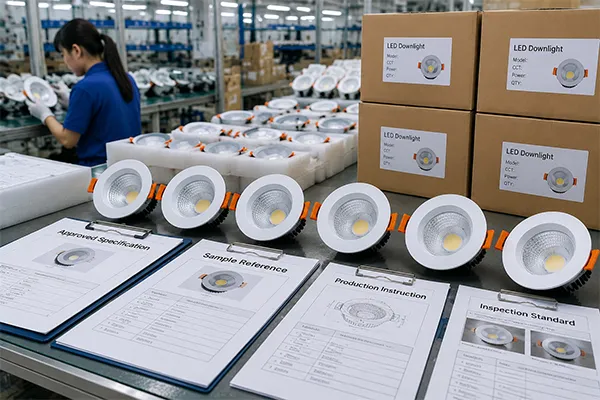
| Production control | How will the factory prevent specification drift? | Approved sample reference, production instructions |
| Compliance | Which documents apply to this exact model and market? | Certificate copies, test reports, declaration documents |
| Packaging | How will branding and labels be checked? | Packaging artwork approval, carton markings |
At Upward Lighting, we conduct a 100% aging test before shipment, generally lasting between 4 and 8 hours.3 Buyers should still clarify what the aging process covers, how records are kept, and whether any additional third-party inspection is needed for their order. An aging test is one quality-control step. It does not replace a complete product evaluation or application-specific professional review.4
When Direct Factory Contact Is Worth the Extra Work
A direct manufacturer relationship often makes the most sense for buyers who have:
- A repeatable LED downlight range.
- A defined market or customer segment.
- Internal staff who can review specifications and samples.
- Plans to build a branded lighting line.
- A need for stable product parameters across repeated purchases.
For these buyers, the additional effort of communicating with a factory may create more control over the finished product and a more useful long-term working relationship.
How Does an LED Downlight Manufacturer Support Repeat Orders?
A successful first order does not automatically create a stable product line. Repeat purchasing introduces new risks, including changes in components, supplier availability, packaging revisions, or unclear records from the original sample approval.5 These details matter most when a local brand or distributor depends on a consistent market offering.
An LED downlight manufacturer can support repeat orders by maintaining approved specifications, sample references, production instructions, component requirements, and inspection expectations. This structure is especially valuable for buyers building private-label ranges, supplying projects over time, or replenishing stock that must remain compatible with earlier deliveries.
Repeatability Is More Valuable Than a One-Time Quote
We often hear from buyers who initially focus on the first container, first project, or first small trial order. That is understandable. Yet a purchasing manager should also ask what happens six or twelve months later.
A repeat-order plan should clarify:
- Which product version was approved
- Which CCT, wattage, CRI, and beam angle apply
- Whether the driver model can change without notice
- Whether LED source changes require buyer approval
- Which finish standard applies
- Which packaging artwork is the current version
- How quality claims will be documented and handled
For a branded product line, consistency is part of the product itself. If a distributor sells a 3000K black anti-glare downlight under its own brand, the next shipment should match the expected appearance, cutout, lighting effect, and labeling requirements as closely as practical.
A Controlled Approval Process Reduces Ambiguity
In our experience, many preventable sourcing disputes start with an incomplete sample approval process. A buyer approves a sample informally, but the confirmed wattage, color temperature, driver requirement, or carton design is not written into a usable production record.
We recommend that buyers use a simple approval sequence:
-
Issue a written product brief.
Include target parameters, target market, expected quantity, and intended application. -
Review the quotation carefully.
Confirm what is included and what remains subject to final sample approval. -
Approve a labeled pre-production sample.
The sample should identify the model, key parameters, and revision where possible. -
Confirm packaging and labeling.
This is especially important for private-label LED downlights. -
Agree on inspection requirements.
Define critical checks before the order enters production. -
Maintain records for replenishment.
Keep approved documents with the purchase order and sample history.
A repeat-order system does not mean that no component can ever change. It means that the supplier and buyer have a process for reviewing changes before they create a market problem.
Manufacturing Visibility and Long-Term Accountability
An LED downlight manufacturer may be able to provide more direct production visibility because the team responsible for quotation, sampling, production coordination, and quality control is closer to the assembly process. Still, buyers should verify how each supplier actually operates.
A company may own some production steps while outsourcing others. Another may offer excellent engineering support but have limited capacity during peak periods. These are not automatic warnings. They are issues to clarify during supplier evaluation.
For projects we support, we find that transparency works best when both parties discuss the order honestly: required quantity, delivery window, customization depth, and required documentation. A qualified third-party inspector can also help buyers review goods against the approved specification before shipment6, particularly when the order is technically complex or commercially important.
When Can a Trading Company Be the More Practical Partner?
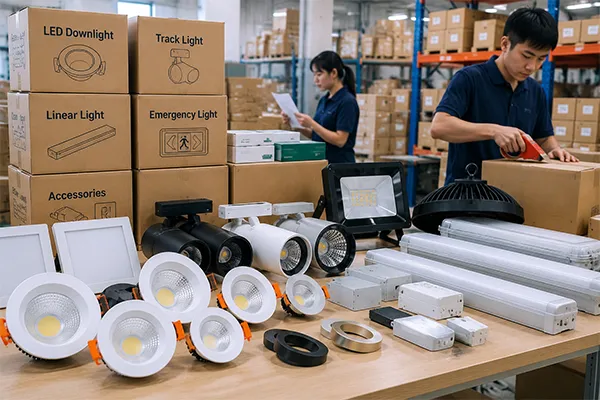
Direct purchasing from several factories can create a heavy management burden. A buyer may need downlights, track lights, linear office lights, emergency lighting, switches, or accessories from different production specialists. Managing every supplier separately can consume time and increase logistics complexity.
A trading company can be the better choice when buyers need multi-category consolidation, small-order coordination, logistics support, flexible payment handling, or a single communication point across several factories.7 The trading company’s value may come from supplier management and purchasing convenience rather than from manufacturing ownership.
Consolidation Can Solve a Real Procurement Problem
A trading company should not be dismissed as simply an extra cost layer. A capable trading partner can reduce complexity for a buyer that does not want to manage several factory relationships.
For example, an importer may need:
- LED downlights from one specialized factory
- Track lights from another supplier
- Office linear lights from a third source
- Decorative fixtures from a separate vendor
- Mixed cartons, accessories, and consolidated export paperwork
If each product category has a different supplier, the buyer must otherwise coordinate multiple quotations, deposits, production schedules, inspections, shipping marks, and freight arrangements. A trading company may offer a simpler interface.
This approach can be useful when the buyer has limited procurement staff or is testing several categories before committing to long-term product development.
The Right Trading Company Adds Coordination Value
Not every trading company provides the same level of service. Buyers should assess whether the company contributes meaningful coordination and technical support.
A capable trading partner may help with:
| Service Area | Potential Value for the Buyer |
|---|---|
| Supplier selection | Identifying factories suited to different categories |
| Product consolidation | Combining goods from multiple sources |
| Communication | Managing language, follow-up, and documentation |
| Quality coordination | Arranging inspections and following up on findings |
| Logistics | Combining shipments and export documents |
| Small orders | Handling fragmented purchases that factories may not prioritize |
| Payment administration | Simplifying payment arrangements across suppliers |
However, buyers should ask precise questions. Who is responsible if the LED downlight fails the agreed specification? Can the buyer review factory information? Who holds the certification documents? Does the trader understand the technical parameters, or does it only forward messages?
Standard Products Often Fit the Trading Model Well
A trading company may be particularly suitable when the buyer is purchasing standard products with limited modification. For example, a wholesaler may need established models in common wattages and CCT options, with no private-label packaging and no complex application requirements.
In that case, the buyer may value:
- Faster supplier coordination
- Broader category access
- Lower administrative workload
- Easier shipment consolidation
- A single contact for mixed purchasing
The buyer should still use the same discipline applied to direct suppliers. They should approve samples, verify applicable documents, define product parameters, and document quality expectations. A trading company can simplify management, but it cannot remove the need for supplier due diligence.8
How Should Buyers Compare Total Sourcing Risk?
The most common comparison mistake is to focus only on the unit price. Price is important, but it is only one part of procurement cost. A slightly lower quote may become less attractive if the buyer later spends significant time resolving unclear specifications, packaging errors, delayed documents, or responsibility disputes.9
Buyers should compare an LED downlight manufacturer and a trading company by evaluating total sourcing risk: specification ownership, quality traceability, certification documentation, communication speed, delivery coordination, post-sale responsibility, and the buyer’s internal ability to manage suppliers. The best option is the one that controls the risks most relevant to the order.
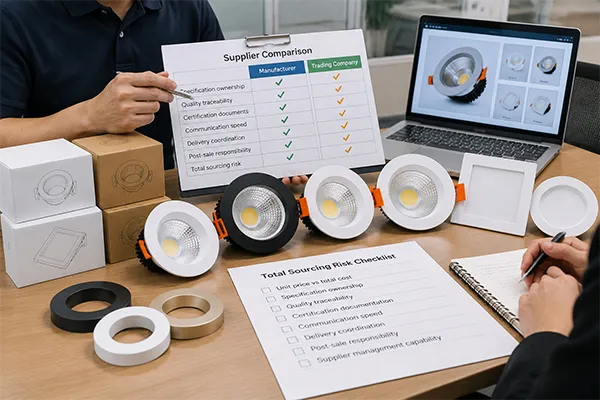
Use a Decision Matrix Before Requesting Final Quotes
We recommend that buyers create a sourcing scorecard before making a decision. The scoring weights should reflect the actual order rather than a generic supplier ranking.
| Evaluation Factor | Direct Manufacturer May Suit Buyers Who Need | Trading Company May Suit Buyers Who Need |
|---|---|---|
| Customization | Detailed changes to product and packaging | Mostly standard models |
| Technical communication | Direct engineering and production discussions | One contact to coordinate several suppliers |
| Product range | Focused category purchasing | Mixed lighting categories |
| Repeat orders | Stable, controlled private-label products | Flexible replenishment across various sources |
| Quality responsibility | Clear factory-level production discussion | Centralized coordination, if contract terms are clear |
| Buyer sourcing capability | Staff able to manage factory relationships | Limited internal resources for supplier management |
| Logistics | Separate factory shipment is acceptable | Consolidated shipment is preferred |
Ask the Questions That Reveal Responsibility
Before selecting a supplier model, buyers should get written answers to these questions:
- Who owns the final approved product specification?
- Who confirms that production matches the approved sample?
- Who provides the applicable CE, RoHS, or other required documentation?
- Which documents apply to the exact model, configuration, and target market?
- Who handles corrective action if a quality issue appears after delivery?
- Can the buyer arrange an independent pre-shipment inspection?
- Who is responsible for packaging, labels, and carton marks?
- How are product or component changes communicated?
- What is the process for warranty claims or field feedback?
- What happens if one factory in a consolidated order is delayed?
Certifications deserve particular care. Buyers should verify that documents are valid, relevant to the supplied product, and suitable for the destination market.10 A certificate copy alone does not prove that every future production batch will match the documented configuration.11 For high-risk, regulated, or application-specific projects, buyers should seek qualified professional advice.
Consider Your Own Procurement Capability
The best sourcing route also depends on the buyer’s team.
A mature importer with technical staff, established inspection procedures, and clear product documents may gain value from working directly with an LED downlight manufacturer. A newer wholesaler with a mixed product basket and limited purchasing resources may gain more from a trading partner that can coordinate multiple supply sources.
Neither approach removes the buyer’s responsibility to define requirements. The supplier can only manufacture or coordinate effectively when the buyer communicates what success looks like.
Frequently Asked Questions
Is an LED downlight manufacturer always cheaper than a trading company?
No. An LED downlight manufacturer may reduce some layers of coordination, but the final cost depends on order quantity, customization, materials, packaging, payment terms, logistics, and service scope. Buyers should compare complete offers with matching specifications instead of assuming that one supplier model is always lower priced.
Should I buy directly from a factory for small LED downlight orders?
It depends on the order purpose. A factory may support small-batch orders when the product fits its production model, especially for future OEM development. However, a trading company may be more practical when the order combines many categories or requires flexible consolidation.
How can I verify an LED downlight manufacturer in China?
Buyers should review business information, product samples, specification documents, quality procedures, applicable certification records, and communication quality. They can also arrange a video audit, factory visit, or independent inspection. No single document, photo, or visit proves long-term consistency by itself.
Can a trading company provide OEM LED downlights?
Yes, some trading companies can coordinate OEM downlight projects through their factory network. Buyers should clarify who controls the technical specification, who approves samples, which factory produces the goods, and who accepts responsibility for quality issues or product changes.
What documents should I request for LED downlights?
The required documents depend on the product and destination market. Buyers commonly request product specifications, test reports, applicable CE or RoHS documentation, packing details, and inspection records. Buyers should verify document relevance with qualified compliance professionals when market requirements are complex.
Conclusion
Choosing between an LED downlight manufacturer and a trading company is a sourcing decision, not a simple price comparison. We recommend direct factory cooperation when your business needs customization, stable private-label products, repeat-order control, and clear production accountability. We recommend considering a trading partner when multi-category consolidation and lower supplier-management complexity are more important. At Upward Lighting, we support buyers with OEM/ODM downlight development, small-batch options, production coordination, aging tests, and documentation discussions. Contact us to review your product requirements and sourcing plan.
"LED Luminaire Reliability: Impact of Color Shift", https://www.energy.gov/sites/prod/files/2017/04/f34/lsrc_colorshift_apr2017.pdf. LED luminaire design guidance explains that drive conditions and thermal management affect optical performance and reliability, while luminaire standards address associated marking and safety-verification requirements. Evidence role: mechanism; source type: institution. Supports: LED luminaire performance and reliability depend on the interaction of LED operating conditions, drivers, thermal management, photometric output, and applicable product marking or testing requirements.. Scope note: The specific design consequences of a wattage change depend on the downlight architecture, components, and target-market requirements. ↩
"8 Ways to Improve Your Supplier Selection Process", https://www.nist.gov/blogs/manufacturing-innovation-blog/8-ways-improve-your-supplier-selection-process. Public procurement and quality-management guidance treats supplier qualification as one element of assurance; documented requirements, monitoring, and verification remain necessary after supplier selection. Evidence role: general_support; source type: government. Supports: Supplier selection alone is insufficient without documented requirements, supplier evaluation, and proportionate quality-assurance controls.. Scope note: Such guidance is general procurement evidence and does not measure the success rate of direct factory sourcing in the lighting sector. ↩
"Life-Cycle Assessment of Energy and Environmental Impacts ...", https://www1.eere.energy.gov/buildings/publications/pdfs/ssl/lca_factsheet_apr2013.pdf. Research on burn-in testing describes its use as a screen for certain early-life electronic failures; verification of a claimed 100% four-to-eight-hour process, however, requires order-specific test records or independent audit evidence. Evidence role: mechanism; source type: paper. Supports: Burn-in or aging tests are used in electronics manufacturing to screen some early-life failures, and quality systems can require retained production and inspection records.. Scope note: General evidence on burn-in does not substantiate this manufacturer's stated test coverage, duration, equipment, or recordkeeping. ↩
"A Methodology for Testing", https://nvlpubs.nist.gov/nistpubs/Legacy/IR/nbsir76-1157.pdf. Reliability literature characterizes burn-in as a targeted screening method rather than a complete demonstration of product safety, performance, lifetime, or fitness for a particular installation. Evidence role: mechanism; source type: research. Supports: Burn-in testing screens selected failure modes but does not establish all electrical safety, photometric, thermal, durability, or suitability characteristics of a luminaire.. Scope note: The appropriate additional evaluations depend on the luminaire design, installation environment, and applicable regulations. ↩
"ISO 9001 Clause 8.5.6 | Understanding Control of Changes",
Quality-management guidance identifies documented change control, traceability, and retained production records as controls that help preserve conformity when products or their supplied components are produced repeatedly. Evidence role: general_support; source type: institution. Supports: Controlled production requires documented changes, traceability, and retained records so that product conformity can be maintained across subsequent manufacturing runs.. Scope note: These controls reduce ambiguity and risk but do not guarantee uninterrupted component availability or identical outcomes in every production run. ↩"Inspection", https://thedocs.worldbank.org/en/doc/735641553266058843-0090022019/original/Section6Inspection.pdf. ISO/IEC 17020 establishes competence and impartiality requirements for inspection bodies, whose inspections may compare products and processes with specified requirements before release or shipment. Evidence role: general_support; source type: institution. Supports: Competent inspection bodies can perform documented examinations of products against specified criteria, including before shipment.. Scope note: An inspection is a sample- or scope-limited assessment and does not guarantee that every unit or future shipment conforms. ↩
"Logistics in Lagging Regions", https://documents.worldbank.org/curated/en/796901468163485463/pdf/702350ESW00P110ee0also0report058852.pdf. Research on trade intermediaries describes their role in reducing some search, coordination, and transaction burdens by connecting buyers with multiple producers and managing cross-border commercial activities. Evidence role: mechanism; source type: paper. Supports: Trade intermediaries can perform coordination, information, logistics, and transaction functions between buyers and multiple producers.. Scope note: The value delivered by any individual trading company depends on its contracts, technical competence, supplier relationships, and fees. ↩
"An introduction to the OECD Due Diligence Guidance for ...", https://www.oecd.org/content/dam/oecd/en/topics/policy-sub-issues/due-diligence-guidance-for-responsible-business-conduct/introduction-to-the-oecd-due-diligence-guidance-for-upstream-actors.pdf. OECD due-diligence guidance states that enterprises should identify, prevent, and address supply-chain risks through their business relationships, rather than treating the use of an intermediary as a substitute for risk assessment. Evidence role: expert_consensus; source type: institution. Supports: Due-diligence frameworks expect enterprises to identify and manage risks in their supply chains, including where activities are conducted through business relationships or intermediaries.. Scope note: OECD guidance is risk-management guidance and does not prescribe a single verification procedure for every lighting purchase. ↩
"G.S. 143-135.9", https://ncleg.gov/EnactedLegislation/Statutes/HTML/BySection/Chapter_143/GS_143-135.9.html. Procurement research on total cost of ownership recognizes that purchase price is only one cost element and that quality failures, administrative effort, delays, and transaction costs can alter the economic value of a supplier offer. Evidence role: general_support; source type: research. Supports: Supplier decisions based only on purchase price can overlook transaction, quality, delay, administration, and failure-related costs that contribute to total cost of ownership.. Scope note: The size of these indirect costs must be estimated from the buyer's own order, contracts, and operating circumstances. ↩
"CE marking – obtaining the certificate, EU requirements", https://europa.eu/youreurope/business/product-rules-compliance/general-product-compliance/ce-marking/index_en.htm. Official product-conformity guidance explains that technical documentation and declarations of conformity must correspond to the product and the applicable legislation of the market where it is placed on the market. Evidence role: definition; source type: government. Supports: Conformity documentation and declarations must relate to the relevant product and applicable legal requirements for the market in which it is placed.. Scope note: The exact documentation and marking obligations vary by jurisdiction, product design, importer role, and intended use. ↩
"Conformity Assessment of Medical Devices - PMC - NIH", https://pmc.ncbi.nlm.nih.gov/articles/PMC12821529/. European product-conformity guidance requires manufacturers to ensure that series production remains in conformity with applicable requirements, meaning that a document for a tested configuration is not, by itself, evidence of continuing conformity for every later batch. Evidence role: mechanism; source type: government. Supports: Product conformity obligations include maintaining production controls so that manufactured products continue to conform to the applicable documented requirements.. Scope note: The applicable conformity-assessment route and production-control obligations vary across regulations and destination markets. ↩