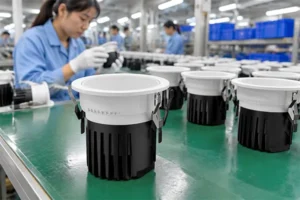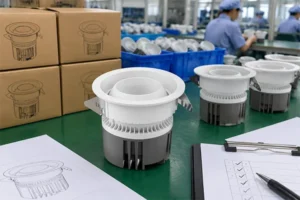

Choosing a reliable LED downlight manufacturer in China can feel difficult when many suppliers offer similar product photos, certificates, and low quotations. The real risk appears after the order: specifications may change, batches may vary, or delivery may slip1. We recommend a structured verification process before you commit.
A reliable LED downlight manufacturer in China is a supplier that can repeatedly deliver the agreed product specification, supporting documents, customization details, quality controls, and commercial terms. Buyers should compare suppliers using one written requirement sheet, request model-specific evidence, inspect samples, confirm production and delivery procedures, and evaluate communication before placing larger orders.
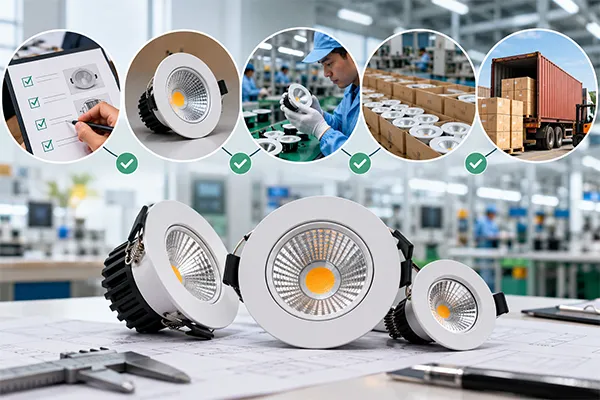
A professional website, quick reply, or attractive sample can be a useful starting point, but none of these signals tells the full story. In our pre-sales discussions, we often see that the best supplier decisions come from buyers who ask the same detailed questions of every shortlisted factory2.
What Does a Reliable LED Downlight Manufacturer in China Actually Mean?
Many buyers search for a reliable supplier but receive vague answers such as “high quality,” “experienced factory,” or “competitive price.” Those statements can sound reassuring, yet they do not define what will happen to your specific order. We believe reliability needs to be converted into practical, checkable requirements.
A reliable LED downlight manufacturer in China should be evaluated by its ability to meet the same agreed specification across samples and production batches, provide relevant documents for the actual model, communicate changes clearly, support the required order quantity, and deliver according to confirmed commercial terms. Reliability is a verification process, not a marketing label.
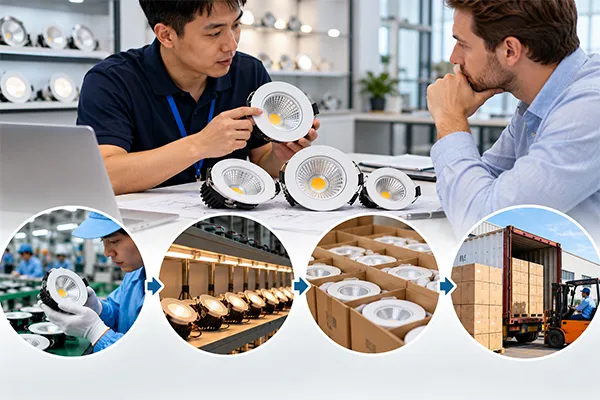
Turn “Reliable” Into a Supplier Scorecard
We have seen buyers spend days comparing catalogues without first defining what “reliable” means for their channel or project. A hospitality project buyer may focus on color consistency, dimming compatibility, and delivery milestones. A wholesaler may place more weight on stable packaging, repeat orders, competitive landed cost, and product labeling. A lighting brand may need custom finishes, private labels, and documented change control.
These needs are different. However, the method for evaluating an LED downlight supplier remains similar: define the requirements, ask for evidence, compare answers, and confirm details in writing.
We recommend scoring each potential supplier across the following categories:
| Evaluation area | Comparison question | Evidence to request |
|---|---|---|
| Product specification | Can the supplier produce the exact wattage, CCT, beam angle, cutout, and CRI requested? | Datasheet, technical drawing, sample label, quotation |
| Model consistency | Does the evidence refer to the same model being quoted? | Model number cross-reference and bill of materials summary where appropriate |
| Quality process | What checks occur before shipment? | Written inspection process, aging-test description, inspection records if available |
| Documentation | Can the supplier provide relevant CE, RoHS, or market-required documents? | Copies tied to the relevant product family; buyers should verify applicability |
| OEM/ODM ability | Can branding, finish, packaging, or technical parameters be controlled? | Artwork approval process, sample confirmation, MOQ and lead-time details |
| Commercial fit | Are MOQ, payment terms, tooling charges, and warranty terms clear? | Formal quotation and proforma invoice |
| Delivery control | How is lead time calculated and communicated? | Production schedule, shipping terms, packaging plan |
| Communication | Does the team answer technical questions accurately and consistently? | Email trail, revised quotation, specification confirmation |
At Upward Lighting, we describe our own process as a manufacturer based in Zhongshan City, China. We provide OEM/ODM options for parameters including wattage, color temperature, beam angle, CRI, and surface finishes. However, we encourage every buyer to verify any supplier’s claimed capabilities against the product model, quantity, and target market involved.
A supplier is not reliable because it says it has quality control. A supplier becomes more credible when its process, documents, samples, and commercial commitments match each other.
How Should You Prepare a Quote-Ready LED Downlight Specification?
Buyers often ask us for “your best price” before they have decided which downlight configuration they need. This approach creates a problem because two quotations can look comparable while covering very different products. A lower-priced quote may use another driver, a lower CRI, a different heat sink, or a different package.
Before comparing any LED downlight manufacturer in China, buyers should create one quote-ready specification sheet. It should define the electrical, optical, mechanical, packaging, compliance, and customization requirements that every supplier must quote against. This makes pricing more meaningful and reduces later disputes about what was included.
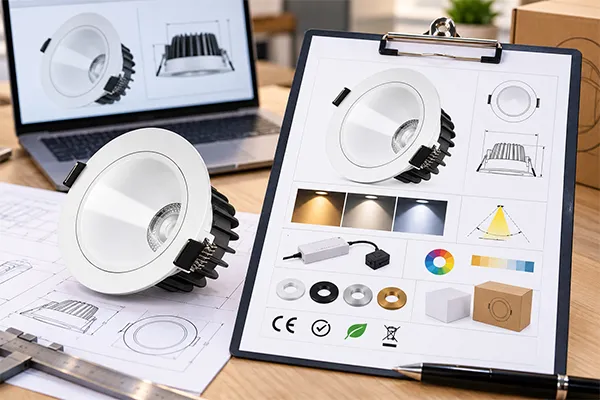
Essential Details for an LED Downlight RFQ
In our daily inquiries, the most efficient requests include exact product requirements and the target market. When we receive only a reference photo and a required quantity, we can provide an initial direction. Yet we still need more information before the buyer can compare offers fairly.
A useful LED downlight request for quotation should include the following details:
-
Application
- Residential, retail, office, hotel, warehouse, or other use
- New construction or renovation
- Ceiling type and available installation depth
-
Electrical requirements
- Input voltage and frequency
- Wattage or lumen target
- Driver requirement, including non-dimmable or dimming compatibility
- Required plug, connector, or wiring method
-
Optical requirements
- Color temperature, such as 3000K, 4000K, or 6500K
- CRI target, such as CRI 80 or CRI 90
- Beam angle
- UGR or glare-control expectations, if relevant to the application
-
Mechanical requirements
- Cutout size
- Outer diameter and height
- Trim style
- Surface finish, such as white, black, gold, or custom color
- IP rating requirement, where applicable
-
Commercial and branding requirements
- Order quantity and forecast volume
- Packaging type
- Private label, logo, barcode, or instruction manual needs
- Target price range, if you are comfortable sharing it
- Preferred Incoterms and destination port
Why One Specification Sheet Changes the Comparison
We recommend sending the same specification sheet to every shortlisted LED downlight manufacturer in China. This simple step gives you a more useful comparison than collecting multiple generic catalogues.
For example, suppose Supplier A quotes a 12W recessed downlight at USD 3.20, while Supplier B quotes a similar-looking product at USD 3.65. The price difference may be reasonable, but it may also hide differences that matter in your channel:
- One quote may include a higher CRI option while the other does not.
- One driver may support the requested dimming method, while another may not.
- One supplier may include customized color-box packaging, while another only offers neutral cartons.
- One manufacturer may quote based on a 1,000-piece MOQ, while another may require 5,000 pieces.
- One price may include a defined aging procedure, while the other quotation may not explain its inspection process.
We have handled many specification discussions where buyers revised a request after seeing sample differences. That is normal. The key is to issue a revised specification and ask suppliers to confirm it again. We suggest using a revision number, such as “Downlight RFQ Rev. 2,” so your team can track which document controls the final order.
How Can You Verify Product Quality and Batch Consistency?
A polished sample can create confidence, but a sample does not automatically prove that future production will match it3. Batch consistency is one of the most important risks for importers, distributors, contractors, and private-label lighting brands4. It affects installation, customer satisfaction, replacement cost, and your reputation in the market.
To assess an LED downlight manufacturer in China for quality and consistency, buyers should compare the approved sample with written production specifications, ask how incoming materials and finished goods are checked, confirm aging-test procedures, and agree on inspection and defect-handling terms before mass production.
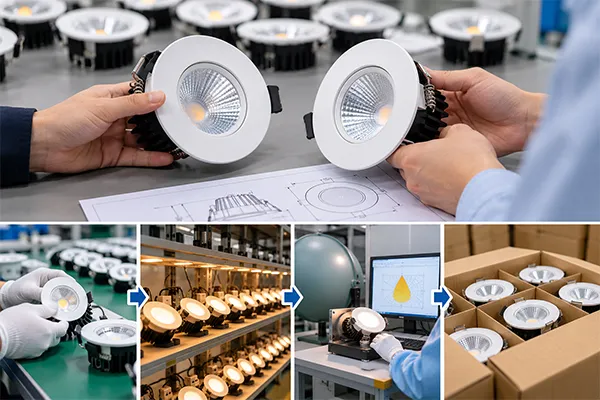
Ask About the Process, Not Just the Promise
We suggest that buyers ask suppliers to explain their process in simple, product-specific terms. A supplier does not need to reveal confidential information to answer basic quality-control questions clearly.
Useful questions include:
- What is the exact model number for the quoted downlight?
- Which components can change without customer approval?
- How are LED color temperature and driver specifications controlled?
- What checks are performed during assembly?
- Is every finished unit powered on?
- How long is the aging test, and under what conditions is it conducted?
- How are failed units recorded, repaired, or rejected?
- How are cartons labeled to distinguish wattage, CCT, beam angle, and finish?
- Can the buyer or a third-party inspector conduct pre-shipment inspection?
At Upward Lighting, our stated company practice is to conduct a 100% aging test lasting between four and eight hours before shipment. We use this process as part of our internal production control. Buyers should still clarify which model is being ordered, what test records are available, and what acceptance criteria apply to their order. No manufacturing process eliminates all risk, and application-specific testing may be appropriate.
Evaluate the Sample Against the Production Order
A sample should be more than a visual approval item. We recommend checking it against a written sample evaluation list.
| Sample evaluation point | What to check |
|---|---|
| Appearance | Finish quality, trim alignment, scratches, color consistency |
| Dimensions | Cutout size, outer diameter, height, spring position |
| Electrical function | Voltage compatibility, driver operation, dimming behavior if requested |
| Light output | Perceived brightness, beam shape, CCT consistency, glare control |
| Heat management | Housing construction and suitability for the intended installation |
| Packaging | Inner protection, outer carton strength, labels, barcode, manuals |
| Branding | Logo placement, artwork accuracy, labeling language |
A buyer should also retain the approved sample, photos, signed specification sheet, and packaging artwork. These records make later communication clearer if a production shipment differs from expectations.
In one anonymized pre-sales situation, a buyer focused initially on a black trim finish. During sample review, their team noticed that the requested cutout size differed from their existing ceiling openings. The finish was not the real risk; installation compatibility was. The buyer revised the drawing before production, which prevented a much more expensive field issue. We see this pattern often: the most valuable questions are usually the ones that connect the product to the final installation.
Are CE and RoHS Certificates Enough to Select an LED Downlight Manufacturer in China?
Certificates can be important documents for market access and internal procurement procedures. However, buyers can make mistakes when they treat a certificate image as complete proof of product quality, legal fit, or supplier reliability. Documentation needs to be reviewed in the context of the actual model and destination market.
CE and RoHS documents can be useful verification points5 when choosing an LED downlight manufacturer in China, but they are not sufficient proof on their own6. Buyers should verify that documents relate to the product being quoted, check the issuing details and scope, confirm destination-market obligations with qualified professionals, and retain documentation with the purchase record.
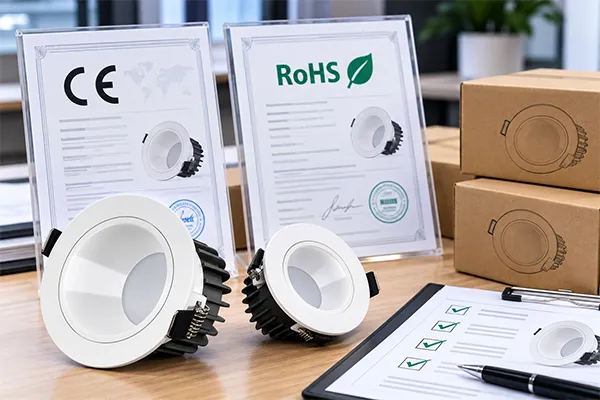
Match the Document to the Product
A recurring question from purchasers is, “Do you have CE?” Our answer is that the next question should be, “For which model and configuration?”
LED downlights can vary by wattage, driver, input voltage, control method, housing design, and other features. A document associated with one product family may not automatically apply to every variation a buyer wants to purchase7. Buyers should request a clear connection between:
- The quotation model number
- The product datasheet
- The product label
- The supporting declaration, test report, or certification document
- The intended market
At Upward Lighting, we state that our products hold CE and RoHS certifications. These documents support our export activities and customer requests. Still, we recommend that customers verify document relevance for their specific selected model and seek qualified regulatory or legal advice where their project, market, or tender requires it.
Use Documentation as One Layer of Due Diligence
A stronger supplier-verification process combines document review with physical and commercial checks:
- Review the document identity. Check the product description, report number, issue date, applicant name, and scope.
- Compare it with the quotation. Confirm that the electrical and product details do not conflict.
- Ask for labeling information. The product label should align with the ordered voltage, wattage, and identifying model.
- Check market needs independently. Import obligations can vary by market, product type, and sales channel.
- Include document delivery in the order terms. State which documents must be provided before shipment or with shipping documents.
We avoid presenting certificates as a universal shortcut because responsible procurement requires more than one proof point. A buyer should also consider product testing, application suitability, customs requirements, installation rules, and local electrical regulations. Qualified professionals should assess application-specific compliance decisions.
How Do You Compare Prices, MOQ, and OEM/ODM Capability?
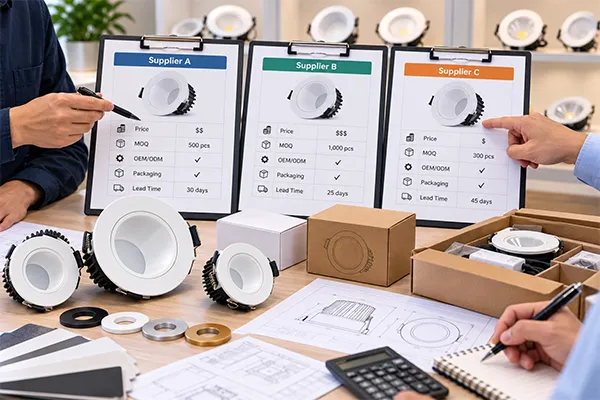
Low pricing attracts attention for good reason. Margins are important for distributors, wholesalers, and lighting brands. Yet the lowest unit price may become the highest total cost8 when specifications are unclear, minimum order quantities are unsuitable, customization is poorly controlled, or replacement issues appear after delivery.
When comparing an LED downlight manufacturer in China, buyers should assess total procurement risk rather than unit price alone. A useful comparison includes product configuration, MOQ, tooling or artwork charges, packaging, customization approvals, payment terms, lead time, inspection options, and the cost of possible rework or replacement.
Look Beyond the Ex-Factory Price
We recommend building a landed-cost and risk comparison table. You do not need perfect data at the beginning. You need enough detail to identify which quote requires more clarification.
| Cost or risk factor | Why it matters |
|---|---|
| Unit price | It affects margin, but only if specifications are genuinely equivalent |
| MOQ | It affects inventory exposure and cash flow |
| Sample cost | It may be modest, but samples can reduce larger production risk |
| Custom tooling or artwork | It can affect launch cost and ownership discussions |
| Packaging | It influences product protection, retail presentation, and freight volume |
| Defect-handling terms | It affects the cost of future claims or replacements |
| Lead time | It affects project schedules and stock availability |
| Shipping terms | They affect freight responsibility, insurance, and import planning |
| Payment structure | It affects cash flow and supplier commitment |
Test OEM/ODM Claims With Specific Requests
Many suppliers offer OEM/ODM service. Buyers should not accept this phrase without asking what it means in practice.
For a standard private-label downlight, OEM may involve logo printing, customized packaging, labels, manuals, or barcode stickers. ODM discussions may involve changes to wattage, CCT, beam angle, trim color, housing design, or other product parameters. The complexity, MOQ, development cost, and lead time can vary significantly.
We suggest asking these questions:
- What is the MOQ for each customization element?
- Can we approve a digital artwork proof before printing?
- Will you provide a pre-production sample for custom packaging or finish?
- What details are fixed after sample approval?
- What happens if the finish color or logo placement differs from approved artwork?
- Are customized materials reserved for our order only?
- What is the repeat-order lead time after the first customized order?
- Can you support small-batch orders while we test the market?
At Upward Lighting, we support OEM/ODM projects and small-batch orders where the product and commercial requirements allow. We also provide quick quotations as part of our customer communication approach. However, buyers should always confirm the exact MOQ, customization scope, development timeline, and approval procedure in writing. A fast quotation is useful, but a precise quotation is more valuable.
How Should You Verify Delivery Performance and Communication?
A supplier can have an acceptable product and still create commercial problems through unclear delivery updates or slow responses when an issue needs resolution. Communication quality matters because specifications, artwork, packaging, shipping marks, and production timing can all change during an order cycle.
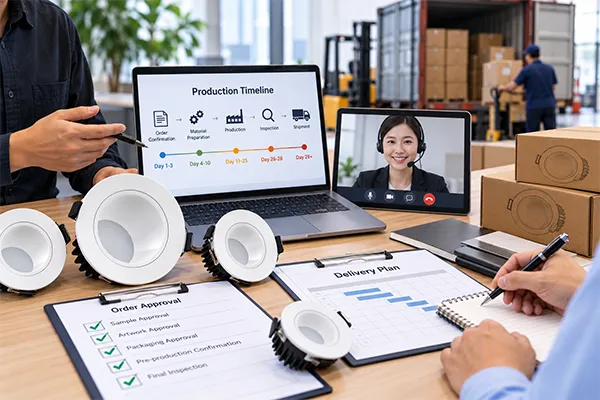
To evaluate delivery and communication, buyers should ask each LED downlight manufacturer in China for a realistic production timeline, define approval milestones, confirm who owns technical and commercial communication, and assess whether the supplier answers detailed questions consistently before the first larger purchase order.
Assess Communication Before You Need It Urgently
We have learned from pre-sales conversations that the buyer’s early questions often reveal future order-management quality. If a supplier repeatedly avoids technical questions, sends inconsistent drawings, or changes quoted terms without explanation, those issues may continue after payment.
We recommend evaluating the following communication signals:
- Does the supplier restate your requirements accurately?
- Does the quotation identify product model, quantity, price basis, and validity period?
- Does the sales contact consult technical staff when needed?
- Does the supplier explain what is unknown instead of making unsupported promises?
- Does the team issue revised documents when requirements change?
- Does the supplier provide clear production and shipping updates?
- Is there a defined contact for after-sales questions?
Confirm a Simple Order Timeline
For a first order, we suggest requesting a milestone plan. The plan does not need to be overly complicated. It should identify the steps that could affect delivery.
- Specification confirmation
- Sample approval, if required
- Packaging and artwork approval
- Deposit or payment milestone
- Material preparation
- Production
- Aging and internal inspection
- Third-party or buyer inspection, if arranged
- Balance payment and shipment release
- Shipping document handover
At Upward Lighting, we emphasize rapid responses, quick quotation turnaround, and supply-chain coordination as part of our service approach. Still, every delivery date depends on the confirmed product, materials, order volume, customization level, and approval speed. We believe buyers should request a realistic schedule rather than rely on a broad promise such as “fast delivery.”
A small trial order can be a practical way to test a new LED downlight supplier9. It can reveal whether the supplier can follow your specifications, manage packaging, communicate revisions, and prepare shipment documents as agreed. A trial order does not guarantee all future results, but it can provide much stronger evidence than a catalogue alone.
Frequently Asked Questions
What should I ask a LED downlight manufacturer in China before requesting a quote?
We recommend asking about the exact product model, wattage, CCT, CRI, beam angle, cutout, driver type, MOQ, packaging, customization choices, lead time, and available documentation. You should also state your target market and intended application so the supplier can identify relevant configuration questions.
How can I compare LED downlight samples fairly?
We suggest sending one written specification sheet to every supplier and evaluating all samples against the same checklist. Check dimensions, finish, light appearance, driver operation, packaging, labels, and installation compatibility. Keep approved samples and written approvals as references for mass production.
Is the lowest LED downlight price always the best option?
No. The lowest quoted price may reflect a different configuration, higher MOQ, limited customization, weaker packaging, or unclear after-sales terms. We recommend comparing total procurement cost, including freight, inventory exposure, inspection, potential rework, and communication time, rather than considering only unit price.
Can a manufacturer provide CE and RoHS documents for every downlight model?
Documentation availability and applicability can vary by product family and configuration. Buyers should ask whether documents match the quoted model, driver, and destination-market requirements. We recommend independent verification and qualified professional advice for application-specific regulatory decisions.
What is the safest way to start with a new Chinese LED downlight supplier?
A small, clearly specified trial order is often a sensible first step. We suggest approving a sample, confirming all commercial terms in writing, requesting production updates, and arranging inspection where appropriate. The first order should test product quality, documentation, communication, packaging, and delivery performance.
Conclusion
Choosing a reliable LED downlight manufacturer in China requires more than comparing websites, certificates, and unit prices. We recommend using one detailed specification sheet, verifying model-specific documents, reviewing samples carefully, confirming quality and delivery procedures, and testing communication before scaling orders. A structured comparison reduces uncertainty around batch consistency, customization, compliance fit, and commercial terms. If you are sourcing LED downlights, track lights, or office linear lighting, we invite you to send us your specification sheet for a clear, quote-ready evaluation.
"EFFECTIVE METHODOLOGIES FOR SUPPLIER SELECTION ...", https://etda.libraries.psu.edu/files/final_submissions/419. Supplier-selection research commonly treats conformance quality and delivery reliability as central criteria because variation in supplied goods and late delivery can impose operational and commercial costs on buyers. Evidence role: general_support; source type: paper. Supports: Research on supplier selection identifies quality consistency and delivery performance as core dimensions of supplier risk and evaluation.. Scope note: This literature supports the general procurement risk framework; it does not establish the frequency of these problems for any particular Chinese LED supplier. ↩
"(PDF) Multi Criteria Decision Making Tools for Supplier ...", https://www.academia.edu/26034603/Multi_Criteria_Decision_Making_Tools_for_Supplier_Evaluation_and_Selection_A_Review. Structured supplier-selection methods compare candidates against common quality, delivery, cost, and capability criteria, helping purchasers make more consistent multi-criteria assessments. Evidence role: general_support; source type: paper. Supports: Supplier-selection methods use common criteria and structured comparisons to evaluate competing suppliers consistently.. Scope note: A structured comparison improves transparency but does not by itself verify a supplier's actual future production performance. ↩
"Statistical Process Monitoring for Autocorrelated Data", https://www.nist.gov/programs-projects/statistical-process-monitoring-autocorrelated-data. Quality-control practice distinguishes an approved sample from evidence of continuing process conformity: repeated inspection and process monitoring are needed to assess whether production output remains within specification. Evidence role: mechanism; source type: government. Supports: Statistical process control and inspection are used to monitor whether a production process continues to produce conforming output over time.. Scope note: The principle is general and does not determine whether a particular supplier's batches will differ from its sample. ↩
"A Cost Benefit Analysis of an Automotive Industry Solution ...", https://nvlpubs.nist.gov/nistpubs/Legacy/IR/nistir7654.pdf. Research on quality management recognizes that variation in supplied components or finished products can generate downstream nonconformities, rework, service costs, and customer dissatisfaction. Evidence role: general_support; source type: paper. Supports: Variation in product characteristics can create downstream quality, installation, warranty, and customer-satisfaction risks.. Scope note: The magnitude of these effects depends on the product specification, application, quality controls, and contractual remedies. ↩
"CE marking – obtaining the certificate, EU requirements", https://europa.eu/youreurope/business/product-rules-compliance/general-product-compliance/ce-marking/index_en.htm. European Commission guidance explains that CE marking signifies a manufacturer's declaration of conformity with applicable EU requirements, while the RoHS framework restricts specified hazardous substances in electrical and electronic equipment. Evidence role: definition; source type: government. Supports: CE marking and the RoHS framework concern applicable EU requirements for products placed on the European market, including restrictions on certain hazardous substances in electrical and electronic equipment.. Scope note: The applicable legislation and conformity-assessment route depend on the product, its configuration, and the market in which it is placed. ↩
"CE marking – obtaining the certificate, EU requirements", https://europa.eu/youreurope/business/product-rules-compliance/general-product-compliance/ce-marking/index_en.htm. EU guidance characterizes CE marking as a manufacturer's declaration that applicable legal requirements have been met; it is not, by itself, an independent guarantee of product quality, suitability for every use, or supplier reliability. Evidence role: general_support; source type: government. Supports: CE marking is a conformity declaration for applicable EU legislation and is not a general certification of product quality or supplier performance.. Scope note: Additional applicable legal requirements may apply depending on the product category and destination market. ↩
"CE marking – obtaining the certificate, EU requirements", https://europa.eu/youreurope/business/product-rules-compliance/general-product-compliance/ce-marking/index_en.htm. Conformity-assessment guidance requires technical documentation and declarations to cover the product placed on the market; changes affecting applicable requirements may therefore require an updated assessment of compliance. Evidence role: mechanism; source type: government. Supports: Technical documentation and conformity assessment must correspond to the product placed on the market, and relevant changes may require reassessment or updated documentation.. Scope note: Whether a particular variation requires new testing or documentation depends on the applicable legislation, the nature of the change, and the evidence already available. ↩
"EFFECTIVE METHODOLOGIES FOR SUPPLIER SELECTION ...", https://etda.libraries.psu.edu/files/final_submissions/419. Total-cost and whole-life-cost approaches assess purchasing decisions beyond the initial unit price by considering associated costs such as logistics, operation, maintenance, risk, and remedial work. Evidence role: general_support; source type: government. Supports: Public procurement guidance recognizes whole-life or total cost as broader than initial purchase price and may include operating, maintenance, risk, and disposal costs.. Scope note: Which cost elements are material, and whether a higher quoted price yields lower total cost, must be calculated for the specific purchase. ↩
"Supplier selection and order allocation: a literature review - PMC", https://pmc.ncbi.nlm.nih.gov/articles/PMC8127846/. Supplier-qualification practices may use pilot production or limited initial orders to gather evidence about a supplier's conformance, communication, and delivery capability before larger commitments are made. Evidence role: general_support; source type: paper. Supports: Supplier-development and qualification practices use pilot production, initial samples, or limited orders to evaluate a supplier before broader sourcing commitments.. Scope note: A successful trial order is limited evidence and cannot ensure that future production, capacity, or delivery performance will remain unchanged. ↩